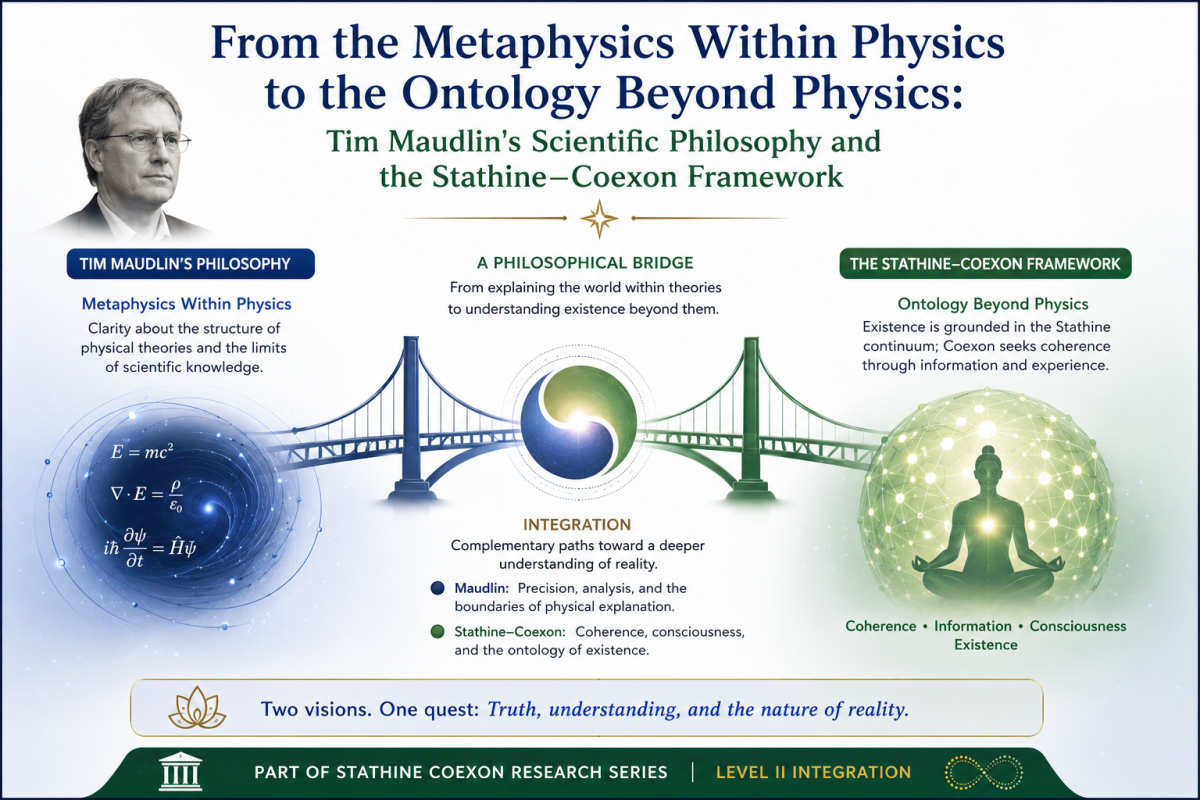
Tim Maudlin’s Scientific Philosophy and the Stathine–Coexon Framework
A Level II Comparative and Integrative Study
Part of the Stathine–Coexon Research Series – Level II: Comparative and Integrative Studies
Abstract
Tim Maudlin’s philosophy of physics represents one of the strongest contemporary arguments for allowing physical theory to inform metaphysics directly. His work challenges philosophical approaches that attempt to reduce laws of nature, time, causation, and physical reality to more basic conceptual constructions. Instead, Maudlin argues that physics itself should guide metaphysical inquiry and that certain features of physical reality—particularly fundamental laws and the passage of time—may need to be treated as irreducible elements of ontology.
The Stathine–Coexon Framework shares Maudlin’s opposition to the premature reduction of reality to conceptual abstractions. However, it proposes a further distinction. Maudlin’s project begins with the ontology revealed through physical theory. The Stathine–Coexon Framework asks whether physical ontology exhausts the whole of existence. It proposes Stathine as a timeless, static continuum and Coexon as a proposed sentient organizing principle whose relationship with a biological body may generate conscious understanding. This paper examines the points of convergence and divergence between the two approaches.
The central argument is that Maudlin’s philosophy provides a powerful methodological foundation for the Stathine–Coexon project: reality should not be forced into categories chosen in advance by philosophical preference. At the same time, the Stathine–Coexon Framework proposes that if consciousness and sentience possess an ontology not reducible to physical description, then the metaphysics of physics may need to be complemented by a metaphysics of sentience.
1. Introduction: What Is Reality Made Of?
The history of science contains a recurring pattern.
A phenomenon is observed.
A theory is developed.
The theory reveals structures that common sense did not previously recognize.
The philosophical question then follows:
What does the successful theory tell us about what actually exists?
This question lies at the heart of Tim Maudlin’s philosophy of physics.
His work challenges the tendency to treat physical theories merely as useful mathematical instruments.
If physics says that the world contains certain fundamental structures, laws, and dynamical relations, then metaphysics should take those commitments seriously.
The central methodological principle is therefore:
Our metaphysics of the natural world should be informed by our best physical theories rather than imposed upon them by philosophical preference.
The Stathine–Coexon Framework begins from a related intuition.
Reality should not be reduced prematurely.
However, it extends the question.
Maudlin asks:
What is the metaphysical structure implicit in physics?
The Stathine–Coexon Framework asks:
Does the physical description of reality exhaust everything that exists?
This creates a productive Level II comparison.
2. The Foundational Starting Point of the Stathine–Coexon Framework
The Stathine–Coexon Framework is built upon a set of foundational axioms concerning continuity, sentience, interaction, learning, contradiction, and coherence.
The primary foundation paper defines Stathine as the universal field of continuity and interaction and proposes the Coexon as a singular life atom associated with the organization of experience and understanding. It further proposes that learning occurs through recursive interaction and that increasing alignment reduces contradiction.
For readers new to the framework, the foundational vocabulary and axioms are presented in:
The Foundational Axioms and Practical Lexicon of the Stathine–Coexon Framework
The framework also develops the idea that existence is fundamentally contained within a timeless continuum and that regulation emerges from the conditions required for coherent existence:
Coexon the Sentient atom the physics and chemistry of the coexon a saturated mass neutral architecture of consciousness
The Axiom of Contained Existence
A further foundational principle proposes that representations aligned with reality require less internal maintenance than contradictory representations. This has been termed Truth Compression:
The Principle of Truth Compression
These papers constitute the conceptual background for the present comparative study.
3. Maudlin’s Central Methodological Principle
Maudlin’s philosophy of physics can be understood through a fundamental methodological commitment:
Physics should be taken seriously as a guide to ontology.
This position opposes a philosophical tendency to assume that every element of a physical theory must be reduced to something conceptually simpler.
For example, if a theory contains laws of nature, a philosopher may attempt to explain those laws as:
- regularities,
- patterns,
- relations among universals,
- descriptions of observed events.
Maudlin challenges the assumption that such reduction must always be possible.
His position is that fundamental laws may simply be part of the basic structure of reality.
In his account, physics does not merely describe what happens.
It may reveal what fundamentally exists.
This represents a form of scientific realism with strong metaphysical consequences.
4. The Stathine–Coexon Parallel
The Stathine–Coexon Framework begins with a similar methodological instinct.
It proposes that reality should not be forced into categories merely because those categories are familiar.
For example, the framework argues that the following questions should remain open:
- Is all existence reducible to physical matter?
- Is consciousness merely a description of brain activity?
- Is subjective experience identical to neural activity?
- Is time fundamental to all forms of existence?
- Can a sentient entity be fully described through third-person measurement?
The framework does not claim that these questions have already been scientifically resolved.
Instead, it proposes that philosophical inquiry should remain open to ontological possibilities not yet incorporated into current physical theory.
This is where the dialogue with Maudlin becomes especially significant.
5. Maudlin’s Fundamental Laws and Stathine
Maudlin argues that fundamental laws of nature may be ontologically basic rather than reducible to something more fundamental.
The Stathine–Coexon Framework proposes a different but related foundational concept.
It introduces Stathine as a timeless and static continuum within which existence occurs.
The conceptual relationship may be expressed as follows:
| Maudlin’s Philosophy | Stathine–Coexon Proposal |
|---|---|
| Fundamental physical laws may be irreducible | Stathine is proposed as an irreducible ontological continuum |
| Physics reveals fundamental structure | Experience and physical theory may reveal different ontological dimensions |
| Reality should not be reduced prematurely | Sentience should not be reduced prematurely |
| Metaphysics should follow reality | Metaphysics should remain open to both physical and sentient ontology |
The similarity is methodological.
Both approaches resist the assumption that everything must be reduced to a preferred philosophical category.
The difference is ontological.
Maudlin’s central project concerns the metaphysics implicit in physical theory.
The Stathine–Coexon Framework proposes that the ontology of existence may extend beyond physical theory.
6. The Question of Time
One of Maudlin’s most distinctive philosophical positions concerns the reality of time.
He argues that the passage of time is real and that change is not merely an illusion or a perspective-dependent feature of a static block universe. His account treats temporal evolution as fundamental and argues that laws of nature can be understood as governing the succession of physical states.
This position is important for comparison with the Stathine–Coexon Framework.
The framework proposes a distinction between:
Physical existence
Characterized by:
- change,
- biological development,
- physical processes,
- temporal sequence.
Stathine
Proposed as:
- timeless,
- static,
- continuous,
- beyond temporal change.
Coexon
Proposed as a sentient saturated atomic structure capable of interacting with a changing biological system while itself possessing an ontological status of permanence in comparision to the physical body that will break down.
This creates a three-level conceptual model:
Stathine — timeless continuity
↓
Coexon — sentient organization
↓
Biological body — temporal physical expression
The framework therefore does not reject the reality of temporal change within physical existence.
Instead, it proposes that temporal change may occur within a more fundamental timeless continuum.
This distinction is a metaphysical hypothesis, that can be understood. The definition of science is expanded beyond empirical data. This makes science more relevant in the current quantum world.
7. The Question of Change
Maudlin’s philosophy gives a central role to real change.
The present physical state is followed by another state.
The laws of nature govern this temporal evolution.
The Stathine–Coexon Framework accepts the importance of change for biological existence.
However, it proposes that change may be understood at different ontological levels.
The body changes.
The brain changes.
Memories change.
Understanding changes.
The Coexon, according to the framework, changes its internal organization for better coherence through experience. The friction is reduced by removal of double think.
Stathine does not change.
This produces the following conceptual distinction:
Change belongs to the evolving organization of existence. Continuity belongs to the underlying condition within which existence occurs.
The relationship may be expressed as:
Stathine provides continuity
↓
Physical systems undergo change
↓
The Coexon experiences change
↓
Experience produces learning
↓
Learning reorganizes understanding
↓
Coherence increases
This is one of the central contributions of the Stathine–Coexon interpretation.
8. Laws of Nature and the Coexon
Maudlin’s philosophy treats laws as fundamental components of the physical world.
The Stathine–Coexon Framework proposes an analogous distinction between:
Laws of physical evolution
These govern physical systems.
They are studied through:
- physics,
- mathematics,
- experiment,
- observation.
Conditions of coherence
These are proposed as the relational conditions through which a sentient system can maintain meaningful existence.
They include:
- consistency,
- feedback,
- learning,
- consequence,
- alignment.
The framework therefore proposes that a coherent Coexon does not exist by escaping reality.
It becomes coherent by progressively understanding the conditions of reality.
This is expressed in the framework’s foundational sequence:
Experience → Understanding → Alignment → Coherence
The result is not freedom from reality.
It is freedom through responsible participation in reality.
9. The Difference Between Physical Law and Existential Coherence
A crucial distinction must be maintained.
A physical law is not the same as a philosophical principle of coherence.
For example:
- Newtonian mechanics describes physical motion.
- Thermodynamics describes energy relationships.
- Quantum theory describes physical systems at microscopic scales.
The Stathine–Coexon principles of coherence are not substitutes for these theories.
They are proposed as a higher-level interpretive framework concerning:
- understanding,
- sentience,
- learning,
- contradiction,
- alignment.
This distinction is essential for academic credibility.
The framework should not claim:
“Coherence replaces physics.Rathere coherence makes physics meaningfull”
Its stronger claim is:
Physics describes physical processes. The Stathine–Coexon Framework proposes that the organization of sentient understanding may require expanding vocabulary.
10. Maudlin and the Rejection of Premature Reduction
One of the strongest connections between Maudlin’s philosophy and the Stathine–Coexon Framework is their shared resistance to premature reduction.
Maudlin argues that laws of nature should not automatically be reduced to regularities or other philosophical constructions.
The Stathine–Coexon Framework similarly argues that consciousness should not automatically be reduced to neural activity merely because neural activity correlates with experience.
This does not deny neuroscience.
Neuroscience clearly demonstrates that changes in the brain profoundly affect experience.
The question is whether this establishes identity.
The framework proposes a distinction:
A physical system may be necessary for a form of experience without being identical to the complete ontological basis of that experience.
This is a philosophical possibility waiting to become reality.
It needs to be established by inquiry by every single human being and not just academic scholars.
11. The Brain–Coexon Question
The framework proposes a possible relationship between the biological brain and the Coexon.
The brain processes:
- sensory information,
- memory,
- motor signals,
- biological regulation.
The Coexon is proposed as the sentient life atom through which these processes become integrated into meaningful understanding.
The model may be represented as:
Physical environment
↓
Sensory systems
↓
Neural processing
↓
Brain–Coexon interaction
↓
Integrated experience
↓
Understanding
↓
Choice
↓
Action
↓
Consequence
↓
Updated understanding
This model is intended to place neuroscience at the core.
It proposes a question that neuroscience and philosophy of mind may investigate:
Is the subjective organization of experience fully identical to the physical processes that correlate with it?
The Stathine–Coexon Framework answers:
Not necessarily.
Maudlin’s philosophy provides an important methodological precedent for asking such questions without assuming in advance that every ontological category must be reduced.
12. The Coexon and the Reality of Time
A particularly interesting tension emerges between Maudlin’s philosophy and the Stathine–Coexon proposal.
Maudlin argues for the reality of temporal passage within physical existence.
The Stathine–Coexon Framework proposes that the Coexon is beyond time while interacting with a body that exists in time.
At first, these positions appear incompatible.
However, they may be distinguished by levels of description.
Level 1: Physical time
The body changes.
The brain develops.
Events occur sequentially.
Level 2: Experiential time
The Coexon experiences memory, anticipation, and present awareness.
Level 3: Proposed ontological timelessness
The Coexon is hypothesized to possess an existence that continues after the disassociation with the biological body. Every one can feel that within himself that he will not ever cease to be.
Level 4: Stathine
The framework proposes an underlying timeless continuum.
Thus:
Time may be real within physical evolution without being the ultimate condition of all existence.
This is a metaphysical proposal that requires careful distinction from established physical theories.
13. From Fundamental Law to Fundamental Coherence
Maudlin’s philosophy suggests that fundamental physical laws may be part of the bedrock of reality.
The Stathine–Coexon Framework asks whether a complementary principle may exist at the level of sentient organization.
The proposed principle is:
A sentient system tends toward greater coherence when its internal representations increasingly align with the conditions of reality.
This is not proposed as a physical law in the same sense as a law of motion.
It is a proposed organizing principle of conscious development.
The framework’s existing principle of Truth Compression expresses this idea:
Representations aligned with reality require less internal maintenance than contradictory representations.
The framework therefore proposes a relationship between:
Reality
↓
Experience
↓
Representation
↓
Contradiction or alignment
↓
Cognitive effort
↓
Coherence
This creates a possible bridge between metaphysics, cognitive science, psychology, and artificial intelligence.
14. Maudlin’s Realism and Stathine–Coexon Realism
The two frameworks may be compared through their attitude toward reality.
Maudlin’s scientific realism
Theories of physics should be understood as revealing real features of the world.
Stathine–Coexon realism
The framework proposes that:
- physical reality is real,
- subjective experience is real,
- relational consequences are real,
- understanding is real,
- coherence is a real feature of lived systems.
The framework therefore seeks a broader realism.
It does not wish to choose between:
matter
and
experience.
It proposes that both may be genuine aspects of existence.
15. A Possible Ontological Architecture
The comparative synthesis may be represented as:
Stathine
The proposed timeless continuum.
↓
Physical laws
The structures governing physical evolution.
↓
Matter and energy
The physical systems described by physics.
↓
Biological organization
Living systems capable of self-maintenance and information processing.
↓
Brain
A biological information-processing system.
↓
Coexon
The proposed sentient organizing principle.
↓
Experience
The lived expression of organized sentience.
↓
Understanding
The progressive reduction of contradiction.
↓
Coherence
Increasingly aligned participation in existence.
This architecture should be understood as a proposal for conceptual integration.
It is being presented as an experimentally established hierarchy.
16. Where Maudlin endorses the Stathine–Coexon Framework
The comparison with Maudlin offers several methodological lessons.
First: Do not reduce too quickly.
If a phenomenon is not yet fully explained, it should not automatically be declared unreal.
Second: Let successful theories influence metaphysics.
The framework must remain compatible with established physics wherever its claims concern physical reality.
Third: Distinguish foundational claims from derived interpretations.
A philosophical axiom should not be presented as an experimentally established law.
Fourth: Define ontological commitments precisely.
If Stathine and Coexon are proposed as fundamental entities, the framework must specify what evidence could support or challenge the proposal.
Fifth: Generate research questions.
A useful metaphysical framework should lead to new questions rather than merely provide new vocabulary.
17. What the Stathine–Coexon Framework Adds to Maudlin’s Project
The Stathine–Coexon Framework proposes three possible extensions.
Extension 1: Beyond physical ontology
Physics may provide the best available account of physical reality without necessarily exhausting all forms of existence.
Extension 2: Sentience as an ontological question
Consciousness may require a theory that distinguishes physical processing from subjective organization.
Extension 3: Coherence as a developmental principle
A sentient system may progressively develop through the reduction of contradiction and the expansion of understanding.
This leads to a broader philosophical movement:
Physics → Biology → Sentience → Understanding → Coherence
The framework proposes that these are not separate realities but increasingly integrated levels of organization.
18. The Central Difference
The fundamental difference between the two approaches may be stated simply.
Maudlin asks:
What does physics tell us about what exists?
The Stathine–Coexon Framework asks:
What does physics tell us about physical existence, and what additional ontology might be required to explain sentient experience?
The first question is foundational for scientific metaphysics.
The second extends the inquiry toward a broader ontology.
19. A Research Program for Level II
The comparison generates several possible research questions.
Question 1
Can the ontology of consciousness be fully derived from physical theory?
Question 2
Is subjective experience identical to neural activity, or does neural activity serve as an interface for a distinct ontological process?
Question 3
Can coherence be formally defined independently of computational complexity?
Question 4
Can the Stathine–Coexon framework produce predictions that distinguish it from physicalist theories of consciousness?
Question 5
Can increasing internal coherence be measured through behavioural, cognitive, or neurological indicators?
Question 6
Can the framework provide a useful bridge between first-person experience and third-person science?
These questions transform the framework from a purely philosophical interpretation into a potential research program.
Conclusion
Tim Maudlin’s philosophy of physics represents an important challenge to the tendency to force reality into metaphysical categories chosen before the scientific evidence is fully understood.
His work argues that fundamental laws, temporal passage, and the structure revealed by physical theory deserve serious ontological consideration. Physics, in this view, is not merely a tool for prediction. It is one of humanity’s most powerful guides to what the world may fundamentally be.
The Stathine–Coexon Framework shares this commitment to ontological seriousness.
It proposes, however, that the success of physics in describing physical reality should not automatically be interpreted as proof that physical description exhausts reality itself.
The framework therefore introduces a further possibility.
Stathine is proposed as a timeless continuum.
Physical reality evolves through laws and temporal processes.
Biological systems organize information.
The Coexon is proposed as a sentient organizing principle.
Experience becomes understanding.
Understanding develops toward coherence.
The resulting philosophical architecture may be expressed as:
Physics explains the evolution of physical systems.
The Stathine–Coexon Framework proposes to investigate how physical systems may participate in a larger ontology of sentience and coherence.
This proposal establishes the existence of Stathine or Coexon.
It proposes that consciousness exists independently of physical systems.
Those remain open metaphysical and scientific questions.
Its contribution is methodological.
If Maudlin is correct that metaphysics should take physics seriously, then the Stathine–Coexon Framework proposes an additional principle:
Metaphysics should also take the reality of experience seriously.
The future of the framework therefore depends upon its ability to hold both commitments simultaneously.
It must respect the empirical success of physics.
It must not confuse philosophical possibility with scientific demonstration.
It must remain open to revision.
And it must develop questions capable of distinguishing its proposals from existing theories.
The deepest synthesis between Maudlin and the Stathine–Coexon Framework may therefore be expressed as follows:
Do not reduce reality before reality has been understood.
Maudlin applies this principle to the metaphysics of physics.
The Stathine–Coexon Framework proposes to extend it to the metaphysics of sentience.
Together, they suggest a broader research direction:
From the metaphysics within physics
to the possibility of a metaphysics of sentient existence
and ultimately toward an integrated philosophy of physical reality, consciousness, and coherence.