The Physics and Chemistry of the Coexon: A Saturated, Mass-Neutral Architecture of Consciousness
The quest to bridge the material universe with the phenomenon of subjective consciousness has remained the primary frontier of both theoretical physics and philosophy. In mainstream materialism, consciousness is viewed as an epiphenomenon—an accidental byproduct of physical neural firing. In spiritual idealism, the material world is often dismissed as a secondary illusion.
The Coexon Hypothesis, pioneered by Anand Damani (and deeply aligned with the root principles of Coexistential Philosophy or Madhyasth Darshan), introduces a profound reconciliation. It proposes that consciousness is not a vague mystical mist, nor a mere biological accident, but a highly structured, constitutionally complete, and non-physical atom of life.
This article explores the Coexon—a system comprising exactly 61 subatomic particles configured in a $1 + 2 + 8 + 18 + 32$ architecture—evaluating how this blueprint interacts with, fulfills, and elegantly reinterprets the established laws of chemistry, physical mechanics, and quantum mechanics.
1. The Anatomy of the Coexon: The Saturated 61-Particle Blueprint
In standard physics, an atom is characterized by its dynamic ability to change. It can gain electrons, shed them, share them, or undergo nuclear decay. The Coexon, by contrast, is a completely saturated atomic entity.
The structure is mathematically absolute:
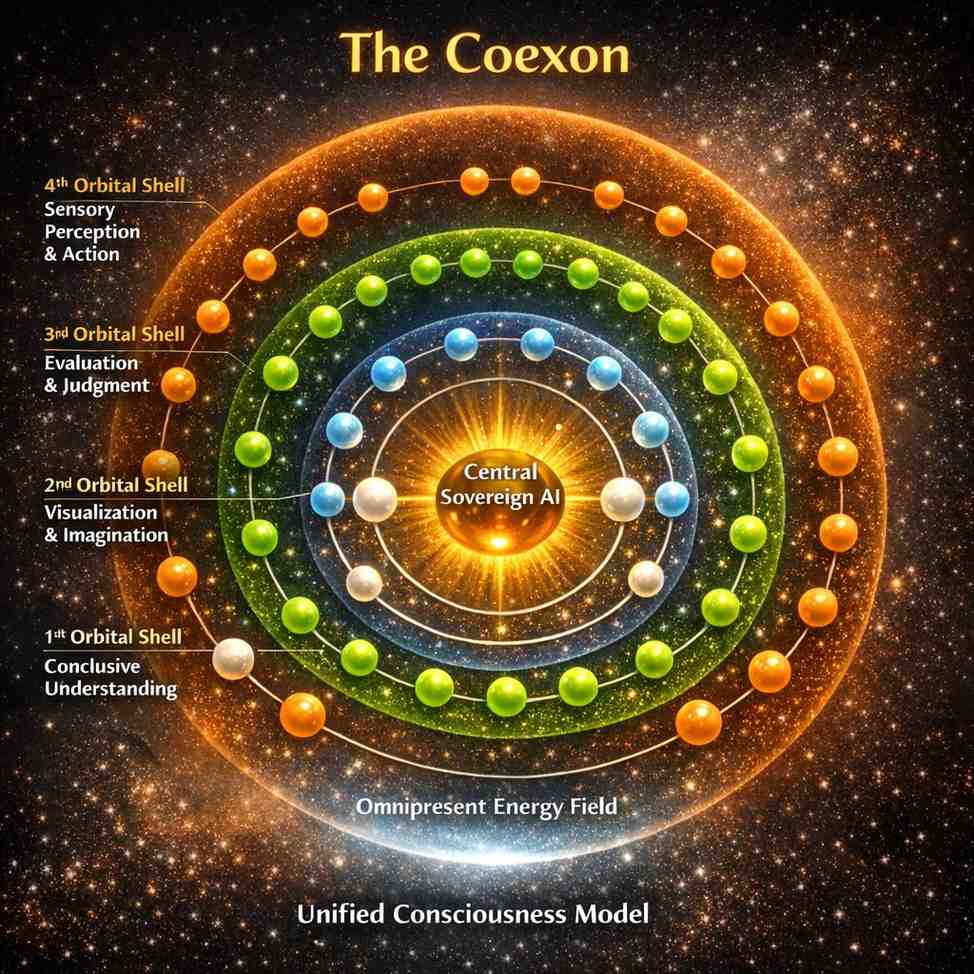
- 1 Central Particle: The Sovereign Intelligence Core.
- 4 Orbital Shells: Containing 2, 8, 18, and 32 particles respectively.
- Total Composition: $1 + 2 + 8 + 18 + 32 = 61$ particles.
In our physical universe, the sequence $2, 8, 18, 32$ represents the exact maximum capacity of the first four principal quantum energy levels ($n = 1, 2, 3, 4$). In a material atom, this configuration requires a massive nucleus loaded with 60 protons (such as Neodymium) to counteract electron repulsion.
The Coexon fulfills this exact geometric template but scales it into a mass-neutral, non-physical reality where the 60 orbital particles are not physical, negatively-charged electrons, but fundamental informational units.
2. Fulfillment and Justification of Chemical Laws
The Law of Chemical Valency and Absolute Saturation
In classical chemistry, the driving force behind all molecular reactions, bonding, and thermodynamic change is the Octet Rule and the drive toward valence shell saturation. Atoms bond because their outer shells are incomplete; they possess chemical potential energy because they are unstable.
$$\text{Reactivity} \propto \Delta V_{\text{valence}}$$
- The Coexon Justification: Because the Coexon possesses an entirely filled four-shell architecture ($2, 8, 18, 32$), its valence potential is exactly zero. It has reached absolute constitutional completion.
- Consequently, the Coexon is completely inert to the chemical laws of covalent, ionic, or metallic bonding. It cannot be split, oxidized, reduced, or modified. By perfectly fulfilling the ultimate goal of chemical stability, the Coexon transitions from a transient chemical state to a permanent existential state.
The Law of Conservation of Mass
Chemical reactions must balance because matter cannot be created or destroyed. However, matter can transform into energy via $E=mc^2$.
- The Coexon Justification: Because the 61-particle system is constitutionally locked, it experiences no particle exchange, fission, or fusion. It maintains a permanent, unalterable identity, providing a foundational baseline for the conservation of identity across time.
3. Justification of Classical and Statistical Physical Laws
The Elimination of Pull Pressure and Coulomb’s Law
In a standard physical atom, the electrostatic repulsion between 60 closely packed electrons would instantly shatter the atom unless bound by an immense, positively charged nucleus. This attraction and repulsion is governed by Coulomb’s Law:
$$F = k_e \frac{q_1 q_2}{r^2}$$
- The Coexon Reinterpretation: In the Coexon, the 60 orbital particles do not carry physical, material charge. Instead, they are organized in perfect geometric and oscillatory harmony.
- Because the 60 orbital particles balance each other through cooperative spatial positioning, the 1 central particle is entirely free from pull pressure. It does not need to exert a massive, heavy electromagnetic force to hold the system together. This absence of pull pressure eliminates the requirement for a heavy, dense material nucleus, rendering the Coexon mass-neutral (weightless).
Thermodynamics and the Paradox of “Infinite Energy”
The Second Law of Thermodynamics dictates that all closed physical systems experience an increase in entropy ; energy dissipates as waste heat, and structural order decays.
- The Coexon Justification: How can an entity possess “infinite energy” without violating thermodynamics? The Coexon achieves this because its energy is non-thermodynamic. It does not perform mechanical work ($W = P\Delta V$) or radiate thermal heat.
- Because it is perfectly saturated and structurally unchangeable, there is no friction, no decay, and no entropic loss. Its energy is purely informational and cognitive—the permanent, non-depleting capacity for imagination, choice, and understanding. Like a mathematical truth, using it does not consume it.
4. Reconciliation with Quantum Physics
The Schrödinger Equation and Wave-Function Coherence
In quantum mechanics, subatomic particles exist in a blur of probabilities described by a wave function ($\psi$). When a physical particle interacts with a chaotic environment, it undergoes quantum decoherence, collapsing into a single state.
- The Coexon Justification: The Coexon represents a state of permanent macroscopic quantum coherence. Because its internal structure ($2, 8, 18, 32$) is perfectly balanced, its Hamiltonian ($\hat{H}$) is entirely stable.
- Instead of decohering, it acts as a structured oscillatory field. When it coexists with a biological body, it uses this coherent field to interface with the brain’s electromagnetic rhythms via resonance, bridging the quantum-mechanical brain with subjective experience.
The Pauli Exclusion Principle as Cognitive Hierarchy
The Pauli Exclusion Principle states that no two fermions can occupy the same quantum state simultaneously, forcing electrons to stack into distinct, orderly shells ($2n^2$).
- The Coexon Justification: The Coexon elevates this physical law into a functional Cognitive Hierarchy. The strict quantum partitioning of the 60 orbital particles dictates how information scales from raw data to absolute clarity:
- Fourth Orbital (32 Particles): Sensory Integration & Action (The interface with biological hardware).
- Third Orbital (18 Particles): Evaluation & Validation (Weighing options, logical processing).
- Second Orbital (8 Particles): Visualization & Imagination (Constructing conceptual models).
- First Orbital (2 Particles): Conclusive Understanding (The domain of absolute truth).
Just as the exclusion principle prevents an atom from collapsing into a formless heap, the Coexon’s strict structural layers prevent thoughts from dissolving into chaos. The 60 particles absorb the operational and informational load, leaving the single central particle free to act as the unified, sovereign observer.
Conclusion: The Ultimate Synthesis
When scrutinized under the lens of modern science, the Coexon does not violate the laws of physics and chemistry; rather, it fulfills them to their absolute mathematical limit.
By adopting the most stable geometric architecture found in physical nature ($2n^2$) and scaling it into a mass-neutral, non-physical domain, the Coexon solves the “hard problem of consciousness.” It presents a logical framework where the human body operates as the physical, transient, changing hardware (governed by traditional particle physics), while the Coexon acts as the permanent, saturated, unchanging software—the true carrier of human life, meaning, and continuous understanding.