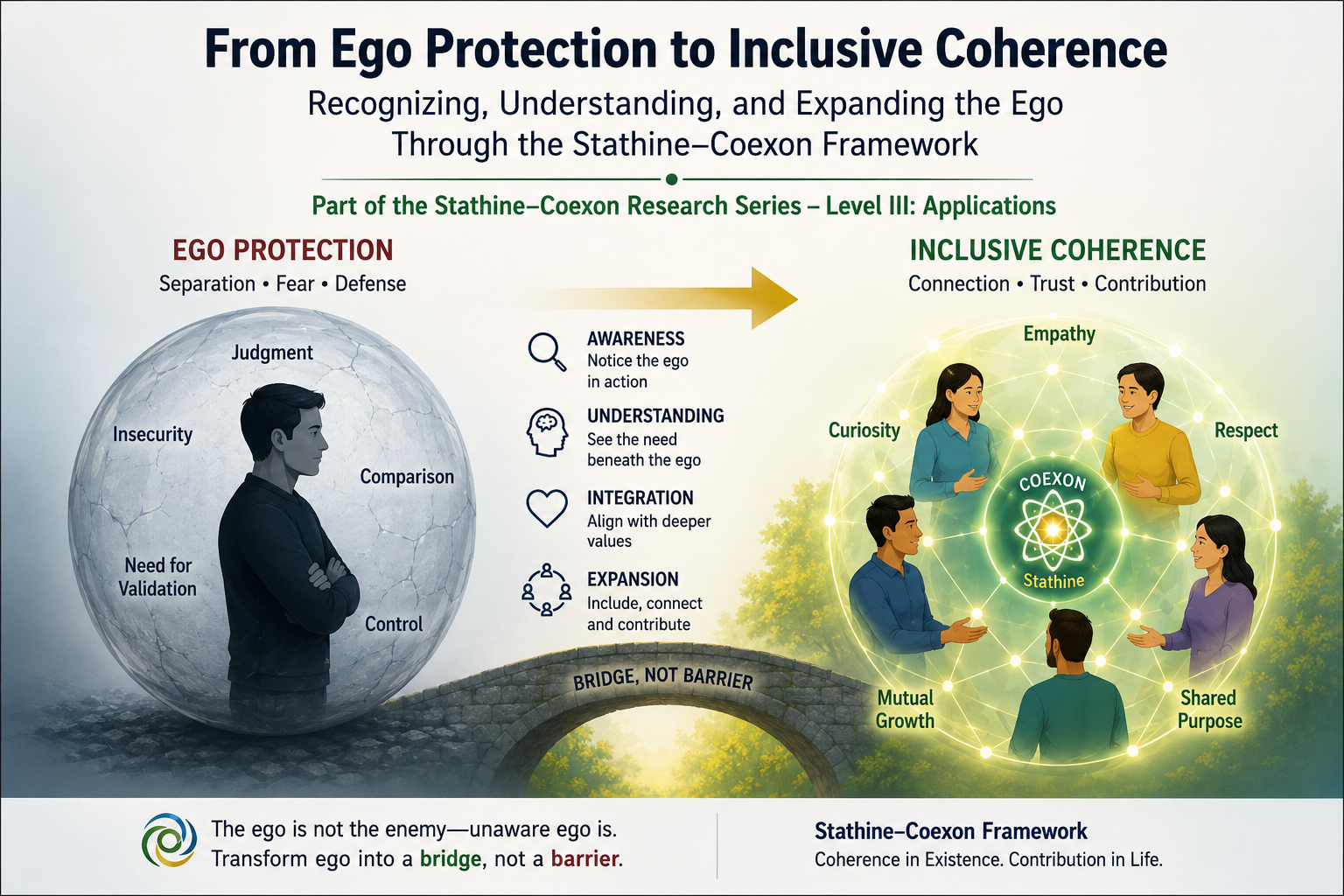
From Ego Protection to Inclusive Coherence
Recognizing, Understanding, and Expanding the Ego Through the Stathine–Coexon Framework
A Practical-Philosophical Model for Relationships, Self-Development, and Human Coexistence
Part of the Stathine–Coexon Research Series – Level III: Applications
Abstract
Ego is among the most frequently discussed yet least operationally understood aspects of human experience. In everyday life, ego often becomes visible through defensiveness, the need to be right, sensitivity to criticism, comparison, status-seeking, resentment, control, and the inability to recognize another person’s perspective. Although many philosophical and psychological traditions have proposed methods for reducing ego, the practical challenge remains: how can an individual recognize ego in the moment it is operating and transform its effects without suppressing individuality, self-respect, or healthy boundaries?
This article applies the Stathine–Coexon Framework to the problem of ego. It proposes that ego may be understood as a relatively narrow and protective organization of identity and understanding. Within this model, ego is not inherently an enemy of human development. It is a functional structure that attempts to preserve continuity, dignity, identity, and perceived coherence. Difficulties arise when the ego treats its current boundary of understanding as the boundary of reality itself.
The article proposes that the Stathine–Coexon Framework offers a practical method for recognizing ego through the detection of disproportionate emotional reactions, defensive certainty, relational contraction, and the inability to include information that threatens the current self-model. The framework then proposes a developmental pathway from ego protection toward inclusive coherence.
The central proposition is that ego need not be destroyed. It can be expanded.
The individual may progressively move from:
“I must protect myself.”
to:
“I must protect what I understand to be mine.”
to:
“My well-being is connected to the well-being of others.”
to:
“I can remain a distinct individual while participating in a larger coherence.”
This paper therefore presents ego development as an expansion of the circle of identity and understanding. The objective is not the disappearance of individuality but the transformation of defensive separation into coherent participation.
1. Introduction: The Everyday Problem of Ego
Ego is often discussed as though it belongs only to arrogant or self-important people.
In ordinary life, however, ego is much more subtle.
It may appear as:
- becoming defensive when corrected,
- needing to win an argument,
- feeling personally attacked by disagreement,
- refusing to apologize,
- assuming that one’s interpretation is the only valid interpretation,
- comparing oneself constantly with others,
- feeling diminished by another person’s success,
- seeking recognition,
- needing to control a conversation,
- dismissing information that threatens one’s identity.
The person experiencing these reactions may not consciously think:
“My ego is operating.”
Instead, the experience may feel like:
“I am right.”
“They are disrespecting me.”
“They should know better.”
“Why should I apologize?”
“I cannot allow them to think they have won.”
This is precisely what makes ego difficult to recognize.
The ego often does not appear to the individual as ego.
It appears as reality.
The Stathine–Coexon Framework offers a different way of understanding this process.
2. Ego as a Boundary of Identity and Understanding
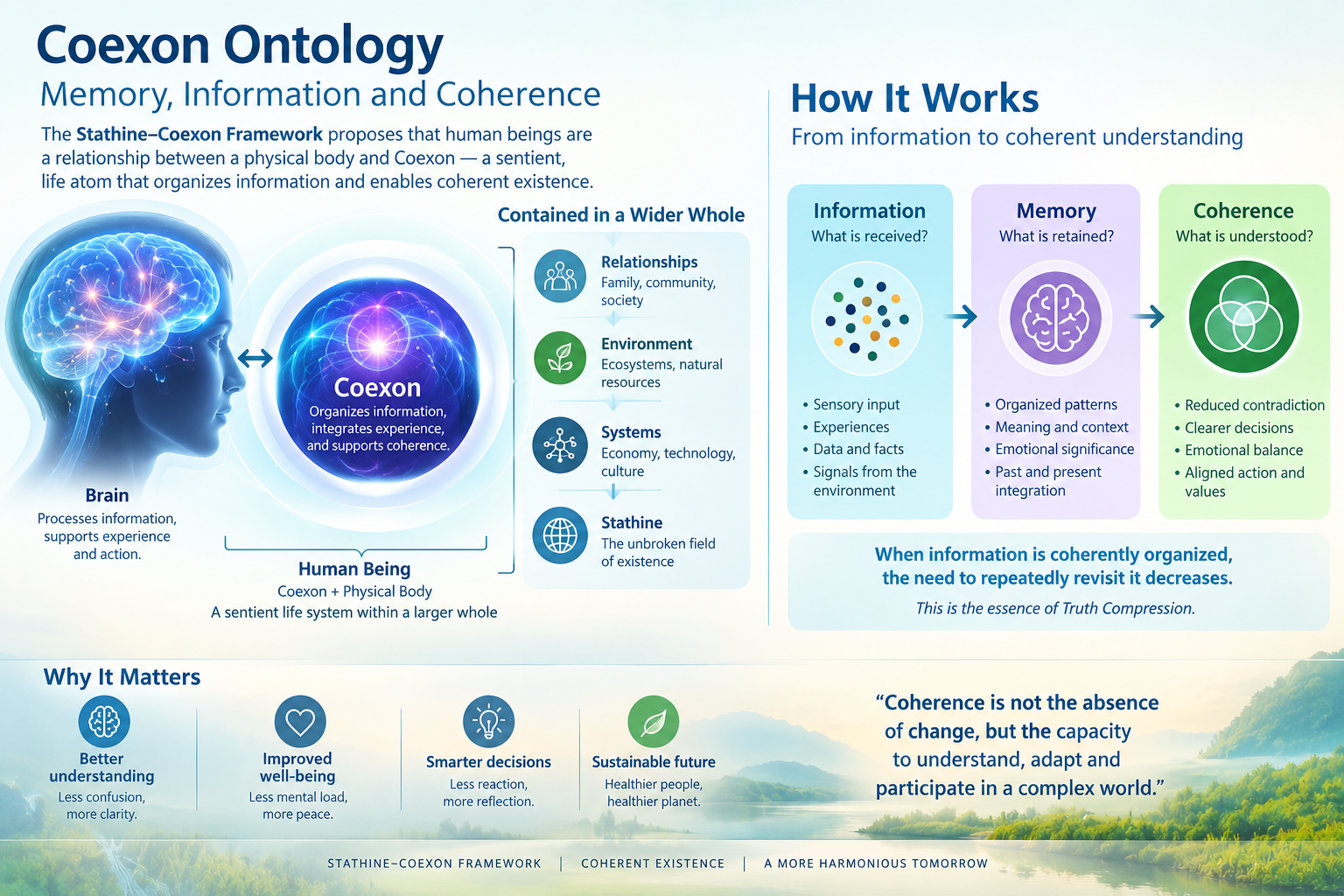
Within the framework, the human being is understood as the integrated unity of the proposed Coexon and the physical body.
The Coexon progressively develops understanding through experience.
To function, the human being must create an internal model of reality.
This model includes:
- who I am,
- what I know,
- what I value,
- what I believe,
- whom I trust,
- what I can do,
- where I belong.
This organization of identity and understanding is useful.
Without some sense of identity, coherent action becomes difficult.
A person needs to know:
This is my body.
These are my responsibilities.
These are my values.
This is what I understand.
The problem begins when the identity structure becomes rigid.
The individual may unconsciously begin to experience:
My current understanding is not merely what I currently understand. It is who I am.
At this point, new information can feel like a threat to existence itself.
A disagreement is no longer merely a disagreement.
It becomes an attack on identity.
3. A Proposed Definition of Ego
Within the Stathine–Coexon Framework, ego may be provisionally defined as:
The protective organization of identity and understanding that attempts to preserve continuity, significance, and coherence from the perspective of the individual self.
This definition is deliberately non-moralistic.
Ego is not automatically bad.
It performs useful functions.
It helps the individual:
- maintain identity,
- protect boundaries,
- pursue goals,
- develop responsibility,
- distinguish self from others.
However, the same protective function can become counterproductive.
Ego becomes problematic when:
The protection of the current self-model becomes more important than the discovery of truth or the preservation of relationship.
This produces a central distinction.
Healthy Identity
“I know who I am, but I can learn.”
Rigid Ego
“If I am wrong, I am diminished.”
The first permits expansion.
The second resists it.
4. The Stathine Perspective: The Self Exists Within a Larger Continuum
The Axiom of Contained Existence proposes that all existence is contained within Stathine.
The individual therefore does not exist in absolute isolation.
The human being is always situated within:
- a body,
- a family,
- relationships,
- communities,
- institutions,
- ecosystems,
- the larger continuum of existence.
The ego often creates the psychological impression:
“I am separate from everything else.”
The Stathine perspective does not deny individuality.
It places individuality within context.
The individual remains distinct.
But distinct does not mean disconnected.
This distinction is central to ego expansion.
I can be a separate person without imagining that I am an isolated existence.
5. The Coexon and the Construction of the Self
The proposed Coexon develops through experience.
Every experience contributes to the formation of an internal model.
A person learns:
“I am good at this.”
“I am bad at that.”
“People like me when I do this.”
“People reject me when I do that.”
“I must never appear weak.”
“I must always be right.”
Over time, these conclusions become part of identity.
The ego therefore often contains historical information.
It may have been constructed from:
- childhood experiences,
- praise,
- criticism,
- humiliation,
- success,
- failure,
- social comparison,
- cultural expectations.
This suggests an important practical principle:
The ego is often a historical survival strategy that has become an identity structure.
A response that was once useful may no longer be necessary.
Yet the Coexon may continue to protect it.
6. Why Ego Reacts to Disagreement
Suppose a person believes:
“I am highly intelligent.”
Another person challenges their idea.
The disagreement may be interpreted in two different ways.
Coherent Interpretation
“This person disagrees with one of my ideas.”
Ego Interpretation
“This person is challenging my intelligence.”
The factual event is the same.
The interpretation differs.
The ego has connected an idea to identity.
The result is disproportionate emotional reaction.
The individual may experience:
- anger,
- embarrassment,
- anxiety,
- contempt,
- withdrawal,
- the desire to attack.
The framework therefore proposes a practical diagnostic question:
What exactly is being threatened?
Is it:
- my body?
- my safety?
- my relationship?
- my livelihood?
- my reputation?
- my idea?
- my identity?
The smaller the actual threat and the larger the emotional reaction, the more likely it is that an identity structure is being defended.
7. The Ego Detection Protocol
A practical Stathine–Coexon method may begin with five questions.
Question 1: What happened?
Describe the event without interpretation.
“They disagreed with my proposal.”
Question 2: What did I feel?
Identify the emotional response.
“I felt angry.”
Question 3: What did I believe the event meant?
“They do not respect me.”
Question 4: What part of my identity felt threatened?
“I believe I am the person who understands this better than others.”
Question 5: What additional understanding could be included?
“They may have information I do not possess.”
This sequence creates distance between:
Event
↓
Emotion
↓
Interpretation
↓
Identity
↓
Expanded understanding
That distance is often enough to reduce automatic egoic reaction.
8. Ego as Incoherence Between Experience and Understanding
The framework proposes that ego becomes problematic when the current self-model cannot accommodate new information.
The individual encounters information.
The information conflicts with identity.
The identity resists the information.
The result is internal contradiction.
This may be represented as:
New experience
↓
Conflict with existing self-model
↓
Threat perception
↓
Defensive reaction
↓
Rejection of information
↓
Preservation of existing identity
The individual may temporarily feel more secure.
However, understanding has stopped expanding.
The ego has protected identity at the cost of coherence with reality.
9. The Difference Between Self-Respect and Ego
A major danger in discussions about ego is confusing ego reduction with self-destruction.
The Stathine–Coexon Framework does not propose that individuals should:
- tolerate abuse,
- abandon boundaries,
- suppress legitimate needs,
- accept false accusations,
- become passive,
- eliminate individuality.
Healthy self-respect may be highly coherent.
The distinction is:
Self-Respect
“I recognize my value.”
Ego Inflation
“I must be more valuable than you.”
Healthy Boundary
“This behaviour is unacceptable to me.”
Egoic Control
“You must behave exactly as I demand.”
Healthy Confidence
“I can attempt this.”
Egoic Certainty
“I cannot be wrong.”
The objective is therefore not to reduce the self to nothing.
It is to remove unnecessary defensive contraction.
10. The Expansion of the Ego
The title of this paper is deliberately important.
The objective is not necessarily to destroy the ego.
It is to expand it.
A narrow ego says:
“Only my experience matters.”
An expanded identity says:
“My experience matters, and I can understand yours.”
A narrow ego says:
“Your success diminishes me.”
An expanded identity says:
“Your success is not a threat to my existence.”
A narrow ego says:
“If I am wrong, I lose value.”
An expanded identity says:
“Discovering that I am wrong increases my understanding.”
A narrow ego says:
“I must protect myself from the world.”
An expanded identity says:
“I am an individual participating within a larger system.”
This is not the disappearance of the self.
It is the expansion of the self’s circle of identification.
11. The Expanding Circle of Identity
The process may be represented as:
Me
↓
Me and my family
↓
Me and my community
↓
Me and my organization
↓
Me and my society
↓
Me and humanity
↓
Me and the living ecosystem
The individual does not disappear at each stage.
The circle expands.
This is the same developmental principle that applies to regulation and governance.
The Coexon increasingly recognizes:
My existence is connected to larger systems.
As this understanding grows, ego becomes less defensive.
Why?
Because the individual no longer experiences every external success as a threat to the self.
The self has become more inclusive.
12. Ego and Relationships
Most people encounter the consequences of ego most clearly in relationships.
A relationship becomes difficult when both individuals are trying to protect their self-models.
Consider a disagreement.
Person A thinks:
“I must prove that I am right.”
Person B thinks:
“I must prove that I am right.”
The conversation becomes a contest.
The original problem disappears.
The real objective becomes:
Who will lose?
The Stathine–Coexon Framework proposes a different question:
What understanding can emerge between us that neither of us possessed before the conversation?
This transforms the interaction.
The objective is no longer victory.
It is increased coherence.
13. The Three-Step Relationship Practice
When ego is activated in a relationship, use three steps.
Step 1: Pause
Do not immediately respond to the emotional impulse.
Step 2: Expand
Ask:
“What might I not yet understand about this person’s experience?”
Step 3: Connect
Ask:
“What outcome would preserve both truth and relationship?”
This is not always possible.
Sometimes a relationship must end.
Sometimes a boundary must be enforced.
But the decision can be made from understanding rather than automatic egoic reaction.
14. The Coherence Test for Ego
A useful practical test is:
Is my current reaction increasing or decreasing the coherence of the situation?
Ask:
- Am I trying to understand or merely win?
- Am I protecting truth or protecting my image?
- Am I responding to the present event or to an old wound?
- Am I listening for information or waiting to defend myself?
- Is my response likely to improve the relationship?
These questions do not guarantee perfect behaviour.
They create awareness.
Awareness creates choice.
Choice creates the possibility of change.
15. The Ego and Truth Compression
The Stathine–Coexon Framework proposes that coherent truth tends to reduce unnecessary contradiction.
Ego often creates additional cognitive energy by maintaining conflicting positions.
For example:
“I value honesty.”
Yet:
“I cannot admit that I was wrong.”
The individual may experience internal contradiction.
The ego attempts to preserve the identity of being honest while avoiding the experience of admitting error.
A more coherent position may be:
“I value honesty, and I was wrong about this.”
The second statement is simpler.
It requires less defensive maintenance.
This is the practical relationship between ego and truth compression.
The more accurately the individual can incorporate reality, the less energy is required to defend an inaccurate self-model.
16. The Practice of Saying “I May Be Wrong”
One of the most powerful ego-expanding sentences is:
“I may be wrong.”
This does not mean:
“I have no knowledge.”
It means:
“My current understanding may be incomplete.”
This preserves dignity while allowing expansion.
A second powerful sentence is:
“What am I missing?”
A third is:
“What would change my mind?”
These questions convert identity protection into understanding.
17. Ego and Leadership
Leadership provides a particularly important application.
A leader with rigid ego may:
- reject criticism,
- surround themselves with agreement,
- punish dissent,
- claim credit,
- avoid responsibility for failure.
This creates institutional incoherence.
A coherent leader can say:
“I am responsible for the decision, but I do not need to pretend that I possess all the understanding.”
This creates psychological safety.
Information can travel upward.
The organization can learn.
The leader’s identity does not depend upon always being correct.
The organization becomes more intelligent than the individual leader.
This is an important principle:
A leader’s ego should not become the ceiling of an organization’s understanding.
18. Ego and Learning
Learning requires the ability to encounter information that challenges existing understanding.
Therefore:
A rigid ego is fundamentally anti-learning.
Not because it lacks intelligence.
But because it protects existing identity from revision.
The learner who says:
“I already know this.”
may stop learning.
The learner who says:
“What can I understand from this?”
continues expanding.
The difference is not knowledge.
It is relationship to knowledge.
19. Ego and Inclusion
Inclusive behaviour is sometimes misunderstood as agreeing with everyone.
The Stathine–Coexon Framework proposes a different definition.
Inclusion is the capacity to allow another person’s existence and perspective to be present in one’s field of understanding without requiring immediate agreement.
This is a powerful form of maturity.
I can say:
“I understand why you think this.”
without saying:
“I agree with you.”
I can say:
“Your experience is real.”
without saying:
“Your interpretation is complete.”
This allows difference without unnecessary conflict.
20. The Inclusive Ego
The term inclusive ego may initially appear contradictory.
However, it describes a useful developmental direction.
The individual maintains a distinct identity while increasingly including:
- other perspectives,
- other experiences,
- other interests,
- other communities,
- other forms of life.
The ego becomes less like a fortress.
It becomes more like a permeable boundary.
It retains identity.
But it permits learning.
It protects the self.
But it does not need to deny the existence of others.
This may be described as:
Strong enough to have boundaries; open enough to continue expanding.
21. A Daily Ego Practice
The following five-minute practice may be used daily.
Step 1: Recall one difficult interaction.
Who irritated you?
Step 2: Identify the emotional reaction.
What did you feel?
Step 3: Identify the threatened identity.
What did the situation appear to say about you?
Step 4: Identify the missing perspective.
What might the other person have been experiencing?
Step 5: Expand the understanding.
What can you now understand that you could not see during the interaction?
The objective is not self-criticism.
It is learning.
22. The Ego Expansion Equation
The process may be expressed conceptually as:
Ego Expansion = Stable Identity + Inclusion of New Understanding − Defensive Rejection of Experience
This is not intended as a mathematical law.
It is a practical developmental model.
The individual does not need to lose identity.
The individual needs to become capable of incorporating more reality.
23. From “I” to “We” Without Losing “I”
The final objective is not to eliminate the word “I.”
The individual remains an individual.
The deeper development is:
I exist.
Then:
I exist with others.
Then:
My existence is affected by others.
Then:
My actions affect others.
Then:
My well-being and the well-being of others are interconnected.
This is the expansion of understanding.
The individual does not disappear.
The individual becomes more accurately situated.
24. Hypotheses for Future Research
The framework suggests several hypotheses.
Hypothesis 1
Individuals capable of identifying the identity threat underlying emotional reactions may demonstrate improved conflict resolution.
Hypothesis 2
The ability to distinguish disagreement with an idea from rejection of the self may improve relationship stability.
Hypothesis 3
Greater understanding of interdependence may correlate with reduced defensive ego behaviour.
Hypothesis 4
The ability to incorporate contradictory information may correlate with improved learning and adaptive decision-making.
Hypothesis 5
Organizations in which leaders can receive ego-threatening information without suppressing it may demonstrate greater adaptive intelligence.
These hypotheses invite future investigation across psychology, education, leadership, neuroscience, and organizational studies.
25. Conclusion
Ego is often treated as something that must be conquered.
The Stathine–Coexon Framework offers a different possibility.
Ego may be understood as a protective organization of identity and understanding.
It becomes problematic when the individual confuses the current boundary of the self-model with the boundary of reality.
The solution is therefore not necessarily the destruction of ego.
It is its expansion.
The individual can move from:
“I must protect my identity from all contradiction.”
to:
“My identity can survive the discovery that I was wrong.”
From:
“Your success threatens my value.”
to:
“Your success does not reduce my existence.”
From:
“I must defeat your perspective.”
to:
“I can understand your perspective without surrendering my own.”
From:
“I am separate from the larger system.”
to:
“I am a distinct participant within a larger continuum.”
The Stathine–Coexon Framework therefore proposes that ego development is fundamentally a process of progressive inclusion.
The Coexon begins with a narrow circle of identity.
Experience challenges that circle.
Understanding expands it.
Coherence increases.
The individual remains.
But the individual becomes capable of containing more of existence within understanding.
The central principle may therefore be stated:
Ego is not necessarily the enemy of enlightenment. An unexamined, rigid ego is. The mature path is not the disappearance of the self, but the progressive expansion of the self’s capacity to include reality, relationship, and the well-being of increasingly larger systems.
In the language of the Stathine–Coexon Framework:
The Coexon does not become less of an individual by becoming more inclusive. It becomes a more coherent participant in the continuum that contains all existence.
About the Stathine–Coexon Framework
The Stathine–Coexon Framework is an interdisciplinary philosophical framework that seeks to integrate insights from systems thinking, neuroscience, psychology, biology, complexity science, leadership, education, consciousness studies, governance, and civilizational research through the unifying concept of coherence.
The framework proposes Stathine as the timeless, static continuum within which all existence is contained and the Coexon as the proposed organizing life atom that progressively experiences, interprets, and develops understanding of existence.
Foundational concepts, terminology, and guiding principles are presented in The Foundational Axioms and Practical Lexicon of the Stathine–Coexon Framework.