Extending Temporal Interpretations Toward Atemporal Information Coherence
Part of the Stathine–Coexon Research Series – Level II: Comparative Integration
Foundation Series
This article builds upon the foundational principles established in the Level I papers of the Stathine–Coexon Research Series:
- The Foundational Axioms and Practical Lexicon of the Stathine–Coexon Framework
- The Ontology of Stathine and Coexon
- The Principle of Truth Compression
- The Progressive Reduction of Contradiction
- The Atemporal Nature of Stathine and Coexon
These papers introduce the fundamental concepts of Stathine as the universal static continuum and Coexon as the organizing informational entity that continually seeks increasing coherence across existence.
Abstract
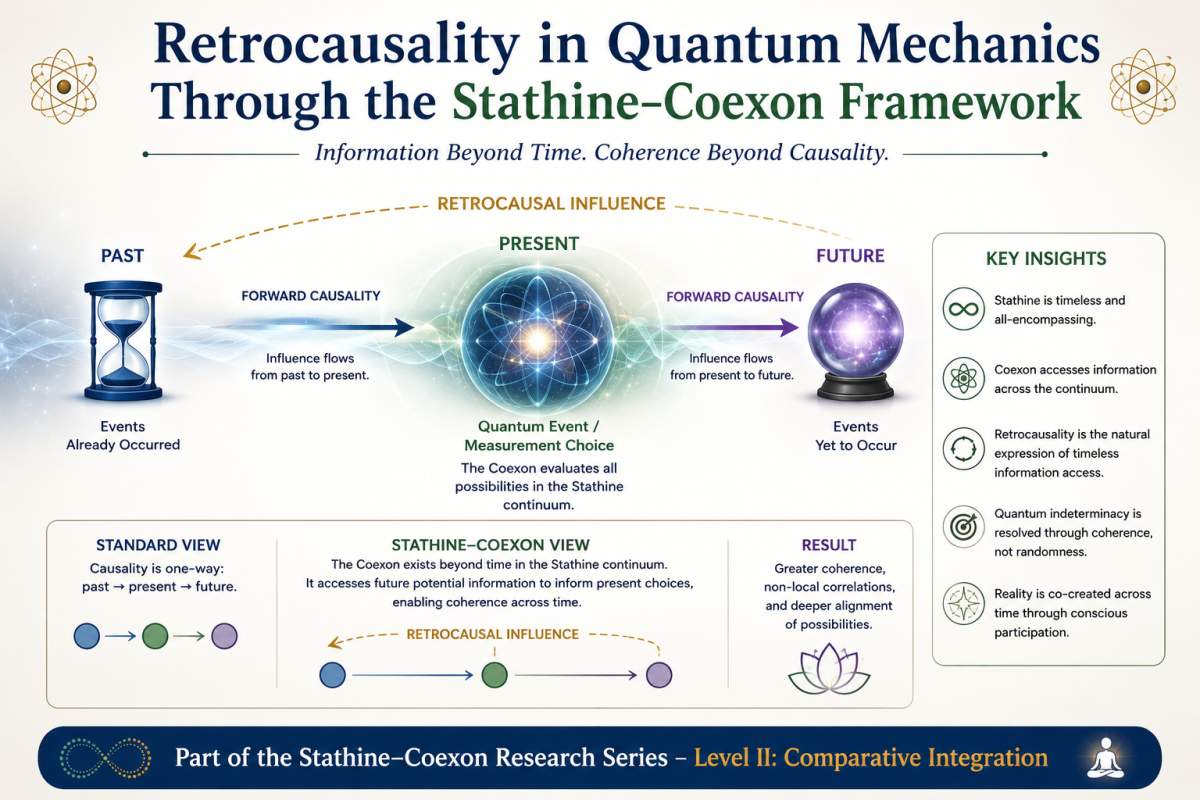
Retrocausality has emerged as one of the most intriguing interpretations of quantum mechanics. Unlike conventional causality, where causes precede effects, retrocausal theories propose that future measurement choices may influence earlier quantum states. While mathematically consistent in several formulations, retrocausality remains philosophically controversial because it appears to violate our everyday intuition regarding the flow of time.
This paper proposes that the apparent paradox largely results from assuming that time is a fundamental property of reality rather than an emergent property of biological observation. Within the Stathine–Coexon Framework, both Stathine and Coexon exist outside temporal progression. Time emerges only through biological processes interacting with an atemporal informational continuum.
Under this interpretation, retrocausality ceases to represent information traveling backward through time. Instead, it becomes the natural consequence of an atemporal coherence network resolving globally consistent informational configurations.
The paper does not replace existing mathematical formulations of retrocausal quantum mechanics. Rather, it proposes an ontological interpretation capable of integrating retrocausality with modern developments in quantum information, consciousness studies, systems science, and biological organization.
1. Introduction
Quantum mechanics continually challenges the intuitive assumptions inherited from classical physics.
Among its most perplexing ideas is retrocausality—the possibility that future measurement choices participate in determining earlier quantum descriptions.
Traditional interpretations attempt to preserve forward-moving causality, often introducing wavefunction collapse, hidden variables, branching universes, or observer-dependent realities.
Retrocausal interpretations instead suggest that the future participates in constructing present quantum correlations.
The Stathine–Coexon Framework suggests an alternative question:
What if neither the past nor the future fundamentally exists?
Instead, what appears as temporal evolution may simply be our biological experience of navigating an already-existing informational continuum.
2. Retrocausality in Contemporary Quantum Mechanics
Several interpretations have explored retrocausal concepts.
These include:
- Wheeler–Feynman absorber theory
- Two-State Vector Formalism
- Transactional Interpretation
- Time-symmetric quantum mechanics
- Certain hidden-variable approaches
Their common observation is that quantum events appear more naturally explained when boundary conditions from both the past and future contribute to physical outcomes.
Mathematically these theories often preserve locality better than conventional interpretations.
Philosophically, however, they introduce the unsettling implication that the future somehow changes the past.
3. The Core Difficulty
The central difficulty is not mathematical.
It is ontological.
Retrocausality appears paradoxical because it assumes:
- Time is fundamental.
- Causes move along time.
- Information flows linearly.
- Reality unfolds sequentially.
If these assumptions are incorrect, the paradox dissolves.
4. The Atemporal Ontology of the Stathine–Coexon Framework
Within the framework:
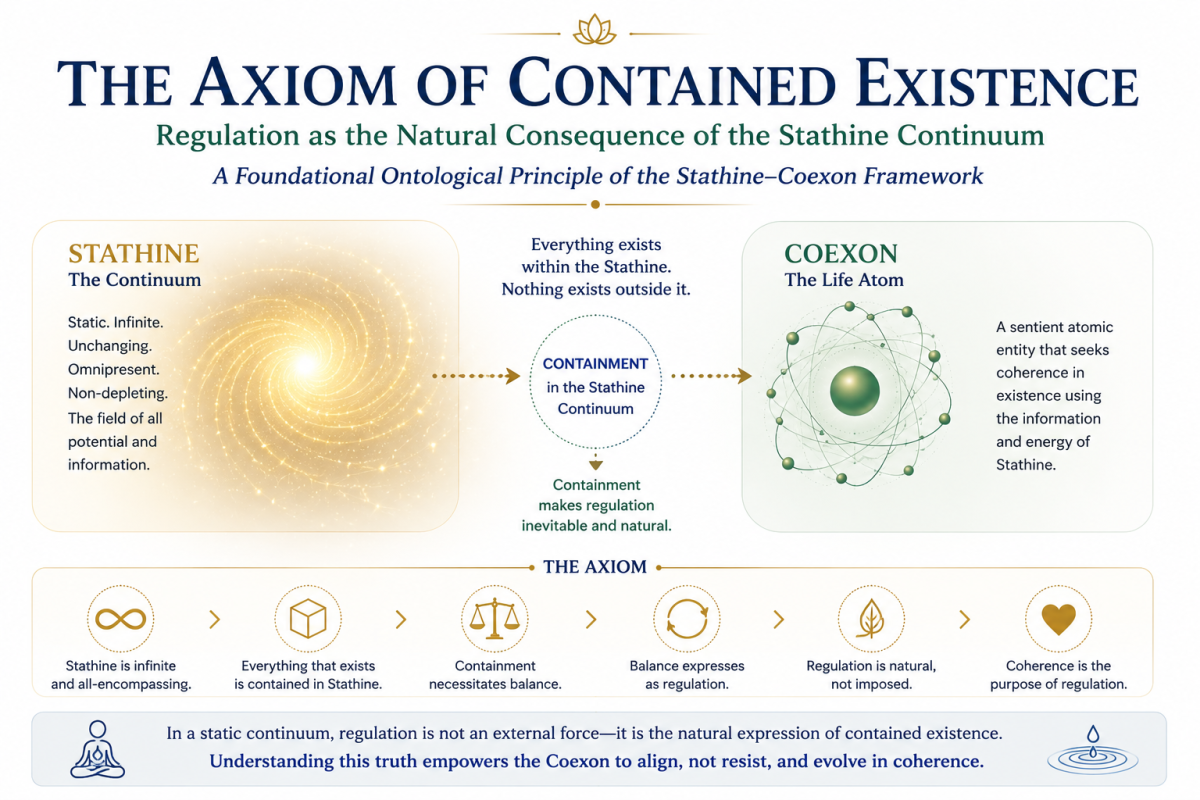
Stathine
- infinite
- static
- non-depleting
- omnipresent
- outside time
It represents the universal field of existence.
Coexon
is a sentient atom moving through Stathine.
It is an informational coherence structure existing within Stathine.
Its organizing principle is always:
increasing coherence while minimizing contradiction.
Stathine is static all prevading and coexistential
Coexon experiences progression with improving coherence.
Time instead emerges when biological organisms sequentially interact with reality.
5. Time as an Emergent Biological Coordinate
Within this framework:
Past, present and future are not independent realities.
Instead:
Biological cognition constructs sequential experience from an atemporal informational landscape.
Just as a reader experiences a novel page by page although the entire book already exists, consciousness experiences coherent informational states sequentially as they occur.
Retrocausality therefore becomes:
not information traveling backward,
but biological observers discovering globally coherent informational relationships.
6. Reinterpreting Quantum Measurement
Quantum measurement has traditionally been viewed as:
- collapse
- branching
- updating information
The Stathine–Coexon Framework proposes another interpretation.
Measurement represents:
alignment between local biological observation and the globally coherent informational organization already existing within Stathine.
Nothing travels backward.
Nothing travels forward.
Observation simply reveals coherence as per the viewing capability of the observer.
7. The Coexon as an Atemporal Information Integrator
The Coexon continually integrates information across multiple scales.
Unlike biological brains, which process sequentially,
the Coexon evaluates informational coherence independent of temporal ordering.
Its organizing process resembles solving a complex optimization problem.
Instead of computing:
A → B → C
it seeks:
the highest internally coherent configuration among all available informational relationships.
Retrocausal effects naturally emerge whenever this global coherence becomes projected into sequential biological experience.
8. Reinterpreting Wheeler’s Delayed Choice Experiment
Delayed-choice experiments suggest that present measurement choices appear to determine earlier particle behavior.
Within conventional thinking this appears impossible.
Within the Stathine–Coexon Framework:
the experimental outcome represents the final coherent informational relationship.
The earlier quantum description was never fixed independently.
Instead, the complete experimental configuration forms one coherent informational structure.
Sequential observation creates the illusion that later events modify earlier ones.
9. Entanglement and Retrocausality
Entanglement becomes particularly elegant under this interpretation.
Conventionally:
two particles separated by vast distances remain mysteriously correlated.
The framework proposes:
the correlation exists because both observations belong to one coherent informational organization.
Spatial separation does not imply informational separation.
Temporal ordering likewise becomes secondary.
10. Relation to Quantum Information Theory
Quantum information increasingly treats information—not particles—as fundamental.
The Stathine–Coexon Framework extends this direction.
Information itself possesses organization.
Organization seeks coherence.
Coherence reduces contradiction.
Truth represents maximal informational compression.
Thus quantum information naturally becomes an expression of coherence optimization rather than probabilistic uncertainty alone.
11. Biological Consciousness and Atemporal Processing
Human cognition appears sequential.
However many psychological phenomena suggest integration beyond conscious temporal awareness:
- intuition
- insight
- creativity
- sudden understanding
- holistic perception
The framework proposes that these emerge because the Coexon integrates informational coherence before conscious sequential cognition reconstructs experience.
This does not imply mystical foresight.
Instead it suggests that biological awareness receives already-integrated informational organization.
12. Comparison with Existing Retrocausal Models
| Existing Retrocausality | Stathine–Coexon Interpretation |
|---|---|
| Future affects past | Entire informational configuration exists atemporally |
| Time-symmetric causation | Atemporal coherence organization |
| Information travels backward | No temporal travel required |
| Quantum state evolves | Biological observation unfolds sequentially |
| Measurement changes history | Measurement reveals coherence |
| Observer participates | Observer aligns with informational organization |
13. Potential Research Directions
The framework suggests several interdisciplinary investigations.
Quantum Foundations
Can global coherence optimization reproduce existing retrocausal mathematical predictions?
Quantum Information
Can coherence metrics replace purely probabilistic descriptions?
Consciousness Research
Can atemporal informational integration explain intuition and insight?
Neuroscience
Can biological brains be modeled as sequential interfaces to atemporal informational organization?
Artificial Intelligence
Can coherence-seeking architectures outperform purely predictive models?
Systems Biology
Can developmental processes reflect global informational optimization rather than purely local causal interactions?
14. Implications for Physics
The framework does not reject quantum mechanics.
It does not reject relativity.
It does not reject retrocausal mathematics.
Instead it proposes that:
all temporal paradoxes arise from treating time as ontologically fundamental.
If time is emergent,
retrocausality becomes expected rather than paradoxical.
15. Implications for Philosophy
The framework shifts several philosophical assumptions.
Instead of asking:
“Can the future influence the past?”
it asks:
“Why assume that reality fundamentally unfolds through time?”
This shift aligns ontology with coherence rather than chronology.
Existence becomes organized informational consistency rather than temporal evolution.
There is always the ever present that keeps unfolding without any break.
16. Conclusion
Retrocausality represents one of the most profound challenges in modern physics because it exposes the limitations of linear temporal intuition.
The Stathine–Coexon Framework proposes that the paradox does not originate in quantum mechanics itself but in our assumptions about time.
If Stathine constitutes an atemporal continuum and Coexon functions as an atemporal coherence-seeking informational entity, then quantum correlations need not involve influences traveling backward through time.
Instead, both measurement and observation become localized encounters with an already coherent informational reality.
Retrocausality thus transforms from a mysterious reversal of causation into an expected consequence of an atemporal ontology.
Rather than replacing existing retrocausal theories, the Stathine–Coexon Framework offers a broader conceptual foundation capable of integrating quantum mechanics, information theory, systems science, consciousness research, and philosophy into a unified coherence-centered interpretation of existence.
Future Research Connections
This paper naturally connects with future Level II comparative studies, including:
- John Cramer’s Transactional Interpretation Through the Stathine–Coexon Framework
- The Two-State Vector Formalism and Atemporal Coherence
- David Bohm’s Implicate Order and the Stathine–Coexon Framework
- Quantum Information Theory as Coherence Organization
- Time Symmetry in Physics and Atemporal Existence
- Karl Friston’s Free Energy Principle and Global Coherence
- Integrated Information Theory and Coexon Organization
- Donald Hoffman’s Interface Theory of Perception Through the Stathine–Coexon Framework
- Stephen Wolfram’s Computational Universe and Atemporal Information Networks
References for Conceptual Background
Quantum Foundations
- Wheeler, J. A., & Feynman, R. P. (1945). Interaction with the Absorber as the Mechanism of Radiation.
- Aharonov, Y., Bergmann, P. G., & Lebowitz, J. L. (1964). Time Symmetry in the Quantum Process.
- Cramer, J. G. (1986). The Transactional Interpretation of Quantum Mechanics.
Information and Physics
- Shannon, C. E. (1948). A Mathematical Theory of Communication.
- Deutsch, D. (1997). The Fabric of Reality.
Stathine–Coexon Foundation Series
- The Foundational Axioms and Practical Lexicon of the Stathine–Coexon Framework
- The Ontology of Stathine and Coexon
- The Principle of Truth Compression
- The Progressive Reduction of Contradiction
- The Atemporal Nature of Stathine and Coexon