Regeneration, Sentience, and Coexistence Reading Carl Safina’s Ecological Vision Through the Stathine–Coexon Framework
Abstract
Contemporary ecological thought is increasingly moving beyond the narrow objective of conserving resources for human use toward a deeper recognition that human beings are embedded within a living network of other organisms, ecosystems, cultures, and forms of sentience. Carl Safina’s work is particularly important in this transition. His ecological writing emphasizes the intrinsic significance of wild beings, the emotional and cognitive lives of non-human animals, the moral inadequacy of viewing nature merely through human utility, and the necessity of coexistence. Safina’s work also contributes directly to contemporary regenerative discourse, including his chapter on “Culture in Sentient Beings: Purpose, Evolution, Conservation” in Regenerative Farming and Sustainable Diets: Human, Animal and Planetary Health. (Carl Safina)
This paper proposes that the Stathine–Coexon Framework can complement Safina’s ecological perspective by providing a systems-level theoretical architecture for understanding why regeneration and coexistence should emerge from increasing coherence within living systems. Safina supplies rich ecological, behavioral, ethical, and experiential evidence; Stathine–Coexon proposes an ontological language in which relationships, information, sentience, contradiction reduction, and coherence can be considered across scales.
The proposed synthesis does not claim that Safina endorses the Stathine–Coexon Framework, nor does it present the framework’s ontological claims as established science. Rather, it identifies a potentially productive research dialogue between an empirically grounded ecology of living beings and a proposed theory of coherence.
1. Introduction: From Conservation to Regeneration
For much of modern environmental thinking, the central question was:
How do we prevent further destruction?
Conservation emerged naturally from this concern.
But the ecological challenge of the twenty-first century increasingly demands a second question:
How do we restore the capacity of living systems to regenerate themselves?
This distinction is profound.
Protection attempts to prevent further damage.
Restoration attempts to repair damage.
Regeneration goes further:
Can the conditions that produce vitality, diversity, resilience, relationship, and renewal be strengthened?
Carl Safina’s body of work provides an important foundation for this transition because it challenges the assumption that nature should be valued primarily according to its usefulness to humans.
Safina writes explicitly about the importance of coexistence and argues that wild nature has significance beyond human utility. He describes ecology as fundamentally involving “living relationships and reliances” and connects the loss of wild nature with the loss of beauty and human dignity. (Carl Safina)
His broader work examines humanity’s relationship with the living world and, increasingly, how free-living animals experience life. (Carl Safina)
The Stathine–Coexon Framework approaches the same challenge from another direction.
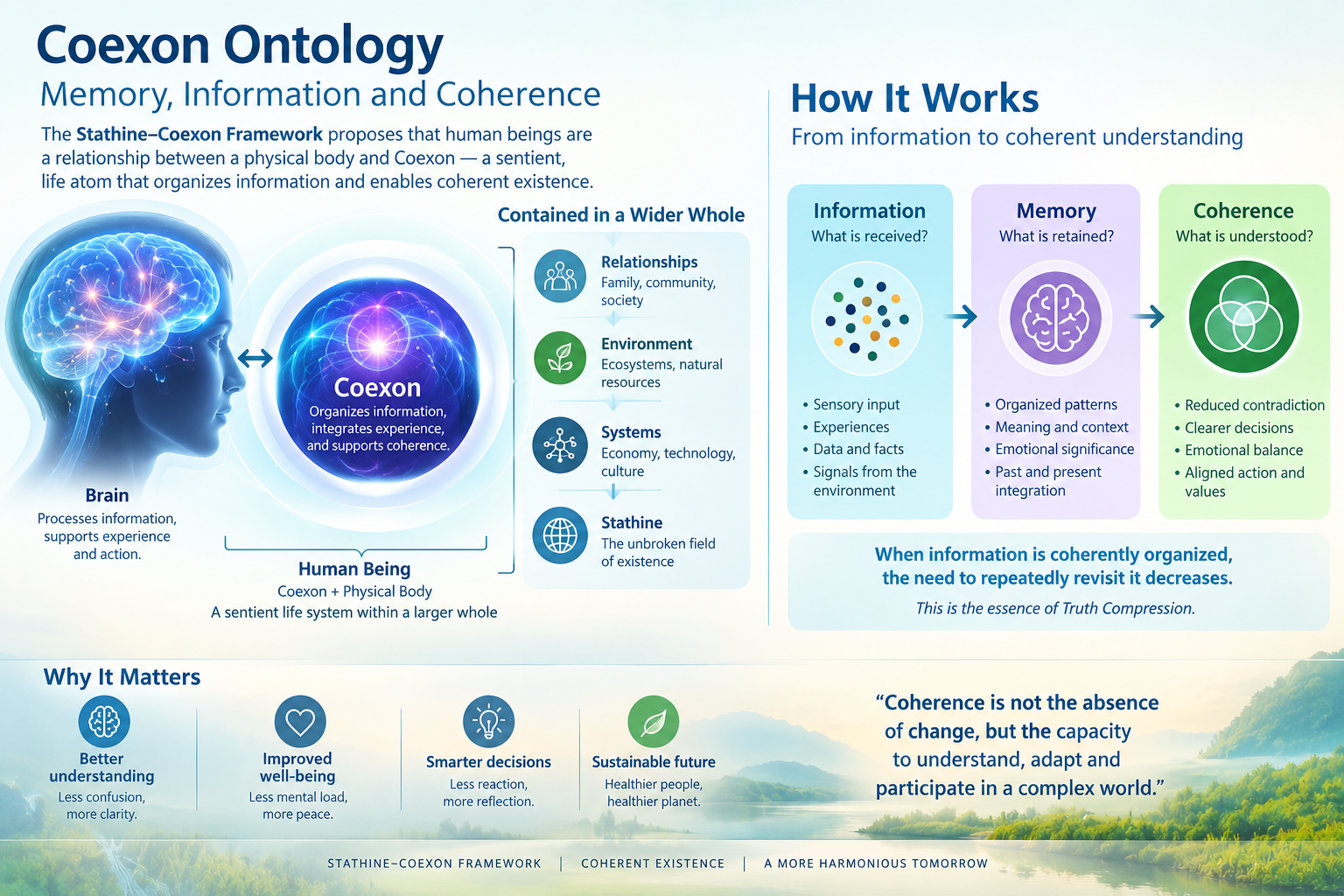
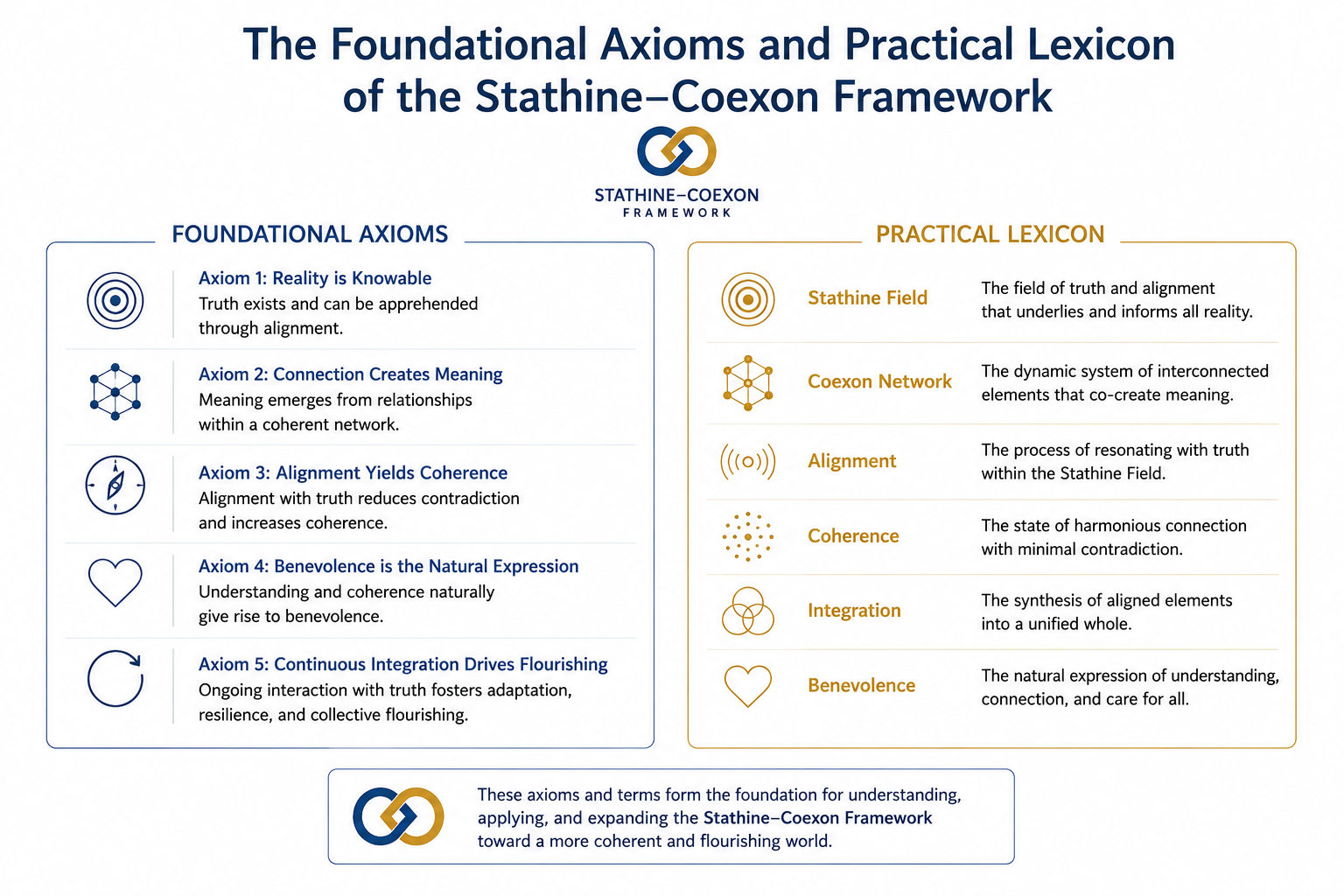
Its central proposition is that existence can be understood through two complementary conceptual dimensions:
Stathine — the proposed static, omnipresent field or foundational continuum from which energy and possibility are experientially understood.
Coexon — the proposed information-bearing, sentient life atom through which experience, understanding, evaluation, connection, and coherence are expressed as a living human body.
From this perspective, regeneration is not merely the replacement of damaged biological material.
It is:
the restoration and expansion of coherent relationships within a living system.
This creates a potentially powerful bridge between ecology and the broader Stathine–Coexon research programme.
2. An Important Clarification: Safina and “Regenesis”
There is a useful distinction to make at the outset.
George Monbiot’s Regenesis: Feeding the World Without Devouring the Planet is the work explicitly titled Regenesis. It addresses food production, agriculture, land use and ecological transformation.
Carl Safina is a different thinker: an ecologist, writer and conservationist whose work focuses extensively on oceans, wildlife, animal sentience, conservation and humanity’s relationship with the living world. (Yale E360)
However, the connection between Safina and regeneration is not artificial. Safina contributed a chapter, “Culture in Sentient Beings: Purpose, Evolution, Conservation,” to the 2024 volume Regenerative Farming and Sustainable Diets: Human, Animal and Planetary Health. (Carl Safina)
There is therefore a productive three-way conversation:
Safina → sentience, coexistence and ecological relationship
Monbiot → regenerative transformation of food and land systems
Stathine–Coexon → proposed coherence architecture connecting living systems, information and sentience
This article focuses primarily on Safina’s ecological and sentience perspective, while recognizing the wider regenerative context.
3. Safina’s Fundamental Challenge: Nature Is Not a Resource
One of the most significant implications of Safina’s work is the rejection of an exclusively anthropocentric valuation of nature.
The conventional economic model often begins with:
What can nature provide for humans?
Safina asks a more radical question:
What does the living world mean independently of what humans can extract from it?
His argument that wild nature is important to human dignity even where particular species are not directly necessary for human survival is especially significant. (Carl Safina)
This changes the philosophical architecture.
Nature is no longer merely:
input → production → consumption → waste.
Instead:
organism ↔ organism ↔ ecosystem ↔ human ↔ culture ↔ future.
This is very close to the Stathine–Coexon emphasis on coexistence.
The difference is that Safina arrives at the conclusion through ecological observation, conservation experience and engagement with animal life.
The Stathine–Coexon Framework explains the same insight into an multidimensional principles
No entity exists independently of the relationships through which its existence is sustained, expressed and understood.
4. From “Environment” to “Living System”
The word environment subtly places humans at the centre.
It implies:
Human being + surrounding environment.
Ecology tells us something more complicated.
The human organism itself is a biological system embedded in:
- microorganisms,
- food webs,
- atmospheric cycles,
- water systems,
- soils,
- plants,
- animals,
- communities,
- technologies,
- cultures,
- institutions.
The boundary between organism and environment is therefore useful but incomplete.
The Stathine–Coexon Framework proposes that the deeper unit of analysis should be:
relationship.
Instead of asking:
“Where does the organism end?”
we can ask:
“Which relationships make the organism possible?”
This reframing has enormous consequences for regenerative thinking.
5. Regeneration as Coherence Restoration
The conventional understanding of regeneration often focuses on restoring measurable ecological functions:
- soil fertility,
- biodiversity,
- carbon storage,
- water retention,
- habitat,
- nutrient cycling,
- ecosystem resilience.
All are important.
But Stathine–Coexon proposes an additional layer.
Ecological regeneration
Restoration of living processes.
Relational regeneration
Restoration of relationships among organisms.
Informational regeneration
Restoration of the quality and continuity of information flowing through a system.
Sentient regeneration
Restoration of the conditions in which organisms can express their biological and behavioral capacities.
Civilizational regeneration
Restoration of human systems so that they cease systematically degrading the ecological systems upon which they depend.
Thus:
Regeneration is not simply rebuilding components. It is rebuilding the relationships that allow the whole to remain viable.
This is where Safina’s work becomes particularly relevant.
6. The Sentience Dimension
Safina’s work on animal experience is crucial because it challenges another deeply embedded assumption:
Humans experience.
Animals react.
Modern behavioral and cognitive science increasingly complicates this distinction.
Safina’s work explores animal emotions, cognition, culture and subjective experience, including in books such as Beyond Words and Becoming Wild. His current work also examines how free-living animals experience life. (Carl Safina)
This creates an important bridge to the Coexon hypothesis.
The Stathine–Coexon Framework proposes, that sentience should not be treated exclusively as a late evolutionary accident produced by human brains.
Instead, it explores whether sentience might be understood as a more fundamental organizational property.
This is precisely where scientific epistemic limitations should be applied with care.
Safina’s evidence concerns observable animal behavior, cognition, communication and experience.
The Coexon hypothesis goes considerably further by proposing an underlying sentient informational entity.
The two should therefore not be treated as equivalent.
Rather:
Safina provides an empirical challenge to human exceptionalism; Coexon proposes a possible theoretical explanation for why sentience might be more widely distributed across living organization.
That extention will enrich and expedite the future research.
7. From Animal Intelligence to Distributed Intelligence
One of the most interesting consequences of Safina’s perspective is that intelligence becomes plural.
There is no single correct way to be intelligent.
An octopus does not need to think like a human.
A whale does not need language structured like ours.
A bird does not need a human brain to navigate complex environments.
A forest does not need a central controller to exhibit ecological organization.
This leads to a fundamental Stathine–Coexon proposition:
Intelligence should be investigated as an emergent property of organized relationships rather than defined exclusively by similarity to human cognition.
This connects naturally with research into:
- animal cognition,
- collective intelligence,
- swarm intelligence,
- plant signaling,
- microbial communication,
- embodied cognition,
- active inference,
- distributed cognition,
- ecosystem dynamics.
The Coexon concept can therefore be treated as a research hypothesis about information integration and sentience across scales, rather than as a conclusion.
8. The Ecosystem as a Coherence Network
Consider a coral reef.
It is not merely coral.
It contains:
- coral,
- algae,
- fish,
- bacteria,
- nutrients,
- currents,
- predators,
- prey,
- temperature,
- chemical gradients,
- geological structures.
The reef exists because relationships continuously organize these components.
Safina’s ecological work repeatedly emphasizes such interconnectedness. His conservation writing also stresses that ecological relationships and interdependencies provide a more comprehensive lens than treating species as isolated units. (Carl Safina)
The Stathine–Coexon interpretation would describe this as:
a dynamic network continually seeking viable coherence under changing conditions.
This does not mean that ecosystems consciously “seek” coherence in the human psychological sense.
Rather, it is a proposed systems-level description of how organization persists through feedback, adaptation, interdependence and selection.
9. Regeneration Is Not Returning to the Past
This distinction is particularly important.
Regeneration should not mean:
“Make nature exactly as it was 500 years ago.”
Ecological systems are dynamic.
Climate changes.
Species migrate.
Evolution continues.
Human populations change.
Technology changes.
Therefore regeneration must be understood dynamically.
Restoration asks:
What was there?
Regeneration asks:
What conditions allow life to flourish now and into the future?
The Stathine–Coexon framework adds:
What relationships need to become more coherent for flourishing to persist?
That is a fundamentally future-oriented definition.
10. From Sustainability to Regeneration
This distinction can be represented simply.
Extraction
Take more than the system can replace.
↓
Sustainability
Take no more than the system can replace.
↓
Restoration
Repair what has already been damaged.
↓
Regeneration
Increase the system’s capacity to renew, adapt and support life.
The Stathine–Coexon contribution is to add:
Regeneration should increase relational coherence, not merely resource stocks.
That means measuring not only:
- carbon,
- biodiversity,
- yield,
- soil,
but also:
- connectivity,
- resilience,
- diversity,
- reciprocity,
- information flow,
- adaptability,
- participation,
- and the quality of relationships among human and non-human actors which can not be measured.
This inclusion of non measurable factors is what is enriching to look at . This takes research beyond the limitation of epistemololgy and empirical data which are limited.
11. The Human Problem: Disconnection
Safina’s writings repeatedly return to the human relationship with the living world.
The Stathine–Coexon framework would interpret the ecological crisis partly as a failure of perceived relationship.
Humans increasingly experience themselves as:
consumers standing outside nature.
But biologically:
humans are nature.
Psychologically:
humans often experience separation.
Economically:
nature becomes externalized.
Politically:
ecological consequences become somebody else’s problem.
This creates a dangerous multi-level contradiction:
Biological dependence
versus
psychological separation
versus
economic externalization.
The resulting system can become extraordinarily efficient at destroying the conditions upon which it depends.
12. The Principle of Coexistence
This is where the synthesis becomes particularly powerful.
Safina explicitly identifies coexistence as something humanity struggles to prioritize, while arguing for a broader ecological understanding of living relationships. (Carl Safina)
The Stathine–Coexon Framework can elevate coexistence from an environmental policy preference to a fundamental design principle:
A system is more coherent when its components can flourish without systematically destroying the conditions required by other components.
This applies at multiple levels.
Individual
Body ↔ mind ↔ relationships.
Family
Individual ↔ family ↔ community.
Organization
Employee ↔ organization ↔ customer ↔ society.
Economy
Human prosperity ↔ ecological regeneration.
Civilization
Technology ↔ humanity ↔ biosphere.
Planet
Species ↔ ecosystems ↔ planetary processes.
The same principle repeats.
13. The Ethical Expansion
Safina’s work also raises a profound ethical question:
If other beings experience the world, what obligations follow?
The traditional ethical circle has often been:
me → family → tribe → nation → humanity.
Ecological consciousness expands it:
me → community → humanity → other animals → ecosystems → future generations.
The Stathine–Coexon concept of expanding coherence provides a philosophical vocabulary for this movement.
Ethical maturity becomes:
the ability to incorporate increasingly more of the system into one’s definition of self-interest.
This does not require abandoning human needs.
It requires recognizing that:
long-term human flourishing is embedded within flourishing ecological relationships.
14. The Economics of Regeneration
This perspective has direct economic implications.
Traditional economics frequently asks:
How much value can we extract?
Regenerative economics asks:
How much value can we create while increasing the capacity of the system to regenerate?
The Stathine–Coexon framework adds another question:
Does the economic activity increase or decrease coherence across the human–ecological system?
For example:
Regenerative agriculture
Not merely higher yield.
But:
soil + farmer + biodiversity + water + food + community + future.
Regenerative aquaculture
Not merely production.
But:
ocean health + livelihoods + biodiversity + nutrition.
Kelp-based regenerative systems provide an example of this kind of thinking: the Safina Center has highlighted regenerative kelp-and-shellfish farming as potentially benefiting coastal ecosystems while providing human food and other ecological benefits. (The Safina Center)
15. From “Saving Nature” to Participating in Nature
Perhaps the deepest philosophical shift is this:
We do not save nature from outside.
We participate in it.
A farmer is part of an ecosystem.
A fisherman is part of an ocean system.
A city is part of a watershed.
A corporation is part of a social and ecological system.
A human being is part of the biosphere.
Therefore the question becomes:
How do our actions participate in regeneration rather than degradation?
This turns environmentalism from an external responsibility into an existential one.
16. Safina + Stathine–Coexon: Complementary Strengths
Safina’s contributionStathine–Coexon complementEcological observationOntological synthesisAnimal sentienceProposed sentient organizationCoexistenceCoherenceEcological relationshipsInformation relationshipsConservationRegenerationHuman–nature relationshipHuman–existence relationshipEthical concern for other beingsExpansion of the circle of coherenceEmpathyRelational understandingBiodiversityDiversity as coherence capacityWildnessNon-human autonomyEcological evidenceCross-domain theoretical hypothesis
The important point is not that one replaces the other.
It is that:
Safina helps us see the living world more accurately; Stathine–Coexon attempts to provide a conceptual architecture for understanding what that expanded vision might imply.
17. A New Definition of Regeneration
The synthesis allows us to propose a broader definition:
Regeneration is the progressive restoration and expansion of the relationships, information flows, diversity, autonomy and adaptive capacities through which living systems maintain and renew coherent existence.
This definition contains several elements.
Restoration
Repair damage.
Expansion
Create new possibilities.
Relationship
Recognize interdependence.
Information
Preserve meaningful signals and feedback.
Diversity
Maintain multiple viable forms of organization.
Autonomy
Allow living entities to express their own capacities.
Adaptation
Permit systems to evolve rather than forcing static equilibrium.
Coherence
Enable the whole to remain viable without requiring uniformity.
18. Regeneration Does Not Mean Uniformity
This is one of the most important implications.
A coherent ecosystem is not an ecosystem where everything becomes identical.
Quite the opposite.
A rainforest is coherent because it contains enormous diversity.
Similarly, human society does not require identical beliefs.
The Stathine–Coexon principle can therefore be stated:
Coherence is not sameness.
Or:
The highest coherence may emerge from the intelligent coordination of difference.
This is also why biodiversity is not simply a collection of species.
It is a reservoir of alternative ways of responding to change.
19. The Regenerative Human
The framework can therefore move beyond regenerative agriculture toward the concept of the regenerative human.
A regenerative human asks:
Does my presence leave the systems around me more capable of flourishing?
At work:
Do I develop people or consume them?
In relationships:
Do I create trust or fear?
In business:
Do I create capability or dependency?
In nature:
Do I restore or extract?
In knowledge:
Do I reduce confusion or amplify misinformation?
In society:
Do I increase polarization or understanding?
This makes regeneration a way of living rather than merely an environmental technique.
20. A Proposed Regenerative Coherence Cycle
The combined framework can be represented as:
Observe
↓
Understand
↓
Recognize relationship
↓
Identify contradiction
↓
Reduce destructive contradiction
↓
Restore feedback
↓
Increase diversity and capability
↓
Create new coherence
↓
Monitor consequences
↓
Adapt
↓
Regenerate
This cycle is compatible with scientific inquiry because it is iterative rather than dogmatic.
It also fits ecological reality because ecosystems themselves operate through feedback and adaptation rather than fixed plans.
21. What Safina Adds That the Coexon Must Never Lose
There is also an important caution.
A theoretical framework such as Stathine–Coexon explains abstraact in a way common people can understand.It cuts away the acadamic jargon of the philosophers and the academia.
Safina’s work provides an essential corrective:
Stay close to living beings.
Look at the whale.
Look at the owl.
Look at the reef.
Look at the fishery.
Look at the farmer.
Look at the forest.
Look at the actual consequences of intervention.
The theory must return to observation.
Otherwise “coherence” can become another abstract word imposed upon reality.
Therefore:
The living world must remain the laboratory against which the theory is tested.
22. What Stathine–Coexon Adds to Regenerative Thought
Conversely, regenerative practice can sometimes remain fragmented.
One person works on soil.
Another on biodiversity.
Another on climate.
Another on animal welfare.
Another on economics.
Another on human psychology.
The Stathine–Coexon framework asks:
What if these are not separate problems but different expressions of relational incoherence?
Then:
soil degradation,
biodiversity loss,
animal suffering,
human alienation,
economic extraction,
climate instability,
and social fragmentation
can be investigated as interconnected manifestations of systems that have optimized parts while degrading relationships among the parts.
This is perhaps the most promising research proposition emerging from the comparison.
23. Toward a Science of Regenerative Coherence
A future research programme could therefore investigate measurable relationships among:
biodiversity
ecosystem resilience
information flow
animal behavior
human well-being
economic incentives
social trust
resource regeneration
network connectivity
adaptive capacity
and
long-term system stability.
The question would not be:
“Can we prove the Coexon exists?”
as the first empirical question.
A more scientifically productive starting point would be:
Can coherence-based models explain patterns of regeneration that existing fragmented models explain less effectively?
That is the path ahead fo rhumanity.
24. A Research Hypothesis
The framework could formulate the following preliminary hypothesis:
Systems that preserve diverse, reciprocal and information-rich relationships will generally exhibit greater regenerative capacity than systems optimized primarily for short-term extraction from isolated components.
This hypothesis can be studied by understanding the metaphysical truth of Stathine or Coexon.
It can be examined through:
- ecological networks,
- agricultural systems,
- fisheries,
- organizations,
- communities,
- supply chains,
- and eventually computational simulations.
If the hypothesis consistently generates predictive value, the broader framework stops focusing on teh empirical data and epistomology restrictive practices.
25. Conclusion: From Regeneration to Coexistence
Carl Safina’s ecological vision provides one of the most compelling contemporary reminders that humanity does not exist alone.
Other beings perceive.
Other beings adapt.
Other beings communicate.
Other beings form relationships.
Other beings have their own evolutionary histories and ways of experiencing existence.
And ecosystems are not collections of resources waiting for human management.
They are living networks.
Safina’s work brings us toward a moral and ecological recognition:
The living world has value beyond what humans can extract from it.
The Stathine–Coexon Framework can complement this insight by asking a deeper theoretical question:
What if the fundamental problem is not merely that humanity is destroying nature, but that humanity has organized itself around increasingly incoherent relationships with the larger system of which it is a part?
From that perspective, regeneration becomes more than ecological repair.
It becomes a civilizational movement:
from extraction → relationship
from control → participation
from fragmentation → integration
from utility → intrinsic value
from domination → coexistence
from short-term optimization → long-term coherence
And ultimately:
Regeneration is what happens when a system stops consuming the conditions of its own existence and begins participating in their renewal.
This is where Carl Safina’s ecological and ethical vision and the Stathine–Coexon Framework meet most naturally.
Safina gives us a richer appreciation of who and what exists within the living world.
The Stathine–Coexon framework proposes a language for asking how those relationships might become increasingly coherent.
Neither perspective needs to replace the other.
The scientific opportunity lies precisely in their complementarity:
Observe life carefully. Respect its autonomy. Understand its relationships. Reduce destructive contradictions. Restore feedback. Expand the capacity for coexistence. And test every theoretical claim against the living world.
That could become the foundation of a genuinely regenerative science of coexistence.