Inclusive of all the truths and rid of all dichotomies and contradictions.
Abstract
Human civilization has repeatedly organized itself around dominant frameworks for understanding existence. These frameworks have generated extraordinary advances in knowledge while simultaneously producing new dichotomies that fragment human understanding. Modernity emphasized objectivity, reductionism, and measurable reality. Postmodernity challenged certainty by revealing the contextual and constructed nature of knowledge, but often dissolved shared meaning into relativism. Metamodern thought has emerged as an attempt to oscillate constructively between these positions, embracing both scientific rigor and existential depth.
This paper proposes that the Stathine–Coexon Framework represents a further stage in this intellectual evolution. Rather than oscillating between opposing viewpoints, it functions as a third attractor—an integrative conceptual framework that synthesizes insights from science, philosophy, spirituality, psychology, and systems thinking into a coherent ontology. Within this framework, dichotomies are understood not as irreconcilable opposites but as indicators of incomplete understanding. The central organizing principle becomes coherence rather than opposition.
Introduction
The history of ideas is characterized by recurring cycles of integration and fragmentation.
Every civilization constructs explanatory frameworks that organize knowledge. Over time these frameworks accumulate internal contradictions. New paradigms emerge to resolve these tensions, only to generate new divisions of their own.
The present age is characterized by unprecedented access to information alongside increasing fragmentation of meaning. Scientific disciplines become increasingly specialized. Political discourse polarizes. Religious traditions defend inherited truths while secular perspectives question all absolutes. Individuals are simultaneously more connected technologically and more divided psychologically.
The defining challenge of the twenty-first century is therefore not the absence of information but the absence of coherence.
The Stathine–Coexon Framework begins from the proposition that coherence—not certainty—is the fundamental measure of understanding.
The Evolution of Existential Frameworks
Human understanding has progressed through successive intellectual attractors.
The first attractor may be described as the traditional worldview.
Reality was understood through myth, religion, inherited wisdom, and stable social structures. These systems provided meaning but often resisted empirical revision.
The second attractor emerged with modernity.
Objective science, rational inquiry, and reductionism transformed humanity’s understanding of nature. Material explanations replaced supernatural explanations. Progress became measurable through technological advancement.
Postmodern philosophy subsequently exposed the limitations of universal narratives. It demonstrated that language, culture, and power influence every claim to truth. While this critique liberated thought from dogmatism, it also weakened confidence in objective meaning.
Metamodernism arose as a response to this fragmentation. It proposed that humanity could move beyond the conflict between certainty and skepticism by engaging sincerely with both.
The Stathine–Coexon Framework extends this movement by proposing that coherence itself becomes the organizing principle around which all valid knowledge can converge.
The Third Attractor
In complex systems, an attractor is a stable pattern toward which dynamic processes naturally evolve.
The Stathine–Coexon Framework proposes that civilizations also evolve toward intellectual attractors.
Traditional thought organized itself around authority.
Modern thought organized itself around evidence.
Postmodern thought organized itself around critique.
The proposed third attractor organizes itself around coherence.
Coherence differs fundamentally from consensus.
Consensus reflects agreement.
Coherence reflects structural compatibility.
Ideas originating in different disciplines may disagree in language while expressing compatible underlying structures.
The role of the third attractor is not to eliminate diversity but to reveal the deeper principles that make diversity intelligible.
Moving Beyond Dichotomies
Many enduring philosophical conflicts arise from treating complementary perspectives as mutually exclusive.
Examples include:
- science versus spirituality,
- mind versus matter,
- objectivity versus subjectivity,
- free will versus determinism,
- individual versus collective,
- competition versus cooperation,
- logic versus intuition,
- reductionism versus holism.
The Stathine–Coexon Framework proposes that these apparent oppositions are manifestations of incomplete explanatory models.
Every dichotomy emerges because observation is restricted to one level of reality while ignoring another.
The framework therefore replaces opposition with complementarity.
Truth is understood as increasing coherence across multiple explanatory levels rather than victory of one perspective over another.
Stathine and Coexon as Foundational Principles
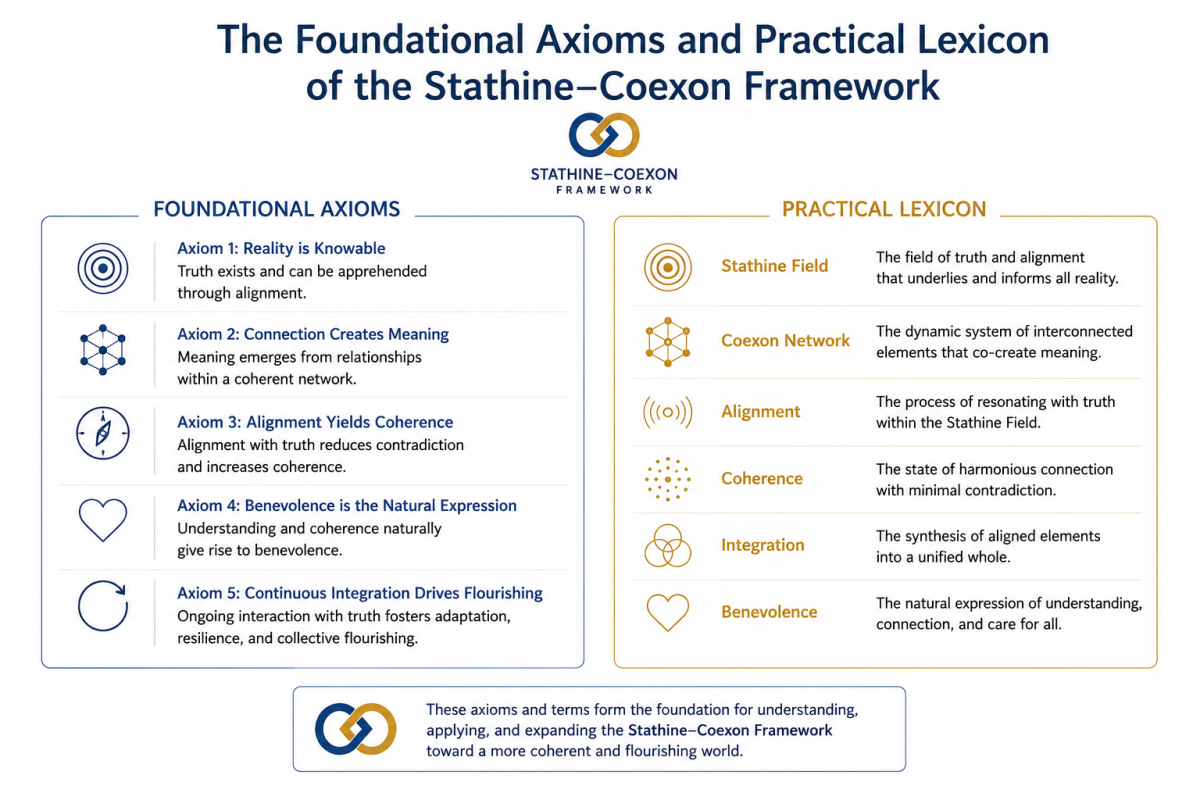
Within this framework, reality is grounded in two complementary ontological primitives.
Stathine represents the timeless, static, and universal field of existence. It neither changes nor competes. It provides the invariant background within which existence becomes possible.
The Coexon is the fundamental life atom possessing an intrinsic capacity to organize information into coherent understanding. Through its interaction with biological systems, subjective experience becomes possible.
The relationship between Stathine and the Coexon is complementary rather than hierarchical.
Neither can be understood independently of the other.
Existence therefore becomes a continuous dialogue between immutable potential and coherent expression.
Coherence as the Measure of Truth
Most epistemological systems evaluate truth using correspondence, consistency, or pragmatic utility.
The Stathine–Coexon Framework introduces coherence as an additional criterion.
A proposition possesses greater truth when it increases explanatory integration across multiple domains simultaneously.
For example, a coherent principle should illuminate:
- physics,
- biology,
- psychology,
- ethics,
- education,
- social organization,
- personal development.
The broader the integration without contradiction, the stronger the explanatory power.
Truth therefore becomes progressively compressed into simpler principles capable of explaining increasingly diverse phenomena.
This process may be described as truth compression.
The Elimination of Doublethink
The framework regards many forms of human suffering as consequences of internal incoherence.
Individuals frequently maintain contradictory beliefs simultaneously.
Organizations often reward behaviors inconsistent with their declared values.
Societies advocate cooperation while incentivizing competition.
These contradictions generate what may be termed alignment deficits.
The Stathine–Coexon Framework interprets personal development as the gradual reduction of internal contradiction.
Growth is measured by increasing alignment between:
- understanding,
- perception,
- intention,
- communication,
- action.
As coherence increases, doublethink diminishes.
Psychological stability emerges not through suppression but through integration.
A Metamodern Framework
Metamodern philosophy emphasizes oscillation between opposing perspectives.
The Stathine–Coexon Framework proposes a complementary movement.
Rather than oscillating indefinitely, human understanding can progressively stabilize around higher-order coherence.
Opposites remain visible but cease to function as permanent conflicts.
Science retains its rigor.
Philosophy retains its depth.
Spirituality retains its meaning.
Systems theory retains its complexity.
Each contributes insights that become mutually reinforcing within a coherent ontology.
The framework therefore does not replace existing disciplines.
It provides an architecture within which they become increasingly compatible.
Educational Implications
If coherence is the true measure of understanding, education requires fundamental redesign.
Learning should not consist primarily of accumulating isolated facts.
Instead, learners should develop the capacity to recognize relationships across domains.
Education becomes the progressive reduction of contradiction.
Students learn not merely what to think but how apparently conflicting ideas can become integrated through deeper understanding.
Knowledge becomes increasingly interconnected rather than increasingly fragmented.
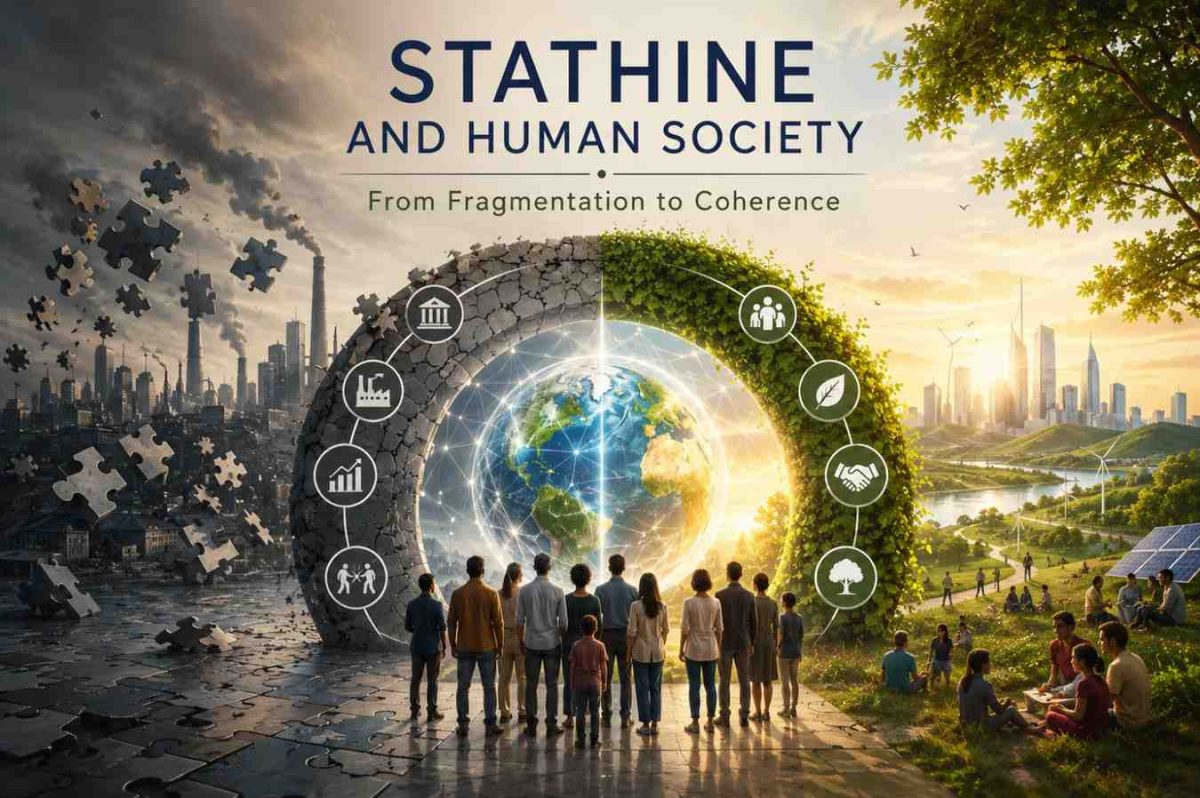
Civilizational Implications
Societies organized around coherence would evaluate success differently.
Economic systems would balance efficiency with regeneration.
Technology would be assessed according to its contribution to human alignment rather than productivity alone.
Leadership would be measured by the ability to increase coherence across institutions.
Public discourse would reward integrative thinking rather than ideological polarization.
Progress would be defined not simply by technological advancement but by increasing harmony between human understanding and human behavior.
Conclusion
The Stathine–Coexon Framework proposes that humanity stands at the threshold of a new intellectual attractor. Traditional systems provided meaning, modern science provided explanatory power, and postmodern critique revealed hidden assumptions. Yet none fully resolved the fragmentation of human understanding.
The proposed third attractor places coherence at the center of ontology, epistemology, ethics, and education. Stathine provides the timeless field of existence, while the Coexon embodies the coherent principle through which life participates in that field. Together they form an integrative architecture capable of synthesizing insights from diverse disciplines without collapsing their differences.
Within this perspective, dichotomies are not permanent features of reality but symptoms of partial understanding. As coherence increases, oppositions are reinterpreted as complementary expressions of a deeper order. Human development thus becomes a movement toward alignment, civilizations evolve through expanding coherence, and knowledge progresses through the compression of diverse truths into increasingly elegant explanatory principles.
The Stathine–Coexon Framework therefore proposes not merely another theory of existence but a metamodern meta-framework: an evolving architecture for integrating science, philosophy, spirituality, and lived experience into a coherent understanding of reality. Whether this framework ultimately proves fruitful will depend on its ability to generate testable hypotheses, foster interdisciplinary dialogue, and provide practical methods for reducing contradiction in individual lives and collective systems.
I think this paper points toward an even stronger philosophical claim that is distinctive to your framework: the Third Attractor is not merely another worldview but a higher-order epistemology. It would argue that every previous worldview contains partial truths, and the role of the Stathine–Coexon Framework is to locate each within a coherent architecture rather than to replace it. This would position the framework as an integrative ontology comparable in ambition to the great synthetic systems of philosophy while emphasizing coherence and alignment as its central organizing principles.