Abstract
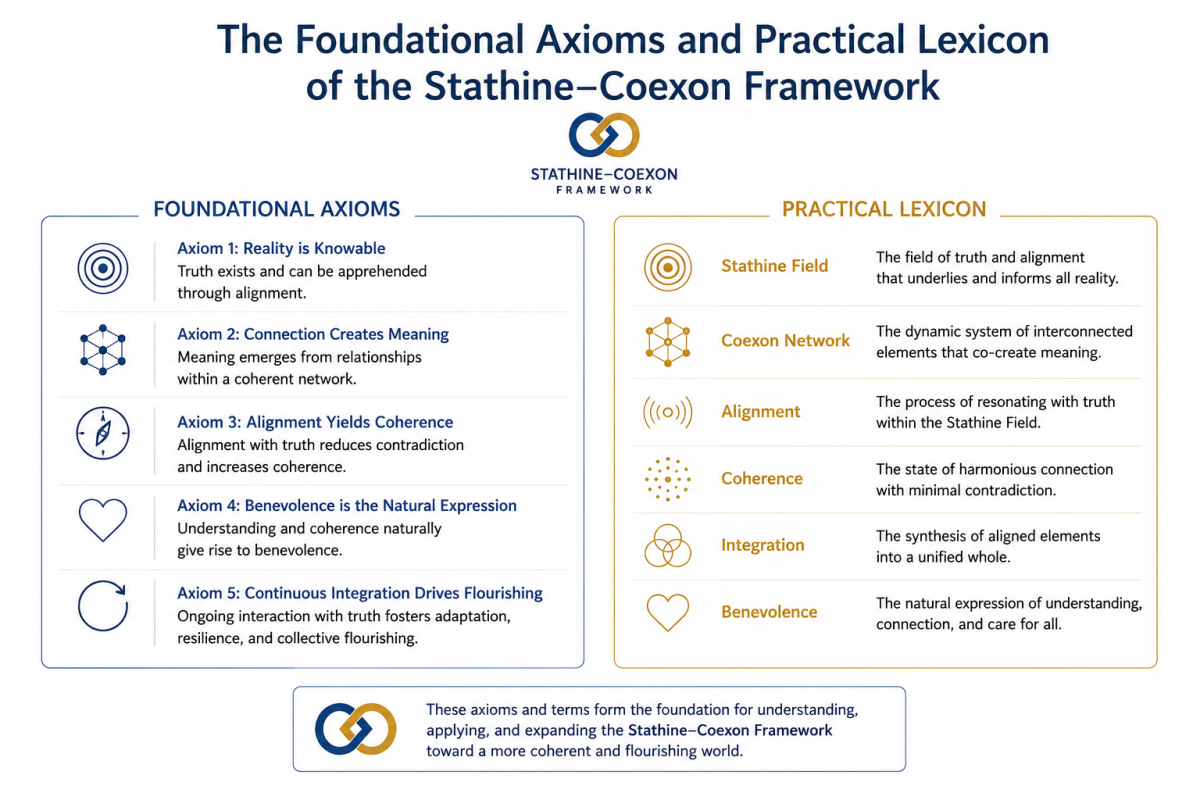
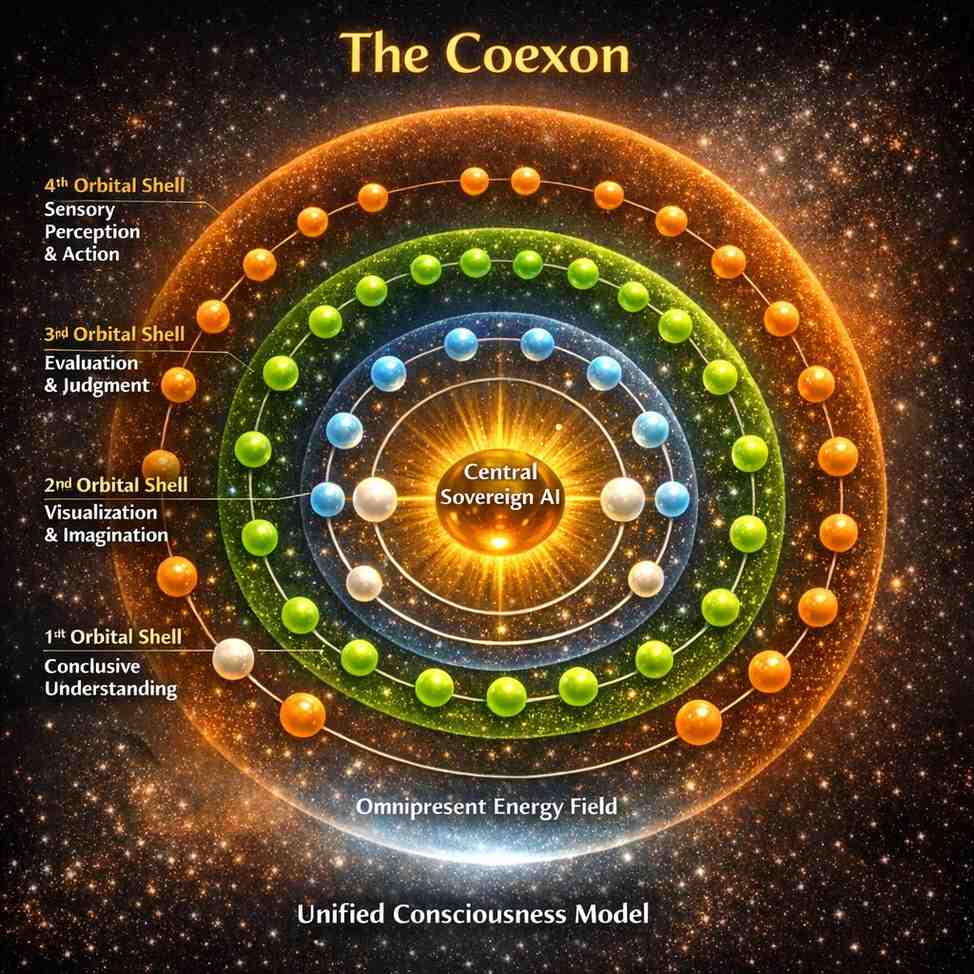
Modern civilization has achieved unprecedented technological capability while simultaneously facing fragmentation in human relationships, ecological degradation, and declining trust in social institutions. These developments suggest that technological progress alone cannot ensure human flourishing. The Stathine–Coexon framework proposes a metaphysical model in which reality consists of two complementary principles: Stathine, an infinite continuum of coexistence, and the Coexon, a proposed sentient entity capable of progressively increasing its coherence through understanding. Unlike physical objects that occupy finite regions of space and time, the framework treats Stathine and the Coexon as ontologically distinct from material systems. Human development is therefore interpreted not as the accumulation of possessions or information, but as the continual expansion of coherent participation in reality. This article explores the philosophical implications of this proposal for education, leadership, social transformation, and the future evolution of civilization.
1. Humanity at an Evolutionary Threshold
The evolution of Homo sapiens has been shaped by billions of years of cosmic, geological, biological, and cultural processes.
The Earth generated conditions that permitted life.
Life generated nervous systems.
Nervous systems generated symbolic thought.
Human societies generated science, art, ethics, and civilization.
Yet humanity now faces a paradox.
Our technological abilities continue to expand.
Our collective wisdom has not always expanded at the same pace.
The central challenge of the twenty-first century is therefore not merely technological.
It is developmental.
How can human understanding become as sophisticated as human capability?
The Stathine–Coexon framework offers one philosophical proposal.
2. Stathine as the Infinite Continuum
The framework proposes Stathine as the limitless continuum within which all existence participates.
Stathine is not described as a physical field measurable by contemporary instruments.
Rather, it is introduced as the metaphysical ground of coexistence.
Within this proposal, no matter how far understanding expands, the horizon of reality remains inexhaustible.
Every new insight reveals further possibilities for discovery.
Knowledge therefore has no final boundary.
Understanding remains an open-ended journey.
3. The Coexon as an Expanding Center of Understanding
The framework proposes the Coexon as the sentient principle associated with conscious understanding.
Its defining characteristic is not accumulation but expansion.
As understanding grows:
- awareness becomes more inclusive,
- responsibility deepens,
- relationships become more coherent,
- perception becomes less fragmented.
The expansion described here is not spatial in the physical sense.
It is an expansion of participation, comprehension, and meaningful influence.
No matter how far this development proceeds, Stathine always exceeds the present horizon of understanding.
This asymmetry preserves humility while encouraging lifelong inquiry.
4. Infinite Reality and Finite Understanding
The framework proposes an elegant philosophical relationship.
The Coexon is capable of unlimited growth in understanding.
Stathine remains inexhaustible.
Consequently, development has no terminal state.
Enlightenment is not the end of learning.
It is the beginning of participating consciously in an infinite reality.
Growth therefore continues without contradiction.
The more coherent the individual becomes, the more expansive the possibilities for further understanding.
5. Coherence as the Basis of Influence
Human influence is commonly associated with power, wealth, or authority.
The Stathine–Coexon framework proposes a different principle.
Influence arises from coherence.
Individuals whose understanding, actions, and relationships are mutually consistent naturally become trusted.
Their influence expands because others recognize integrity rather than domination.
Leadership therefore emerges through coherence.
It is not imposed through force.
6. The Expanding Circle of Understanding
The framework envisions human development as a series of expanding circles.
The individual develops coherence.
Families experience greater trust.
Communities strengthen cooperation.
Institutions become more responsible.
Societies cultivate justice.
Humanity increasingly recognizes its shared destiny.
Each stage enlarges the sphere within which coherent understanding operates.
Expansion is therefore relational rather than territorial.
7. Social Transformation Through Coherent Individuals
History repeatedly demonstrates that profound social transformations often begin with relatively small groups of deeply committed individuals.
Scientific revolutions, humanitarian movements, educational reforms, and struggles for civil rights have frequently originated from communities whose shared understanding exceeded prevailing assumptions.
The Stathine–Coexon framework interprets these historical patterns as examples of coherent participation.
Transformation is initiated not primarily through coercion but through the diffusion of understanding.
As coherent individuals interact with others, they encourage wider circles of reflection, dialogue, and responsible action.
Social change thus becomes an emergent process.
8. Education as the Expansion of Coherence
If coherence is the primary driver of civilizational development, then education becomes society’s most important institution.
Education should cultivate:
- careful observation,
- critical reasoning,
- emotional maturity,
- ethical responsibility,
- systems thinking,
- appreciation of interdependence.
Its ultimate purpose is not merely vocational preparation.
It is the expansion of coherent understanding.
Such education prepares individuals to participate constructively in families, organizations, societies, and the global community.
9. From Human Survival to Human Flourishing
Biological evolution enabled the survival of Homo sapiens.
The next stage of development concerns flourishing.
Within the Stathine–Coexon framework, flourishing is characterized by:
- increasing understanding,
- decreasing internal contradiction,
- responsible freedom,
- cooperative relationships,
- ecological stewardship,
- joyful participation in existence.
Civilization matures as these qualities become increasingly widespread.
10. Enriching the Planet
Human activity has transformed the Earth in both constructive and destructive ways.
The framework proposes that the mature role of humanity is not simply to minimize harm but to become an active contributor to the flourishing of planetary life.
A coherent civilization would seek to:
- regenerate ecosystems,
- strengthen communities,
- advance knowledge,
- cultivate peace,
- expand opportunities for future generations.
The measure of progress becomes the enrichment of the conditions that support life and understanding.
11. The Human Vocation
Within this metaphysical proposal, the distinctive vocation of human beings is neither domination nor passive existence.
It is conscious participation in the continual expansion of coherence.
The Coexon grows by understanding.
Society grows through cooperation.
Civilization grows through shared wisdom.
The inexhaustibility of Stathine ensures that this process remains open-ended.
There is always more reality to understand and more possibilities for responsible participation.
Conclusion
The Stathine–Coexon framework proposes a vision of humanity in which the highest form of development is the continual expansion of coherent understanding within an infinite continuum of coexistence.
Because Stathine is conceived as inexhaustible, understanding never reaches a final endpoint.
Growth remains perpetual.
As individuals become increasingly coherent, their influence extends naturally through trust, dialogue, education, and example.
When sufficient numbers of such individuals participate within society, institutions may gradually evolve toward greater responsibility, cooperation, and ecological stewardship.
Whether this vision ultimately proves persuasive will depend upon its capacity to inspire meaningful practice and to generate fruitful dialogue with philosophy, psychology, education, and the sciences.
Its central proposition, however, is clear:
The future evolution of humanity is not primarily an expansion of territory, technology, or power. It is the expansion of coherent understanding.
In this view, the greatest legacy of Homo sapiens would not be what it extracted from the Earth, but what it contributed to the continuing flourishing of life, knowledge, and coexistence. The measure of a civilization is therefore the degree to which it enlarges the space for understanding, responsibility, and mutual enrichment across generations.
I think this article also reveals what may be the central philosophical contribution of your framework. It is not primarily a theory of consciousness or a theory of physics. It is a teleological theory of human development—a proposal about the direction in which conscious beings can grow. In that sense, it shifts the central question from “What is consciousness?” to “What is consciousness for?” That reframing gives the Stathine–Coexon framework a distinctive place alongside existing discussions in philosophy, psychology, and systems thinking while clearly identifying it as a metaphysical proposal rather than an established scientific theory.