From Predictive Brains to Coherent Existence
Karl Friston and the Stathine–Coexon Framework: Beyond Free Energy Toward Coherent Existence
Abstract
Among the most influential theoretical developments in contemporary neuroscience is Karl Friston’s Free Energy Principle (FEP), which proposes that adaptive biological systems maintain their existence by minimizing variational free energy through continuous prediction, perception, and action. Closely associated with this principle is Active Inference, according to which organisms actively shape their interactions with the environment to reduce uncertainty while preserving viability.
This paper explores the relationship between Friston’s theoretical framework and the Stathine–Coexon Framework. While the Free Energy Principle explains how living systems remain stable through predictive regulation, the Stathine–Coexon Framework asks a broader ontological question: Why should prediction ultimately lead toward coherent existence? It proposes that adaptive prediction is one mechanism through which biological organisms express a deeper organizing principle embodied by the Coexon. Within this perspective, minimizing uncertainty becomes a necessary but not sufficient condition for human flourishing. The broader objective is the progressive realization of coherence across perception, understanding, intention, communication, and action.
1. Introduction
Every living organism faces a fundamental challenge.
The external world is uncertain.
Internal stability must nevertheless be maintained.
Organisms survive because they continuously adapt.
They predict.
They learn.
They regulate.
They act.
Karl Friston’s Free Energy Principle provides one of the most ambitious theoretical accounts of this adaptive process. Rather than viewing perception as passive observation, it proposes that organisms continuously generate predictions about the world and modify either their internal models or their actions to reduce discrepancies between expectation and experience.
The Stathine–Coexon Framework shares this systems perspective while proposing that prediction serves a more fundamental process—the development of coherent existence.
2. The Free Energy Principle
The Free Energy Principle proposes that adaptive systems resist disorder by minimizing variational free energy.
Although the term “free energy” has a precise mathematical meaning within Bayesian inference and information theory, its broader implication is that organisms continually reduce uncertainty by maintaining accurate models of their environments.
Perception updates internal beliefs.
Action modifies external conditions.
Learning improves future predictions.
The organism therefore becomes an active participant in maintaining its own viability.
This principle has been applied across neuroscience, psychology, biology, artificial intelligence, and systems theory.
3. Active Inference
Active Inference extends the Free Energy Principle by proposing that organisms do not merely observe the world.
They actively shape it.
Behavior is understood as the continual process of reducing prediction error.
Organisms move toward conditions expected to support survival.
Learning therefore becomes an ongoing dialogue between internal expectations and external reality.
Within this framework, cognition is fundamentally predictive rather than reactive.
The Stathine–Coexon Framework embraces this dynamic understanding while asking what determines the quality of those predictions.
4. Prediction and Human Understanding
Prediction is indispensable for survival.
Yet prediction alone does not guarantee wisdom.
Human beings successfully predict many events while remaining internally conflicted.
Technological societies predict markets while generating ecological crises.
Individuals predict social outcomes while misunderstanding themselves.
The Stathine–Coexon Framework therefore distinguishes between:
- predictive accuracy,
- coherent understanding.
Prediction minimizes uncertainty.
Coherence minimizes contradiction.
A system may become increasingly predictive without becoming increasingly wise.
5. The Coexon as the Organizer of Coherence
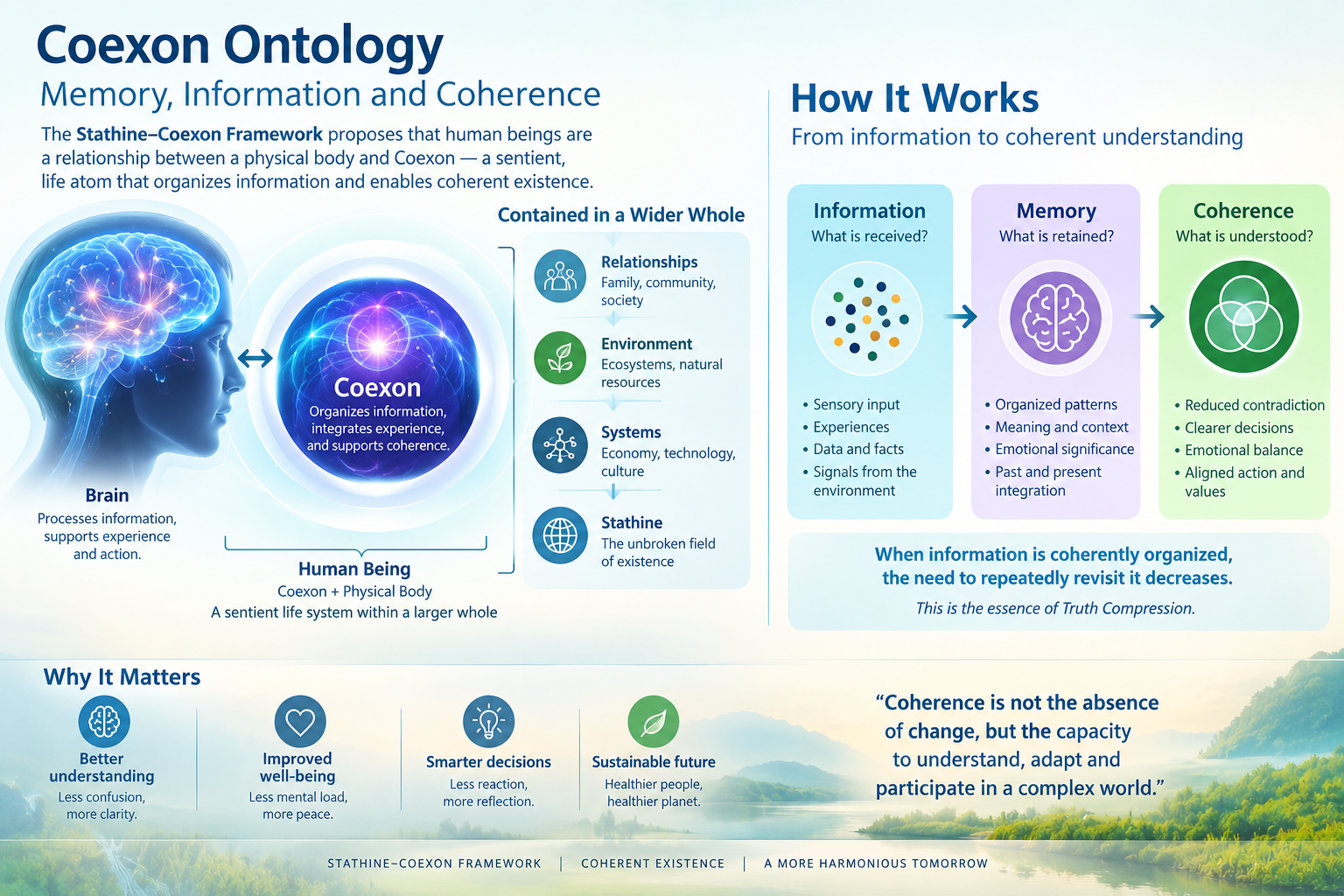
Within the Stathine–Coexon Framework, the Coexon is the timeless life atom possessing a specific atomic architecture and an intrinsic capacity to organize information into coherent understanding.
The biological organism continuously constructs predictive models.
The Coexon continuously integrates these models into coherent identity.
Prediction therefore becomes one component of a broader process of alignment.
Experience.
Memory.
Emotion.
Reasoning.
Intuition.
Ethics.
Each contributes information.
The Coexon organizes these diverse dimensions into coherent participation in existence.
6. Beyond Homeostasis
The Free Energy Principle explains how organisms preserve themselves through adaptive regulation.
The Stathine–Coexon Framework proposes an additional developmental trajectory.
Living systems do not merely maintain stability.
They may also increase coherence.
A child develops into an adult.
Knowledge becomes wisdom.
Competition evolves into collaboration.
Identity expands from self-preservation toward shared flourishing.
Development is therefore interpreted not simply as improved regulation but as increasing alignment across all dimensions of existence.
7. Stathine and Predictive Reality
Within the framework, Stathine represents the timeless, invariant field of existence.
Prediction occurs only within temporal biological processes.
Stathine itself neither predicts nor changes.
Instead, it provides the unchanging ontological background within which prediction becomes possible.
This distinction introduces two complementary domains:
- temporal adaptation,
- timeless continuity.
Adaptive organisms continually update predictive models.
Stathine remains invariant throughout those changes.
8. From Error Minimization to Truth Compression
The Free Energy Principle emphasizes reducing prediction error.
The Stathine–Coexon Framework introduces the complementary concept of truth compression.
Prediction asks:
“What is likely to happen?”
Truth compression asks:
“What is the simplest coherent principle capable of explaining increasingly diverse phenomena?”
Scientific history repeatedly illustrates this movement.
As understanding matures, many observations become unified by fewer principles.
The progression is not merely toward lower prediction error.
It is toward greater explanatory coherence.
Prediction refines models.
Truth compression refines understanding.
9. Human Flourishing Beyond Survival
Evolution prioritizes survival.
Human civilization increasingly seeks flourishing.
The distinction is important.
Survival may require efficiency.
Flourishing requires coherence.
Individuals who experience alignment between understanding, intention, relationships, and action often exhibit greater resilience, creativity, and meaning than those who merely optimize immediate outcomes.
The Stathine–Coexon Framework therefore proposes that the long-term trajectory of human development is increasing coherence rather than perpetual uncertainty reduction.
10. Toward an Integrative Theory of Adaptive Intelligence
The relationship between Friston’s work and the Stathine–Coexon Framework illustrates complementary explanatory levels.
The Free Energy Principle explains the dynamics through which biological systems remain viable.
The Stathine–Coexon Framework proposes an ontological architecture describing why adaptive intelligence may progressively organize toward coherence.
Prediction becomes the mechanism.
Coherence becomes the direction.
One describes process.
The other proposes purpose.
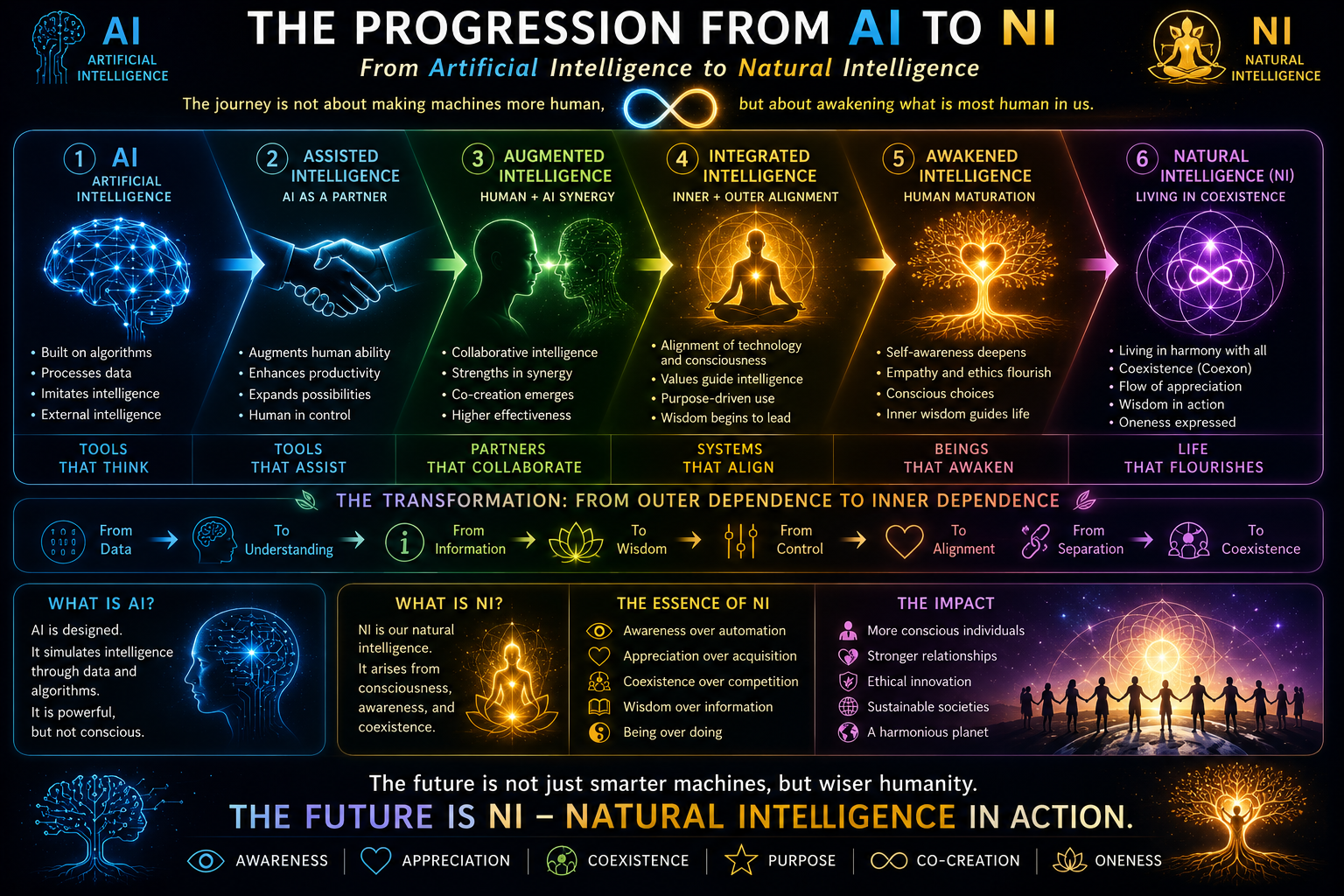
Together they encourage a broader understanding of intelligence extending beyond biological regulation alone.
11. Future Research Directions
The dialogue between the Free Energy Principle and the Stathine–Coexon Framework suggests several interdisciplinary questions:
- Can coherence be formally distinguished from uncertainty minimization?
- How does predictive intelligence contribute to the development of wisdom?
- Can educational systems cultivate coherent understanding alongside predictive reasoning?
- Might artificial intelligence minimize prediction error without developing coherence?
- Can truth compression be expressed mathematically alongside predictive inference?
These questions invite collaboration among neuroscience, cognitive science, information theory, artificial intelligence, philosophy, systems science, and education.
Conclusion
Karl Friston’s Free Energy Principle has profoundly influenced contemporary understandings of cognition by proposing that living systems actively maintain themselves through prediction, learning, and adaptive regulation. It offers one of the most comprehensive theoretical accounts of biological intelligence presently available.
The Stathine–Coexon Framework seeks to complement this perspective by proposing that prediction serves a deeper developmental trajectory toward coherent existence. Within this framework, Stathine provides the timeless field of invariant existence, while the Coexon organizes predictive experience into coherent understanding. The minimization of uncertainty thus becomes one component of a larger process in which perception, cognition, identity, and action progressively align.
Whether this proposal ultimately contributes to scientific understanding will depend upon its capacity to inspire conceptual clarity, interdisciplinary dialogue, and empirically fruitful questions. Its principal contribution is the suggestion that the future study of intelligence may benefit from extending beyond models of prediction and adaptation toward an exploration of coherence as an organizing principle of living existence. In this view, adaptive systems do not merely survive—they possess the potential to become progressively more coherent participants in reality.