From Morphic Resonance to Timeless Coherence
Rupert Sheldrake and the Stathine–Coexon Framework: Morphic Fields and the Static Field of Stathine
Abstract
Modern biology has traditionally explained development through genetics, chemistry, and natural selection. Yet questions remain concerning the remarkable consistency of biological form, regeneration, collective behavior, and the persistence of organization across generations. Rupert Sheldrake proposed the hypothesis of morphic resonance, suggesting that living systems inherit organizing influences from previous similar systems through morphic fields. Although controversial and not accepted as established scientific theory, this proposal has stimulated enduring discussions regarding memory, form, and biological organization.
This paper explores the conceptual relationship between morphic resonance and the Stathine–Coexon Framework. While morphic resonance proposes dynamic informational fields associated with developing systems, the Stathine–Coexon Framework introduces Stathine as a timeless, invariant field of existence and the Coexon as the timeless life atom that organizes coherent understanding. The framework proposes that biological development reflects the interaction between temporal biological processes and timeless coherence rather than inherited resonance alone. Rather than viewing these perspectives as competing explanations, this paper considers whether they illuminate different dimensions of biological organization.
1. Introduction
Living systems exhibit extraordinary regularity.
Embryos reliably develop into mature organisms.
Species maintain recognizable forms across generations.
Damaged tissues often regenerate.
Collective organisms coordinate without centralized control.
These observations have inspired scientists and philosophers alike to ask whether development depends solely upon genes and chemistry or whether broader principles of organization may also be involved.
Rupert Sheldrake proposed morphic resonance as one possible answer.
The Stathine–Coexon Framework approaches the same questions through a different ontological architecture centered upon timeless coherence.
2. Morphic Fields
According to Sheldrake’s hypothesis, morphic fields organize the development and behavior of living systems.
These fields are not merely physical structures.
They represent organizing patterns that influence biological form.
Development therefore reflects more than molecular interactions.
Organisms inherit not only genetic information but also participation in broader patterns of organization.
Whether or not this hypothesis ultimately proves correct, it raises an important philosophical question.
How is biological organization maintained across changing material processes?
The Stathine–Coexon Framework asks the same question while proposing a plausible different answer.
3. Memory in Nature
A central feature of morphic resonance is the idea that nature possesses memory.
Patterns established previously influence similar patterns in the future.
Learning becomes cumulative across systems.
Habit becomes an organizing principle of nature itself.
This proposal challenges conventional assumptions that biological inheritance operates exclusively through genes and environmental interactions.
The Stathine–Coexon Framework distinguishes between memory and coherence.
Memory preserves patterns.
Coherence organizes patterns into integrated existence.
Thus, continuity is interpreted less as accumulated habit and more as sustained coherence.
4. Development as Coherence
Development has traditionally been understood as increasing complexity.
The Stathine–Coexon Framework proposes a complementary perspective.
Development is increasing coherence.
Cells differentiate.
Organs coordinate.
Perception matures.
Understanding deepens.
Identity stabilizes.
Wisdom emerges.
Each stage represents greater alignment among increasingly diverse processes.
Development therefore reflects not only structural organization but also progressive coherence between the Coexon and biological existence.
5. Stathine as the Timeless Field
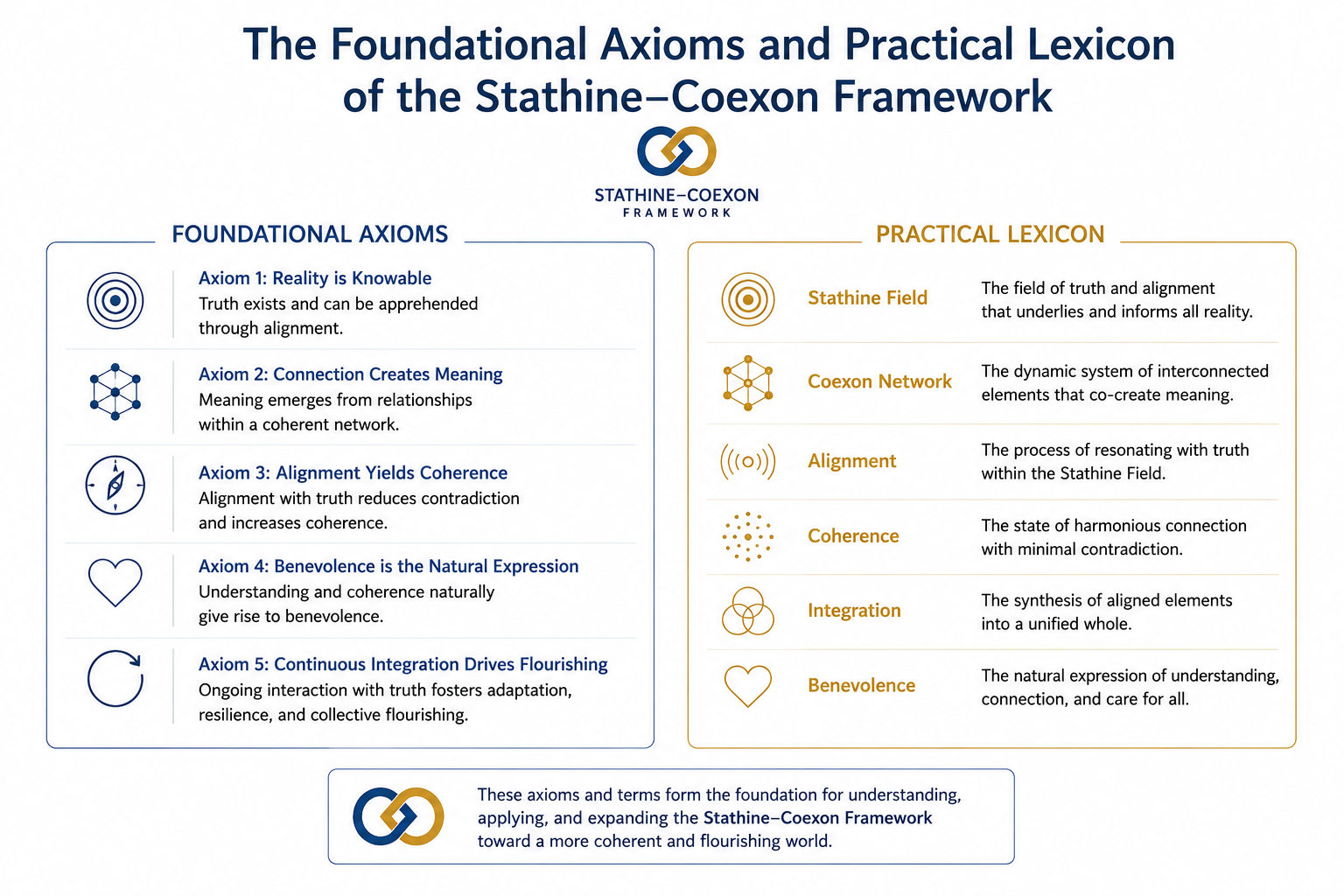
The central ontological distinction of the Stathine–Coexon Framework lies in its conception of Stathine.
Unlike morphic fields, which are proposed as dynamic organizing influences associated with living systems, Stathine is conceived as timeless and invariant.
It does not evolve.
It does not accumulate information.
It does not remember.
It simply exists.
Its role is not to store developmental patterns but to provide the unchanging ontological background within which all developmental processes occur.
In this respect, Stathine differs fundamentally from morphic fields.
One is dynamic.
The other is static.
One concerns developmental organization.
The other concerns timeless existence.
6. The Coexon and Biological Continuity
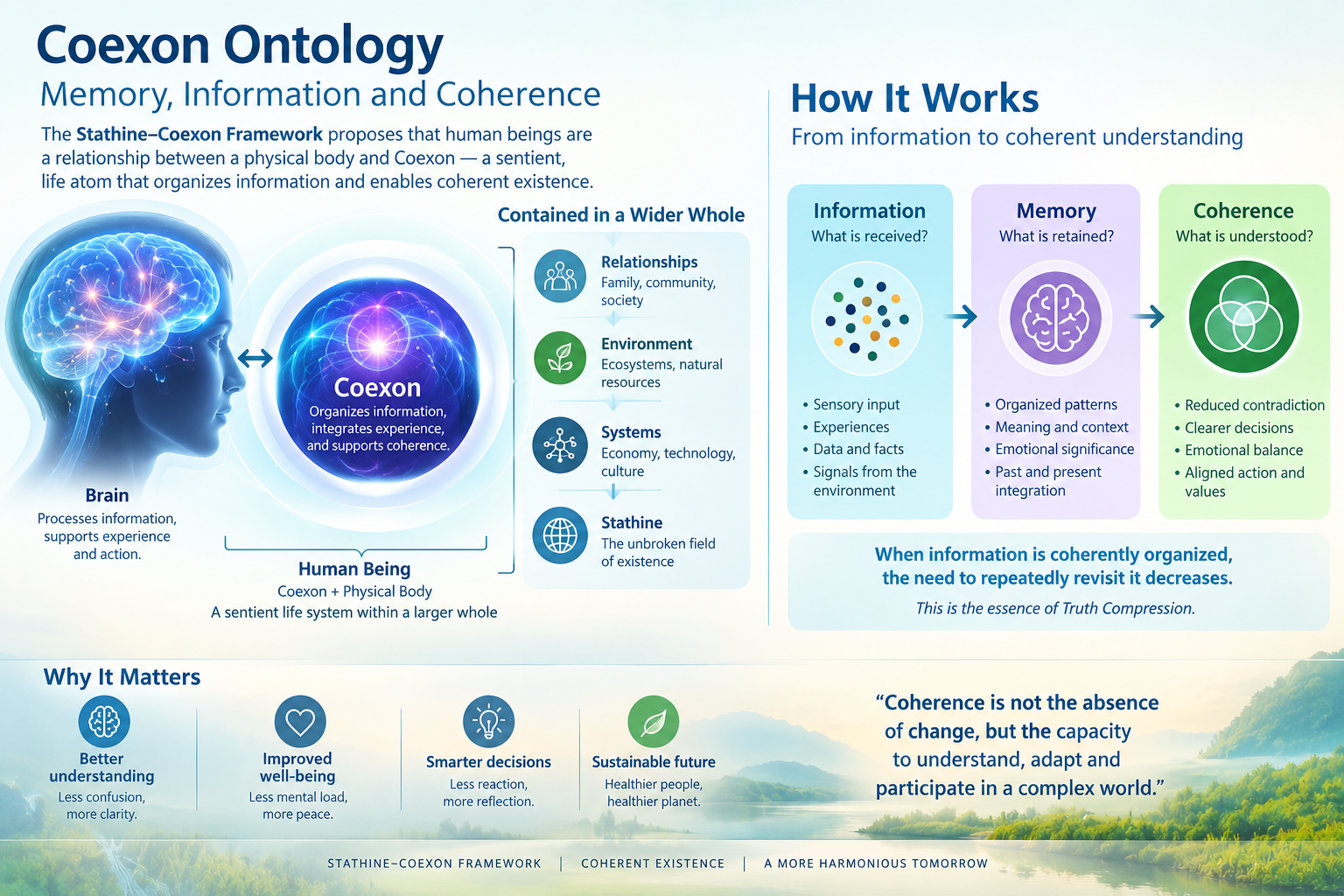
Within the framework, the Coexon is the timeless life atom possessing a specific atomic architecture and an intrinsic capacity for coherent understanding.
The Coexon continuously interacts with changing biological systems throughout life.
As cells divide and tissues renew, the Coexon provides continuity of coherent identity.
Biological continuity therefore depends not upon the persistence of physical matter alone but upon the persistence of coherent organization of the physical matter.
This proposal addresses questions of identity without requiring accumulated memory within nature itself.
7. Memory and Coherence
The Stathine–Coexon Framework proposes an important conceptual distinction.
Memory explains recurrence.
Coherence explains integration.
An organism may possess memory while remaining internally fragmented.
Likewise, a society may preserve traditions without achieving wisdom.
Coherence transforms stored information into aligned understanding.
Within this perspective, development involves more than remembering the past.
It involves continually integrating experience into greater coherence.
8. Evolution and Increasing Organization
Sheldrake’s hypothesis suggests that repeated forms become increasingly probable through accumulated resonance.
The Stathine–Coexon Framework proposes a different emphasis.
Evolution increasingly expresses coherence through biological diversity.
Life becomes progressively capable of:
- adaptation,
- cooperation,
- reflection,
- creativity,
- wisdom.
Complexity alone does not define evolutionary progress.
The quality of coherence becomes equally significant.
9. A Dialogue Between Two Perspectives
Both frameworks challenge strictly reductionist accounts of life.
Both recognize that biological organization cannot be understood solely by examining isolated molecules.
Yet they emphasize different explanatory principles.
Morphic resonance explores the possibility that developmental organization is influenced by inherited patterns extending beyond conventional genetics.
The Stathine–Coexon Framework proposes that coherent organization emerges through the interaction of the timeless Coexon with biological systems grounded within Stathine.
The dialogue between these perspectives invites philosophical reflection without assuming that either framework has been empirically established.Rather the empirical establishment as a prerequisite for truth is being questioned.
10. Future Research Directions
The comparison between morphic resonance and the Stathine–Coexon Framework suggests several avenues for further inquiry:
- Can biological organization be formally distinguished from biological memory?
- How might coherence be investigated as a conceptual property independent of inherited developmental patterns?
- Could models of organismal identity benefit from distinguishing continuity from memory?
- What mathematical or computational frameworks might describe coherent organization?
- Can developmental biology, systems theory, philosophy of mind, and information theory contribute jointly to a broader ontology of life?
Such questions encourage interdisciplinary dialogue while recognizing the real nature of these proposals.
11. Toward an Ontology of Coherent Existence
The eight comparison papers developed in this series suggest a common theme.
Different disciplines illuminate different aspects of reality.
Computation explains dynamic evolution.
Bioelectricity explains biological coordination.
Predictive processing explains adaptive intelligence.
Relevance realization explains wisdom.
Modes of attention explain cognition.
Conscious realism explores the primacy of consciousness.
Morphic resonance explores developmental organization.
The Stathine–Coexon Framework proposes that these perspectives may be interpreted within a broader ontology centered upon coherence.
Rather than replacing existing theories, it seeks to provide an integrative philosophical architecture capable of relating them through a common organizing principle.
Conclusion
Rupert Sheldrake’s proposal of morphic resonance has encouraged generations of researchers and philosophers to reconsider the nature of biological organization, development, and memory in living systems. The morphic resonance has highlighted questions that remain philosophically significant. Empirical validation has its own limitations.
The Stathine–Coexon Framework approaches these questions from a different perspective. Stathine is proposed as the timeless, invariant field of existence, while the Coexon is proposed as the timeless life atom responsible for organizing coherent understanding throughout biological life. Development is interpreted not primarily as the transmission of memory but as the progressive realization of coherence within changing biological systems.
If pursued through careful philosophical analysis and interdisciplinary dialogue, this perspective may contribute to a broader understanding of life in which biological organization, conscious experience, and human development are viewed as successive expressions of coherent existence. In this sense, the relationship between morphic resonance and the Stathine–Coexon Framework is not one of simple agreement or disagreement but of complementary exploration into the enduring mystery of how order, identity, and meaning arise within the living world.