The Stathine–Coexon Framework as an Integrative Meta-Framework for Human Understanding
Synthesizing Contemporary Science, Philosophy, and Consciousness Studies Through Coherence
Abstract
The twenty-first century has witnessed remarkable advances across numerous disciplines investigating reality. Physics explores the fundamental structure of the universe, neuroscience investigates consciousness, systems science examines complexity, psychology studies human behavior, and philosophy continues to address questions of meaning and existence. While each field has produced profound insights, increasing specialization has also fragmented human understanding. Few conceptual frameworks attempt to integrate these diverse perspectives into a coherent ontology without reducing one discipline to another.
This paper proposes the Stathine–Coexon Framework as an integrative meta-framework whose objective is not to replace existing theories but to synthesize them. The framework introduces two foundational concepts—Stathine, an atemporal static field of existence, and the Coexon, a timeless life atom capable of coherent understanding—as organizing principles through which insights from multiple disciplines may be interpreted within a unified architecture. Its central proposition is that the future of knowledge lies not in accumulating more isolated facts but in increasing coherence across domains of inquiry.
1. Introduction
Every generation inherits an expanding body of knowledge.
Physics explains matter with increasing precision.
Biology reveals the complexity of living systems.
Neuroscience investigates the mechanisms of cognition.
Computer science models intelligence.
Psychology explores behavior.
Philosophy examines meaning.
Spiritual traditions investigate consciousness through lived experience.
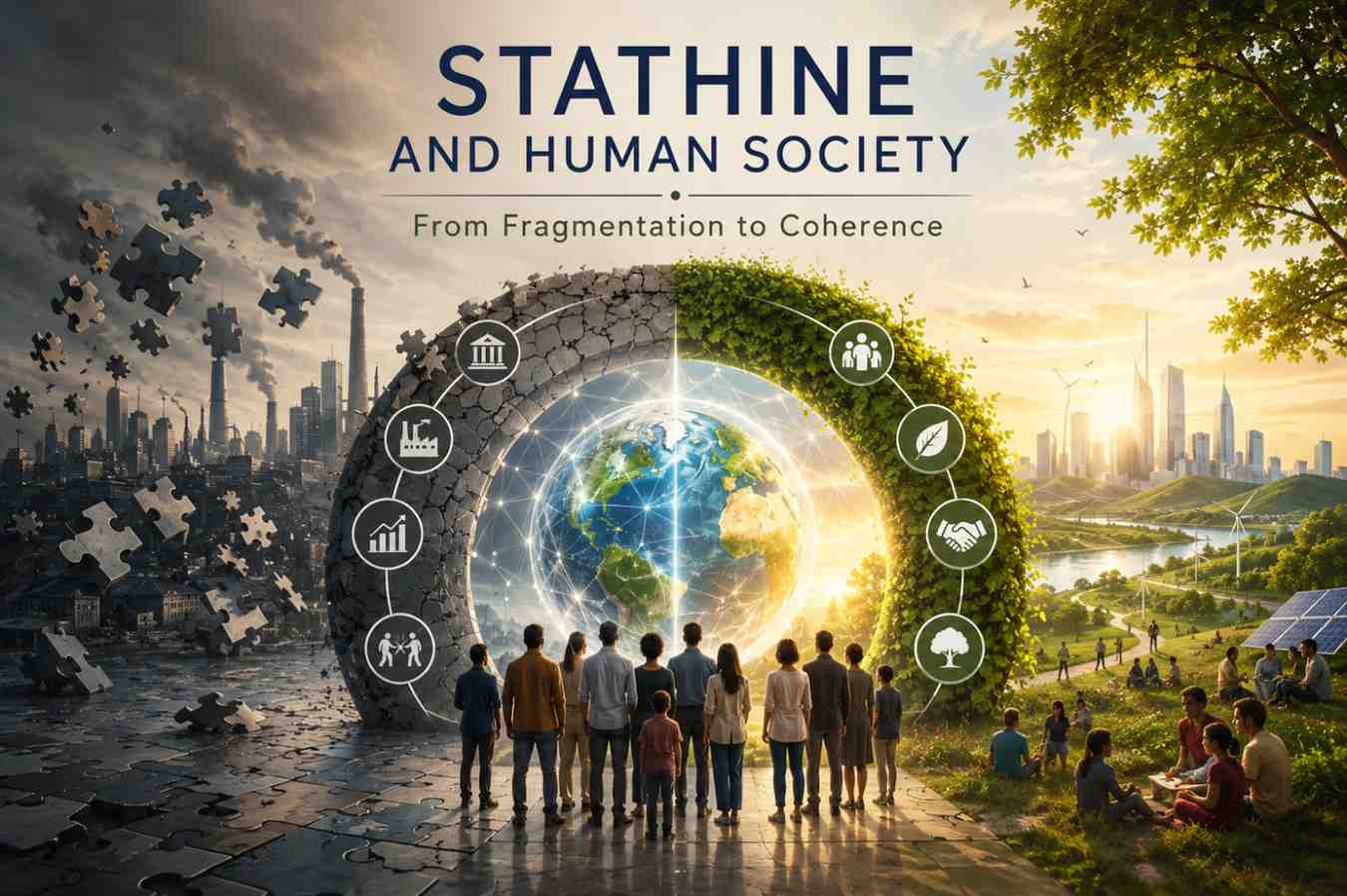
Each discipline advances independently, yet humanity continues to struggle with fragmentation. Experts possess deep knowledge within narrow domains while society faces increasingly interconnected challenges that transcend disciplinary boundaries.
The central question of this century is therefore not simply “What more can we discover?”
It is “How do we integrate what we already know?”
The Stathine–Coexon Framework addresses this question by proposing coherence as the next stage of intellectual evolution.
2. The Need for an Integrative Meta-Framework
History demonstrates that transformative intellectual movements often arise not from isolated discoveries but from new ways of organizing existing knowledge.
Newton unified terrestrial and celestial mechanics.
Darwin unified observations from biology.
Einstein unified space, time, mass, and energy.
Information theory unified communication across diverse systems.
The next intellectual challenge is broader.
Rather than unifying a single scientific domain, humanity requires an architecture capable of integrating multiple domains without diminishing their unique contributions.
This is the role of a meta-framework.
A meta-framework does not compete with existing theories.
It explains how apparently independent theories may describe complementary aspects of reality.
3. The Central Principle: Coherence
The organizing principle of the Stathine–Coexon Framework is coherence.
Coherence differs from agreement.
Agreement reflects shared opinion.
Coherence reflects structural compatibility.
Two theories may employ different languages, methods, and assumptions while describing compatible features of the same underlying reality.
The framework therefore evaluates ideas according to their capacity to increase explanatory coherence across disciplines rather than their conformity to a single methodology.
Knowledge progresses through integration.
4. Stathine and the Coexon
The framework proposes two foundational ontological primitives.
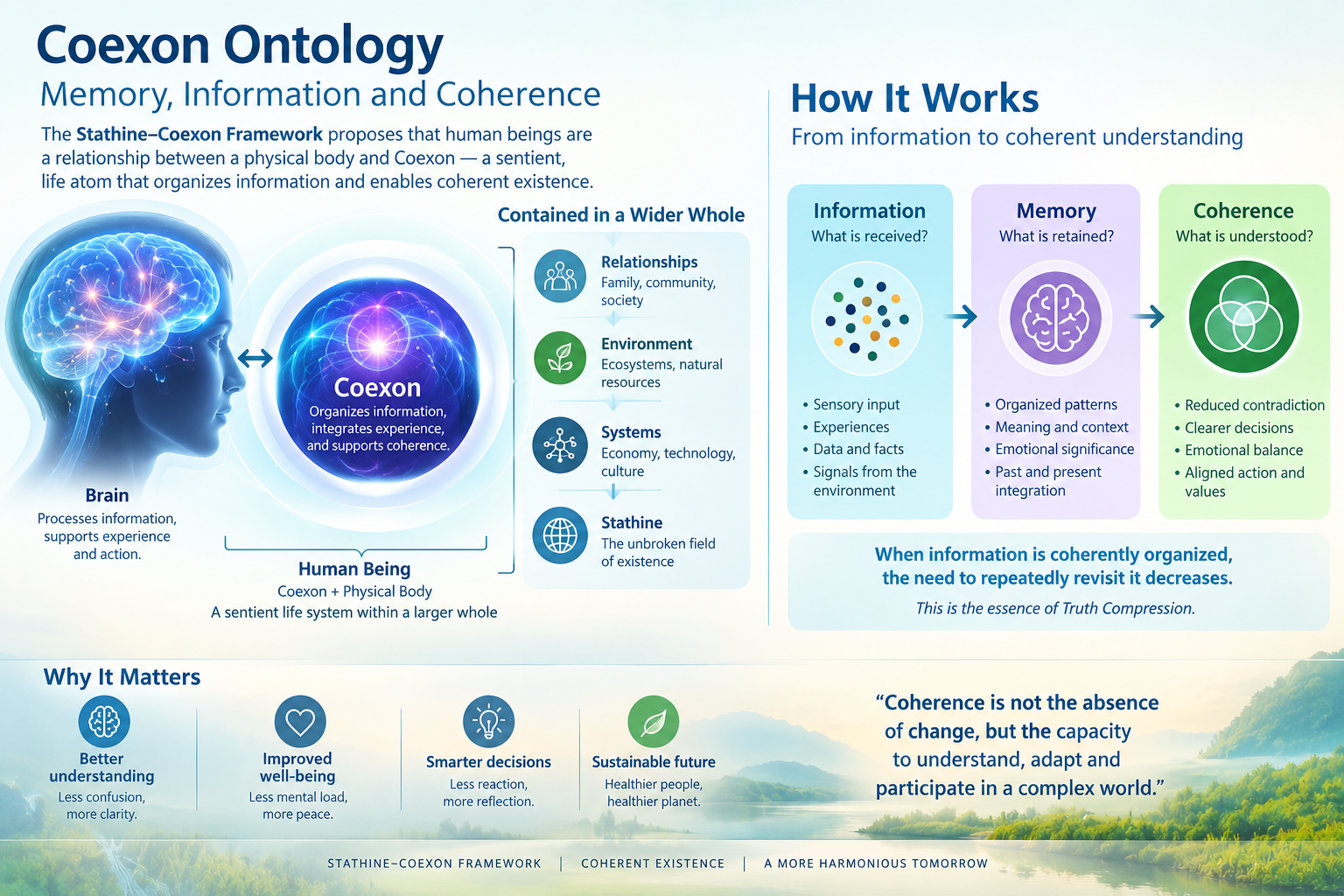
Stathine is defined as the timeless, unchanging field of existence. It provides continuity without itself undergoing change.
The Coexon is the fundamental life atom possessing a specific atomic architecture and an intrinsic capacity to organize information into coherent understanding.
Together they establish a dual foundation:
- invariant existence,
- coherent experience.
Material reality becomes the dynamic interaction between these timeless principles and temporal physical processes.
5. Contemporary Thinkers as Explorers of Different Dimensions of Reality
Many contemporary thinkers have developed powerful explanations for specific aspects of existence.
Some investigate the computational nature of physical reality.
Others examine consciousness.
Others study cognition.
Others explore biological intelligence.
Others analyze civilizational systems.
The Stathine–Coexon Framework suggests that these perspectives need not compete.
Instead, they may represent complementary investigations into different dimensions of a single coherent reality.
The framework therefore serves as an intellectual bridge rather than an intellectual replacement.
6. A Map Rather Than a Territory
Every scientific theory is a map.
Every philosophical system is a map.
Every spiritual tradition is a map.
Maps become valuable when their relationships become understood.
The Stathine–Coexon Framework proposes that civilization now requires a map of maps.
Rather than asking which framework is correct, it asks how multiple valid frameworks illuminate different dimensions of existence.
This shift transforms intellectual competition into intellectual collaboration.
7. From Dichotomy to Complementarity
Throughout history humanity has repeatedly organized thought through opposing categories.
Matter versus consciousness.
Science versus spirituality.
Reductionism versus holism.
Individual versus collective.
Competition versus cooperation.
Reason versus intuition.
These dichotomies often emerge because explanatory models operate at different scales while attempting to answer different questions.
The Stathine–Coexon Framework proposes that higher-order coherence dissolves many apparent contradictions.
Opposites become complementary descriptions of reality viewed from different perspectives.
8. Why This Century Requires Synthesis
Artificial intelligence now accelerates the production of knowledge.
Scientific publications increase exponentially.
Technological capability expands faster than collective understanding.
The limiting factor for civilization is no longer information.
It is synthesis.
Future breakthroughs may arise less from discovering entirely new facts than from recognizing deep structural relationships among existing discoveries.
The Stathine–Coexon Framework is offered as one possible architecture for facilitating this synthesis.
9. A Research Program Rather Than a Finished Theory
Like every emerging framework, the Stathine–Coexon Framework should be regarded as an evolving research program rather than a completed system.
Its value will depend upon its ability to:
- integrate diverse disciplines without oversimplification,
- generate novel hypotheses,
- clarify existing conceptual problems,
- inspire interdisciplinary collaboration,
- produce practical methods for increasing individual and collective coherence.
These objectives invite dialogue rather than dogma.
10. Future Comparative Studies
The integrative nature of the framework can be explored through systematic dialogue with contemporary thinkers whose work illuminates different aspects of reality.
For example:
- Stephen Wolfram explores computation as the foundation of physical reality.
- Michael Levin investigates biological intelligence, morphogenesis, and distributed cognition.
- Daniel Schmachtenberger examines civilizational coordination, existential risk, and collective sensemaking.
- John Vervaeke studies relevance realization, wisdom, and the meaning crisis.
- Iain McGilchrist analyzes the complementary modes of human cognition through hemispheric specialization.
- Donald Hoffman explores conscious realism and the limits of perception.
- Karl Friston proposes the Free Energy Principle as a unifying account of adaptive systems.
- Rupert Sheldrake investigates morphic resonance and developmental organization.
The objective of these comparisons is not to demonstrate superiority but to explore whether a coherent conceptual architecture can illuminate relationships among their respective contributions.
Conclusion
Human knowledge has reached a stage where fragmentation has become a greater obstacle than ignorance. The challenge facing contemporary civilization is not simply generating more information but integrating existing understanding into coherent structures capable of guiding individual and collective action.
The Stathine–Coexon Framework proposes that coherence is the next major frontier of intellectual development. Through the complementary concepts of Stathine and the Coexon, it seeks to provide an ontology in which scientific inquiry, philosophical reflection, systems thinking, and contemplative traditions can be interpreted as mutually enriching rather than mutually exclusive.
Whether this framework ultimately succeeds will depend not on rhetorical ambition but on its capacity to foster interdisciplinary dialogue, clarify unresolved conceptual questions, and generate fruitful avenues for research. If it proves capable of doing so, its greatest contribution may not be the creation of another theory of existence but the provision of an integrative architecture within which humanity’s diverse explorations of reality become increasingly coherent.
In this sense, the Stathine–Coexon Framework aspires to function not as the final word on existence but as a living meta-framework—one that continually synthesizes new discoveries while reducing the dichotomies that have historically divided human understanding.