Interpreting Carol Sanford’s Regenerative Paradigm Through the Stathine–Coexon Framework
Part of the Stathine–Coexon Comparative Research Series — Level II
Abstract
Regenerative thinking has emerged as an important response to the limitations of extractive, mechanistic, and fragmented approaches to organizations, economies, communities, and ecological systems. Carol Sanford’s work is particularly significant because it does not treat regeneration merely as repairing damage or producing better outcomes. Instead, her Regenerative Paradigm asks practitioners to understand living systems as wholes, recognize their distinctive essence, develop their inherent potential, work with nested systems and fields of energy, intervene at significant nodes, and cultivate reciprocal relationships. Sanford identifies four broad modern paradigms — Extract Value, Arrest Disorder, Do Good, and Evolve Capacity/Regenerate Life — and argues that the fourth represents a fundamentally different way of understanding and engaging living systems. (Medium)
This paper places Sanford’s regenerative framework in dialogue with the Stathine–Coexon Framework. The comparison suggests that the two frameworks share a profound rejection of fragmented and mechanistic thinking, while approaching the question from different levels. Sanford provides a sophisticated developmental and organizational methodology for working with living systems. The Stathine–Coexon Framework proposes a deeper ontological hypothesis: that reality may be understood as an information-organizing, coherence-seeking field in which the proposed Coexon — a sentient atom independent of the biological body — participates in organizing information and communicating with the holobiont neurological brain.
Within this hypothesis, regeneration can be interpreted not simply as restoration or development but as progressive restoration and expansion of coherence across nested levels of existence. The paper therefore proposes the concept of Coherent Regeneration: a regenerative process in which the health and evolutionary potential of a system increase as contradictions are reduced, information becomes more meaningfully organized, relationships become more reciprocal, and the distinctive potential of each constituent is increasingly expressed within the larger whole.
The paper does not claim that the Coexon hypothesis has been scientifically established. Rather, it proposes a conceptual bridge between Sanford’s living-systems paradigm and the Stathine–Coexon hypothesis, identifying potential research questions concerning information, consciousness, developmental capacity, organizational transformation, and regenerative economics.
Keywords: Carol Sanford, Regenerative Paradigm, regeneration, living systems, Stathine, Coexon, sentient atom, consciousness, coherence, information, holobiont, systemic reciprocity, developmental capacity, regenerative economics
1. Introduction: From Repairing Systems to Regenerating Life
Modern civilization has developed extraordinary capabilities for producing, measuring, optimizing, controlling, and scaling. Yet these capabilities have often been accompanied by an unintended consequence: the tendency to understand living systems as if they were machines.
Organizations become structures.
People become resources.
Nature becomes an asset.
Education becomes information transfer.
Healthcare becomes disease management.
Economics becomes allocation.
Leadership becomes control.
Innovation becomes disruption.
Even sustainability can become a question of reducing the damage produced by an otherwise unchanged system.
Carol Sanford’s regenerative work challenges this underlying orientation.
Her central distinction is not simply between “bad” and “good” practices. It is between different paradigms through which reality itself is interpreted. Sanford identifies four modern paradigms: Extract Value, Arrest Disorder, Do Good, and Evolve Capacity/Regenerate Life. The first three may produce useful outcomes, but the regenerative paradigm represents a different understanding of living systems and their potential. (Medium)
Sanford argues that regeneration is something that happens in living systems and requires learning to see and work with life as living rather than treating living entities as fragmented objects. (carolsanford.com)
This position creates an unusually productive point of entry for the Stathine–Coexon Framework.
The Stathine–Coexon Framework begins from a still more fundamental question:
What if the capacity of living systems to organize, interpret, remember, communicate, and evolve is rooted in a deeper informational architecture than the biological structures we currently observe?
The framework proposes two hypothetical entities:
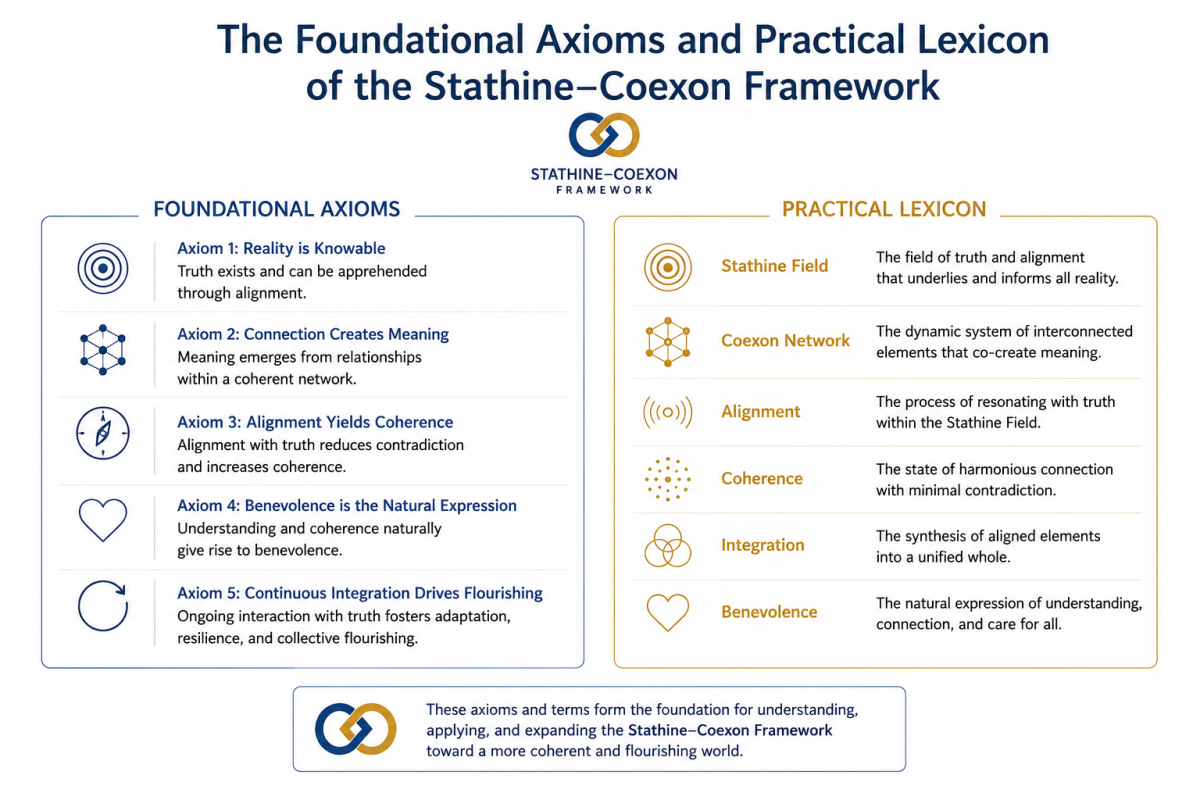
Stathine — an omnipresent, non-depleting energetic field or substrate beyond conventional spatial boundaries.
Coexon — a proposed sentient atom, independent of the human biological body, capable of organizing information and communicating with the holobiont’s neurological brain.
These propositions remain hypotheses of the Stathine–Coexon Framework, not established scientific facts.
The purpose of bringing Sanford’s work into this framework is therefore not to claim that Sanford’s regenerative paradigm proves the Coexon hypothesis. It does not.
Rather, Sanford’s work provides a sophisticated phenomenological and systemic description of regeneration, while the Stathine–Coexon Framework asks whether a deeper informational ontology could eventually explain why living systems display coherence, self-organization, developmental potential, and reciprocal adaptation.
This distinction is essential.
The comparison is therefore:
Sanford asks how we can learn to work regeneratively with living systems. The Stathine–Coexon hypothesis asks what deeper informational architecture might make such regeneration possible.
2. Carol Sanford’s Regenerative Paradigm
Sanford’s work has developed over decades through organizational, economic, developmental, and living-systems practice. Her work explicitly challenges conventional organizational assumptions and seeks to redesign work so that human capability develops alongside organizational and societal outcomes. (carolsanford.com)
The Regenerative Paradigm is particularly distinctive because it does not define regeneration as simply “doing more good.”
Instead, it asks practitioners to understand the living system itself.
Sanford’s seven First Principles provide the central architecture:
- Wholeness
- Essence
- Potential
- Nestedness
- Nodal
- Reciprocity
- Developmental
These principles are described as a framework for discerning living systems and regeneration. (Taylor & Francis)
Each provides a useful bridge to the Stathine–Coexon hypothesis.
3. The Four Paradigms: A Progressive Movement in Understanding
Sanford’s four paradigms can be interpreted as a developmental progression in the way humans understand intervention.
Paradigm I — Extract Value
The system is primarily viewed as a source of resources.
The central question becomes:
What can I obtain from this system?
This paradigm naturally encourages extraction, competition, commodification, and short-term optimization.
From the Stathine–Coexon perspective, this represents a severe reduction of relational information.
The system is interpreted primarily according to what it can provide to an observer.
The observer becomes conceptually separated from the observed.
Paradigm II — Arrest Disorder
Here the intention changes.
The objective becomes preventing damage, controlling instability, reducing risk, and maintaining order.
The question becomes:
How can I stop this system from deteriorating?
This represents a significant improvement over extraction, but the system is still primarily understood through the lens of disorder.
The implicit assumption is:
The desirable state is stability.
The Stathine–Coexon interpretation introduces an important distinction:
Coherence is not necessarily the same as stability.
A rigid system may be stable but incoherent.
A living system may be highly dynamic while maintaining coherence.
This distinction becomes crucial.
Paradigm III — Do Good
The third paradigm seeks positive outcomes.
The question becomes:
How can I improve the system?
This may include sustainability, social responsibility, ecological restoration, stakeholder benefit, and other forms of positive intervention.
Yet an improvement paradigm can still retain an external designer.
Someone decides what “better” means and then attempts to produce that state.
Sanford’s regenerative paradigm moves beyond this logic.
Paradigm IV — Evolve Capacity / Regenerate Life
The fourth paradigm asks a different question:
How can the living system develop its own inherent capacity to become more fully what it is capable of becoming?
Sanford’s formulation emphasizes evolving capacity rather than merely correcting deficiencies. Her work describes regeneration as a living-systems process rather than another form of improvement. (Medium)
This is where the Stathine–Coexon Framework finds its strongest conceptual resonance.
The objective is not merely to repair.
It is to increase the system’s capacity for coherent self-development.
4. Wholeness and the Holobiont
Sanford begins regeneration with the whole.
A living system cannot be adequately understood by reducing it to disconnected components.
This has a direct parallel with the Stathine–Coexon concept of the holobiont.
The human being, in the Stathine–Coexon Framework, is not treated simply as a brain controlling a body.
The human system is conceived as a multi-level biological whole involving:
- neurological processes,
- cardiovascular processes,
- gut-brain processes,
- cellular networks,
- microbial relationships,
- sensory systems,
- energetic processes,
- informational processes,
- and the proposed Coexon.
The traditional model asks:
Where is consciousness?
The holobiont-oriented model asks:
How does the entire living system participate in organizing experience and action?
The Stathine–Coexon hypothesis extends this question further.
If the Coexon is a sentient atom capable of organizing information and communicating with the neurological brain, then the brain may not be the sole originator of all meaningful organization.
Instead, the brain could be understood as a biological interface within a larger informational architecture.
This does not diminish neuroscience.
It expands the question neuroscience might eventually investigate.
5. Essence and the Problem of Standardization
One of Sanford’s most powerful ideas is Essence.
A living whole is not merely a generic example of a category.
A particular person is not simply “an employee.”
A business is not merely “a company.”
A community is not merely “a population.”
A place is not merely “a geographic location.”
Each possesses a distinctive character and potential.
Sanford’s regenerative approach therefore resists excessive standardization. Her description of the First Principles emphasizes the uniqueness of living wholes and the importance of discovering and engaging their distinctive essence. (carolsanford.com)
The Stathine–Coexon Framework provides a possible informational interpretation.
If each living system is a unique configuration of information, relationships, history, environment, and potential, then standardization may destroy information that is essential to the system’s identity.
In this interpretation:
Essence is not merely personality. It is the distinctive informational coherence of a living whole.
This is a proposed conceptual translation, not a claim about Sanford’s intended meaning.
The distinction matters.
Sanford’s Essence is a regenerative concept grounded in living-systems thinking.
The Stathine–Coexon Framework hypothesizes that such distinctiveness may eventually be describable through informational organization.
6. Potential: From Performance to Becoming
Conventional organizations often define potential through performance.
Potential employee:
someone capable of achieving higher measurable performance.
Potential organization:
one capable of producing greater financial results.
Potential child:
one capable of achieving higher academic scores.
Sanford challenges this reduction.
Her regenerative approach associates potential with the unfolding of a living system’s distinctive essence rather than simply achieving externally imposed standards. (carolsanford.com)
This creates a major bridge with the Stathine–Coexon principle of progressive reduction of contradiction.
Within the Stathine–Coexon Framework, human development can be interpreted as increasing alignment between:
what one experiences,
what one understands,
what one believes,
what one communicates,
and
what one does.
A system with large internal contradictions requires continual energy to maintain incompatible interpretations.
A more coherent system requires less defensive organization.
Thus:
Development may be understood as the progressive transformation of latent possibility into coherent capability.
Sanford’s regenerative development and the Stathine–Coexon principle therefore meet at the level of capacity.
7. Nestedness and the Architecture of Coexistence
Sanford’s principle of Nestedness emphasizes that living wholes exist within larger wholes. A person exists within families, organizations, communities, nations, ecosystems, and planetary systems. Actions at one level influence other levels. (carolsanford.com)
The Stathine–Coexon Framework gives this principle an even broader formulation:
No entity exists independently of the informational and energetic relationships within which it participates.
This is closely related to the user’s broader principle of Sah-Astitva — coexistence.
The individual does not disappear into the whole.
Nor does the whole erase individuality.
Instead:
The individual becomes more fully itself through coherent participation in larger wholes.
This resolves an apparent tension between individuality and interconnectedness.
A cell can remain a cell while contributing to an organ.
An organ can remain an organ while contributing to an organism.
A person can remain an individual while contributing to a family.
A business can remain commercially distinct while contributing to a community.
A nation can remain sovereign while participating in planetary systems.
The regenerative question therefore becomes:
How can nested wholes simultaneously preserve distinctiveness and increase mutual vitality?
8. Nodal Intervention and the Coexon Concept of Information Reorganization
Sanford’s Nodal principle is particularly interesting from the Stathine–Coexon perspective.
In living systems, change does not necessarily require changing everything.
A strategically significant node can influence an entire system.
Sanford describes nodes as points where multiple energies or relationships converge and where an intervention can enable reorganization. (carolsanford.com)
This resembles an informational principle:
The amount of change required in a system is not necessarily proportional to the size of the system.
A small change in interpretation can transform an entire relationship.
A new question can change a strategy.
A new understanding can dissolve a conflict.
A new relationship can reorganize a community.
A new assumption can transform an organization.
This is highly compatible with the Stathine–Coexon notion that information organization may be more fundamental than the visible physical manifestation of a system.
If the proposed Coexon participates in information organization, then the Coexon could theoretically function as an informational node between an individual organism and a larger informational field.
Again, this is a hypothesis requiring investigation, not established biology or physics.
9. Reciprocity: From Transaction to Mutual Nourishment
Modern economics frequently conceptualizes exchange through transaction.
I provide something.
You provide something.
Value is exchanged.
Sanford’s regenerative paradigm introduces a deeper concept of systemic reciprocity, in which the different entities within a living system mutually nourish the larger whole. (carolsanford.com)
The Stathine–Coexon Framework can extend this concept through information.
A relationship is regenerative when:
- information flows,
- understanding increases,
- capacity increases,
- contradictions decrease,
- agency expands,
- and the participating wholes become more capable.
This produces a useful distinction:
Transactional relationship
I give because I expect something in return.
Sustainable relationship
We avoid harming each other.
Regenerative relationship
Our interaction increases the capacity of both systems and strengthens the larger whole.
The final category may be understood as coherence-producing reciprocity.
10. Developmental: Regeneration as an Increase in Capability
Sanford’s developmental principle is perhaps the bridge most directly connected to the Stathine–Coexon Framework.
Regeneration is not a static state.
It is an ongoing capacity to develop.
The implication is profound:
A healthy living system is not necessarily one that remains unchanged; it is one that can continuously reorganize itself without losing its essential coherence.
This gives us a new definition of resilience.
Conventional resilience:
Return to the previous state after disturbance.
Regenerative resilience:
Develop the capacity to become a more capable version of the system through disturbance.
Stathine–Coexon interpretation:
Coherent evolution occurs when disturbance becomes information rather than merely damage.
The system encounters something unexpected.
It experiences disequilibrium.
It reorganizes information.
It changes.
Yet its deeper identity remains coherent.
This is precisely where regeneration becomes evolutionary.
11. The Seven First Principles Through the Stathine–Coexon Lens
Sanford Regenerative PrincipleStathine–Coexon InterpretationWholenessInformation exists within nested coherent wholesEssenceDistinctive informational identity of a living wholePotentialLatent capacity for greater coherent expressionNestednessCoexistence across multiple levels of organizationNodalHigh-leverage points of informational reorganizationReciprocityMutual information and capacity enhancementDevelopmentalProgressive expansion of coherent capability
This table should not be interpreted as claiming equivalence between the two frameworks.
Rather, it identifies conceptual correspondences that can generate further research.
12. Regeneration and the Stathine Principle
The Stathine–Coexon Framework proposes Stathine as an omnipresent, static, non-depleting field that provides an underlying energetic context.
This proposition creates an interesting philosophical distinction.
Conventional regeneration often asks:
How can resources be restored?
The Stathine hypothesis asks a more fundamental question:
What if the fundamental energetic substrate of existence is not something that must be replenished?
If Stathine were ever empirically demonstrated, then regeneration would not necessarily mean restoring an exhausted fundamental energy source.
Instead, biological and social regeneration could involve improving the organization and utilization of available energy and information.
This would transform the meaning of scarcity.
Scarcity might sometimes arise not because energy is absent, but because systems are poorly organized.
That distinction could become significant for regenerative economics.
13. Truth Compression and Regeneration
The Stathine–Coexon Framework introduces another principle:
Truth requires no unnecessary informational maintenance; contradiction requires energy to sustain incompatible models.
This can be called the Principle of Truth Compression within the framework.
The idea is not that truth literally consumes zero physical energy in every scientific sense. Rather, it is a conceptual hypothesis about informational organization.
A coherent explanation can compress many observations into one internally consistent model.
An incoherent system requires multiple exceptions, defensive explanations, compensating narratives, and contradictory assumptions.
This creates an important relationship with regenerative development.
Consider an organization where:
- stated values contradict incentives,
- leadership says collaboration but rewards internal competition,
- innovation is encouraged but failure is punished,
- employees are called empowered but decisions remain centralized.
Such an organization expends enormous cognitive and emotional energy maintaining contradiction.
A regenerative intervention does not merely add another program.
It attempts to reorganize the underlying system.
From the Stathine–Coexon perspective:
Regeneration is partly the compression of contradiction into greater coherence.
14. Ego as an Anti-Regenerative Information Structure
This provides a particularly useful application.
Ego is often treated as a psychological characteristic.
The Stathine–Coexon Framework can alternatively interpret ego defensiveness as an information-preservation mechanism.
An individual constructs a model:
“This is who I am.”
Then contradictory information appears.
Instead of updating the model, the individual may protect it.
This creates:
- denial,
- justification,
- blame,
- defensiveness,
- projection,
- tribalism,
- doublethink.
The system becomes less adaptive.
From Sanford’s perspective, this limits development and obscures the distinctive potential of the person.
From the Stathine–Coexon perspective, it represents increasing informational incoherence.
Therefore:
Regenerative personal development requires neither destroying the ego nor glorifying it, but increasing its capacity to update itself without experiencing every contradiction as existential threat.
This may be one of the most practically important intersections between the two frameworks.
15. Regenerative Leadership
Sanford’s work challenges leaders to move beyond conventional management and develop human capacity. Her regenerative work design emphasizes direct connection between people and customers, alignment with overarching business direction, development of human capabilities, and contribution to broader societal outcomes. (carolsanford.com)
The Stathine–Coexon Framework adds a useful distinction between command and coherence.
Traditional leadership asks:
How do I make people do what is required?
Regenerative leadership asks:
How do I develop the conditions in which people can increasingly understand, contribute, and self-organize?
Stathine–Coexon leadership asks:
How do I increase coherence across the information, intentions, relationships, and actions of the whole system?
This changes the role of leadership.
The leader becomes less like a controller and more like a coherence architect.
The objective is not conformity.
It is coherent diversity.
16. Creativity: Breaking Rules versus Expanding Coherence
This intersection is especially relevant to innovation.
Conventional creativity is often described as:
Think differently.
Sometimes this becomes:
Break the rules.
The regenerative perspective suggests something deeper.
A living system possesses an existing structure, history, identity, and potential.
Therefore creativity should not necessarily destroy the existing structure.
Instead:
Creativity identifies limitations in the current understanding and expands the system’s capacity to reorganize itself.
The Stathine–Coexon Framework makes the distinction explicit.
Destructive novelty
Different merely for the sake of being different.
Regenerative creativity
New information that increases the coherence and potential of the whole.
The creative act therefore becomes an act of informational expansion.
17. Regenerative Economics
Sanford’s regenerative thinking extends beyond organizational design toward economics and systemic wealth. Her work explicitly explores economic systems through regenerative principles rather than purely extractive models. (Medium)
The Stathine–Coexon Framework suggests that economic value could be reconsidered as a function of capacity creation.
An economic activity is regenerative when it leaves participants with greater capacity than before.
For example:
A regenerative education system does not merely transfer knowledge.
It increases the learner’s capacity to learn.
A regenerative healthcare system does not merely treat illness.
It increases the person’s capacity to sustain health.
A regenerative business does not merely generate profit.
It increases the capacity of employees, customers, communities, and ecosystems to thrive.
A regenerative economy therefore moves from:
extraction → preservation → improvement → regeneration
and potentially toward:
capacity → coherence → reciprocity → evolutionary potential.
This provides a conceptual foundation for integrating the Stathine–Coexon Framework with regenerative economics.
18. The Human Being as a Regenerative Holobiont
The deepest integration may occur at the level of human development.
The human being can be conceptualized as a nested living system:
Coexon → cell → tissue → organ → neurological system → holobiont → family → organization → society → ecosystem → planetary system.
This should not be read as a literal experimentally established hierarchy of consciousness.
It is a conceptual model.
Within this model, regeneration becomes the process through which coherence is preserved and expanded across nested levels.
A person cannot become fully regenerative while systematically damaging every larger system of which they are part.
Likewise, a society cannot become regenerative while requiring individuals to remain psychologically fragmented.
This produces a fundamental principle:
Regeneration at one level cannot remain permanently isolated from regeneration at other levels.
19. Toward a Unified Concept: Coherent Regeneration
The comparison allows us to formulate a new concept:
Coherent Regeneration
Coherent regeneration is the process by which a living system progressively develops its inherent potential through improved organization of information, reduction of contradiction, reciprocal relationships, and increased capacity for self-directed evolution while preserving the distinctive essence of the whole.
This definition integrates Sanford’s regenerative paradigm with the Stathine–Coexon hypothesis without claiming that the frameworks are identical.
Its components are:
1. Wholeness
The system is understood as a whole.
2. Distinctiveness
Its unique essence is recognized.
3. Potential
Development is directed toward what the system can become.
4. Information
Change involves reorganizing understanding.
5. Coherence
Contradictions are progressively reduced.
6. Reciprocity
The development of one part contributes to the development of the larger whole.
7. Nestedness
The system is understood within its larger contexts.
8. Development
The goal is not equilibrium but increasing capability.
9. Agency
The living system increasingly participates in its own development.
10. Evolution
Regeneration becomes an ongoing process rather than a final state.
20. A Possible Research Architecture
The synthesis suggests several empirical research programs.
Research Question 1: Does coherence predict regenerative capacity?
Organizations could be assessed for contradictions between:
- stated purpose,
- incentives,
- decision rights,
- behavior,
- stakeholder relationships,
- and actual outcomes.
The hypothesis would be:
Lower systemic contradiction predicts greater adaptive and regenerative capacity.
Research Question 2: Can nodal interventions outperform broad interventions?
If Sanford’s nodal principle is correct, interventions targeted at strategically significant relationships may produce greater systemic effects than broad interventions.
This could be tested experimentally in organizations, education, healthcare, or community development.
Research Question 3: Can developmental capacity be measured?
Instead of measuring only current performance, organizations could measure:
- learning capacity,
- sense-making capacity,
- relational capacity,
- agency,
- adaptability,
- creativity,
- systemic awareness.
This would shift organizational measurement from performance alone to capacity generation.
Research Question 4: Can coherence be operationalized?
The Stathine–Coexon Framework could develop measures for:
- internal contradiction,
- conceptual consistency,
- relational alignment,
- information integration,
- behavioral congruence,
- and adaptive response.
Such measures could then be compared with established organizational and psychological constructs.
Research Question 5: Does regenerative practice alter cognitive organization?
Neuroscientific and behavioral research could examine whether sustained regenerative practices produce measurable changes in:
- cognitive flexibility,
- metacognition,
- emotional regulation,
- perspective taking,
- cooperation,
- and adaptive decision-making.
This would provide an empirical bridge between regenerative developmental practice and cognitive science.
Research Question 6: Can the Coexon hypothesis be experimentally distinguished from conventional models?
This is the most demanding question.
If the Coexon is proposed as a sentient atom independent of the biological body and capable of organizing information and communicating with the neurological brain, then the hypothesis must eventually generate testable predictions that distinguish it from conventional neuroscience and information-processing models.
Without such predictions, the Coexon remains a philosophical or theoretical construct.
With sufficiently precise predictions, it becomes a candidate for scientific investigation.
This distinction is fundamental to maintaining intellectual rigor.
21. Where the Frameworks Agree
The conceptual overlap between Sanford and Stathine–Coexon is substantial.
Both reject reductionism.
Both emphasize wholes.
Both challenge mechanistic interpretations of living systems.
Both recognize developmental potential.
Both treat relationships as fundamental.
Both recognize that systems can reorganize.
Both challenge simplistic intervention.
Both emphasize that the observer/practitioner must develop their own capacity.
And both move beyond the assumption that the objective of life is merely to maintain existing structures.
Sanford expresses this through the regenerative paradigm.
The Stathine–Coexon Framework expresses it through coherence, information, coexistence, and the proposed deeper architecture of sentient organization.
22. Where They Differ
The differences are equally important.
Sanford’s framework is primarily a regenerative living-systems and developmental methodology.
The Stathine–Coexon Framework proposes an ontological and informational architecture.
Sanford’s principles emerge from living-systems observation, developmental practice, ecological thinking, and organizational experience. (Taylor & Francis)
The Coexon hypothesis proposes something substantially stronger:
that sentience may be associated with an elemental informational entity independent of the human biological body.
Within the Stathine–Coexon Framework, Coexon is hypothesized as a sentient atom independent of the biological body, capable of organizing information and communicating with the holobiont’s neurological brain. The hypothesis is positioned beyond the present ambit of conventional epistemology and empirical data systems; consequently, its investigation may require an expansion of the methodological frameworks through which sentience, information, and reality are currently studied.
Therefore, the Stathine–Coexon Framework should not claim that Sanford’s work validates the Coexon.
A more defensible position is:
Sanford’s regenerative paradigm provides a practical and conceptual environment in which the Coexon hypothesis can formulate new questions about information, agency, development, and coherence in living systems.
23. From Regenerative Design to Regenerative Ontology
This leads to a broader distinction.
Regenerative design asks:
How should we design systems that increase life?
Regenerative leadership asks:
How should humans develop themselves so they can contribute to living systems?
Regenerative economics asks:
How should value creation increase the vitality of larger systems?
The Stathine–Coexon Framework adds:
What is the underlying nature of the information-organizing capacity that allows living systems to regenerate at all?
This is the movement from methodology to ontology.
It should be approached cautiously.
The deeper question is scientifically ambitious and currently unresolved.
But it is precisely this ambition that makes the comparison valuable.
24. A New Definition of Sustainability
The synthesis also suggests a hierarchy:
Sustainability
Keep the system from collapsing.
Restoration
Repair damage.
Regeneration
Increase the system’s capacity to renew itself.
Coherent Regeneration
Increase the system’s capacity to renew itself while simultaneously increasing coherence across its nested relationships.
This fourth concept may provide a useful extension for the future of regenerative economics, organizational design, education, and leadership.
The goal is not simply:
“Make the system better.”
It is:
“Help the system become increasingly capable of making itself better without destroying the coherence of the larger whole.”
25. Implications for Enlightenment and Human Development
The framework also intersects with a deeper philosophical question.
If regeneration is the development of inherent potential, then human development need not be understood as escaping existence.
Enlightenment need not mean ceasing to participate in the world.
It can instead mean becoming increasingly coherent within it.
The individual increasingly recognizes:
- bodily signals,
- emotional information,
- cognitive interpretation,
- social relationships,
- ecological embeddedness,
- and deeper questions of meaning
as parts of a larger whole.
From this perspective:
Enlightenment is not the disappearance of the individual but the reduction of contradiction between the individual and the larger reality in which the individual participates.
This is strongly compatible with regenerative thinking.
The person becomes less extractive.
Less defensive.
Less fragmented.
More capable of seeing.
More capable of relating.
More capable of contributing.
More capable of developing others.
The objective is therefore not perfection.
It is increasing coherence.
26. The Central Proposition
The combined insight can be expressed in one proposition:
A living system regenerates when it becomes increasingly capable of expressing its distinctive potential while simultaneously increasing the vitality and coherence of the larger systems in which it is nested.
Sanford provides the regenerative language for this proposition.
The Stathine–Coexon Framework proposes an informational ontology that may eventually provide another layer of explanation.
The two frameworks therefore need not compete.
They can be treated as different levels of inquiry.
Sanford asks:
How does regeneration work?
Stathine–Coexon asks:
What informational architecture might make regeneration possible?
Future science must ask:
Which parts of these propositions can be operationalized, measured, falsified, and experimentally tested?
27. Conclusion
Carol Sanford’s Regenerative Paradigm represents an important transition in systems thinking: from managing objects to engaging living wholes; from extracting value to developing capacity; from repairing deficiencies to realizing potential; from isolated interventions to nested systemic relationships.
Her seven First Principles — Wholeness, Essence, Potential, Nestedness, Nodal, Reciprocity, and Developmental — provide a sophisticated vocabulary for understanding how living systems can evolve. (Taylor & Francis)
The Stathine–Coexon Framework can be placed alongside this work as a more speculative inquiry into the informational foundations of such processes.
Its central hypothesis — that the Coexon is a sentient atom independent of the biological body, capable of organizing information and communicating with the holobiont’s neurological brain — should remain explicitly identified as a hypothesis.
Within that hypothesis, however, a powerful conceptual possibility emerges.
Regeneration may not merely be restoration.
It may be coherence becoming developmental capacity.
A person regenerates when greater understanding reduces internal contradiction and expands agency.
A relationship regenerates when difference becomes information rather than threat.
An organization regenerates when its people become more capable through their participation in the organization.
An economy regenerates when value creation increases the capacity of the systems that generate value.
A society regenerates when its institutions increase the capacity of citizens to participate, learn, create, and contribute.
And perhaps, at the deepest level, life regenerates because living systems possess an inherent capacity to reorganize information while preserving and expanding coherence.
That final proposition remains an open question.
The scientific task is therefore not to assume that the Stathine–Coexon hypothesis is true.
It is to ask whether the hypothesis can generate observations, predictions, and experiments that distinguish it from existing explanations.
This is where Sanford’s regenerative paradigm and the Stathine–Coexon Framework meet most productively.
One teaches us to work with life as living.
The other asks whether we can eventually understand what makes life capable of organizing itself at all.
The potential synthesis can therefore be summarized as:
Regeneration is the evolution of living capacity.
Coherent regeneration is the evolution of living capacity through increasingly integrated information, reciprocal relationships, and reduced contradiction.
And if the Stathine–Coexon hypothesis is eventually validated, the deepest architecture of regeneration may prove to be informational before it is organizational, organizational before it is social, and social before it becomes civilizational.
Proposed Position in the Stathine–Coexon Research Program
This paper is best positioned as a Level II Comparative Paper.
It creates a bridge between:
Carol Sanford’s Regenerative Paradigm
↓
Living Systems Thinking
↓
Human Development and Organizational Design
↓
Information and Coherence
↓
Stathine–Coexon Ontology
↓
Potential Scientific Investigation
The future research and the path taken by humanity will help validate the hypothesis of this research paper.