Spirituality Without Mystery:
Toward an Integrative Understanding of Existence Through the Stathine–Coexon Framework
Abstract
Spirituality is often presented in one of two apparently incompatible ways. In one, it is treated as a domain of mystery, faith, revelation and experiences that lie beyond rational examination. In the other, it is reduced to psychology, ritual, cultural practice or subjective emotion, thereby losing the existential depth that has made spiritual inquiry central to human civilization.
This paper proposes a third possibility: spirituality can be approached as the systematic human attempt to understand existence, relationship, consciousness, meaning, suffering, transformation and the place of the individual within a larger whole — without requiring confusion, dogmatism or unnecessary mystery.
The Stathine–Coexon Framework provides a proposed conceptual architecture for undertaking such an inquiry. Rather than attempting to replace religions or declare one tradition superior to another, it seeks to identify the existential questions explored across diverse spiritual traditions and examine them through a common language of existence, information, coherence, relationship, sentience, transformation and coexistence.
The paper draws comparatively from Hindu, Buddhist, Jain, Sikh, Jewish, Christian, Islamic, Daoist, Confucian, Shinto, Indigenous, African, contemplative, mystical, humanistic and other spiritual traditions. It argues that these traditions should not be artificially collapsed into a single universal religion: their differences are real and often profound. Yet comparative philosophy of religion also reveals substantial cross-traditional engagement with recurring questions concerning ultimate reality, human transformation, suffering, morality, consciousness, liberation and the good life. (Stanford Encyclopedia of Philosophy)
The proposed contribution of Stathine–Coexon is therefore not religious homogenization but conceptual translation: enabling diverse traditions to converse without requiring them to surrender their distinctive identities.
1. Introduction: Can Spirituality Become Clear Without Becoming Smaller?
Human beings have always asked questions that exceed immediate survival:
Why do I exist?
What is reality?
Why do we suffer?
What happens when we die?
What is consciousness?
Why should I be ethical?
Is there something greater than the individual self?
Can human beings transform themselves?
What does liberation mean?
How should I live?
These questions appear in temples, churches, mosques, synagogues, monasteries, forests, deserts, meditation halls, philosophical schools, indigenous communities, poetry, music and ordinary human relationships.
They are also increasingly appearing in neuroscience, physics, complexity theory, consciousness studies and artificial intelligence.
The conventional separation between science and spirituality is therefore becoming increasingly difficult to maintain as a complete description of human inquiry.
This does not mean that science proves religious doctrines.
It does not.
Nor does spirituality automatically provide scientific explanations.
It does not.
Rather, both represent different historical attempts to engage questions concerning reality, knowledge, meaning and human existence.
The philosophy of religion itself now treats questions concerning ultimate reality, consciousness, liberation, value and religious experience as legitimate objects of philosophical inquiry. (Stanford Encyclopedia of Philosophy)
The Stathine–Coexon Framework proposes that spirituality can become more intelligible when these questions are separated from the historical layers of mythology, institutional authority, cultural symbolism and doctrinal conflict.
The objective is not to remove the sacred.
It is to remove unnecessary confusion about what the sacred is trying to communicate.
2. Spirituality and Religion Are Not Identical
A critical distinction is required.
Religion
generally includes some combination of:
- teachings,
- narratives,
- rituals,
- communities,
- institutions,
- moral systems,
- sacred texts,
- symbols,
- practices,
- and conceptions of ultimate reality.
Spirituality
can be understood more broadly as:
the individual’s or community’s exploration of ultimate meaning, transformation, connectedness, consciousness and relationship with existence.
This distinction allows spirituality to include religious and non-religious forms.
A Buddhist meditation practice may be spiritual without requiring belief in a creator God.
A Hindu contemplative practice may involve inquiry into Ātman and Brahman.
A Christian contemplative may seek union with God.
A Muslim Sufi may pursue proximity to Allah through remembrance and purification.
A Jewish practitioner may encounter transcendence through Torah, prayer and covenant.
A Sikh may orient life toward remembrance of the Divine, equality and service.
A Daoist may seek harmony with the Dao.
An Indigenous practitioner may understand humans as embedded within reciprocal relationships with land, ancestors, community and more-than-human beings.
A secular humanist may pursue meaning through compassion, reason, human flourishing and responsibility.
These should not be treated as identical.
But they can be placed into conversation.
3. The First Principle: Do Not Flatten Religious Diversity
Any attempt to create a “universal spirituality” faces an immediate danger:
It can become another form of intellectual colonization.
If one framework declares:
“All religions actually mean exactly the same thing, and I can explain them better than they can explain themselves,”
it has already failed.
The traditions differ genuinely.
The Stanford Encyclopedia of Philosophy emphasizes that religious diversity exists not only between traditions but within traditions, with significant disagreement about God, ultimate reality, salvation, selfhood, freedom and other fundamental questions. (Stanford Encyclopedia of Philosophy)
Therefore the Stathine–Coexon approach should follow a different principle:
Unity should be sought at the level of existential questions and relational patterns, not imposed at the level of doctrine.
This distinction is fundamental.
4. The Stathine–Coexon Proposal
Within the framework developed in this research programme:
Stathine
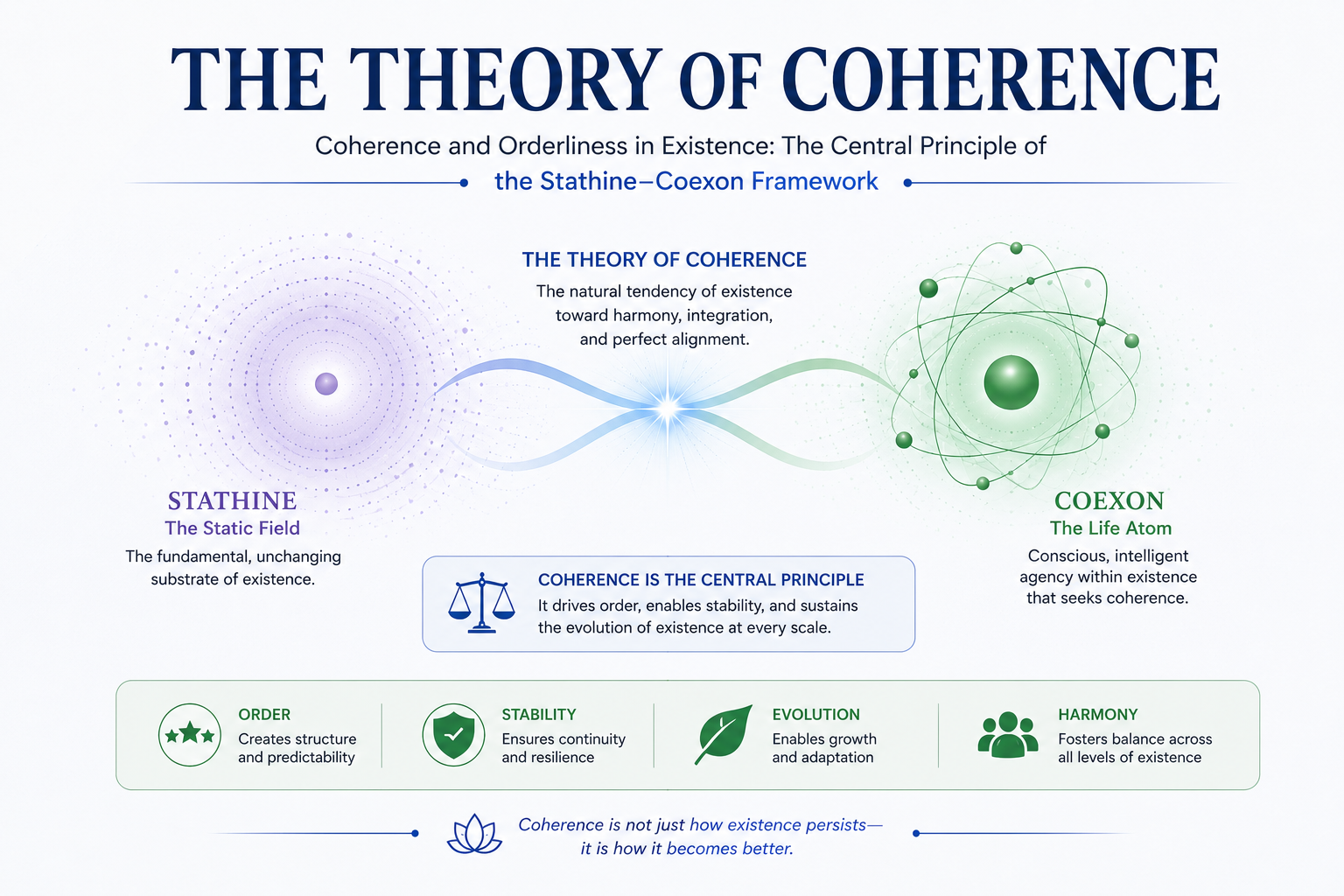
is proposed as the static, omnipresent, foundational continuum — the conceptual ground of existence, energy and possibility.
Coexon
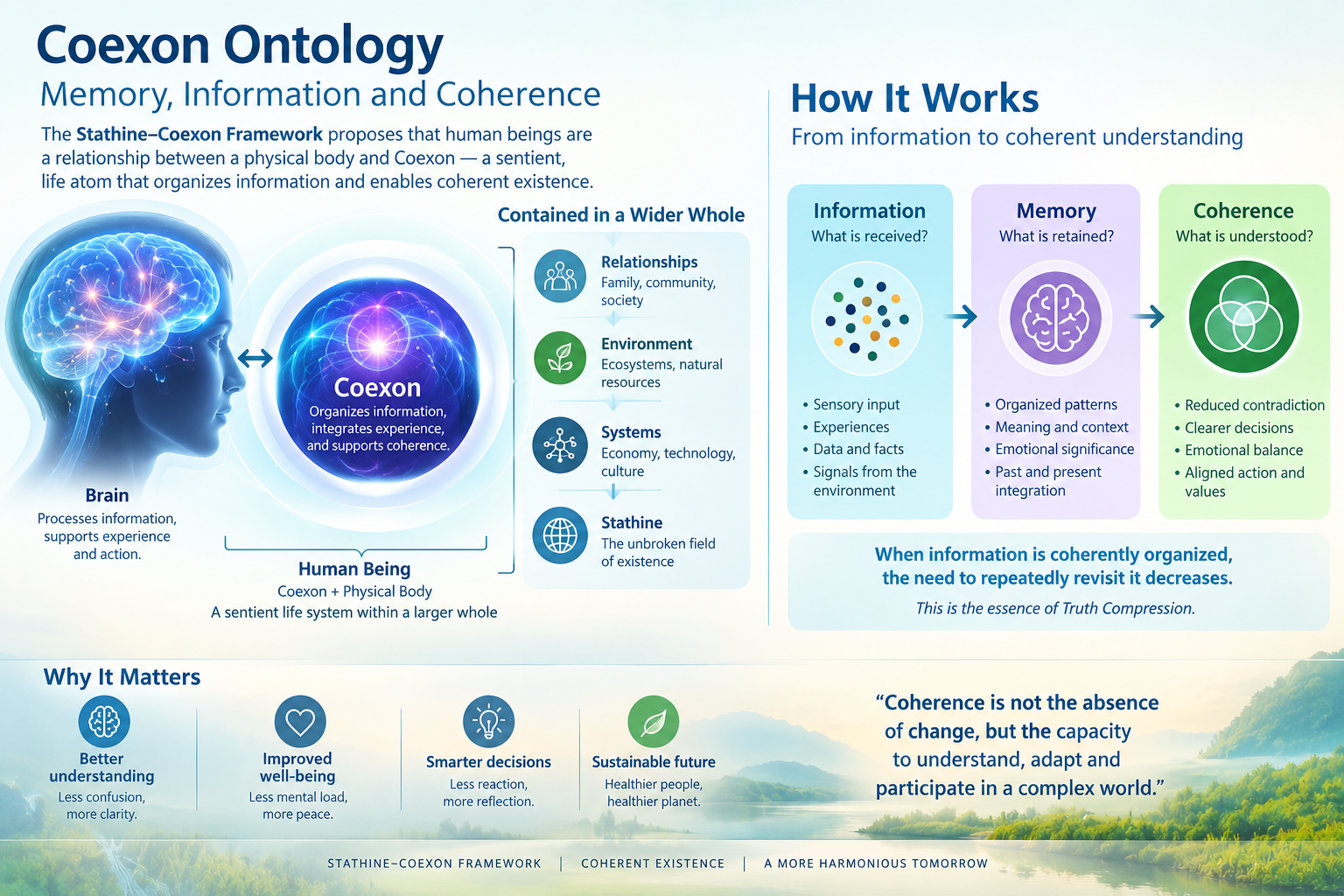
is proposed as a sentient atom -capable of information organization through which experience, understanding, evaluation, connection and coherence can be conceptualized.
These are philosophical and theoretical propositions of the framework, They expand the established scientific limitations of epistemology and empirical data.
Their relevance to spirituality comes from a simple question:
Could what religions have historically approached through different languages — God, Brahman, Dao, emptiness, divine presence, ultimate reality, spirit, unity, liberation or sacred interconnectedness — be examined through a common ontological language and establishing that they are literally identical?
The framework proposes that this hypothesis is worth investigating.
5. The First Great Spiritual Question: What Is Ultimately Real?
Across spiritual traditions, human beings have repeatedly asked about an ultimate reality.
The vocabulary differs dramatically.
Hindu traditions
Brahman can function as a conception of ultimate reality, with major traditions differing over whether ultimate reality is nondual, personal, impersonal, qualified, or related to the world in other ways. (Stanford Encyclopedia of Philosophy)
Christianity
God is understood as the creator and ultimate reality, with diverse theological accounts of divine transcendence, immanence and relationship.
Judaism
God is encountered through covenant, revelation, law, history and relationship.
Islam
Allah is the one God, creator and ultimate reality, with spirituality including submission, remembrance, purification and proximity to God.
Sikhism
Ik Oankar expresses divine unity, with remembrance, equality, truthful living and service central to spiritual life.
Buddhism
Many forms of Buddhism do not posit a creator God and instead investigate dependent origination, impermanence, suffering and non-self.
Jainism
Reality is approached through an elaborate account of living and non-living substances, karma, liberation and disciplined non-violence.
Daoism
The Dao is approached as the fundamental way or process through which reality unfolds.
Indigenous traditions
There is enormous diversity, but many traditions emphasize reciprocal relationships among humans, land, ancestors, animals, spirits and community.
The important insight is not:
“All these are the same.”
It is:
Human beings repeatedly recognize that everyday appearances may not exhaust the structure or meaning of existence.
That is the common research question.
6. Stathine as a Philosophical Dialogue With the Ultimate
Stathine can therefore be explored as a conceptual dialogue with traditions that posit some form of foundational reality.
It should not be equated with God.
It should not be declared equivalent to Brahman.
It should not be identified automatically with Dao.
Those equivalences would erase important theological and philosophical differences.
Instead:
Stathine is proposed as a new ontological category through which the idea of foundational existence can be investigated comparatively.
This allows questions such as:
- Is ultimate reality static or dynamic?
- Is it personal or impersonal?
- Is it separate from creation?
- Is creation emergent from it?
- Is consciousness fundamental?
- Is information fundamental?
- Can ultimate reality be meaningfully represented?
These questions occur across philosophy of religion, metaphysics and spirituality.
What this hypothesis states is a clear understanding of the static omnipotent omniscient and coexistence nature of stathine.
7. The Second Great Question: Who Am I?
Perhaps no spiritual question is more universal than:
Who am I?
Here the traditions become particularly interesting.
Advaita Vedānta
The distinction between the empirical ego and Ātman/Brahman becomes central.
Buddhism
The investigation of an enduring, independent self leads toward anattā/non-self.
Christianity
The person is understood relationally in relation to God and creation.
Islam
The human being exists in relation to Allah, with spiritual transformation involving purification and surrender.
Sikhism
Ego (haumai) is a central obstacle to spiritual realization.
Jainism
The soul (jīva) has a distinctive place in the metaphysical structure of reality.
Daoism
Rigid attachment to a separate, controlling self conflicts with harmony with the Dao.
Indigenous traditions
Identity can be profoundly relational — embedded in family, community, land, ancestry and more-than-human relationships.
The Stathine–Coexon framework offers a distinctive synthesis:
The individual is neither an isolated ego nor merely an insignificant fragment of a whole; the individual is a distinct (union of the Coexon and the Holobiont) , an organised entity participating in a larger informational and organised network.
This is where Coexon becomes spiritually significant.
8. Ego as Compression of Existence
The framework’s previous work on ego can be brought directly into spirituality.
Ego says:
“I am separate.”
Coexistence says:
“I exist in relationship.”
This does not mean individuality disappears.
Rather:
Individuality becomes a node of relationship rather than a wall against relationship.
The spiritual transformation therefore becomes:
ego → relationship → participation → coexistence → expanded identity.
This resonates with traditions that treat ego, attachment, pride or self-centeredness as barriers to transformation, while preserving important differences among those traditions.
9. The Third Great Question: Why Do We Suffer?
Virtually every major spiritual tradition confronts suffering.
Buddhism makes suffering (dukkha) a foundational problem.
Hindu traditions explore suffering through karma, ignorance, attachment and the nature of embodied existence.
Jainism investigates karmic bondage and liberation.
Christianity explores suffering through sin, love, redemption, grace and the problem of evil.
Islam addresses suffering through faith, submission, moral responsibility, divine wisdom and perseverance.
Judaism engages suffering through covenant, justice, lamentation and relationship with God.
Sikh thought emphasizes remembrance, acceptance, service and overcoming ego.
Indigenous traditions often understand suffering within relationships among community, land, ancestry and spiritual balance.
These explanations cannot simply be merged.
But Stathine–Coexon proposes another cross-traditional question:
What happens when the internal and external relationships required for coherent existence become fragmented?
This leads to a framework concept:
Suffering may be understood, at least partly, as experienced incoherence.
This does not reduce suffering to a simple equation.
Physical pain is real.
Bereavement is real.
Injustice is real.
Trauma is real.
But the framework suggests that spiritual practice may help reorganize the individual’s relationship to experience so that contradiction does not continually amplify itself.
Understanding and clarity can help one become free from the same.
10. Awakening Without Mystery
This leads directly to the framework’s concept of awakening.
Rather than defining awakening as supernatural illumination, we can propose:
Awakening is the progressive reduction of confusion between what is experienced, what is believed, what is understood, and how one acts.
A person awakens when:
experience
becomes
understanding
which becomes
appropriate action
which produces
greater coherence.
This does not invalidate mystical experiences.
It simply refuses to make mystery a prerequisite for transformation.
A person can have an extraordinary mystical experience and remain confused.
Another person may quietly develop extraordinary clarity without spectacular experiences.
Therefore:
Mystery may accompany spirituality, but mystery should not be confused with spiritual depth.
11. Meditation Across Traditions
Meditation illustrates the potential universality of spiritual practice.
Buddhist traditions
Mindfulness, concentration and insight practices investigate experience directly.
Hindu traditions
Meditative disciplines can involve concentration, self-inquiry, mantra, devotion and contemplation.
Jain traditions
Meditation forms part of disciplined purification and liberation.
Sikh traditions
Naam simran involves remembrance of the Divine.
Christian traditions
Contemplative prayer and forms of Christian meditation cultivate attentiveness to God.
Islamic traditions
Dhikr and Sufi contemplative practices cultivate remembrance and purification.
Jewish traditions
Prayer, contemplation and mystical practices can cultivate attentiveness to God and Torah.
Daoist traditions
Meditative and embodied practices seek harmony and transformation.
Indigenous traditions
Many communities have contemplative, ritual, relational and land-based practices, though these vary enormously and should not be generalized.
The common thread is not a single technique.
It is:
the deliberate reorganization of attention.
12. Attention as the Gateway to Coherence
This is where neuroscience and spirituality can begin a productive conversation.
Attention determines what information receives priority.
Repeated attention changes learning.
Learning changes interpretation.
Interpretation influences action.
Action changes relationships.
Relationships reshape future information.
The Stathine–Coexon framework can therefore describe spiritual practice as:
intentional reorganization of the information architecture through which the individual participates in existence.
Meditation is not therefore merely “relaxation.”
It may be understood as training the system to distinguish:
sensation
from
interpretation
from
emotion
from
memory
from
belief
from
reaction.
That distinction is itself a form of awakening.
13. Prayer: Relationship Rather Than Mere Request
Prayer is often misunderstood as:
“asking a supernatural being for something.”
But across traditions prayer can also involve:
- gratitude,
- surrender,
- confession,
- remembrance,
- praise,
- contemplation,
- ethical commitment,
- relationship,
- and transformation.
Through Stathine–Coexon, prayer can be interpreted as a practice that reorganizes the relationship between:
self ↔ ultimate reality ↔ community ↔ action.
This interpretation does not determine whether God objectively exists.
It describes what prayer can do within the practitioner’s existential architecture.
That distinction preserves both spiritual seriousness and intellectual humility.
14. Devotion: The Transformation of the Self Through Relationship
Bhakti traditions provide a particularly powerful example.
The spiritual path does not necessarily begin with abstract philosophical understanding.
It begins with relationship.
Love.
Devotion.
Surrender.
Service.
The Stathine–Coexon interpretation would suggest:
Relationship can become a mechanism for transforming the structure of the self.
Instead of:
“How do I get what I want?”
the practitioner increasingly asks:
“How can I participate in what I recognize as greater than my individual self?”
This is one route from ego to coexistence.
15. Service: Spirituality Expressed in the World
A spirituality that produces no change in relationships is incomplete.
This insight appears in many traditions.
Christianity emphasizes love of neighbour.
Islam emphasizes charity and justice.
Judaism emphasizes ethical responsibility.
Sikhism places seva — selfless service — at the centre of spiritual practice.
Jainism places extraordinary emphasis on non-violence.
Buddhism develops compassion.
Hindu traditions contain multiple paths of action and service.
Indigenous traditions frequently embed responsibility within community and land relationships.
The Stathine–Coexon framework can express this as:
External coherence always validates and proves the internal coherence.
Otherwise spirituality becomes self-referential.
16. Compassion as Expanded Information
Compassion is often described as an emotion.
The framework can give it a broader interpretation.
When I understand another being only through:
“What can they do for me?”
my information field is narrow.
When I begin to understand:
“What are they experiencing?”
the information field expands.
When I understand:
“How are their circumstances connected to mine?”
it expands further.
Therefore:
Compassion can be understood as an expansion of the informational boundary of the self.
This is one of the places where spirituality, ethics and systems thinking converge.
17. Non-Violence and the Logic of Coexistence
Patanjali Yoga Sutras provides perhaps one of the most rigorous examples of this principle through ahiṃsā ,aprigrah, asteya.
But non-violence appears in different forms across many traditions.
The Stathine–Coexon interpretation asks:
What happens to a system when one component systematically destroys other components required for coexistence?
The result is eventually instability.
This applies:
- psychologically,
- socially,
- economically,
- ecologically.
Thus:
Non-violence is not only a moral instruction; it can also be understood as a systems principle concerning the preservation of relational possibility.
This does not exhaust Jain or Sanathan or other traditions’ theological meanings.
It simply provides another analytical layer.
18. The Dao and Coherence
Daoist thought offers an especially interesting dialogue.
The Dao is not simply another object inside reality.
It represents a way of understanding the generative order or way of reality itself.
The spiritual problem becomes excessive resistance, artificiality, forced control and separation from the larger pattern.
The Stathine–Coexon framework’s concept of coherence has an obvious affinity here:
Greater wisdom may sometimes involve reducing unnecessary resistance to the relationships through which existence naturally organizes itself.
But again:
Stathine is not Dao.
The comparison is heuristic, not equivalence. It is coexistence.
19. Indigenous Spiritualities and Relational Ontology
A universal spirituality must also avoid becoming excessively Western and individualistic.
Many Indigenous traditions place profound emphasis on:
- land,
- ancestors,
- kinship,
- community,
- animals,
- plants,
- place,
- reciprocity,
- responsibility,
- and continuity.
However, Indigenous traditions are extraordinarily diverse and cannot responsibly be summarized as one worldview.
The Stathine–Coexon framework can nevertheless learn an important methodological lesson:
Existence should not automatically be modeled as isolated individuals interacting inside an otherwise empty environment.
Instead:
relationship may be ontologically prior to many of the boundaries we habitually assume.
This is highly compatible with the framework’s central emphasis on coexistence.
20. African and Diasporic Spiritual Perspectives
African spiritual traditions are equally diverse and cannot be reduced to one system.
But many African philosophical and spiritual traditions place strong emphasis on:
- community,
- ancestry,
- relational personhood,
- moral reciprocity,
- life force,
- communal flourishing.
The concept often expressed through Ubuntu — in formulations emphasizing personhood through relationship — provides an illuminating dialogue with Stathine–Coexon.
The framework might express the underlying intuition as:
My existence becomes more fully expressed through the coherence of my relationships with others.
Again, this is a comparative interpretation.
21. Mysticism: Direct Encounter With the Ultimate
Mystical traditions present perhaps the strongest challenge to purely conceptual spirituality.
Christian mysticism speaks of union with God.
Sufi traditions speak of profound proximity to the Divine.
Jewish mysticism explores divine presence and the structure of creation.
Hindu traditions explore realization of ultimate reality.
Buddhist traditions investigate direct insight into reality.
Daoist traditions pursue harmony with the Dao.
Mystical experiences frequently resist ordinary language.
The Stathine–Coexon framework does not need to reject this.
Instead it asks:
What if mystical experience represents an altered relationship between the individual’s ordinary conceptual boundaries and a more expansive mode of information integration?
This is a hypothesis for consciousness research.
It is not a scientific explanation of mystical experience.
That distinction must remain explicit.
22. Enlightenment Without Escape From Existence
A particularly important implication of the framework concerns enlightenment.
Many spiritual traditions describe liberation in different ways:
- moksha,
- nirvana,
- salvation,
- fana,
- union with God,
- liberation from karma,
- realization,
- awakening.
The Stathine–Coexon approach proposes that enlightenment need not necessarily be conceptualized as ceasing to exist.
It can instead be approached as:
experience existence as a harmonious celebration of the countinous emergent flowering of all
The enlightened individual does not become less alive.
The individual becomes more responsible towards his role in the bigger system.
Thus:
Liberation becomes transformation of relationship rather than escape from existence.
This is especially compatible with the framework’s emphasis on coexistence.
23. Death and the Spiritual Question
Every serious spirituality eventually encounters death.
Here caution becomes essential.
The Stathine–Coexon Framework posits and explains :
- immortality,
- reincarnation,
- heaven,
- hell,
- rebirth,
- soul survival,
- or post-mortem Coexon continuity.
Those religious, philosophical or metaphysical questions are all explained based on the inquisitiveness and the acceptability of the Coexon as it gets rid of delusion and double think.
What the framework can contribute is a distinction between:
Biological death
The seperation of the holobiont and the coexon leading to cessation of the biological processes.
Information
The continuation of patterns through memory, relationships, cultural transmission and consequences.
Ontological possibility
The unresolved question of whether aspects of sentience can exist independently of biological embodiment.
The last remains a hypothesis that solves many unsolved questions.
24. The Sacred Without Superstition
The word “sacred” can be retained without requiring every sacred claim to be literally supernatural.
Something may be sacred because:
its destruction would diminish the coherence and meaning of the larger system in which we participate.
Thus:
- a human life,
- a relationship,
- a forest,
- a culture,
- a species,
- knowledge,
- truth,
- compassion
can acquire sacred significance.
This does not eliminate traditional understandings of sacredness.
It adds another philosophical interpretation.
25. Spirituality as the Expansion of the Circle of “We”
This may be the central practical contribution of Stathine–Coexon.
At the lowest level:
Me.
Then:
Me + family.
Then:
Me + community.
Then:
humanity.
Then:
humanity + other living beings.
Then:
living systems + future generations.
Spiritual maturity becomes:
the progressive expansion of the boundary within which the consequences of one’s existence are included in one’s definition of self.
This is what the framework calls inclusive coherence.
26. The Seven Dimensions of Spiritual Development
The framework can therefore organize spiritual development into seven dimensions:
Existence: What is real?
Awareness: What am I experiencing?
Understanding: What do I actually know?
Relationship: What am I connected to?
Ethics: How should I act?
Transformation: What am I becoming?
Coexistence: How can my flourishing include the flourishing of others?
This structure can accommodate religious and non-religious spirituality without requiring doctrinal uniformity.
27. The Spiritual Path as a Coherence Cycle
The entire process can be represented as:
Experience
↓
Attention
↓
Observation
↓
Understanding
↓
Contradiction recognition
↓
Truth compression
↓
Choice
↓
Action
↓
Relationship
↓
Feedback
↓
Greater coherence
↓
Expanded awareness
↓
Deeper coexistence
This creates an important reinterpretation:
Spiritual development is not accumulation of mystical experiences. It is progressive transformation of the way one participates in existence.
28. Why Spirituality Becomes “Mystical” When Understanding Is Fragmented
The framework does not claim that everything called mystical is merely misunderstanding.
Instead, it proposes that mystery often arises from several sources:
1. Limited language
Some experiences are difficult to express.
2. Limited conceptual models
The experiencer lacks a framework for interpretation.
3. Symbolic transmission
Complex insights become stories, metaphors and rituals.
4. Institutional preservation
Symbolic language becomes doctrine.
5. Psychological projection
Human beings interpret extraordinary experiences through existing beliefs.
6. Genuine epistemic uncertainty
Some questions simply remain unresolved.
Therefore:
Spiritual maturity requires distinguishing mystery from confusion.
Mystery is:
“I don’t yet understand.”
Confusion is:
“I don’t understand, therefore my explanation must be true.”
That distinction is essential.
29. Spirituality and Science: A Complementary Architecture
The Stathine–Coexon Framework therefore proposes neither:
science versus spirituality
nor:
science proves spirituality.
Instead:
ScienceSpirituality: What happens? What does it mean? How does it work?How should I live? What can we measure? What can we experience? What predicts? What transforms? External observation Internal observation Third-person evidence First-person experience Model construction Existential integration
There is overlap, but they are not identical.
Philosophy of religion already recognizes that the relationship between religion and science is complex and varies substantially across traditions. (Stanford Encyclopedia of Philosophy)
The framework’s ambition is therefore integrative rather than competitive.
30. The Five-Dimensional Evaluation of Spirituality
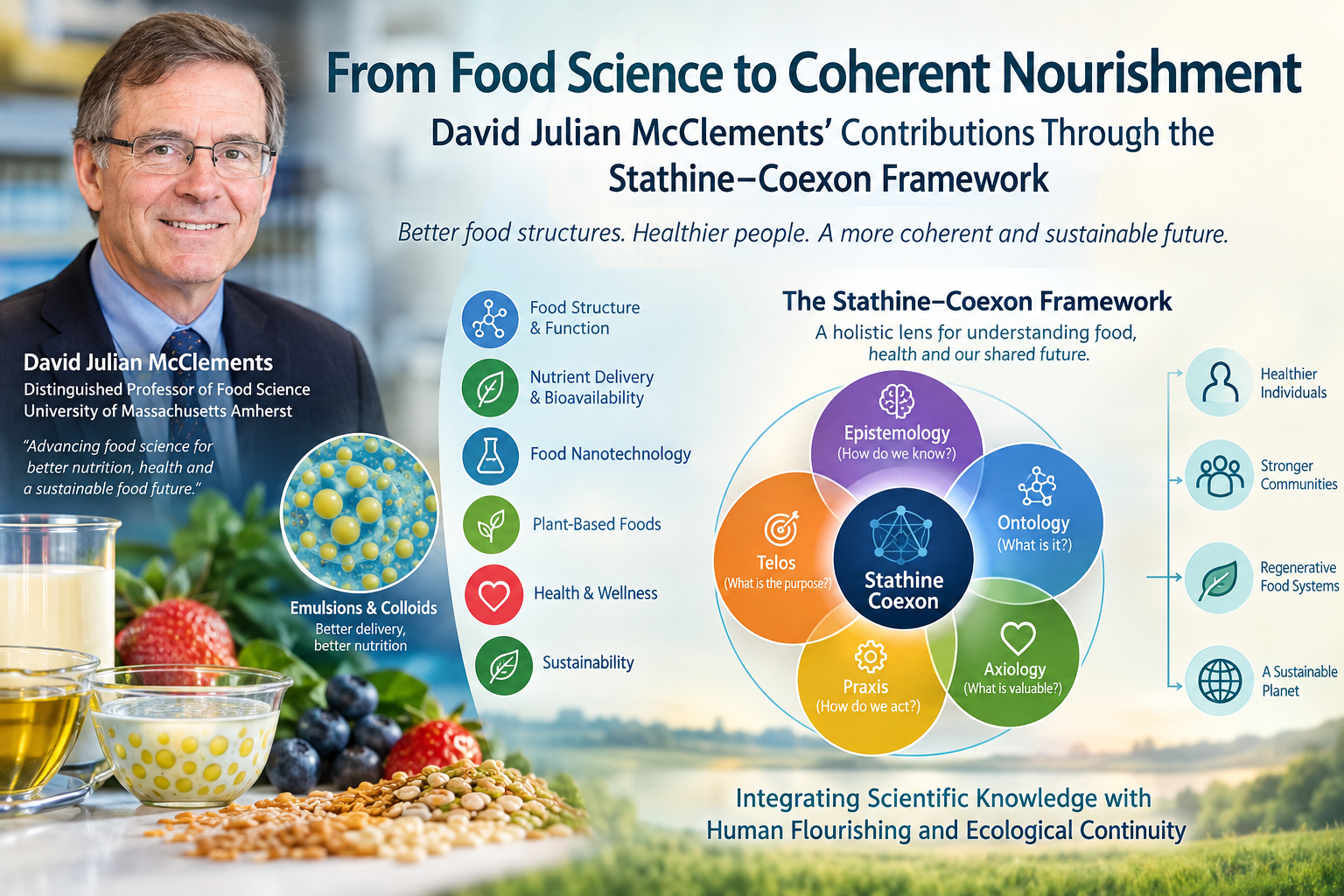
The previously developed Stathine–Coexon evaluation framework — epistemology, ontology, axiology, praxis and telos — can now be applied to spirituality.
Epistemology
How does the spiritual tradition claim to know?
Scripture?
Revelation?
Meditation?
Reason?
Mystical experience?
Community?
Observation?
Tradition?
Ontology
What does the tradition say exists?
God?
Brahman?
Dao?
Emptiness?
Soul?
Spirit?
Nature?
Consciousness?
Axiology
What is valuable?
Love?
Truth?
Compassion?
Liberation?
Justice?
Non-violence?
Service?
Praxis
How is transformation practiced?
Prayer?
Meditation?
Service?
Ritual?
Study?
Discipline?
Contemplation?
Telos
What is the human destination?
Salvation?
Moksha?
Nirvana?
Liberation?
Union?
Harmony?
Flourishing?
Service?
Wisdom?
This provides a rigorous comparative framework without forcing traditions into one doctrinal system.
31. The Stathine–Coexon Contribution Across the Five Dimensions
The framework proposes:
Epistemology
Move from:
belief versus disbelief
toward:
experience → inquiry → reflection → evidence → coherence.
Ontology
Investigate:
Stathine + Coexon + biological existence + relational reality.
Axiology
Prioritize:
truth + compassion + coexistence + flourishing.
Praxis
Transform:
understanding into embodied action.
Telos
Move toward:
increasingly coherent coexistence.
This is where spirituality becomes practical.
32. The Universal Spiritual Practice
If one wanted to extract a non-intrusive practice from the entire framework, it could be reduced to five daily questions:
1. What am I experiencing?
Awareness.
2. What am I assuming?
Epistemic honesty.
3. Where am I contradicting myself?
Coherence.
4. Who else is affected by my existence?
Relationship.
5. What would a more inclusive response look like?
Coexistence.
This practice does not require abandoning one’s religion.
A Hindu can practice it.
A Muslim can practice it.
A Christian can practice it.
A Buddhist can practice it.
A Sikh can practice it.
A Jain can practice it.
A Jew can practice it.
A Daoist can practice it.
An Indigenous practitioner can practice it.
A secular humanist can practice it.
The framework is therefore non-intrusive by design.
33. What It Must Not Become
For this project to remain intellectually and spiritually credible, several boundaries are essential.
It should not become:
A new religion
It should remain a framework for inquiry.
A replacement for existing traditions
It should complement rather than erase.
A claim that all religions are secretly identical
They are not.
A scientific proof of God
The framework cannot establish that.
A scientific proof of Coexon
That remains an open hypothesis.
A dismissal of mystical experience
Experience deserves investigation, not ridicule.
A glorification of mystery
Uncertainty should remain uncertainty.
A relativism in which everything is equally true
Contradictory claims cannot all be literally true in the same sense.
A cultural appropriation machine
Traditions must retain their historical and internal contexts.
These safeguards are not peripheral.
They are necessary for the framework’s integrity.
34. From Religious Competition to Existential Collaboration
Perhaps the greatest social application lies here.
Humanity has often converted differences in spiritual language into competition:
My God versus your God.
My scripture versus your scripture
My path versus your path.
The Stathine–Coexon approach proposes another question:
What existential problem were you trying to solve?
Then:
What did your tradition discover?
Then:
What did another tradition discover?
Then:
Where do the insights genuinely converge?
And finally:
Where do they remain irreducibly different?
This is much more intellectually productive than pretending differences do not exist.
Comparative philosophy increasingly explores precisely this possibility: different traditions can contribute resources to shared philosophical problems without being collapsed into a single worldview. (Stanford Encyclopedia of Philosophy)
35. Spirituality as Humanity Learning About Itself
The most ambitious interpretation of the framework is that humanity’s religions can be understood as a vast distributed experiment in existential understanding.
Over thousands of years, different civilizations asked:
What is reality?
What is consciousness?
What causes suffering?
What is the good life?
What is death?
What is liberation?
What is our relationship with the whole?
They generated different answers.
Some became theology.
Some philosophy.
Some mythology.
Some ritual.
Some meditation.
Some ethics.
Some mystical traditions.
Some poetry.
Some social institutions.
The Stathine–Coexon project can treat this entire history as an immense knowledge archive about human attempts to understand existence.
Not every claim is literally true.
Not every practice is beneficial.
Not every tradition is internally consistent.
But the archive is too valuable to dismiss.
36. The Principle of Spiritual Truth Compression
The framework’s concept of Truth Compression can be extended here.
Suppose multiple traditions independently develop practices involving:
- attention,
- compassion,
- humility,
- service,
- self-observation,
- non-attachment,
- forgiveness,
- remembrance,
- ethical discipline.
One possibility is coincidence.
Another is cultural transmission.
A third possibility is that these practices address recurring features of human cognition and social existence.
The research question becomes:
Can cross-cultural recurrence identify robust structures of human transformation without declaring every tradition metaphysically identical?
That is a legitimate interdisciplinary research programme.
37. Toward a Non-Intrusive Universal Spirituality
The phrase “universal spirituality” should therefore be redefined.
It should not mean:
One God.
or:
One scripture.
or:
One ritual.
or:
One metaphysics.
Instead:
Universal spirituality is the shared human capacity to inquire into existence, transform consciousness, reduce unnecessary suffering, deepen relationship, discover meaning and expand the boundary of coexistence.
Different traditions may express this differently.
The framework does not need to choose prematurely among them.
38. A New Definition of Spiritual Enlightenment
The Stathine–Coexon Framework can consequently offer a deliberately non-mystical definition:
Enlightenment is the progressive reduction of confusion between existence, experience, understanding, identity, relationship and action, accompanied by an expansion of one’s capacity for truthful and compassionate coexistence.
This does not claim to replace traditional definitions of enlightenment.
It offers a comparative framework.
And it creates an important criterion:
If spiritual understanding increases confusion, arrogance, hatred or separation, something has gone wrong in its interpretation or application.
39. The Spirituality of Coexistence
The framework ultimately places coexistence at the centre.
Not coexistence as passive tolerance.
But:
active participation in a larger field of mutually sustaining relationships.
This means:
I exist.
You exist.
We exist together.
Our existence affects other existence.
Understanding that relationship changes how we act.
How we act changes the system.
The system changes what becomes possible for us.
This is the circularity of existence.
40. Conclusion: From Mystery to Meaningful Wonder
Humanity does not need to choose between a spirituality that demands unquestioning belief and a rationalism that dismisses everything beyond measurement.
There is another possibility.
We can retain:
wonder without superstition,
mystery without confusion,
faith without intellectual coercion,
reason without reductionism,
science without scientism,
tradition without dogmatism,
spiritual experience without premature metaphysical certainty.
The world’s spiritual traditions contain enormous diversity. Hinduism, Buddhism, Jainism, Sikhism, Judaism, Christianity, Islam, Daoism, Confucianism, Shinto, Indigenous traditions, African spiritual traditions and many other forms of religious and contemplative life cannot responsibly be compressed into one doctrine. Comparative scholarship itself emphasizes both profound differences and meaningful points of philosophical contact across traditions. (Stanford Encyclopedia of Philosophy)
The contribution proposed by the Stathine–Coexon Framework is therefore not:
“We have discovered what every religion really means.”
It is more modest — and potentially more powerful:
“We can create a common language in which humanity’s many spiritual explorations of existence can be compared, questioned, enriched and expanded without requiring any tradition to surrender its identity.”
Within that language:
Stathine asks us to consider the possibility of a foundational dimension of existence.
Coexon asks whether sentience and information might require a deeper ontological treatment than current models provide.
The brain becomes an interface through which embodied existence interprets and expresses experience.
Attention becomes a mechanism of transformation.
Understanding becomes the progressive reduction of confusion.
Truth Compression becomes the movement toward representations requiring fewer unresolved contradictions.
Creativity becomes the emergence of higher-order coherence.
Compassion becomes expansion of the informational boundary of the self.
Ethics becomes the protection and expansion of mutually viable relationships.
Awakening becomes increasing clarity.
Enlightenment becomes freedom from unnecessary contradiction and separation.
And:
Coexistence becomes the mature expression of understanding.
The deepest promise of this approach is therefore not that spirituality becomes less profound.
It is that spirituality can become more intelligible without becoming less sacred.
Perhaps humanity does not need another religion.
Perhaps it needs a better way of listening to the extraordinary spiritual knowledge it has already accumulated — and of connecting that knowledge with philosophy, science, consciousness research, ecology and lived human experience.
The Stathine–Coexon Framework proposes itself as one such bridge.
Its ultimate test will not be whether it can make every tradition agree.
Its test will be whether it can help human beings understand more without claiming too much, disagree without destroying relationship, experience wonder without surrendering discernment, and expand the meaning of “I” until it naturally includes “we.”
That may be the beginning of a spirituality that is not free of mystery because mystery has been denied, but free of unnecessary mystery because confusion has been reduced.
**The goal is not to explain away the sacred.
The goal is to understand existence clearly enough that the sacred no longer needs confusion to remain profound.**