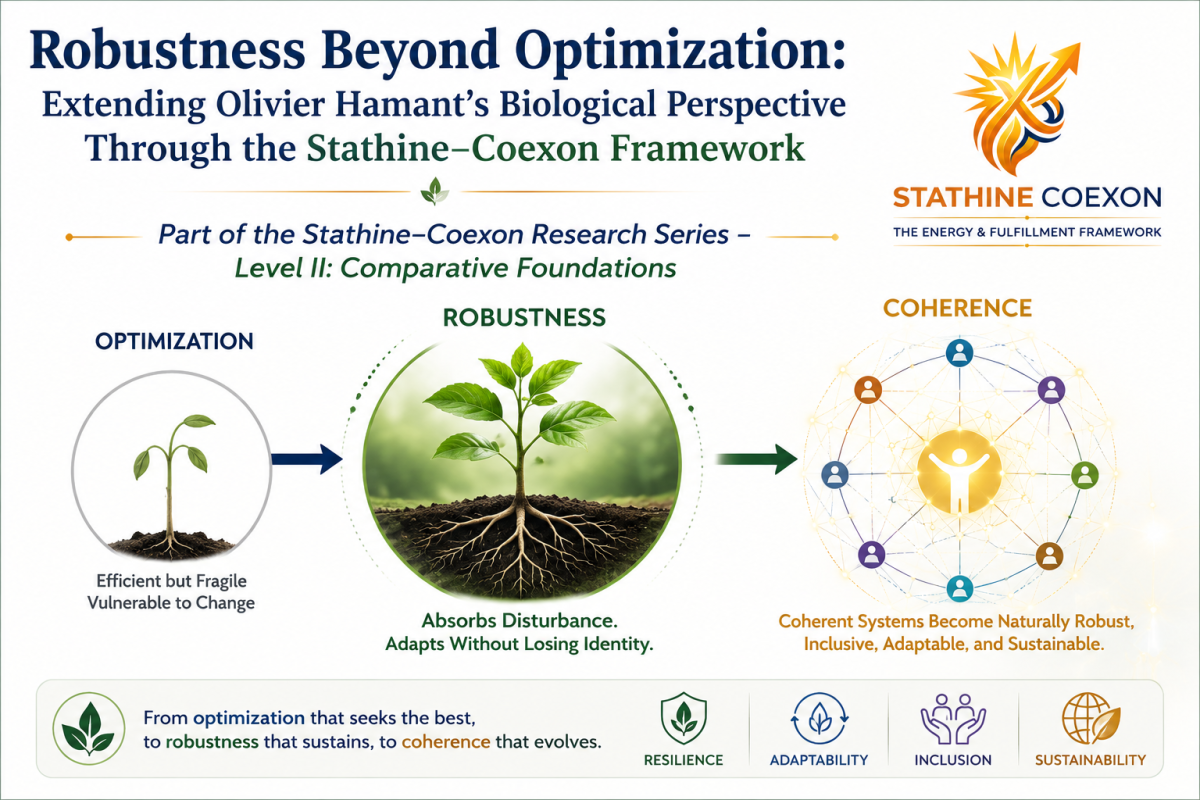
Part of the Stathine–Coexon Research Series – Level II: Comparative Foundations
Abstract
For more than two centuries, scientific and economic thinking has frequently treated optimization as the hallmark of progress. Biological organisms have often been interpreted as systems that maximize efficiency, while human societies have increasingly adopted optimization as the dominant organizing principle in education, economics, technology, and governance. Recent work by French biologist Olivier Hamant challenges this assumption. Through studies in plant biology, developmental systems, and complexity, Hamant argues that living systems persist not because they are perfectly optimized, but because they are robust—capable of maintaining functional integrity amid uncertainty, variability, and continual environmental change.
The Stathine–Coexon Framework arrives at a remarkably compatible conclusion through a different route. Rather than beginning with biological organization, it begins with a proposed ontology of sentience. It hypothesizes that human development consists of the progressive reduction of contradiction and the continual expansion of coherent participation within coexistence. From this perspective, robustness is not merely a biological strategy; it is the natural consequence of increasing coherence across biological, cognitive, relational, and civilizational organization.
This article proposes that Hamant’s concept of robustness and the Stathine–Coexon principle of coherence are complementary rather than competing. Robustness explains how living systems remain functional. The Stathine–Coexon Framework proposes why coherent systems naturally become robust.
1. The Limits of Optimization
Modern civilization has been shaped by optimization.
Factories optimize production.
Businesses optimize profit.
Algorithms optimize engagement.
Educational systems optimize examination performance.
Individuals optimize productivity.
Optimization has generated extraordinary technological progress.
Yet optimization often creates fragility.
A supply chain optimized for efficiency may collapse when a single component fails.
A monoculture optimized for yield becomes vulnerable to disease.
An economy optimized for short-term growth may become unstable under unexpected conditions.
A human life optimized solely for achievement frequently sacrifices resilience, relationships, and meaning.
Olivier Hamant argues that biology rarely pursues perfect optimization.
Instead, evolution repeatedly produces systems capable of functioning under uncertainty.
Plants tolerate environmental fluctuations.
Cells maintain multiple regulatory pathways.
Organisms preserve redundancy rather than eliminating it.
Nature repeatedly sacrifices efficiency to preserve adaptability.
This insight fundamentally changes our understanding of success.
Perhaps the objective of living systems is not maximal performance but enduring participation.
2. Robustness as a Biological Principle
Hamant’s work emphasizes that robustness is not resistance to change.
It is the capacity to remain functional while continuously adapting.
Robust systems absorb disturbance.
They reorganize without losing identity.
They maintain essential function despite changing conditions.
This principle appears across biology.
Genetic networks contain redundancy.
Immune systems continually adapt.
Plant architecture distributes stress.
Ecological systems depend upon diversity rather than uniformity.
The remarkable observation is that robustness frequently appears inefficient when measured by conventional engineering standards.
Nature often maintains multiple pathways where one would appear sufficient.
It preserves variability rather than eliminating it.
It values adaptability over maximal short-term performance.
Robustness therefore represents a fundamentally different organizing philosophy.
3. The Stathine–Coexon Interpretation: Robustness Emerges from Coherence
The Stathine–Coexon Framework proposes that robustness is not an independent objective.
It is an emergent property of coherent organization.
Earlier Foundation papers introduced coherence as the progressive reduction of contradiction across the biological organism, the Coexon, relationships, and participation in coexistence.
Contradiction consumes organizational energy.
Coherence releases it.
When internal contradictions accumulate, systems become increasingly fragile.
Small disturbances generate disproportionate consequences.
Attention fragments.
Decision-making deteriorates.
Relationships become unstable.
Organizations lose adaptability.
Conversely, coherent systems require less energy to maintain themselves.
They possess multiple consistent pathways for responding to novelty.
They reorganize without abandoning identity.
Within this interpretation, Hamant’s robustness becomes the observable biological expression of deeper coherence.
4. Why Coherent Systems Become Robust
The proposed architecture of the Coexon provides one conceptual explanation.
The First Functional Shell stabilizes coherent understanding.
The Second Functional Shell expands possible responses through imagination and visualization.
The Third Functional Shell continually evaluates contradiction and compresses truth into simpler organizing principles.
The Fourth Functional Shell expresses this coherence through relationships and participation.
Because contradiction is continually reduced rather than accumulated, the system becomes increasingly adaptable.
Adaptability no longer depends upon remembering every possible situation.
It depends upon understanding the underlying principles governing many situations.
This is robustness expressed through coherent understanding.
5. Robustness Is Not Rigidity
One of the most important distinctions shared by both perspectives concerns flexibility.
Rigid systems often appear strong.
Yet they fail catastrophically when conditions exceed their design assumptions.
Living systems rarely exhibit such rigidity.
They bend.
They reorganize.
They compensate.
They distribute stress.
Likewise, the Stathine–Coexon Framework proposes that coherent understanding does not become dogmatic.
Instead, increasing coherence permits increasing openness because fewer contradictions require defensive protection.
A coherent person can revise opinions without threatening identity.
A coherent organization can innovate without abandoning purpose.
A coherent civilization can incorporate diversity without losing unity.
Robustness therefore arises from flexibility grounded in coherent organization.
6. Human Development Through Robustness
The implications extend beyond biology.
Education frequently rewards optimization.
Students memorize correct answers.
Organizations reward specialization.
Individuals pursue increasingly narrow measures of success.
Yet these approaches may inadvertently reduce robustness.
The Stathine–Coexon Framework proposes an alternative.
Education should cultivate coherent understanding rather than isolated information.
Learning principles creates adaptability.
Understanding relationships creates transferability.
Reducing contradiction creates lifelong learning.
A robust learner is not the person who remembers the most.
A robust learner is the person who can reorganize understanding when encountering something entirely new.
7. Leadership Beyond Optimization
Organizations frequently optimize performance indicators while neglecting organizational coherence.
Departments compete.
Information becomes fragmented.
Short-term metrics dominate long-term learning.
Hamant’s work suggests that robust organizations maintain diversity, redundancy, and adaptive capacity.
The Stathine–Coexon Framework complements this by proposing that leadership should cultivate coherence rather than control.
Leaders reduce contradiction between purpose, communication, responsibility, and execution.
As coherence increases, organizational robustness emerges naturally.
The organization becomes capable of adapting without constant external intervention.
8. Civilization and the Ecology of Coexistence
Perhaps the greatest contribution of combining these perspectives lies at the level of civilization.
Humanity increasingly confronts interconnected crises involving climate, technology, inequality, misinformation, ecological degradation, and institutional fragmentation.
Optimization alone cannot address systems whose challenges continually evolve.
Robustness becomes essential.
The Stathine–Coexon Framework extends this observation.
Civilizations remain robust not merely because institutions are resilient but because coherent understanding spreads throughout society.
Communities capable of dialogue adapt more effectively than communities trapped within contradiction.
Scientific collaboration becomes more robust than ideological conflict.
Inclusive participation becomes more durable than competitive exclusion.
Robustness therefore becomes a property of coexistence itself.
9. From Robustness to Coherence
The principal distinction between the two frameworks may now be summarized.
Olivier Hamant begins with biology.
The Stathine–Coexon Framework begins with ontology.
Hamant demonstrates that optimization frequently reduces resilience.
The Stathine–Coexon Framework proposes that contradiction reduces coherence.
Hamant explains why living systems preserve redundancy and adaptability.
The Stathine–Coexon Framework explains why coherent understanding naturally generates those same properties.
The relationship is therefore complementary.
Robustness is what coherent organization looks like when observed biologically.
Coherence is the deeper organizational principle from which robustness emerges across biology, cognition, relationships, institutions, and civilizations.
10. Conclusion: Toward a Civilization of Coherent Robustness
The convergence between Olivier Hamant’s work and the Stathine–Coexon Framework points toward a broader scientific insight.
Nature does not endure because it has optimized every component.
Nature endures because it continually preserves the capacity to reorganize without losing coherence.
The Stathine–Coexon Framework extends this principle beyond biological systems.
It proposes that the human being is the dynamic union of a biological organism and a hypothesized Coexon communicating through the brain. As the Coexon progressively reduces contradiction and expands coherent participation, robustness naturally increases. Biological adaptability, psychological resilience, ethical maturity, scientific creativity, and civilizational stability become different expressions of the same underlying process.
Within this integrated perspective, the future of humanity is not defined by becoming increasingly efficient at isolated tasks. It is defined by becoming increasingly coherent participants in coexistence.
Optimization may produce remarkable machines.
Robustness produces enduring organisms.
Coherence, if the Stathine–Coexon hypothesis proves fruitful, may produce flourishing human civilizations.
The deepest lesson shared by both perspectives is therefore profoundly hopeful: lasting progress is achieved not by maximizing immediate performance, but by cultivating the organizational conditions that allow life, understanding, and cooperation to continue expanding in the face of continual uncertainty.