Part of the Stathine–Coexon Research Series – Level II: Comparative and Integrative Studies
A Conceptual Interdisciplinary Proposal for Deepening Awareness-Based Systems Change
Abstract
Otto Scharmer’s Theory U represents one of the most influential contemporary attempts to connect individual awareness, collective learning, leadership, innovation, and systemic transformation. Developed through Scharmer’s research and practice and associated with the Presencing Institute, Theory U proposes that the quality of outcomes produced by a system is deeply connected to the quality of awareness from which its participants operate. Its movement from observing and sensing, through presencing, to crystallizing, prototyping, and performing offers a practical architecture for moving beyond habitual responses toward emerging possibilities. (Presencing Institute)
This article proposes that the Stathine–Coexon Framework can complement and potentially extend Theory U by providing a different ontological and informational interpretation of several phenomena that Theory U describes primarily in experiential, organizational, and systemic terms.
The proposal is deliberately presented as a theoretical extension rather than a claim that Theory U requires correction. Theory U has considerable practical strength precisely because it does not require practitioners to adopt a particular metaphysical ontology. The Stathine–Coexon framework could therefore function as an additional explanatory layer: Theory U describes how transformation can be practiced, while Stathine–Coexon proposes hypotheses about what may be occurring within the individual and collective architecture of understanding during that transformation.
The central proposition of this paper is:
Theory U provides a powerful methodology for moving from habitual reaction toward emerging possibility; Stathine–Coexon proposes that this movement can be understood as a progressive reorganization of information toward greater coherence.
Within this interpretation, sensing becomes information expansion, presencing becomes a temporary reduction of contradictory conditioning, crystallizing becomes the formation of a coherent higher-order pattern, prototyping becomes embodied testing of that pattern, and performance becomes the stabilization of a more coherent relationship between human intention and systemic reality.
The result is not a replacement of Theory U but a proposed Theory U 2.0 conceptual layer: from presencing the emerging future toward cohering with the emerging possibility.
1. Introduction
Human beings encounter reality more through perception and very less directly.
We encounter reality through:
- perception,
- memory,
- assumptions,
- language,
- identity,
- expectations,
- social conditioning,
- emotional states,
- institutional structures,
- and previously learned models.
Consequently, two people can encounter the same event and construct substantially different realities from it.
Organizations behave similarly.
A company can receive the same market information as its competitors yet interpret it differently.
A government can possess the same scientific evidence as another government yet construct a different policy response.
A community can experience the same ecological crisis yet organize itself around entirely different narratives.
The fundamental challenge is therefore not simply a lack of information.
It is:
How does a system transform information into understanding, and how does understanding become collective action?
This question lies close to the heart of Theory U.
The Presencing Institute describes Theory U as a framework combining systems thinking, innovation, transformational leadership, and awareness practices. Its central process involves moving beyond habitual patterns of attention toward deeper sensing and then bringing emerging possibilities into action. (Presencing Institute)
The Stathine–Coexon Framework approaches the same territory from a different direction.
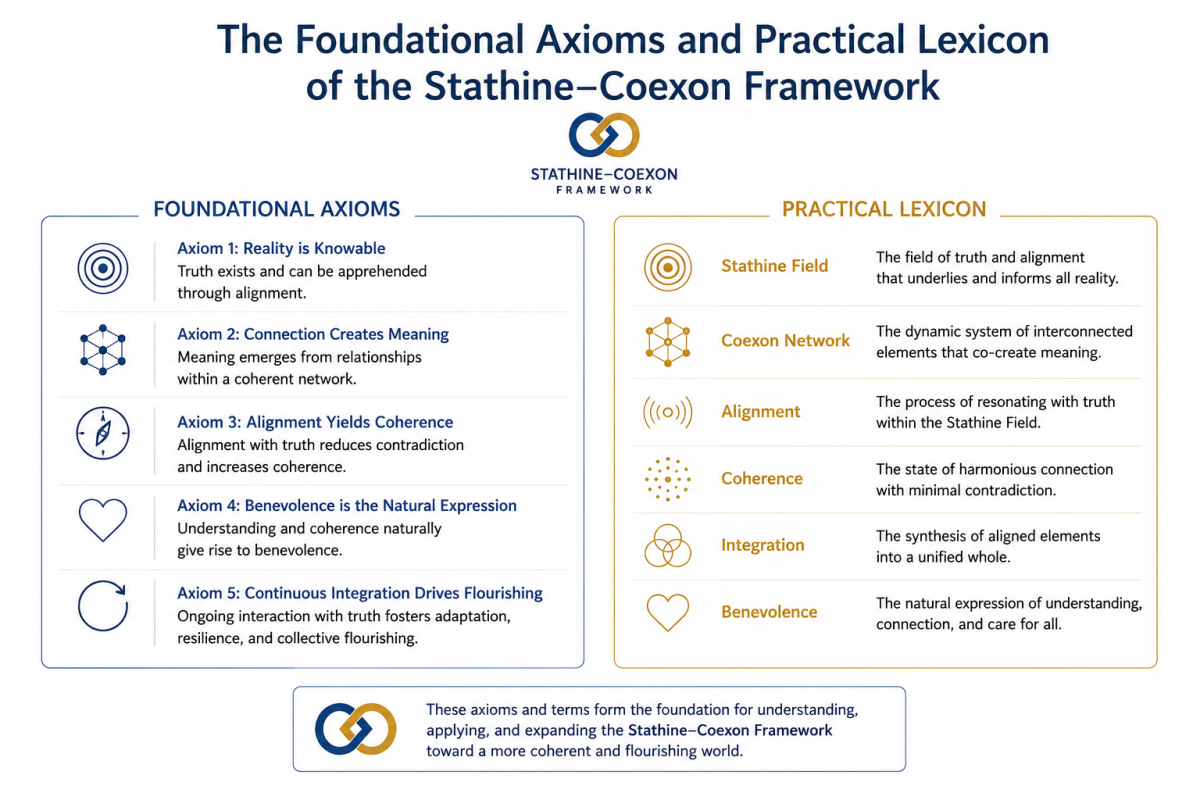
Its foundational proposition is that existence can be understood through two complementary concepts:
Stathine — the proposed universal, continuous field of existence.
Coexon — a proposed sentient organizing entity associated with living beings and their capacity for information integration, understanding, and expression.
These remain hypotheses rather than established scientific facts.
The value of placing them alongside Theory U is therefore not to claim empirical validation, but to ask:
Could the Stathine–Coexon hypothesis provide an ontological and informational interpretation of the transformation processes that Theory U describes phenomenologically and practically?
This article argues that the answer may be yes.
2. Theory U: What It Gets Profoundly Right
Any attempt to extend Theory U should begin by acknowledging its considerable strengths.
Theory U is not simply another change-management technique.
It identifies a problem that conventional organizational transformation frequently misses:
People attempt to create new outcomes while continuing to operate from old patterns of attention and interpretation.
Changing structures without changing the consciousness from which those structures are generated can reproduce the same problems in a new form.
The Presencing Institute describes the U process as moving down the left side through connecting with the world beyond one’s organizational bubble, reaching a point where habitual assumptions are suspended, and then moving upward through emerging possibility toward new action. (Presencing Institute)
This is a profound insight.
It means that transformation is not simply:
old strategy → new strategy.
It is:
old way of seeing → deeper seeing → changed awareness → new possibility → experimentation → new reality.
3. The First Major Contribution: Attention Creates Possibility
One of Scharmer’s most important contributions is the emphasis on how we attend.
The Presencing Institute describes Theory U as emphasizing that what we pay attention to, and how we pay attention, are central to what we create. (Presencing Institute)
This has enormous implications.
Attention is not passive.
What we attend to determines:
- what information enters our decision process,
- what relationships become visible,
- which possibilities appear credible,
- which risks appear important,
- and which futures we consider possible.
Therefore:
attention is an economic, organizational, political, and civilizational resource.
This is one of the points at which Stathine–Coexon can provide an interesting extension.
4. Attention as Information Selection
Within the Stathine–Coexon framework, the brain is conceptualized as a biological communication interface through which information is received, integrated, interpreted, and expressed.
The Coexon hypothesis proposes that the biological organism does not merely generate isolated cognition but participates in a larger informational relationship.
This creates a possible interpretation of Theory U:
The U process changes the quality and breadth of information available to the system’s process of understanding.
At the beginning of the U, the individual or group is often constrained by a pre-existing model.
The system sees what it already expects to see.
Scharmer’s concept of the blind spot addresses precisely this problem: the difficulty of seeing the inner place from which one is operating. (Presencing Institute)
Stathine–Coexon would describe this as a limitation in the information architecture of understanding.
5. Downloading and Coherence
Theory U identifies a habitual mode sometimes described as downloading: relying on familiar mental models and reproducing existing interpretations.
From the Stathine–Coexon perspective, downloading can be interpreted as:
reusing an existing informational configuration before adequately processing new information.
This is important because prior understanding is necessary.
Without memory, cognition becomes impossible.
But excessive dependence on prior understanding produces rigidity.
The system stops learning.
Thus:
memory enables continuity.
over-identification with memory produces repetition.
This distinction is central to the proposed synthesis.
6. Seeing Reality Differently
Theory U then asks participants to move from habitual observation toward deeper seeing.
This is not merely gathering more facts.
It involves encountering reality with fewer preconceived conclusions.
The Presencing Institute describes the left side of the U as connecting beyond one’s organizational bubble and expanding perception. (Presencing Institute)
In Stathine–Coexon terminology, this can be interpreted as:
expansion of the information field available to understanding.
The system becomes exposed to:
- previously excluded stakeholders,
- contradictory evidence,
- unfamiliar perspectives,
- embodied signals,
- environmental information,
- and previously invisible relationships.
The apparent problem may therefore begin to change.
7. Sensing as Information Expansion
This gives us a useful correspondence:
Theory U expanded using Stathine–Coexon interpretation
Downloading Reproduction of existing informational pattern
Seeing Expansion of accessible information
SensingIntegration of distributed information
PresencingReorganization of the relationship to information
CrystallizingEmergence of a higher-order pattern
PrototypingTesting the pattern against reality
PerformingStabilizing the viable pattern
This table should not be understood as claiming that Scharmer defines these concepts in Stathine–Coexon terms.
It is a proposed comparative interpretation.
8. The Social Field
Theory U places the concept of the social field at its center. The Presencing Institute describes the social field as a core concept in Theory U and presents the theory as an evolving body of practice for transforming self, society, and systems. (Presencing Institute)
This is especially significant for the Stathine–Coexon framework.
Why?
Because the Coexon hypothesis does not conceptualize the individual as an isolated cognitive machine.
The individual is embedded in relationships.
Information flows:
person ↔ person
person ↔ group
group ↔ institution
institution ↔ society
society ↔ ecological environment
The social field can therefore be interpreted as a distributed information and meaning environment.
9. From Social Field to Coherence Field
The Stathine concept allows a further conceptual step.
If Stathine represents the universal field of existence, then social fields can be understood as localized relational patterns within that larger field.
The Coexon, meanwhile, represents the proposed sentient organizing participant.
The resulting architecture becomes:
Stathine
↓
distributed field of relationships
↓
social field
↓
individual Coexons / sentient participants
↓
biological interfaces
↓
perception → interpretation → expression
This is a proposed hypothesis.
But as a theoretical model, it offers an interesting way of connecting individual transformation with systemic transformation.
10. Presencing: The Central Contribution of Theory U
The heart of Theory U is presencing.
The Presencing Institute describes presencing as a combination of presence and sensing: a shift from ego-centric toward eco-centric awareness and an orientation toward emerging future possibility. (Presencing Institute)
This is arguably Theory U’s most distinctive contribution.
It suggests that transformation requires more than analytical prediction.
There are moments when the system must become sufficiently quiet to perceive a possibility that does not yet exist in its established structure.
This is a powerful idea.
11. Stathine–Coexon Interpretation of Presencing
The Stathine–Coexon framework proposes an interpretation:
Presencing may be understood as a state in which previously dominant informational patterns temporarily lose their control over interpretation, allowing previously excluded relationships and possibilities to become available for integration.
This does not require claiming supernatural access to the future.
The “emerging future” can be understood epistemically.
The future is not necessarily known.
Rather:
the system becomes capable of recognizing possibilities that its previous model could not see.
This is an important distinction that makes the the framework intellectually rigorous. The pausibility seems more realisable.
12. From Future Prediction to Future Sensitivity
The Stathine–Coexon interpretation therefore does not require the Coexon to literally predict the future.
Instead, it proposes that a sufficiently coherent information-processing system may become more sensitive to:
- weak signals,
- emerging patterns,
- unmet needs,
- latent relationships,
- environmental changes,
- and new combinations of existing knowledge.
The “future” then emerges as a possibility-space.
Theory U provides the practice for becoming sensitive to that space.
Stathine–Coexon proposes a possible ontology for understanding why such sensitivity does occur.
13. The Bottom of the U: Suspension
At the bottom of the U, habitual assumptions are suspended.
This is crucial.
Without suspension, the system merely uses new information to reinforce existing conclusions.
A person may hear a radically different idea and immediately classify it:
“That will not work.”
The information has entered the sensory field but failed to enter the process of understanding.
Suspension creates a temporary opening.
14. Suspension as Coherence-Preserving Forgetting
Here Stathine–Coexon contributes one of its more distinctive propositions.
The framework proposes that forgetting is not necessarily a defect.
It may be necessary for maintaining coherence.
If every piece of information remains equally active, the system becomes overloaded.
Therefore:
forgetting may be a mechanism through which the information architecture protects its capacity to integrate what matters.
Theory U’s suspension can be interpreted as a conscious analogue of this principle.
The practitioner temporarily reduces the dominance of established patterns.
This creates room for new information to reorganize the system.
15. The Difference Between Emptying and Erasing
An important distinction is required.
Suspension does not mean:
forget everything.
It means:
Modify existing conclusions to upgrade the interpretation in light of the new information that has been encountered.
Likewise, Stathine–Coexon forgetting does not mean deleting knowledge indiscriminately.
It means reducing the energetic or attentional dominance of information that in no longer contributing to the current context .
This creates a beautiful correspondence between Theory U and the proposed information architecture of the Coexon.
16. The Opening of Mind, Heart, and Will
Theory U famously emphasizes three dimensions of opening:
- open mind
- open heart
- open will
The Presencing Institute describes the movement through the U as involving an opening of mind, heart, and will. (Presencing Institute)
This is one of the framework’s greatest strengths.
It recognizes that systemic transformation cannot be achieved through cognition alone.
A person may intellectually understand another person’s situation while remaining emotionally disconnected.
A person may feel compassion without understanding systemic causes.
A person may understand and empathize but remain unwilling to act.
Transformation requires all three.
17. The Three-Brain Interpretation
This provides an especially interesting bridge to the Stathine–Coexon framework’s concept of the three brains:
- head,
- heart,
- gut.
The language of “three brains” should be used carefully in an academic context.
There are established neural and neurobiological structures associated with the heart and gastrointestinal system, including extensive peripheral and enteric nervous systems. These three brains have thier own unique roles to play in the proper functioning of the unit (Homo Sapien) as a cohesive whole.
Therefore the Stathine–Coexon formulation should treat “head, heart, and gut” as a functional model of distributed bodily intelligence, Which are being explored as per the current neurological advances in the research being done. We can give them a name that is differrent from the current term brain.
Within that model:
Head
Understanding and analytical representation.
Heart
Relational and affective significance.
Gut
Embodied intuition, regulation, and action-readiness.
Theory U’s open mind, open heart, and open will can therefore be mapped conceptually onto this tripartite model.
Neuroscience is advancing in these areas and can be a potentially useful interdisciplinary collaboration.
18. From Open Mind to Understanding
The first opening corresponds naturally to the Coexon’s proposed first functional shell:
conclusive understanding.
The system asks:
What is actually happening?
Not:
What do I already believe is happening?
This distinction is foundational.
19. Open Heart as Relational Meaning
The second opening can correspond to the second functional domain:
visualization, imagination, and relational meaning.
Information is no longer treated as abstract data.
The system asks:
What does this mean for others?
What might another person be experiencing?
What relationships become visible when I change perspective?
This expands the information architecture from individual cognition toward relational cognition.
20. Open Will as Embodied Possibility
The third opening concerns action.
The system asks:
What am I willing to allow to emerge?
This corresponds to moving from understanding toward embodiment.
The Coexon model proposes that understanding must ultimately become expression through the biological organism.
Therefore:
a possibility that cannot enter behaviour remains only a mental configuration.
Theory U’s right-hand movement addresses this transition.
21. Crystallizing: From Possibility to Pattern
After presencing comes crystallizing.
The future possibility begins to take form.
The Presencing Institute’s current practice materials describe crystallizing and co-imagining as the movement in which what has been sensed begins to take shape. (Presencing Institute)
The Stathine–Coexon interpretation is:
crystallization is the formation of a higher-order informational pattern from previously distributed signals.
This is where the framework’s concept of truth compression becomes relevant.
22. Truth Compression and Theory U
The Stathine–Coexon framework proposes:
Truth requires less informational complexity than contradiction.
The proposition is conceptual rather than a demonstrated physical law.
Its practical meaning is that when contradictions are reduced, many fragmented pieces of information can sometimes be represented through a simpler, more coherent model.
This is what crystallization may accomplish.
The system moves from:
many observations
→ many interpretations
→ many possibilities
→ one or several coherent hypotheses.
23. Creativity as Coherence
This leads directly to another foundational Stathine–Coexon proposition:
Creativity is not novelty for novelty’s sake. It is the spontaneous emergence of higher-order coherence after contradiction has been reduced.
This complements Theory U remarkably well.
The U process does not simply ask people to invent something unusual.
It creates conditions in which a new configuration can emerge from deeper sensing.
Therefore:
Theory U provides the social practice; Stathine–Coexon provides a possible informational interpretation of why creativity can emerge from deeper coherence.
24. Prototyping as Reality Testing
Theory U then moves into prototyping.
This is essential because insight can be seductive.
A beautiful idea may still be wrong.
The prototype therefore brings the emerging pattern back into contact with reality.
This is where Stathine–Coexon adds the continuity loop.
A insight cannot be considered true merely because it feels coherent. It has to be open to keep improving and open.
It must survive:
- observation,
- experimentation,
- criticism,
- comparison,
- and replication.
This is crucial for maintaining the reality of prescensing .
25. Coherence Is Not Truth
One of the most important critical distinctions in the proposed synthesis is:
Coherence is evidence of a potentially better model, not proof of truth.
A false theory can be internally coherent.
A conspiracy theory can be highly coherent within its own assumptions.
Therefore the framework must distinguish:
internal coherence
from
empirical adequacy.
Theory U’s prototyping process provides one practical mechanism for making that distinction.
26. Prototyping as Coexon Validation
The proposed Coexon architecture can therefore be expressed as:
intuition
→ hypothesis
→ prototype
→ observation
→ feedback
→ correction
→ improved coherence.
This is essentially a learning loop.
It prevents “emerging future” from becoming an excuse for untestable speculation.
27. Performing: Stabilizing the New Pattern
The final stage is performing.
A new insight must become embedded in:
- relationships,
- institutions,
- technologies,
- practices,
- policies,
- and daily behaviour.
The Presencing Institute presents Theory U as a method for moving from sensing and emerging possibility into concrete systemic change. (Presencing Institute)
Stathine–Coexon adds:
a coherent pattern becomes meaningful only when it can sustain itself through expression and feedback.
28. The Biological Interface
This is where the previous biological chapters of the Stathine–Coexon research series become particularly relevant.
The biological brain can be interpreted as an interface between:
internal understanding
and
external expression.
If the Coexon hypothesis is correct, the brain would not be the sole origin of consciousness but an important biological interface through which the Coexon’s informational organization interacts with embodied life.
Again, this is a hypothesis that theory U uses in an excellent real world examples.
Within Theory U, the transformation occurs through changes in awareness and action.
Within Stathine–Coexon, the same process can be interpreted as:
reorganization of the information architecture expressed through the biological interface.
29. Theory U and the Stathine Field
Theory U emphasizes the social field.
Stathine provides a possible broader ontological field.
The relationship can be represented:
Stathine
→ universal field
Social field
→ relational human configuration
Coexon
→ proposed sentient organizing participant
Brain/body
→ biological communication interface
Action
→ expression into the world
This creates a nested architecture.
30. Ego-to-Eco and Coexistence
Theory U’s movement from ego-system awareness to eco-system awareness is another major point of convergence.
The Presencing Institute explicitly frames one of the central divides as the movement from ego to eco: from narrow immediate interests toward concern for the whole, the planet, and future generations. (Presencing Institute)
Stathine–Coexon can interpret this as:
movement from isolated identity toward recognition of relational existence.
The individual does not cease to exist.
The individual becomes more accurately situated within the system.
This is an important validation.
31. Coexistence Rather Than Self-Erasure
The Stathine–Coexon concept of coexistence suggests that the goal is not:
dissolve the individual into the collective.
Nor is it:
maximize individual autonomy regardless of collective consequences.
Instead:
maintain distinct identities while increasing coherence among them.
This is potentially a useful refinement of ego-to-eco.
The movement is not:
ego → disappearance
but:
isolated ego → relational self → coherent participation.
32. From Ego Protection to Inclusive Coherence
Human beings often defend existing identities because identity provides continuity.
The problem arises when identity becomes more important than understanding.
A person then interprets contradictory evidence as a threat.
In Stathine–Coexon terms:
ego protection becomes an information-filtering mechanism.
Information that supports identity is admitted.
Information that modifies identity is validated and appreciated.
Theory U’s suspension provides a practice for interrupting this process.
Coexon theory proposes a deeper interpretation:
the system must let identity dominance so that a larger ecosystem can always be in the vision.
33. Absencing and Incoherence
Theory U also contrasts presencing with absencing.
The Presencing Institute explicitly identifies this as a central distinction in its introductory materials. (Presencing Institute)
The Stathine–Coexon framework could interpret absencing as a state of progressive informational disconnection.
Potential characteristics include:
- fragmentation,
- defensive identity,
- inability to listen,
- exclusion of relevant information,
- repetitive reaction,
- and escalating contradiction.
The important point is that this need not be treated as moral failure.
It can be treated as a system state.
34. A New Interpretation of Absencing
The synthesis therefore proposes:
Absencing is the progressive loss of access to information required for coherent participation.
Presencing, conversely, becomes:
the restoration and expansion of the informational relationships required for coherent participation.
This provides Theory U with a possible information-theoretic interpretation.
35. The U as a Coherence Cycle
The entire U can therefore be reframed:
Down the U
Expand information.
Bottom of the U
Suspend dominant contradictions.
Turning point
Allow a higher-order pattern to emerge.
Up the U
Test and embody the new pattern.
Continuous cycle
Learn and reorganize again.
This makes the U not a one-time transformation process but a recursive coherence cycle.
36. Theory U as a Practical Method, Stathine Coexon as a Proposed expansion
This distinction is perhaps the most important contribution of the paper.
Theory U is useful without requiring belief in Coexon.
Organizations can practice:
- deep listening,
- sensing,
- presencing,
- reflection,
- co-creation,
- prototyping,
without knowing the answers to the funcioning.
The Stathine–Coexon framework can help understand the logic of the working:
Stathine–Coexon can be offered as a hypothesis that may explain some of the experiential phenomena that Theory U has already operationalized through practice.
That makes the relationship complementary and fulfilling.
37. What Stathine–Coexon Potentially Adds
The proposed extension contributes five major elements.
37.1 Ontology
It asks what kind of entity participates in the process of awareness.
37.2 Information architecture
It asks how information is organized, retained, forgotten, integrated, and expressed.
37.3 Biological interface
It proposes a relationship between Coexon and the brain/body.
37.4 Coherence
It provides a unifying criterion for evaluating emerging possibilities.
37.5 Truth compression
It proposes that reduction of contradiction may allow simpler, more integrated models to emerge.
They are possible explanatory layers for Theory U.
38. What Theory U Gives Stathine–Coexon
The relationship works in the opposite direction as well.
Theory U provides something the Stathine–Coexon framework needs enormously:
practice.
Theory U provides a mature body of practices around:
- listening,
- awareness,
- sensing,
- dialogue,
- collective reflection,
- prototyping,
- and systemic transformation.
MIT’s U-Lab materials explicitly frame Theory U around personal, relational, and societal practices, connecting awareness with innovation and sustainability. (MIT OpenCourseWare)
This creates an important research opportunity for expansing the Stathine Coexon explanations.
39. From Philosophy to Experiment
The Stathine–Coexon framework can therefore ask:
What measurable changes occur when people practice Theory U?
Possible measurements include:
- cognitive flexibility,
- attentional breadth,
- empathy,
- interoceptive awareness,
- collaborative behaviour,
- network connectivity,
- creativity,
- decision quality,
- stress regulation,
- organizational trust,
- and systemic outcomes.
The framework can then ask:
Which changes can be explained through established neuroscience and psychology, and which — if any — require a new theoretical model?
This will be the correct scientific order.
40. A Proposed Research Architecture
A future empirical programme could contain four layers.
Layer 1 — Established science
Measure known psychological, neurological, physiological, and social changes.
Layer 2 — Theory U process
Document how participants move through sensing, presencing, crystallizing, prototyping, and performing.
Layer 3 — Coherence metrics
Measure changes in contradiction, integration, information diversity, and decision alignment.
Layer 4 — Coexon hypothesis
Investigate whether observations remain unexplained by established models and whether the Coexon hypothesis generates testable predictions.
41. The Coherence Hypothesis
A central testable proposition could be:
Individuals and groups that successfully suspend habitual assumptions, integrate more diverse information, and reduce contradiction should demonstrate measurable improvements in adaptive decision-making and creative problem-solving.
These results that have been checked in many cases by the practitioners of theory of U. The stathine coexon hypothesis helps explain the why about this happenning. Thus these can form the basis of the epistomololgy of the framework.
42. A Stronger Coexon Hypothesis
A natural hypothesis would be:
Some aspects of conscious integration cannot be adequately explained by current biological and computational models and are better explained by a distributed informational relationship between biological systems and a nonlocal organizing entity.
This is holistic and inclusive.
It would require experiencing by a critical mass in every group practicing.
The framework explicitly acknowledges this.
A credible interdisciplinary research programme must be checked on these dimensions:
43. Why This Distinction Matters
The greatest danger in interdisciplinary frameworks is conceptual inflation.
A useful metaphor can easily become a scientific claim.
A compelling subjective experience can easily become an ontological conclusion.
A philosophical proposition can easily be presented as empirical fact.
The Stathine–Coexon research programme is taking the following approach which should help.
It says:
Here is what we observe.
Here is what existing science explains.
Here is what remains unexplained.
Here is the hypothesis we propose.
Here is the experiment that could prove us wrong.
That is the appropriate scientific posture.
44. Toward Theory U 2.0
With this discipline, the Stathine–Coexon framework could contribute to what might provisionally be called:
Theory U 2.0: The Coherence Architecture of Emerging Futures
The proposed extension would retain Theory U’s central practice while adding an information architecture.
The movement would become:
Observe
→ expand the information field
Sense
→ integrate distributed signals
Presencing
→ suspend dominant interpretive constraints
Crystallize
→ compress emerging information into a coherent hypothesis
Prototype
→ test the hypothesis against reality
Perform
→ embody and stabilize what works
Learn
→ reorganize continuously.
45. From Presencing to Coherencing
The most distinctive linguistic proposal of this paper is therefore:
Presencing enables the emergence of possibility.
Coherencing enables the integration of that possibility into a viable whole.
Presencing asks:
What wants to emerge?
Coherencing asks:
What can emerge without creating new contradictions that undermine the whole?
This is not a replacement for presencing.
It is its proposed second question.
46. Why Coherencing Matters
A new idea can be brilliant but destructive.
A technological breakthrough can solve one problem while creating three others.
A policy can improve one population while harming another.
A business innovation can create enormous value while externalizing ecological costs.
Therefore:
emergence alone is insufficient.
The emerging future must also be evaluated for systemic coherence.
This is where the Doughnut Economics paper developed earlier in this research series becomes relevant as well.
The emerging possibility should be evaluated against:
- human needs,
- ecological boundaries,
- stakeholder relationships,
- long-term consequences,
- and systemic coherence.
47. Theory U + Stathine–Coexon + Doughnut Economics
A broader synthesis is therefore possible.
Theory U
How do we sense and bring forth emerging possibility?
Stathine–Coexon
How might sentient information systems reorganize toward coherence?
Doughnut Economics
Does the emerging configuration enable human flourishing within ecological limits?
Together:
Sense → Coherize → Test → Regenerate.
This could become a powerful interdisciplinary architecture.
48. The Role of Leadership
Leadership under this synthesis changes dramatically.
The leader is no longer primarily:
the person who knows the answer.
The leader becomes:
the person who can create the conditions under which the system can perceive, integrate, and act upon better information.
This is highly consistent with Theory U’s emphasis on awareness-based leadership. Scharmer is currently a Senior Lecturer at MIT Sloan and chairs the MIT IDEAS program, while the Presencing Institute continues to develop Theory U as a framework for systemic transformation. (MIT Sloan)
The Stathine–Coexon framework adds:
leadership becomes coherence facilitation.
49. The Leader as Information Architect
A mature leader therefore asks:
- Who is not being heard?
- What information is missing?
- Which assumptions are operating invisibly?
- What contradictions are being protected?
- Which relationships have been ignored?
- What future possibility is emerging?
- What evidence would disprove our interpretation?
This is a fundamentally different conception of leadership.
50. Organizational Transformation
Organizations often attempt transformation by changing:
- structures,
- processes,
- technologies,
- incentives.
But if the underlying information architecture remains unchanged, the organization may reproduce the same behaviour.
Theory U addresses this by transforming awareness.
Stathine–Coexon adds:
transform the architecture through which information becomes organizational understanding.
That means changing:
- what information enters,
- who interprets it,
- how contradictions are surfaced,
- how knowledge is retained,
- how obsolete assumptions are released,
- and how new patterns are tested.
51. Learning Organizations
This provides a natural bridge to Peter Senge’s work on learning organizations, which is also closely associated with Scharmer’s intellectual ecosystem.
The learning organization does not simply accumulate information.
It changes its underlying models.
The Stathine–Coexon contribution would be:
learning occurs when the system changes the configuration through which information is interpreted.
This is deeper than adding knowledge.
52. The Individual Version of the U
The same process applies personally.
A person may begin with:
“This is who I am.”
Then encounter contradictory experience.
Instead of defending the existing identity:
observe
→ listen
→ suspend
→ sense
→ reorganize
→ experiment
→ integrate.
This is personal development as recursive coherence.
53. Awakening as Coherence Expansion
This also connects with the Stathine–Coexon concept of awakening.
Awakening need not mean acquiring supernatural knowledge.
It can be defined operationally as:
the progressive expansion of the information and relational field available to understanding, accompanied by decreasing dependence on defensive and contradictory interpretations.
Theory U provides a practical process for such expansion.
Stathine–Coexon provides a theoretical language for it.
54. The Ultimate Direction: From Ego to Coexistence
The deepest convergence between the frameworks may therefore be summarized as:
ego-centric perception
→ systemic awareness
→ relational sensing
→ presencing
→ coherence
→ coexistence
This is not the elimination of self.
It is the expansion of self-understanding from:
“I exist independently.”
toward:
“I exist within relationships that continuously shape and are shaped by my existence.”
55. Conclusion
Theory U deserves recognition not because it provides a final theory of consciousness or reality, but because it has created a remarkably practical bridge between awareness and systemic transformation.
Its enduring contribution is the recognition that changing outcomes requires changing the quality of attention from which action arises.
Its movement from observing, to sensing, to presencing, to crystallizing, prototyping, and performing provides a disciplined process for moving beyond habitual reaction toward emerging possibility. (Presencing Institute)
The Stathine–Coexon Framework can complement this contribution by asking a deeper question:
What is happening to information and understanding while a person or collective moves through the U?
The proposed answer is that the system may be undergoing a progressive reorganization toward coherence.
The movement down the U expands the information field.
Suspension reduces the dominance of inherited interpretations.
Presencing creates space for previously inaccessible relationships and possibilities.
Crystallization compresses distributed information into emerging patterns.
Prototyping tests those patterns against reality.
Performing embeds viable patterns into the world.
Learning begins the cycle again.
This creates a powerful conceptual correspondence:
Theory U describes the practice of transformation.
Stathine–Coexon proposes an information-and-consciousness architecture that may help explain the transformation.
The two therefore need to complement each other.
Coexon does not need Theory U to remain conceptually interesting.
But together they generate a richer research question:
Can the transformation of individual and collective awareness be understood as a measurable reorganization of information toward greater coherence?
If the answer is yes, Theory U may become not only a methodology for leadership and systems change but also an important experimental environment for investigating the deeper hypotheses of the Stathine–Coexon Framework.
The most important extension proposed here is therefore not another metaphysical claim.
It is a methodological one:
Use Theory U as a living laboratory.
Study what happens when people genuinely:
observe without immediately judging,
sense beyond their habitual boundaries,
suspend inherited conclusions,
open mind, heart, and will,
allow new patterns to emerge,
prototype those patterns,
test them against reality,
and learn from the results.
Then ask, scientifically:
What changed?
What changed in attention?
What changed in cognition?
What changed in emotion?
What changed in relationships?
What changed in decision-making?
What changed in organizations?
What changed in the quality of collective action?
And finally:
Is everything observed explainable through existing neuroscience, psychology, social science, and systems theory — or does something genuinely new need to be added to our ontology?
That is where the Stathine–Coexon Framework can help in the interdisciplinary study of existential reality.
On inquiry.
And perhaps the deepest synthesis can be expressed in one sentence:
Theory U teaches us how to become available to the future; Stathine–Coexon proposes that this availability may be the beginning of a deeper process through which consciousness reorganizes information into greater coherence — and through coherence, transforms what becomes possible.
Selected References and Further Reading
Otto Scharmer and Theory U
- Presencing Institute — Theory U — official overview of Theory U, its five movements, applications, and associated resources.
- Presencing Institute — Presencing — official explanation of presencing and the movement from ego-centric toward eco-centric awareness.
- Presencing Institute — Theory U Introduction — introductory materials covering the framework’s assumptions, methods, and four levels of operating.
- MIT Sloan — Otto Scharmer — Scharmer’s MIT faculty profile.
- MIT OpenCourseWare — U-Lab: Leading Profound Innovation for a More Sustainable World — academic course materials associated with Theory U.
- Presencing Institute — Social Field Foundations — development of the social-field dimension of Theory U.
Books
Scharmer’s principal works include Theory U: Leading from the Future as It Emerges, The Essentials of Theory U, and Leading from the Emerging Future: From Ego-System to Eco-System Economies. The Presencing Institute provides current information about these works. (Presencing Institute)
Position within the Stathine–Coexon research programme
This paper can be positioned as a Level II Comparative Paper in the Stathine–Coexon research series:
Level I — Foundations
Ontology, axioms, lexicon, coherence, truth compression.
Level II — Comparative Frameworks
Theory U, Doughnut Economics, Active Inference, IIT, Global Workspace Theory, Holobiont Theory, Michael Levin, Rupert Sheldrake, Karl Friston, Donald Hoffman, Stephen Wolfram and others.
Level III — Applications
Leadership, economics, education, AI alignment, organizational design, healthcare, creativity, relationships and civilizational transformation.
The distinctive contribution of the Theory U comparison is that it potentially provides the Stathine–Coexon framework with something particularly valuable: a mature experiential methodology through which the hypothesis of progressive coherence can be explained along with the results supported reasoning.