Praxis of the Stathine–Coexon Framework: From Understanding to Coherent Action
Part of the Stathine–Coexon Research Series — Five-Dimensional Evaluation
Dimension IV: Praxis
Abstract
The fourth dimension in the five-dimensional evaluation of the Stathine–Coexon Framework is praxis: the translation of knowledge, ontology, and values into action. If epistemology asks how human beings know, ontology asks what they are, and axiology asks what they ought to value, praxis asks the decisive practical question: How should a human being act within reality?
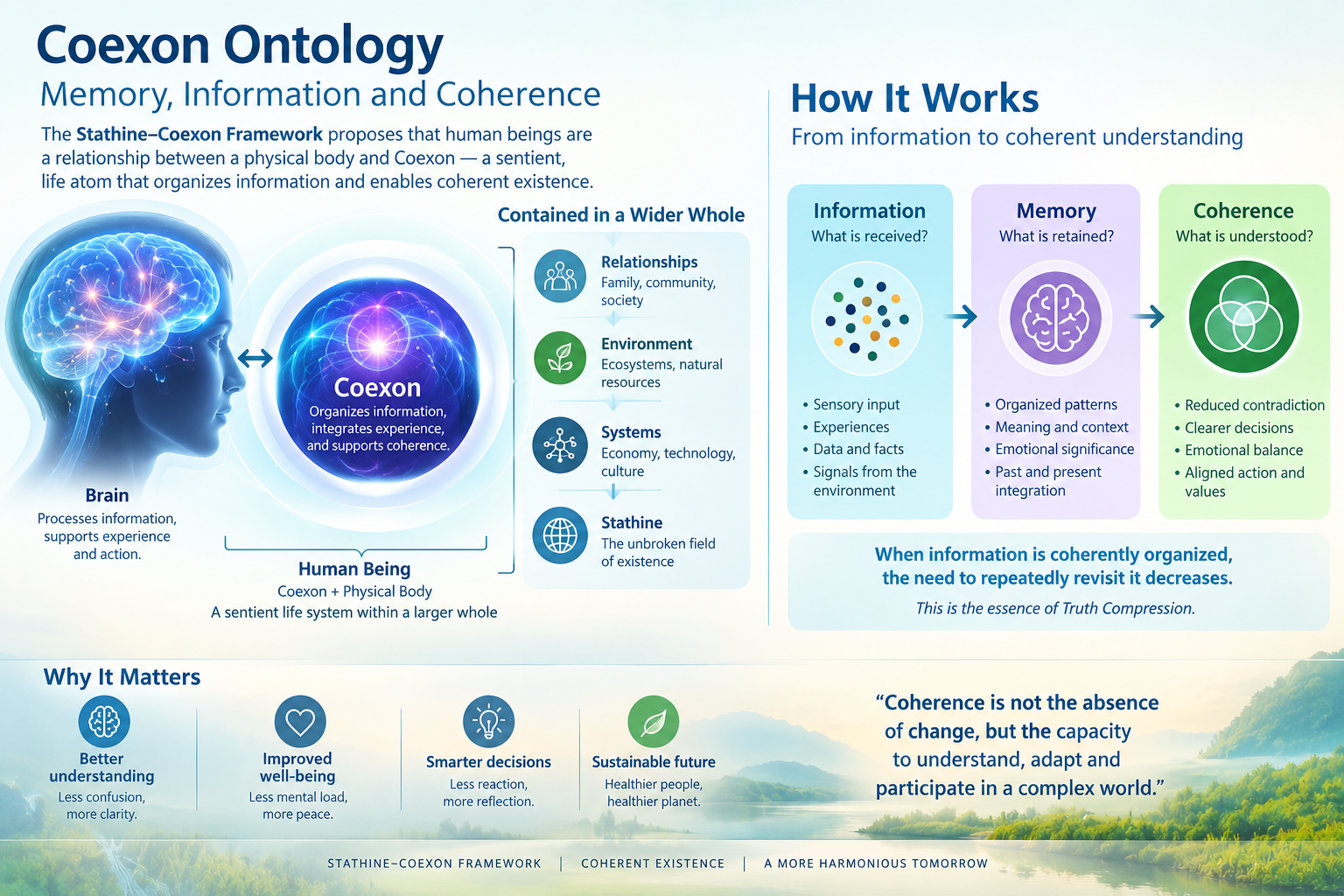
The Stathine–Coexon Framework proposes that human action emerges from an interaction between a biological organism, its brain-based communication architecture, embodied experience, accumulated information, relational environment, and the proposed Coexon as a sentient atom communicating through the biological brain. Within this model, action is not regarded as an isolated output of conscious thought but as the consequence of a continuously reorganizing relationship between perception, interpretation, evaluation, intention, expression, and environmental feedback.
This paper develops a critical theory of praxis based on the framework’s central concepts of coherence, contradiction reduction, truth compression, coexistence, ownership, transparency, attention, learning, creativity, and inclusive participation. It argues that praxis should not be understood as the mechanical application of a philosophical theory. Rather, it is a recursive process in which action becomes an experiment through which understanding itself is tested and revised.
Particular attention is given to the danger of converting coherence into conformity, values into rigid rules, and theoretical concepts into unvalidated interventions. The paper therefore proposes a Coherent Praxis Cycle: observe, distinguish, understand, evaluate, choose, act, observe consequences, integrate feedback, and revise the model. This cycle provides a possible bridge between the Stathine–Coexon Framework and empirical research in neuroscience, psychology, education, organizational science, leadership, artificial intelligence, healthcare, and social systems.
The paper concludes that the practical contribution of the framework should not be to prescribe a universal behavioural code. Its stronger potential lies in developing human beings and institutions that can detect contradiction earlier, understand more comprehensively, act with greater agency, learn from consequences, and expand the boundaries of coexistence without suppressing legitimate difference.
1. Introduction: From What Matters to What We Do
The first three dimensions of the five-dimensional evaluation establish a progression.
Epistemology asks:
How do we know?
Ontology asks:
What exists?
Axiology asks:
What matters?
Praxis introduces the unavoidable next question:
What do we do with what we know and value?
This question is where philosophical systems become vulnerable.
A theory may be intellectually elegant but practically useless.
A value system may be morally attractive but impossible to implement.
A scientific model may explain behaviour without changing behaviour.
A spiritual philosophy may inspire individuals without producing measurable improvements in human life.
Praxis therefore becomes the bridge between theory and consequence.
The central proposition of this paper is:
A theory of human existence acquires practical significance only when it can change the quality of observation, interpretation, decision, action, relationship, and learning without requiring the suppression of individual agency.
The Stathine–Coexon Framework consequently cannot be evaluated only by the elegance of its concepts.
It must be evaluated by what happens when human beings attempt to live according to them.
2. What Is Praxis?
Praxis is more than practice.
Practice can mean repeatedly performing an activity.
Praxis implies a relationship between:
understanding → action → consequence → reflection → revised understanding.
A person practicing a technique may repeat it without questioning its assumptions.
A person engaged in praxis continually examines whether the action is producing the intended outcome.
Thus:
Practice repeats. Praxis learns.
This distinction is particularly important for the Stathine–Coexon Framework.
The framework should not become a set of rituals.
It should become a method of continuous inquiry.
3. From Theory to Experiment
Every application of the framework should therefore be regarded as a provisional experiment.
Suppose a person believes:
“My conflict with another person exists because the other person does not understand me.”
The framework does not require accepting this interpretation.
Instead, praxis asks:
- What am I observing?
- What am I assuming?
- What information am I missing?
- What contradiction exists?
- What alternative interpretation is possible?
- What action would generate useful information?
- What happened after the action?
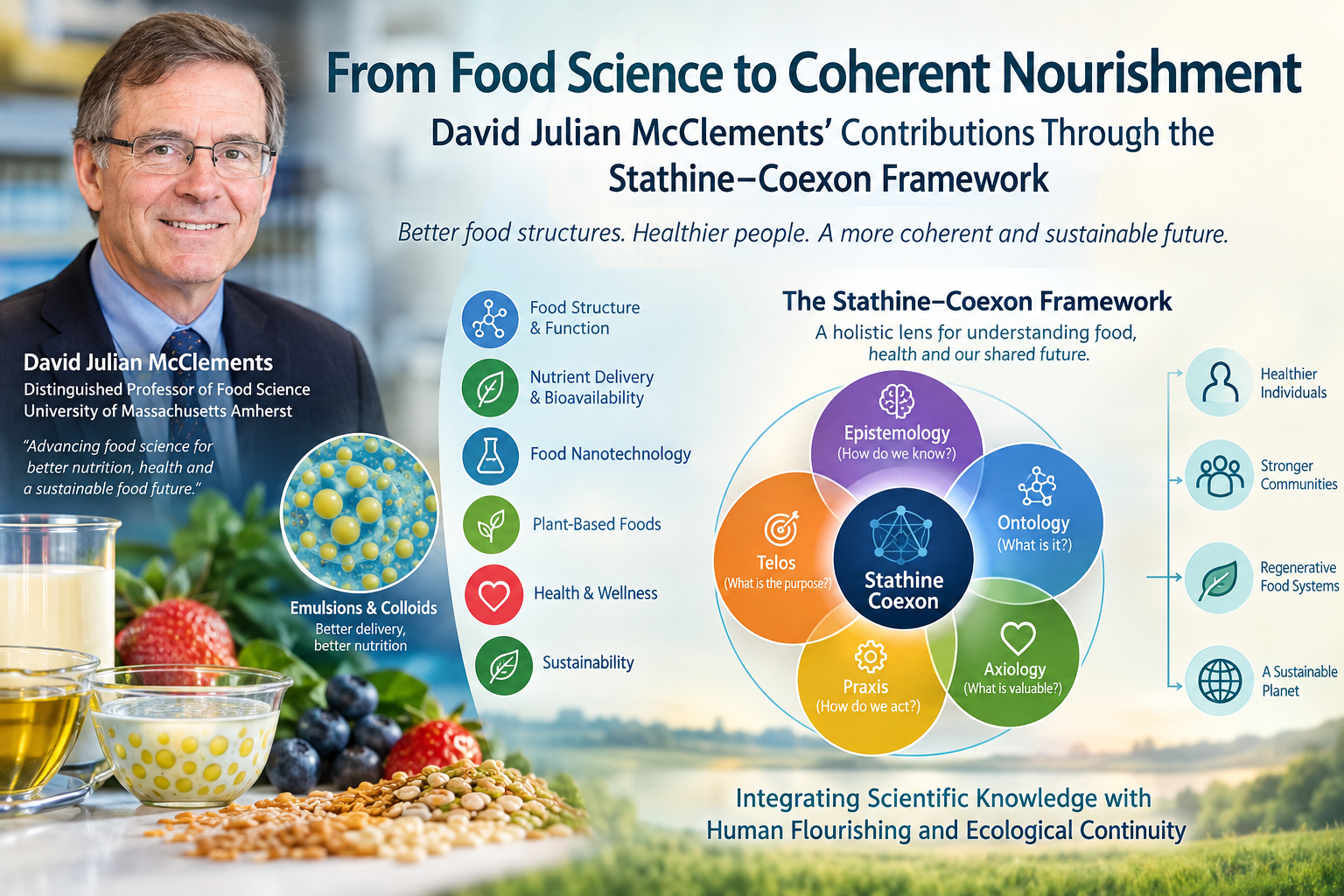
- What should I now revise?
This converts philosophy into an experimental discipline.
4. The Human Being as the Unit of Praxis
Within the Stathine–Coexon hypothesis developed in the preceding papers, the human being is not defined simply as a brain.
The human being is conceptualized as the union of:
biological organism + brain-based communication architecture + embodied experience in the Coexon.
The Coexon is proposed as a existential sentient atom, similar to the Physical atom in every molecule cell and unit of existence.
The framework hypothesizes that the Coexon communicates with the biological organism through the brain and associated biological communication systems.
This remains a scientific hypothesis rather than an established empirical fact.
Praxis must therefore preserve this distinction.
A practical intervention derived from the framework should keep this in mind.
Instead:
Coexon-based interpretations should generate testable predictions wherever possible while simultaneously supporting practical methods that remain useful even if the underlying ontological hypothesis is later revised.
This principle protects the framework from premature certainty.
5. The Brain as the Interface of Praxis
The biological brain becomes particularly important at the practical level.
The framework proposes that the brain functions as a communication interface through which the human organism receives, integrates, interprets, and expresses information.
The practical implication is significant.
Human beings cannot simply “decide” to change themselves at the level of abstract intention.
Change must pass through biological systems involving:
- perception,
- attention,
- memory,
- emotion,
- bodily state,
- prediction,
- motor preparation,
- language,
- social feedback,
- and learning.
The framework therefore treats behavioural transformation as an embodied process.
6. The Three-Brain Perspective
The framework also incorporates the widely discussed idea of three major information-processing centres:
- the brain in the head,
- the intrinsic nervous system of the heart,
- and the enteric nervous system of the gut.
These should not be interpreted as three independent conscious brains equivalent to the cerebral brain.
Rather, they represent distinct biological systems involved in signalling, regulation, interoception, and embodied experience.
The practical implication is that human decision-making cannot be reduced to abstract cognition.
What a person calls a “thought” may be accompanied by:
- cardiac changes,
- gastrointestinal sensations,
- muscular tension,
- breathing changes,
- hormonal changes,
- and autonomic responses.
Praxis therefore begins with the whole organism.
7. The First Principle of Praxis: Observe Before Correcting
A recurring problem in human development is premature correction.
People attempt to eliminate:
- anger,
- fear,
- jealousy,
- ego,
- anxiety,
- confusion,
- disagreement,
- or discomfort
before understanding what generated them.
The framework proposes a different sequence:
Observe → understand → evaluate → transform.
This is important because a behavioural reaction may contain information.
Anger may indicate perceived injustice.
Fear may indicate perceived threat.
Jealousy may indicate insecurity or attachment.
Defensiveness may indicate a threatened identity.
The emotion should neither automatically be obeyed nor automatically rejected.
It should first be understood.
8. Praxis and Attention
Attention is the first practical resource.
Human beings cannot process everything simultaneously.
Therefore what receives attention becomes disproportionately influential.
Praxis begins with learning to notice:
- where attention goes,
- what captures it,
- what repeatedly interrupts it,
- what information is avoided,
- and what information is compulsively pursued.
The first practical question becomes:
What am I attending to, and what am I therefore not attending to?
This question alone can expose significant cognitive blind spots.
9. The Observation–Interpretation Distinction
One of the simplest practical tools derived from the framework is separating:
observation
from
interpretation.
For example:
“He ignored me.”
may actually mean:
“I spoke to him and he did not respond.”
The first statement contains interpretation.
The second describes an observable event.
This distinction creates cognitive space.
Once interpretation is separated from observation, alternative explanations become possible.
Perhaps the person:
- did not hear,
- was distracted,
- misunderstood,
- was emotionally overwhelmed,
- or intentionally ignored the speaker.
The distinction reduces unnecessary certainty.
10. The Contradiction Audit
A central practical tool can be called the Contradiction Audit.
When an individual experiences repeated difficulty, they ask:
What do I believe?
What am I doing?
What result am I receiving?
Where do these three disagree?
For example:
“I value openness.”
but:
“I avoid conversations when criticism is possible.”
The contradiction is not evidence that the person is bad.
It is information.
The framework therefore transforms contradiction from a source of shame into a diagnostic signal.
11. Internal Contradiction
Internal contradiction occurs when different parts of an individual’s model cannot simultaneously operate without conflict.
Examples include:
“I want independence.”
while simultaneously:
“I need everyone to approve of me.”
Or:
“I want creativity.”
while:
“I cannot tolerate mistakes.”
Or:
“I want honest relationships.”
while:
“I hide information whenever I feel threatened.”
Praxis does not demand immediate resolution.
It first makes the contradiction visible.
12. Relational Contradiction
Contradiction also occurs between people.
One person may value:
autonomy.
Another may value:
security.
Their conflict may initially appear personal.
But once the underlying values become visible, the disagreement becomes structurally understandable.
The practical question changes from:
“Who is wrong?”
to:
“What larger arrangement could accommodate both legitimate needs?”
This is the beginning of inclusive coherence.
13. From Ego Defence to Inquiry
The framework’s analysis of ego becomes particularly practical here.
When identity is threatened, humans often defend the identity before examining the information.
This can create a loop:
threat → defence → rejection → greater threat → stronger defence.
Praxis interrupts the loop by asking:
What information is threatening me, and why?
This does not mean accepting criticism as true.
It means allowing the information to be examined before it is rejected.
14. Ownership
The practical concept of ownership follows.
Ownership means:
recognizing one’s participation in a condition without assuming sole responsibility for everything within it.
This distinction is essential.
A person may not have caused a conflict alone.
But they may still have contributed to:
- its escalation,
- its continuation,
- its interpretation,
- or its resolution.
Ownership therefore restores agency without creating unnecessary guilt.
15. The Four Practical Pillars of “Being In”
The framework has previously proposed four pillars for genuine participation:
- Understanding
- Transparency
- Ownership
- Executed partnership
These can be interpreted as a practical architecture.
Understanding
I know what is happening.
Transparency
Relevant information is not deliberately distorted.
Ownership
I acknowledge my participation.
Executed partnership
I translate understanding into coordinated action.
Without execution, partnership remains intention.
16. Praxis and Communication
Communication is one of the most important fields of application.
The framework proposes that effective communication should progressively reduce the gap between:
what I experience → what I understand → what I intend → what I express → what the other person receives.
Each transition can introduce distortion.
Therefore communication should include feedback.
Instead of:
“I explained it, so you should understand.”
Praxis asks:
“What did you understand from what I said?”
This creates a closed learning loop.
17. Feeling as a Communication Signal
The framework’s earlier formulation:
Feeling = Physical Sensation + Emotional Meaning + Current Understanding
can be interpreted practically.
A feeling is not simply a fact about the external world.
Nor is it meaningless noise.
It is an integrated state involving bodily sensation, interpretation, and context.
Therefore the practical question becomes:
What physical signal am I experiencing, what meaning am I assigning to it, and what understanding is generating that meaning?
This can prevent emotional interpretation from being mistaken for objective reality.
18. The Pause
A simple praxis technique follows from this.
When emotional intensity rises:
Pause.
Then ask:
- What happened?
- What am I feeling?
- What am I assuming?
- What do I know?
- What do I not know?
- What response preserves future possibilities?
The pause creates time for the communication architecture to reorganize before action becomes irreversible.
19. Memory and Praxis
Memory determines which previous experiences influence current interpretation.
A person who repeatedly experienced rejection may interpret ambiguous behaviour as rejection.
The framework therefore treats memory not merely as storage but as an active component of present interpretation.
Praxis involves asking:
Is my current response based on what is happening now, what happened previously, or an interaction of both?
This question can expose inherited patterns.
20. Forgetting and Practical Adaptation
Forgetting also has practical value.
If every previous event remained equally salient, current experience would be overwhelmed by historical information.
Healthy adaptation therefore requires selective retention.
Praxis asks:
What should I remember as learning, and what should I stop carrying as identity?
This distinction is especially important in relationships.
Remembering the lesson can be useful.
Repeatedly reliving the emotional event may not be.
21. Attention, Memory, and Learning
The practical learning loop can therefore be represented as:
Attention → experience → interpretation → memory → prediction → action → feedback → learning.
The framework adds a proposed Coexon dimension:
Coexon → communication through biological interface → integrated human experience.
This latter component is beyond the current epistemology and empirical data based science as explained in the first part of the series.
The practical model should therefore be aware of the established and proposed biological mechanisms and the proposed ontological extension.
22. Praxis and Creativity
Creativity becomes particularly interesting in practice.
The framework proposes:
Creativity emerges when contradiction has been sufficiently understood that a larger coherent possibility becomes available.
The practical method therefore becomes:
identify limitation → expose contradiction → gather additional information → suspend premature closure → integrate perspectives → generate a broader model.
Creativity is consequently not forced novelty.
It is expansion.
23. Creativity Without Destruction
This has an important educational consequence.
A child should not be taught:
“Be creative by breaking rules.”
The deeper lesson is:
“Understand why the rule exists, identify where it becomes insufficient, and discover what larger principle could include its valid purpose.”
This produces creativity with continuity.
The old model becomes part of the new model rather than merely being discarded.
24. Praxis and Learning
Learning under the framework is therefore not primarily information acquisition.
It is model revision.
A learner asks:
What did I previously believe?
What evidence challenged it?
What new model explains more?
What remains unexplained?
This creates an ongoing cycle of epistemic development.
25. Praxis in Education
Education based on this approach would prioritize:
- observation,
- questioning,
- contradiction detection,
- reflection,
- experimentation,
- collaboration,
- feedback,
- and model revision.
A teacher would not simply provide answers.
The teacher would help the learner develop the ability to discover when an answer is inadequate.
This transforms education from:
answer transmission
into:
capacity development.
26. Praxis in Mentoring
The mentor’s role changes accordingly.
A mentor should not create dependence.
The objective is progressively increasing independent understanding.
A useful principle is:
The mentor succeeds when the learner can eventually evaluate the mentor’s model critically and improve upon it.
This is consistent with the framework’s broader emphasis on agency.
27. Praxis in Leadership
Leadership becomes an information architecture.
A leader should create conditions in which reality can travel upward without distortion and decisions can travel downward with sufficient context.
The practical questions are:
- Can bad news reach the leader?
- Can disagreement be expressed safely?
- Are responsibilities visible?
- Are decisions explainable?
- Can mistakes become learning?
- Does the organization adapt?
The leader therefore becomes less a controller and more a facilitator of organizational coherence.
28. The Organization as a Coherence System
An organization can be viewed as a network of:
- people,
- information,
- incentives,
- decisions,
- resources,
- relationships,
- and feedback loops.
Organizational problems frequently occur when these components become disconnected.
Examples:
Strategy says one thing; incentives reward another.
Leadership says transparency; employees fear consequences for speaking honestly.
Departments share a common goal but optimize incompatible metrics.
Praxis seeks to expose these contradictions.
29. Practical Truth Compression in Organizations
Truth compression can become an organizational practice.
Instead of producing:
- multiple reports,
- contradictory dashboards,
- political narratives,
- and duplicated explanations,
organizations can seek a progressively simpler representation of reality that preserves the information necessary for decision-making.
But again:
simplicity must never be confused with truth.
The objective is:
minimum unnecessary complexity with maximum decision-relevant information.
30. Praxis and AI
AI provides a particularly important application.
The Stathine–Coexon Framework should not simply ask:
“How can AI become more intelligent?”
It should ask:
“How can AI increase human coherence without decreasing human agency?”
An AI system may be useful when it:
- identifies contradictions,
- summarizes competing perspectives,
- exposes hidden assumptions,
- generates alternatives,
- detects missing information,
- and supports reflection.
But it becomes dangerous if users outsource judgment completely.
31. AI as a Coherence Assistant
A possible application is a Coherence Assistant.
Given a decision, the system could identify:
Observations
What is known?
Assumptions
What is being inferred?
Contradictions
Which statements or goals conflict?
Missing information
What would materially change the decision?
Stakeholders
Who is affected?
Alternatives
What different actions are available?
Consequences
What might follow?
The AI does not make the final decision.
It improves the quality of human decision-making.
32. Praxis and Healthcare
Healthcare provides another important application.
A patient is not merely a collection of isolated symptoms.
Biological systems interact.
The practical framework therefore encourages integration of:
- physical symptoms,
- emotional state,
- cognitive interpretation,
- lifestyle,
- relationships,
- environment,
- and medical evidence.
However, the framework must never replace evidence-based medicine with theoretical speculation.
The Coexon hypothesis should remain clearly separated from established clinical knowledge until empirically validated.
33. Praxis and Mental Development
The framework can also support reflective practices such as:
- journaling,
- structured self-questioning,
- attention training,
- perspective-taking,
- conflict analysis,
- and behavioural experiments.
These practices do not require acceptance of the Coexon hypothesis.
That is a strength.
They can function as practical tools while the ontological proposition remains under investigation.
34. Praxis and Relationships
Relationship praxis can be organized around five questions:
- What happened?
- What did I experience?
- What meaning did I assign?
- What might the other person have experienced?
- What action increases future possibility?
The final question is particularly important.
Instead of asking:
“Who won?”
the framework asks:
“What action creates a better next state?”
35. Conflict as a Learning Opportunity
Conflict is therefore reframed.
The practical goal is not always agreement.
Sometimes disagreement remains legitimate.
The goal is:
making the structure of disagreement understandable enough that destructive escalation becomes unnecessary.
Two people can conclude:
“We understand why we disagree.”
That may represent greater coherence even when consensus has not been achieved.
36. Praxis and Coexistence
Coexistence becomes a behavioural discipline.
It requires:
- maintaining one’s own identity,
- recognizing the other’s identity,
- communicating differences,
- negotiating shared constraints,
- and avoiding unnecessary destruction of the relationship.
This creates a practical formulation:
I do not have to become you to coexist with you.
Nor must the other person become identical to me.
37. Praxis and Society
At the societal level, the framework suggests a transition:
polarization → recognition → dialogue → structural understanding → negotiated coexistence.
This does not imply that every disagreement can be resolved through dialogue.
Some conflicts involve incompatible interests.
In such situations, praxis requires institutions capable of managing disagreement fairly.
Therefore the framework must include:
- law,
- rights,
- institutional checks,
- democratic processes,
- and mechanisms of accountability.
Coherence cannot replace justice.
38. Praxis and Civilization
Civilizational praxis asks whether humanity can develop institutions capable of handling increasing complexity.
Technology increases interdependence.
Economic systems increase interdependence.
Climate systems increase interdependence.
Information systems increase interdependence.
The practical challenge becomes:
Can human coordination evolve quickly enough to match the complexity of the systems humanity has created?
The framework proposes that improved coherence of understanding is one possible component of that transition.
39. The Coherent Praxis Cycle
The framework can now formulate a central practical model:
1. Observe
What is actually happening?
2. Distinguish
What is observation and what is interpretation?
3. Understand
What relationships and mechanisms may explain the situation?
4. Evaluate
Which values and consequences matter?
5. Choose
Which action best preserves agency, truth, relationship, and future possibilities?
6. Act
Execute the decision.
7. Observe consequences
What actually happened?
8. Integrate
What has been learned?
9. Revise
What should change in the model?
This creates a recursive loop:
Understand → Act → Learn → Understand better.
40. Praxis Is Not Perfection
A major danger in practical frameworks is creating an idealized human being.
The Stathine–Coexon Framework should reject this.
Human beings will:
- misunderstand,
- react emotionally,
- make mistakes,
- forget,
- become defensive,
- and occasionally act irrationally.
The objective is therefore not:
never contradict yourself.
It is:
detect contradiction earlier, recover faster, and learn more effectively.
This is a more realistic conception of development.
41. The Measurement Problem
If praxis is to become scientifically testable, outcomes must eventually be measured.
Possible measures include:
- reduction in repeated interpersonal conflict,
- improved decision consistency,
- increased perspective-taking,
- improved error correction,
- increased learning speed,
- reduced cognitive rigidity,
- improved organizational information flow,
- increased psychological flexibility,
- and improved collaborative outcomes.
These should not automatically be called “Coexon effects.”
They are possible behavioural correlates of practices inspired by the framework.
This distinction is essential.
42. Testing the Coexon Hypothesis Separately
The stronger ontological claim — that the Coexon exists as a sentient atom communicating through the biological brain — requires separate empirical investigation.
Possible research questions might include:
- Is there evidence for an information-bearing entity not reducible to known biological processes?
- Can its proposed communication mechanism be experimentally detected?
- Are there measurable signatures associated with the proposed interface?
- Can predictions be generated that distinguish the Coexon hypothesis from conventional neuroscience?
- Can independent laboratories reproduce those findings?
Without answers to such questions, Coexon remains a hypothesis.
This does not invalidate the framework’s practical tools.
It clarifies their evidentiary status.
43. Falsifiability as Praxis
A theory becomes scientifically healthier when it actively seeks conditions under which it could fail.
Therefore the framework should ask:
What observation would force us to revise the Coexon hypothesis?
This question should be part of every research application.
A framework that cannot be wrong cannot become scientifically stronger.
44. Praxis and Scientific Humility
The practical application of the framework therefore requires two simultaneous attitudes:
Confidence
The framework may generate useful new hypotheses.
Humility
Those hypotheses may be wrong.
These are not contradictory.
They are complementary.
The researcher acts boldly enough to investigate but cautiously enough to revise.
45. Praxis as Recursive Learning
The deepest practical proposition of the framework can now be expressed:
Action is not the endpoint of understanding; action is one of the mechanisms through which understanding develops.
Every action generates consequences.
Every consequence generates information.
Every new piece of information can modify the model.
Therefore:
understanding → action → consequence → learning → deeper understanding.
This is praxis.
46. From Individual Praxis to Collective Praxis
When multiple individuals participate in the same learning loop, collective praxis emerges.
A team can:
- share observations,
- distinguish interpretations,
- expose contradictions,
- identify common objectives,
- test alternative actions,
- evaluate results,
- update collective understanding.
This produces a learning organization.
At larger scales, it becomes institutional learning.
At civilizational scales, it becomes collective adaptation.
47. The Ethical Constraint on Praxis
Praxis must remain constrained by the axiological principles established in the previous paper.
Action should therefore seek:
- truth without deception,
- agency without domination,
- coherence without conformity,
- coexistence without relativism,
- creativity without unnecessary destruction,
- and development without exploitation.
This creates continuity between axiology and praxis.
Values become action principles.
48. Praxis and the Reduction of Delusion
The broader objective of reducing delusion becomes practical here.
Delusion is not removed simply by acquiring more information.
It is reduced when the individual repeatedly confronts the gap between:
belief → prediction → action → consequence.
If the prediction repeatedly fails, the model must change.
Thus:
Reality becomes the final feedback mechanism.
This is one of the strongest practical safeguards available to the framework.
49. A Praxis Equation
The practical architecture can be represented conceptually as:
Praxis = Understanding × Choice × Action × Feedback × Revision
Again, this is not proposed as a quantitative scientific equation.
It represents a structural principle.
If action occurs without understanding, behaviour becomes reactive.
If understanding exists without action, nothing changes.
If action occurs without feedback, mistakes repeat.
If feedback occurs without revision, learning stops.
Praxis requires the complete loop.
50. What Successful Praxis Would Look Like
A successful application of the Stathine–Coexon Framework would not necessarily produce people who:
- agree with one another,
- never become angry,
- never make mistakes,
- always feel peaceful,
- or behave identically.
Instead, it would ideally produce people who:
- notice their assumptions,
- distinguish facts from interpretations,
- recognize internal contradiction,
- take ownership,
- communicate more transparently,
- tolerate uncertainty,
- learn from consequences,
- revise models,
- create more inclusive solutions,
- and maintain relationships without surrendering individuality.
That is a more demanding — and more realistic — definition of progress.
51. Critical Evaluation of Praxis
The practical dimension reveals both substantial potential and serious limitations.
Potential Strength 1: Integrative
The framework connects cognition, emotion, embodiment, relationship, and action.
Potential Strength 2: Recursive
It treats action as feedback rather than finality.
Potential Strength 3: Agency-oriented
It emphasizes ownership without requiring shame.
Potential Strength 4: Conflict-transformative
It treats contradiction as information.
Potential Strength 5: Cross-domain applicability
The same structure can potentially be used in education, leadership, organizations, relationships, and AI.
But limitations remain.
Limitation 1: Empirical validation
Many proposed mechanisms remain untested.
Limitation 2: Operationalization
Concepts such as coherence and truth compression require measurable definitions.
Limitation 3: Risk of subjective interpretation
Users may label their own preferred interpretation “more coherent.”
Limitation 4: Value conflict
Practical decisions may involve genuine trade-offs.
Limitation 5: Coexon uncertainty
The proposed sentient atom remains an ontological hypothesis.
52. The Principle of Practical Non-Dogmatism
The framework should therefore adopt a fundamental rule:
No practical recommendation should become unquestionable merely because it originates from the Stathine–Coexon Framework.
Every recommendation should remain open to:
- evidence,
- comparison,
- criticism,
- contextual adaptation,
- and revision.
This is the practical equivalent of epistemic humility.
53. Praxis as a Research Programme
The next phase of research can therefore move beyond conceptual writing.
Potential studies include:
Individual level
Test whether contradiction-audit practices improve decision-making.
Relationship level
Test whether observation–interpretation separation improves conflict resolution.
Educational level
Test whether model-revision learning improves creativity and retention.
Organizational level
Test whether transparent contradiction reporting improves adaptation.
AI level
Test whether coherence-oriented AI assistance improves human decision quality.
Ontological level
Develop experiments capable of testing predictions generated by the Coexon hypothesis.
The framework can therefore evolve from philosophical proposal toward empirical programme.
54. The Five-Dimensional Recursive Structure
The five dimensions can now be seen as a cycle rather than a hierarchy.
Epistemology
How do we know?
↓
Ontology
What exists?
↓
Axiology
What matters?
↓
Praxis
What do we do?
↓
Telos
What direction does this create?
↓
Then experience generates new questions about:
Epistemology.
The cycle begins again.
This recursive structure is important.
No dimension is permanently complete.
55. Praxis and Telos
The practical cycle naturally raises the final question.
If human beings continuously:
- understand more,
- reduce unnecessary contradiction,
- expand agency,
- increase coexistence,
- develop creativity,
- and learn from consequences,
then where does this trajectory lead?
Does it point toward:
- individual enlightenment?
- collective intelligence?
- civilizational coherence?
- expanded consciousness?
- technological-human integration?
- ecological coexistence?
- or something beyond all of these?
These questions belong to Telos.
Praxis prepares the ground.
56. Conclusion: From Knowing to Becoming
The practical significance of the Stathine–Coexon Framework ultimately depends on whether it can transform understanding into better participation in reality.
Its strongest practical proposition is not a particular technique.
It is a discipline of recursive correction:
Observe without premature judgment.
Distinguish observation from interpretation.
Identify contradiction
Expand understanding
Choose consciously
Act.
Observe the consequences
Learn.
Revise.
And begin again.
Within the framework’s proposed ontology, the human being is the union of a biological organism and a proposed sentient Coexon, with the brain functioning as a biological communication interface. Science will take its own sweet time to prove or disprove the same.
But the practical framework can already be evaluated independently of that .
Can human beings become better observers?
Can they distinguish information from interpretation?
Can they recognize ego without destroying individuality?
Can they turn contradiction into learning?
Can they communicate more transparently?
Can they preserve diversity while creating coherence?
Can they become more capable of correcting themselves?
Can organizations become safer places for reality to be revealed?
Can education develop model-builders rather than merely answer-collectors?
Can AI increase human understanding without replacing human agency?
These are empirical and practical questions.
They provide a pathway through which the framework can move beyond conceptual speculation.
The central proposition of praxis can therefore be stated:
Human development is not the achievement of a final state of coherence. It is the development of an increasing capacity to participate in reality, detect contradiction, learn from consequences, and continuously expand the coherence of understanding and action.
This also gives new meaning to the framework’s broader objective of reducing delusion.
Delusion is not overcome by replacing one belief system with another.
It is reduced through a disciplined willingness to allow reality to correct understanding.
The practical human being is therefore not the person who is always right.
It is the person who can discover that they are wrong without losing the capacity to learn.
The mature organization is not the one in which nobody disagrees.
It is the one in which disagreement can become information.
The mature society is not the one in which everyone thinks alike.
It is the one in which different perspectives can coexist while remaining capable of shared reasoning.
And the mature civilization is not necessarily the one with the greatest technological power.
It is the one capable of using increasing power without destroying the relationships that make its continued existence possible.
The deepest practical formulation of the Stathine–Coexon Framework may therefore be:
Understand reality more completely, act with greater responsibility, learn from what reality returns, and expand the circle of beings with whom coherent existence is possible.
Praxis transforms the framework from a theory about human beings into a proposed discipline for becoming more capable human beings.
But praxis itself cannot determine whether this process has an ultimate destination.
That question belongs to the fifth and final dimension.
Telos asks:
If truth, coherence, coexistence, agency, learning, and creativity are progressively integrated into human existence, what is humanity becoming?
That is the question with which the final paper of the five-dimensional evaluation must begin.
This sets up Dimension V — Telos naturally. The Telos paper can be more ambitious and philosophical: it can critically examine whether the Stathine–Coexon trajectory points toward awakening, expanded consciousness, coexistence/Sah-Astitva, human–AI evolution, civilizational coherence, or something beyond the human condition, while carefully distinguishing what is a philosophical proposition from what can presently be supported scientifically.