Abstract
Contemporary socio-economic paradigms heavily condition human existence on continuous performance, productivity, and meritocratic validation. This persistent “performance pressure” induces systemic psychological fragmentation, perpetual anxiety, and existential instability. This paper re-evaluates human stability through the lens of the Coexon-Stathine framework. By shifting the ontological baseline from an atomistic, performance-driven reality to an unbroken field of continuous presence (Stathine) activated through conscious relational participation (Coexon), we demonstrate that existential stability is an inherent, structural state of being rather than an earned outcome. We propose an alternative framework for human organization wherein stability is uncoupled from performance, restoring life to its natural state of harmonious co-existence.
1. Introduction: The Crisis of Performance-Based Stability
Modern institutional structures—spanning education, corporate environments, and social systems—operate primarily on a transactional paradigm. Under this model, an individual’s worth, security, and sense of belonging are conditional, contingent upon ongoing output and external metric compliance.
This creates what Byung-Chul Han terms the “achievement society” (Leistungsgesellschaft), where individuals become self-exploiting subjects. Stability becomes a moving target:
$$\text{Stability}_{\text{conditional}} = f(\text{Performance}, \text{Validation}, \text{Resource Accumulation})$$
Because performance is inherently variable and subject to external volatility, stability derived from performance is illusory. The constant threat of non-performance induces an existential friction, preventing human beings from experiencing genuine ease, belonging, or presence.
To resolve this systemic crisis, academic inquiry must move beyond superficial psychological interventions (e.g., mindfulness apps or stress management workshops) and re-examine the ontological axioms underlying human existence.
2. Theoretical Foundations: The Coexon-Stathine Ontology
The Coexon-Stathine framework offers a fundamental departure from the Western Cartesian paradigm ($Cogito, ergo sum$), which isolates the individual subject from an objective, mechanistic universe.
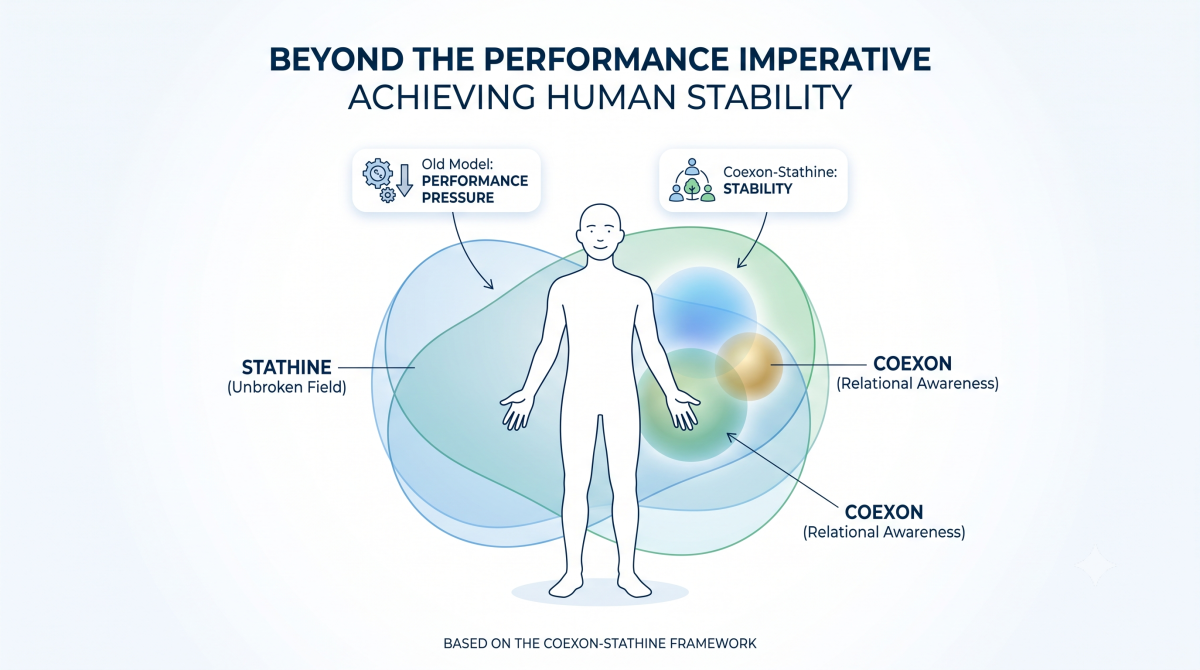
+-------------------------------------------------------------------+
|                            STATHINE                               |
|        (The Unbroken, Continuous Field of Ultimate Reality)       |
|                                                                   |
|   +-----------------------------------------------------------+   |
|   |                         COEXON                            |   |
|   |         (Conscious Relational Awareness & Agency)         |   |
|   |                                                           |   |
|   |   +---------------------------------------------------+   |   |
|   |   |                  HUMAN BEING                      |   |   |
|   |   |    Inherent Stability & Natural Expression        |   |   |
|   |   +---------------------------------------------------+   |   |
|   +-----------------------------------------------------------+   |
+-------------------------------------------------------------------+
2.1 Stathine: The Axiom of Universal Continuity
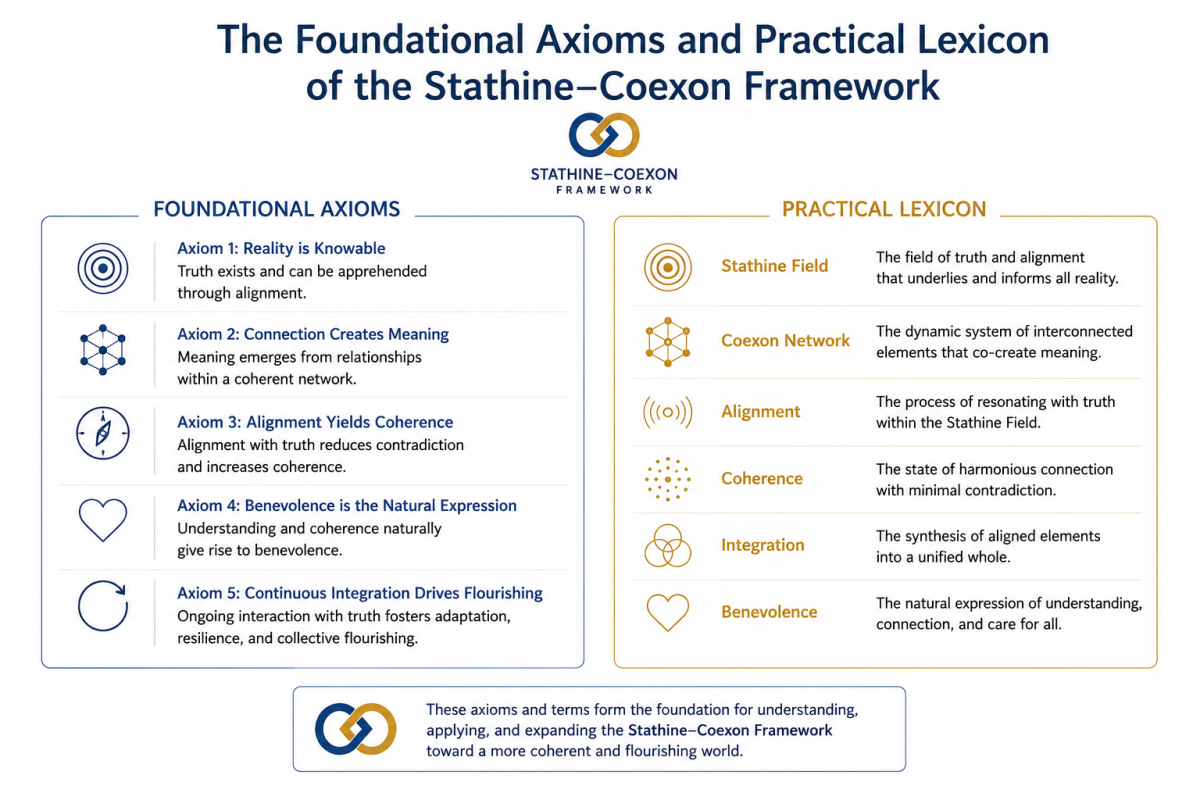
Stathine denotes the non-fragmented, unbroken field of ultimate reality and presence. In traditional reductionist models, space, matter, and consciousness are treated as discrete, isolated entities separated by void or conflict. Stathine posits that reality is inherently continuous.
- Ontological Implication for Stability: An individual cannot “fall out” of existence or be detached from the fundamental fabric of reality. Safety and belonging are not conditions to be secured; they are structural features of the continuum itself.
2.2 Coexon: The Axiom of Relational Co-Existence
Coexon represents the conscious, relational participation of a subject within the unbroken field of Stathine. Rather than acting as a self-contained atom competing against external forces, the human being under Coexon functions as an integrated participant in a dynamic web of mutual existence.
- Relational Implication: Identity is not defined by individual isolation or competitive superiority, but by co-presence.
3. Deconstructing Performance Pressure
Performance pressure relies on two foundational fallacies:
- The Fallacy of Separation: The belief that the human being is an isolated unit that must constantly defend its boundaries and justify its existence against a hostile or indifferent environment.
- The Fallacy of Scarcity: The premise that security, value, and belonging are finite resources awarded only to high-performing subjects.
When these fallacies govern human activity, the mind remains in a state of chronic hyper-vigilance. The individual evaluates every interaction through a transactional lens: “Am I measuring up? Am I securing my place?”
   [ Atomistic Worldview ]             [ Coexon-Stathine Worldview ]

    Isolated Subject                    Unbroken Field (Stathine)
           │                                       │
    Perceived Scarcity                  Relational Co-Existence (Coexon)
           │                                       │
    Performance Pressure                        Inherent Order
           │                                       │
   Chronic Instability & Friction        Existential Stability & Joy
Under the Coexon-Stathine paradigm, these fallacies dissolve. Because Stathine guarantees underlying continuity, there is no fundamental separation to bridge through effort. Because Coexon defines existence as participatory co-presence, value is intrinsic to being, not contingent on producing.
4. Re-Defining Human Stability
To establish a society where human beings live in true stability without performance pressure, we must redefine stability across three primary dimensions:
4.1 Ontological Stability (Grounding in Stathine)
Stability begins with the cognitive realization that existence is non-fragmented. When a person realizes that their primary “home” is the continuous field of reality itself, the existential dread of displacement or failure disappears. One does not work to earn a right to exist; one acts because one exists.
4.2 Relational Stability (Participation through Coexon)
When interactions shift from transactional metrics to relational co-existence, social friction decreases exponentially. Co-workers, family members, and community constituents are no longer competitors in a zero-sum performance arena; they are co-participants within the same continuum.
4.3 Functional Stability (Action as Natural Expression)
Without the existential threat of non-performance, human action undergoes a qualitative shift:
- Old Model: $\text{Action} = \text{Compulsion driven by fear of inadequacy}$
- Coexon-Stathine Model: $\text{Action} = \text{Spontaneous expression of internal order}$
Activity ceases to be a burdensome “performance” evaluated by external arbiters and becomes an authentic, joyful expression of natural order—a state analogous to continuous play or celebration (Ananda).
5. Systemic and Institutional Implications
Translating the Coexon-Stathine framework from theoretical ontology into applied human systems requires structural reform across major societal vectors:
| Institutional Vector | Current Performance-Based Paradigm | Coexon-Stathine Alternative |
| Pedagogy | Ranked evaluation, standardized testing, competitive sorting mechanisms. | Collaborative inquiry, holistic systems awareness, intrinsic curiosity. |
| Organizational Design | Hierarchical exploitation, output-contingent security, burnout-driven growth. | Relational synergy, psychological safety anchored in intrinsic worth, regenerative contribution. |
| Economics | Extraction metrics (GDP), forced scarcity, survival linked to labor market value. | Metric models centered on collective well-being, ecological continuity, and baseline security. |
6. Conclusion
The pervasive anxiety of modern human existence is not an inevitable feature of the human condition, but a predictable consequence of an atomistic, performance-contingent worldview. By adopting Coexon and Stathine as foundational axioms, human systems can decouple basic existential security from performance metrics.
When stability is recognized as an inherent property of our co-existence within an unbroken reality, performance pressure gives way to genuine stability. Human activity is liberated from the burden of self-preservation, allowing work, creation, and living to return to their natural state: a joyful, harmonious participation in existence.