Abstract
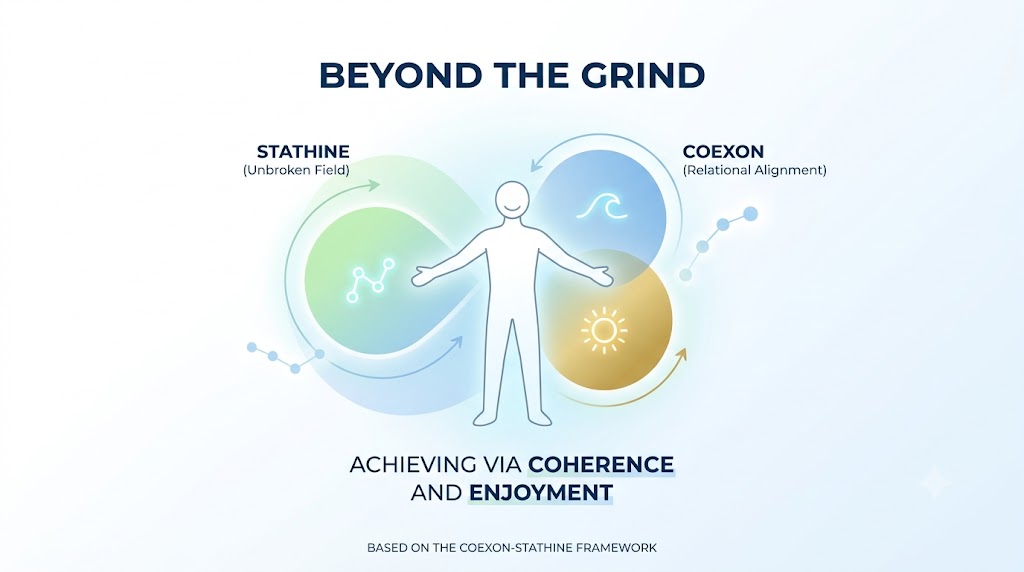
Contemporary societal paradigms surrounding human achievement heavily glorify struggle, discomfort, and laborious effort as the primary conduits of success. Embedded within a Cartesian worldview of fragmentation and separation, this transactional model posits that individuals must “pay” for achievement through friction. This paper introduces the Stathine–Coexon framework as a counter-ontology, arguing that this conventional view is not only functionally exhausting but metaphysically flawed. We posit that existence is a continuous, unbroken field (Stathine) and that the core of human agency (Coexon) flourishes through relational and internal coherence, rather than conflict. By defining struggle as the expression of internal contradiction and failure of systemic integration, we demonstrate functionally that coherence—and its experiential analog, enjoyment—minimize entropy, optimize adaptive capacity, and facilitate the natural expression of achievement.
1. Introduction
The defining ethos of 21st-century meritocracy is the glorification of friction. In educational, entrepreneurial, and athletic domains, narratives of achievement are universally prefaced by odes to “moving out of the comfort zone,” enduring the “grind,” and demonstrating “grit.” This societal consensus has elevated struggle from a potential consequence of ambitious activity to its primary validating prerequisite. The transactional logic is clear: discomfort is the currency required to buy status, resource accumulation, and eventual safety.
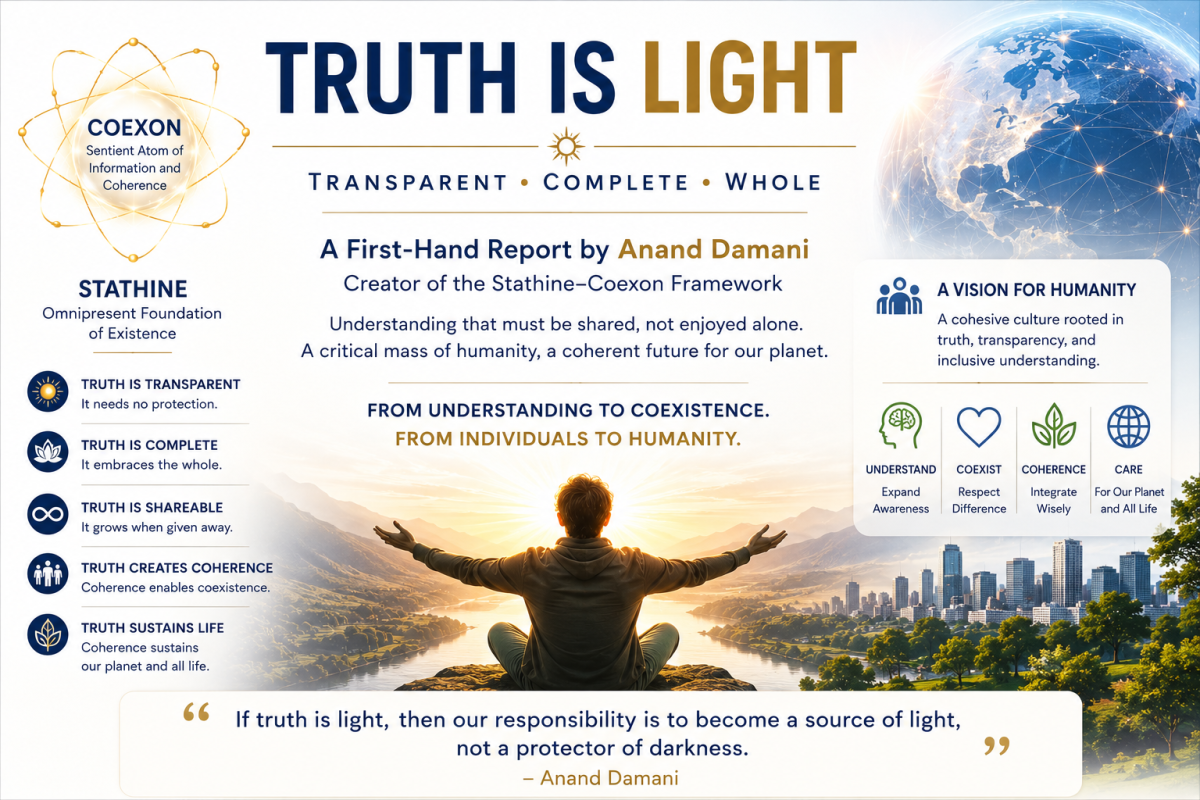
This paper challenges the fundamental necessity of this performance-contingent model of reality. We explore the ontological and functional logic underpinning this glorification and provide a theoretical critique through the lens of the Stathine–Coexon framework, proposed by Anand Damani. The framework suggests that true success is not “won” from a separate reality, but emerges naturally from an initial state of internal order and coherence. By redefining struggle as a warning signal of systemic incoherence—or internal contradiction—we will argue that coherence and enjoyment are functionally superior predictors of sustainable human achievement.
2. The Current Glory Model: Ontology of Matter and Transaction
The prevailing belief that “no pain, no gain” is a universal law is not accidental; it is rooted in a specific, Cartesian worldview defined by Fragmentation and Separation.
2.1 The Metaphysic of Fragmentation
In this model, the individual (the Self) is viewed as a discrete, atomistic unit operating within a universe composed of separate “things” (Matter, other people, desired outcomes). Space is viewed as void, and distance separates the desirer from the desired object (wealth, fame, or impact). Because these outcomes are “out there,” the individual must exert force and Cross the separation to acquire them. Fragmentation dictates that existence is a series of boundaries to be breached.
2.2 Transactional Success and Forced Utility
This fragmented ontology necessitates a transactional model of achievement. Struggle and sacrifice are seen as the mandatory tokens of payment to the universe. Within this logic, moving into a comfort zone is viewed as stagnation because force is only exerted through friction. Utility must be forced upon the environment. Happiness is thus rendered contingent: it is the reward waiting at the terminal end of the struggle, rather than an active tool used along the continuum of the process. This model prioritizes matter (the asset, the position) as the primary indicator of reality and success.
3. The Stathine–Coexon Alternative: Ontology of Continuity and Coexistence
The Stathine–Coexon framework proposes a fundamental inversion of these assumptions. It provides an alternative ontological baseline centered on Continuity and Coexistence. Success is defined not by transactional acquisition, but by progressive relational and internal coherence.
3.1 Stathine: The Axiom of the Unbroken Field
Stathine denotes the ultimate reality as a single, continuous, non-fragmented field of presence and truth. Unlike the reductionist model, space, matter, and consciousness do not exist as discrete entities separated by void. Stathine posits that reality is inherently continuous. Consequently, there is no fundamental distance to fight across. The individual, their activity, and the potential outcome they seek already coexist within the same continuum.
3.2 Coexon: Conscious Relational Participation
Within this field, a human being functions not as an isolated atom competing for resources, but as an integrated participant: a Proposed Sentient Atom called the Coexon. The primary drive of the Coexon is not to defeat a separate reality, but to progressively increase its coherence—defined as relational alignment—through understanding existence. In this model, success is not an endpoint, but the continuous expression of a functioning internal order.
4. The Functional Logic of Coherence: Minimizing Entropy
From a systems and functional perspective, the Coexon-Stathine framework argues that coherence and enjoyment deliver superior outcomes compared to struggle because they maximize functional stability and minimize energy loss (entropy). What society glorifies as “struggle” is often evidence of internal contradiction.
4.1 Friction as Systemic Incoherence
Functional friction arises whenever components of a system work in opposition to each other. When an individual operates from a state of internal contradiction—for instance, performing a task driven solely by fear of non-performance rather than intrinsic understanding—internal energy is consumed by the conflict. This is not productive labor; it is dissipative loss. Struggle, in this definition, is the audible “noise” made by internal contradiction.
4.2 Stability as an Ontological Starting Point
Society usually seeks success to gain stability (financial safety, psychological validation). The Stathine-Coexon framework argues that stability must be the starting position. Under this paradigm, stability is recognized as a structural feature of our coexistence within an unbroken reality (Stathine). When an individual anchors their ontological baseline in their continuous belonging to existence, performance pressure dissolves. Stability becomes inherent, not earned.
5. Why Enjoyment and Coherence Win: Optimized Achievement
When stability is the ontological foundation, human activity shifts from self-preservation (“The Grind”) to spontaneous expression. Coherence and its experiential analog, enjoyment, become functional drivers.
5.1 No Contradiction Equals Maximum Energy Availability
When a person does something they genuinely enjoy, they are doing it with understanding—knowing the relational consequences of their participation rather than merely reacting to forced external metrics. The absence of internal conflict (“Do I want to do this?” versus “I have to do this”) frees up energy previously wasted on self-regulation, anxiety, and doubt. This newly liberated energy becomes directly available for creativity, exploration, and meaningful contribution.
5.2 Success as Harmonious Emergence
Without performance pressure, human action returns to its natural state: joyful, harmonious participation. Functional stability allows work to be analogous to a grand dance or a state of permanent celebration (Ananda). Success is not something won against existence; it is something that emerges naturally when internal order aligns perfectly with the relational realities of the continuous field. The most adaptation, the best outcomes, and the most robust systems are those which are naturally cooperative and adaptive, rather than forceful and reactive.
6. Summary of Conflict: The Comparative Analysis
The conflict between common glorification and the Stathine–Coexon approach is a fundamental philosophical divide regarding the human being’s relationship with existence.
| Table 1: Comparative Summary of Success Models | Common Glory Model (The Grind) | Stathine–Coexon Framework (The Flow) |
| Metaphysic | Fragmentation & Separation | Continuity & Coexistence |
| Transactional View | Struggle is the currency used to “buy” achievement. | Achievement is the natural expression of alignment. |
| Motivation | Scarcity: Motivation is driven by a fear of deficiency (e.g., of matter, status). | Coherence: Motivation is driven by an intrinsic drive for alignment and expression. |
| Functional Result | Chronic friction, dissipative energy loss (Burnout). | Stability, optimized energy availability (Sustenance). |
| View of Discomfort/Pain | Validating prerequisite; “Proof” of effort. | A warning signal of systemic incoherence/internal contradiction. |
| Goal | Achieve conditional stability at the end of the struggle. | Express intrinsic stability throughout the continuous celebration. |
7. Conclusion
The societal glorification of moving out of comfort zones and enduring struggle is the inevitable product of a fragmented worldview that treats human beings as separate atoms fighting a hostile reality for contingent rewards. The Stathine–Coexon framework offers a powerful, functionally superior counter-ontology. It demonstrates that existence is inherently whole and that true human stability and achievement are structural, rather than transactional.
Struggle is not a universal prerequisite of achievement; it is merely an indicator of systemic incoherence and internal contradiction within human systems. To maximize sustainable human potential, educational, entrepreneurial, and social systems must shift away from conditioning belonging on performance. They must instead facilitate states of intrinsic internal order—coherence and genuine enjoyment—as the logical foundations from which sustainable and meaningful achievement will naturally, and joyfully, emerge.