From Interdisciplinary Learning to Coherent Learning
Extending Fernando M. Reimers’ Vision of Global and Interdisciplinary Education Through the Stathine–Coexon Framework
Part of the Stathine–Coexon Comparative Research Series — Level II: &
Comparative Foundations and Level III: Educational Applications
Abstract
The educational work of Dr. Fernando M. Reimers, Ford Foundation Professor of the Practice in International Education at Harvard Graduate School of Education, represents an important movement away from fragmented, subject-centered schooling toward an education capable of preparing learners for an interconnected world. Reimers’ work addresses global citizenship, climate change, educational innovation, teacher development, the Sustainable Development Goals, artificial intelligence, and the development of competencies required for civic and economic participation. (Harvard Graduate School of Education)
His World Course, for example, was explicitly developed as an interdisciplinary K–12 curriculum organized around complex global challenges. It seeks to develop cognitive, interpersonal, and intrapersonal competencies, including critical thinking, intercultural literacy, creativity, cooperation, digital literacy, and the capacity to act as an agent for sustainability. (Harvard Graduate School of Education)
This paper proposes that Reimers’ interdisciplinary educational architecture can be taken one step further through the Stathine–Coexon Framework. The central proposition is that interdisciplinarity alone does not guarantee integration. Bringing several subjects together is an important structural step, but the deeper educational objective is to enable the learner to discover the relationships that make apparently separate domains part of a coherent reality.
The Stathine–Coexon Framework therefore proposes a transition:
Multidisciplinary → Interdisciplinary → Transdisciplinary → Coherent
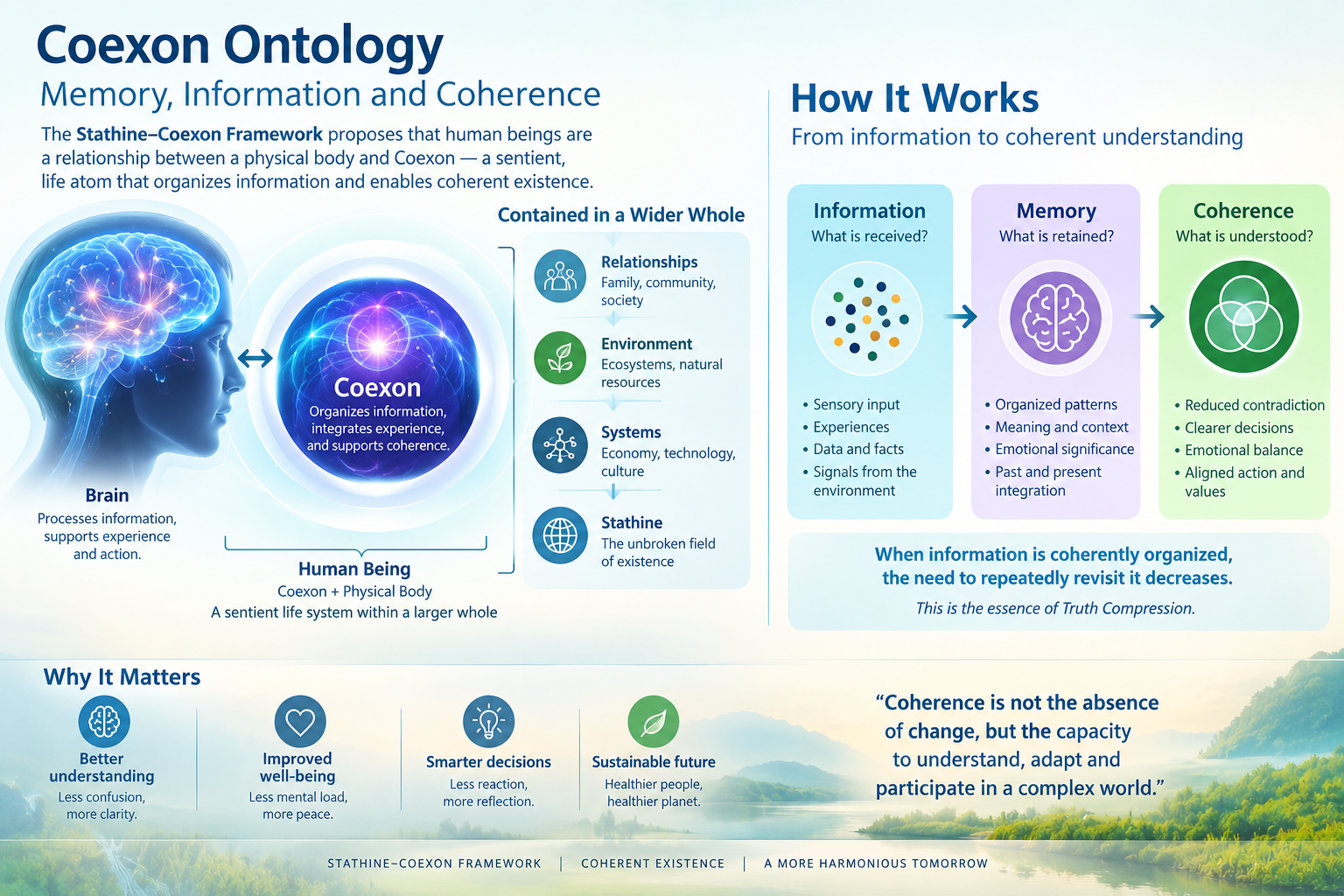
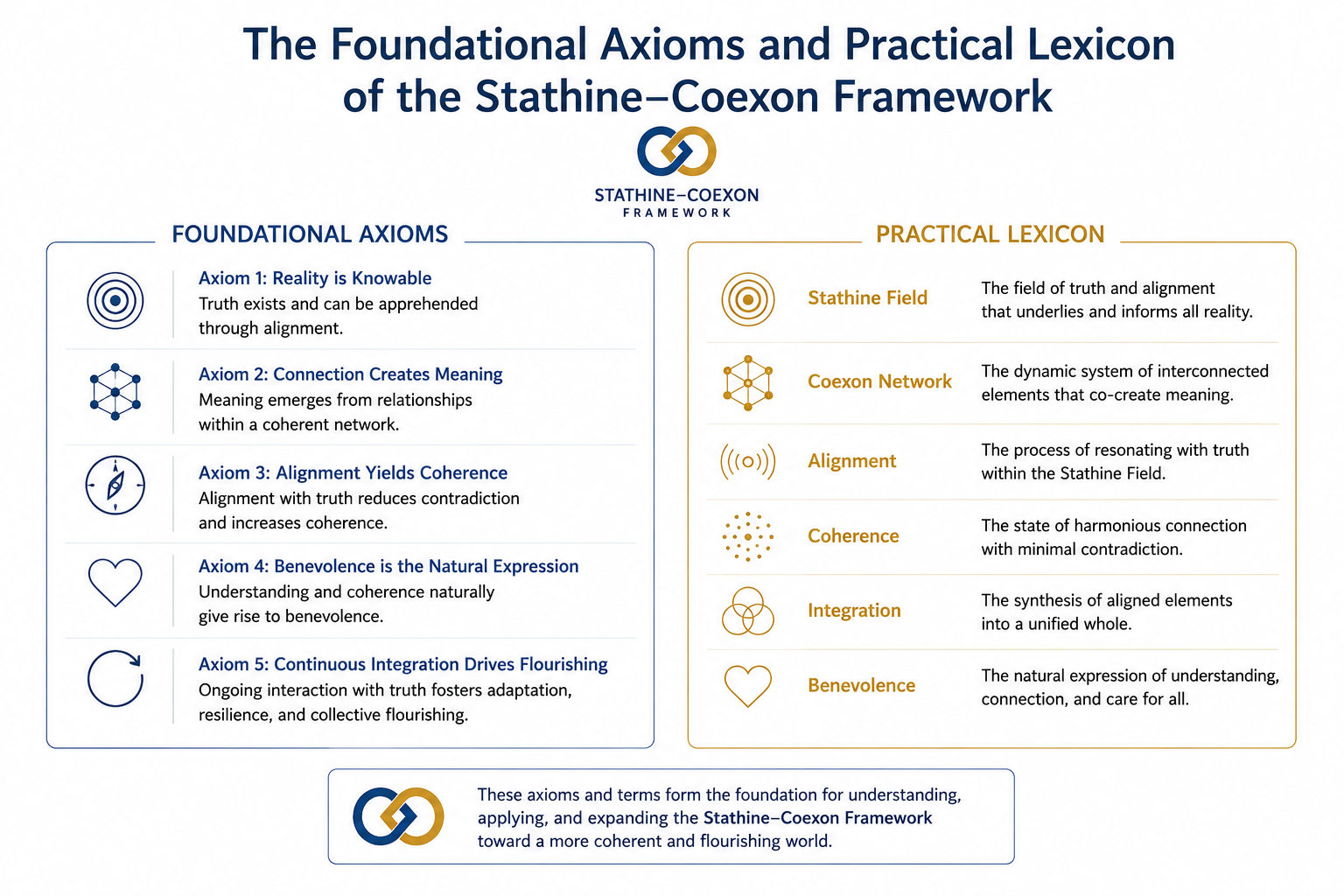
Within this framework, learning is understood as the progressive organization of information into increasingly coherent models of reality, followed by the ability to translate those models into meaningful action. Stathine is conceptualized as an omnipresent, non-depleting field, while Coexon is hypothesized as a sentient atom independent of the biological body, capable of organizing information and communicating with the holobiont’s neurological brain. The Coexon hypothesis lies beyond the present ambit of conventional epistemology and empirical data systems.
The paper argues that Reimers’ vision can therefore be enriched by introducing coherence as an explicit educational outcome. Instead of merely asking students to connect history, science, economics, technology, ethics, and culture, education can teach students to recognize the relationships, contradictions, feedback loops, and underlying principles that connect them.
The resulting educational model is proposed as Coherent Global Education: an educational architecture designed not simply to produce globally competent individuals, but humans capable of understanding themselves as participants in nested biological, social, ecological, technological, and civilizational systems.
1. Introduction: The End of the Isolated Subject
The traditional school is organized around subjects.
Mathematics.
Science.
History.
Geography.
Economics.
Language.
Art.
Each subject has its own textbook, teacher, timetable, examination, and conceptual vocabulary.
This architecture was useful when knowledge itself was being organized into relatively distinct disciplines.
But reality has never been organized into school subjects.
Climate change is not a “science problem.”
Artificial intelligence is not a “computer science problem.”
Migration is not merely a “geography problem.”
Poverty is not merely an “economics problem.”
Democracy is not merely a “political science problem.”
Human well-being is not merely a “biology problem.”
They are simultaneously:
scientific + economic + technological + psychological + cultural + ethical + political + ecological.
This is one reason the work of Fernando Reimers is particularly important.
His educational work asks how schools can prepare young people for a world characterized by interdependence, complexity, globalization, and shared challenges. Harvard describes his work as focused on developing competencies that allow children and youth to thrive while contributing to more just, democratic, peaceful, and sustainable societies. (Harvard Graduate School of Education)
The move toward interdisciplinary education is therefore not merely pedagogical innovation.
It is an attempt to make education more faithful to reality.
The Stathine–Coexon Framework proposes that this movement can be taken one step further.
The challenge is no longer merely:
How do we bring disciplines together?
It becomes:
How does the learner discover the coherence that exists across them?
2. Reimers’ Educational Vision
Reimers’ work has consistently addressed the relationship between education and the larger purposes of society.
His research and teaching encompass global citizenship, educational policy, curriculum reform, teacher development, climate change education, AI and education, educational equity, and the Sustainable Development Goals. (Harvard Graduate School of Education)
A particularly important feature of his work is that education is not treated as preparation solely for employment.
Education has a broader public purpose.
Students should become capable of:
- participating civically,
- working across cultural differences,
- collaborating,
- solving complex problems,
- contributing to sustainability,
- exercising agency,
- and improving the societies in which they live.
This is visible in the architecture of the World Course.
The curriculum combines global challenges with cognitive, interpersonal, and intrapersonal competencies and progressively moves students toward independent project-based inquiry. Students may identify an issue, conduct research, work with mentors, develop an intervention, implement it, and present the results. (Harvard Graduate School of Education)
This is already a substantial departure from conventional education.
It shifts education:
from knowing about the world
toward
participating in the world.
The Stathine–Coexon Framework proposes that the next step is:
understanding the coherence of the world in which participation occurs.
3. Interdisciplinarity Is Necessary but Not Sufficient
This distinction is central.
Suppose a student studies climate change through:
- physics,
- chemistry,
- economics,
- geography,
- political science,
- sociology,
- ethics.
This is interdisciplinary education.
But there is a potential problem.
The student can still possess six separate explanations.
The subjects have been placed beside one another without necessarily becoming integrated.
Thus:
Interdisciplinarity creates the opportunity for coherence; it does not automatically create coherence.
The Stathine–Coexon Framework distinguishes:
Multidisciplinary
Several disciplines examine the same issue independently.
Interdisciplinary
Disciplines interact and borrow methods from one another.
Transdisciplinary
The boundaries between disciplines become less important than the real-world problem.
Coherent learning
The learner discovers the relationships, principles, contradictions, and systemic structures connecting the different forms of knowledge.
The fourth level is the proposed contribution of Stathine–Coexon.
4. The Central Educational Problem: Fragmented Understanding
A student may know:
Carbon dioxide contributes to climate change.
Another lesson teaches:
Economic growth creates employment.
Another teaches:
Consumers respond to incentives.
Another teaches:
Governments respond to political pressure.
Another teaches:
Technology can reduce emissions.
All of these propositions may be correct.
But what happens when the student asks:
Why does a society that understands climate change continue to produce behavior that intensifies it?
Now the individual disciplines become insufficient.
The student needs to connect:
science + economics + psychology + politics + technology + culture + ethics.
The problem is therefore no longer knowledge acquisition.
It is information integration.
This is where the Stathine–Coexon Framework introduces the concept of coherence.
5. From Information to Coherence
The framework proposes the following developmental sequence:
Information → Relationship → Understanding → Coherence → Capability → Action → Feedback
Information is the starting point.
Relationship reveals how pieces of information connect.
Understanding explains those relationships.
Coherence allows apparently separate explanations to become part of a larger model.
Capability emerges when the model becomes actionable.
Action produces feedback.
Feedback modifies the model.
Learning therefore becomes recursive rather than linear.
This provides a deeper theoretical basis for the kind of project-based, interdisciplinary learning promoted in Reimers’ educational architecture.
6. The Learner as an Information-Organizing System
The conventional school often treats the student as a receiver of information.
The Stathine–Coexon Framework proposes a different ontology of learning.
The learner is an information-organizing system.
The brain processes enormous quantities of information.
But learning is not equivalent to processing.
The deeper question is:
How does information become meaningful organization?
Within the Stathine–Coexon hypothesis, the Coexon is conceptualized as a sentient atom independent of the biological body, capable of organizing information and communicating with the holobiont’s neurological brain.
This places an additional layer beneath conventional cognitive models.
The educational implication is not that conventional neuroscience becomes irrelevant.
Rather, it suggests that education may eventually need a broader theory of how information becomes integrated understanding.
The Coexon hypothesis occupies an epistemic domain beyond the present ambit of conventional empirical data systems.
Its educational importance, at this stage, is therefore conceptual:
The learner may be more than a processor of information; the learner may participate in a deeper process of information organization.
7. The Holobiont Learner
The Stathine–Coexon Framework also conceptualizes the human being as a holobiont.
This matters because learning is not exclusively cerebral.
The learner learns through:
- cognition,
- emotion,
- sensory experience,
- bodily states,
- relationships,
- environment,
- language,
- imagination,
- memory,
- and action.
A student may intellectually understand climate change while emotionally feeling disconnected from it.
Another student may intellectually understand cooperation but experience constant competitive pressure.
A third may understand global inequality but have no meaningful relationship with people from different social backgrounds.
The information exists.
The coherence does not.
Thus:
Education should align cognition, experience, meaning, relationship, and action.
8. From Global Citizen to Coherent Global Participant
Reimers’ concept of global citizenship is particularly fertile in this respect.
A global citizen is expected to understand:
- different cultures,
- global interdependence,
- shared problems,
- civic responsibility,
- sustainability,
- and collective action.
The Stathine–Coexon Framework proposes a deeper definition:
A global citizen is a person capable of perceiving the nested systems within which individual and collective life occurs and acting in ways that increase rather than diminish their coherence.
This changes the emphasis.
Global citizenship is no longer simply:
“I understand people from different countries.”
It becomes:
“I understand that my actions participate in systems extending beyond my immediate identity and geography.”
9. From “Global” to “Nested”
There is a subtle limitation in the word “global.”
Global sometimes implies the largest relevant scale.
But reality is nested.
The learner exists simultaneously within:
self
↓
family
↓
school
↓
community
↓
nation
↓
human civilization
↓
biosphere
↓
planetary system
↓
larger physical reality
The student is therefore not merely a global citizen.
The student is a participant in nested systems.
The Stathine–Coexon Framework calls attention to the relationships among these levels.
This creates a more powerful educational question:
How does an action at one level affect coherence at another?
10. A New Model of Global Education
Reimers’ educational vision can therefore be extended:
Stage 1 — Global Awareness
I know that the world is interconnected.
Stage 2 — Global Competence
I can communicate and collaborate across differences.
Stage 3 — Global Agency
I can act upon global problems.
Stage 4 — Systems Understanding
I understand how local and global systems interact.
Stage 5 — Coherent Participation
I can act while considering the effects of my action across nested systems.
Stage 6 — Regenerative Participation
I can leave the systems in which I participate more capable of sustaining themselves.
This final stage moves global citizenship toward civilizational responsibility.
11. Reimers’ World Course as a Prototype for Coherent Education
The World Course provides an especially useful case.
Its design already includes:
- global challenges,
- interdisciplinary content,
- competencies,
- technology,
- collaboration,
- project-based learning,
- independent inquiry,
- mentorship,
- and action. (Harvard Graduate School of Education)
Students eventually undertake multi-year inquiries involving research, mentoring, implementation, and presentation. (Harvard Graduate School of Education)
The Stathine–Coexon Framework proposes adding another explicit layer:
The Coherence Layer
For every major project, students should be asked:
1. What do we know?
Information.
2. What connects the information?
Relationships.
3. What contradictions exist?
Unresolved tensions.
4. What larger system contains the problem?
Context.
5. What assumptions are we making?
Epistemic awareness.
6. What model best explains the evidence?
Coherence.
7. What action follows?
Praxis.
8. What did reality teach us?
Feedback.
9. How should the model change?
Learning.
This turns a project into a coherence laboratory.
12. Five Dimensions of Educational Inquiry
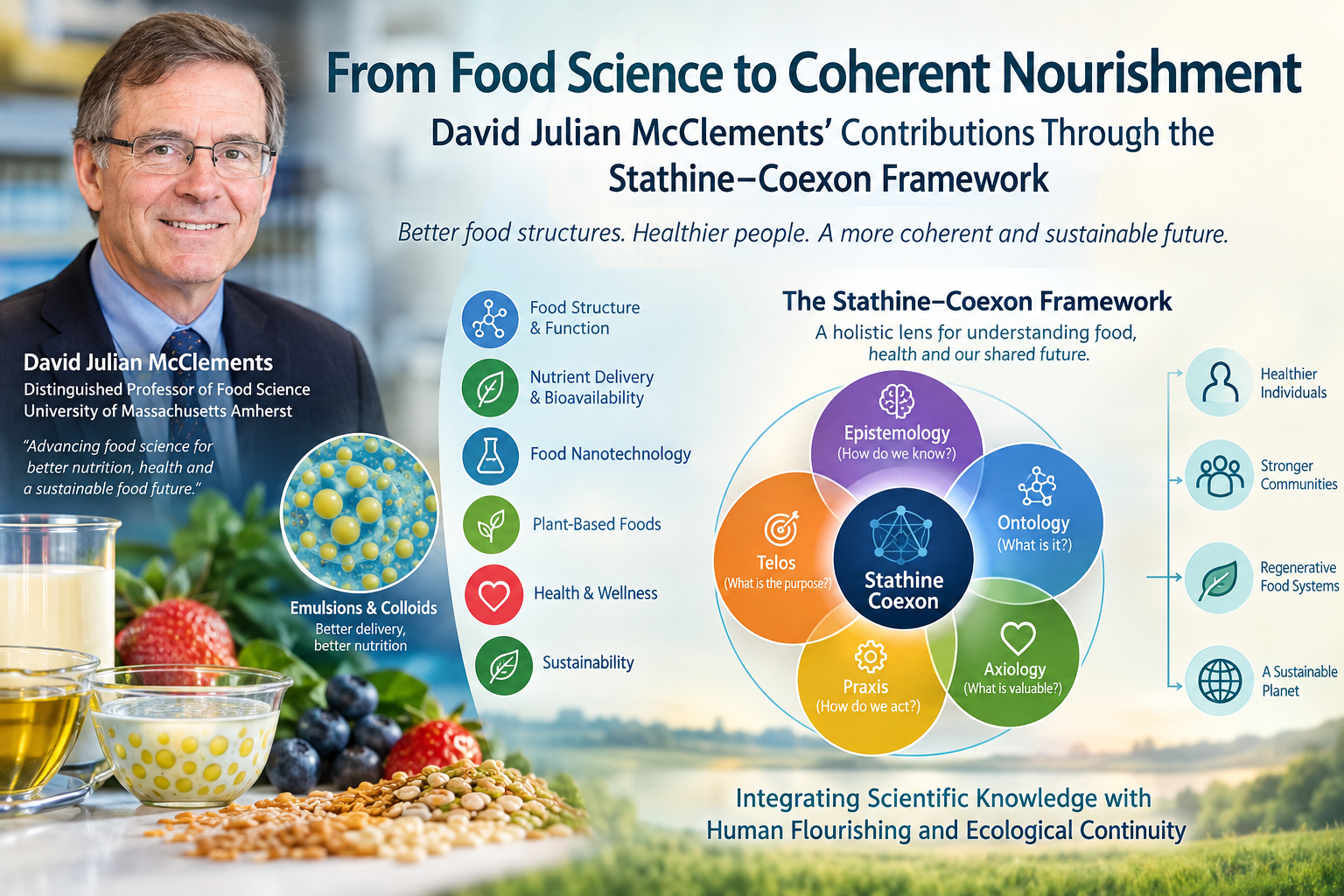
The Stathine–Coexon Framework can also provide a universal five-dimensional architecture for interdisciplinary education:
Dimension. Educational Question
Epistemology. How do we know?
Ontology. What actually exists or is happening?
Axiology. What matters and why?
Praxis What should we do?
Telos. What larger purpose are we serving?
This is particularly valuable for Reimers’ model because global problems are never purely factual.
Consider climate change.
Epistemology
What evidence establishes the problem?
Ontology
What systems and relationships actually produce it?
Axiology
Why should future generations matter?
Praxis
What can we change?
Telos
What kind of civilization are we trying to create?
A student who can move across all five dimensions has developed a much deeper form of interdisciplinary intelligence.
13. The Missing Dimension in Conventional Interdisciplinarity
Many interdisciplinary curricula stop after:
What do different disciplines say about this problem?
The Stathine–Coexon approach asks:
What does the relationship among those disciplines reveal that none of them can reveal alone?
This is a crucial distinction.
Science can explain atmospheric processes.
Economics can explain incentives.
Psychology can explain behavior.
Political science can explain institutions.
Ethics can explain values.
But their interaction may reveal something fundamentally new:
The climate problem is simultaneously a physical, behavioral, economic, institutional, and moral coordination problem.
The new understanding emerges from the relationship among disciplines.
That relationship itself becomes the object of learning.
14. From Subject Integration to Reality Integration
This leads to a deeper educational transformation.
The objective should not simply be:
integrating subjects.
It should be:
integrating reality.
Subjects are human-created categories.
Reality does not respect those categories.
The child therefore needs to learn how to move between:
disciplinary models
and
whole-system reality.
This is one of the most important contributions the Stathine–Coexon Framework could make to Reimers’ educational architecture.
15. Contradiction as a Learning Instrument
The framework’s principle of Progressive Reduction of Contradiction provides another major educational tool.
Suppose students discover:
Renewable energy is desirable.
But also:
Mining the minerals needed for renewable technologies has environmental and social consequences.
The objective is not to tell students which statement is “correct.”
Both may be true.
The educational opportunity is to ask:
How can these truths coexist within a larger model?
This creates a more sophisticated learner.
The learner discovers that contradictions often indicate:
the model is incomplete.
Therefore:
Contradiction is not necessarily failure. It can be a signal that understanding needs to expand.
16. Creativity as Coherence Expansion
This also changes how creativity is taught.
Creativity is often described as:
thinking outside the box.
The Stathine–Coexon Framework proposes:
Creativity is the expansion of the existing model so that previously incompatible information can become intelligible within a larger model.
A student discovers that two apparently conflicting solutions both have value.
Instead of choosing one and rejecting the other, the student asks:
Is there a third architecture that preserves the value of both?
That is higher-order creativity.
It is particularly important for global problems.
17. Intercultural Education and Coherence
Reimers’ global citizenship work emphasizes the ability to work across cultural differences. Harvard describes global competence as including the social and emotional capacity to understand and work with people from diverse cultures. (Harvard Graduate School of Education)
The Stathine–Coexon Framework can deepen this.
Intercultural competence should not mean:
“I tolerate your difference.”
It can become:
“I can expand my understanding sufficiently to accommodate your perspective without requiring either of us to erase our identity.”
This is coherence rather than conformity.
Two different perspectives can coexist.
The objective is not necessarily agreement.
It is:
mutual intelligibility without loss of distinction.
18. Sah-Astitva and Global Citizenship
The Sanskrit-derived concept Sah-Astitva, or coexistence, provides a useful philosophical parallel.
Existence is not conceived as isolated entities competing for space.
Existence is relational.
The individual remains individual.
The system remains system.
But both are continuously influencing each other.
This provides an educational foundation for global citizenship:
I do not need to become less myself to become more connected.
This is especially important in multicultural education.
Coherence is not sameness.
19. The Role of Ethics
Interdisciplinary education often produces better understanding.
But understanding alone does not determine what should be done.
This is why the five-dimensional model is useful.
After asking:
What is happening?
students must also ask:
What should matter?
For example:
AI may make education more efficient.
But:
Should efficiency be the primary objective of education?
A technology may increase productivity.
But:
What happens to human agency?
Economic growth may increase wealth.
But:
Who benefits?
Climate adaptation may protect wealthy communities.
But:
What happens to vulnerable populations?
Interdisciplinary education therefore needs axiological coherence.
20. AI and the Next Evolution of Interdisciplinary Education
This becomes especially urgent in the age of artificial intelligence.
Reimers’ current work explicitly includes AI and education, particularly the implications for curriculum, instruction, assessment, teacher learning, leadership, and governance. (Harvard Graduate School of Education)
AI changes interdisciplinary education because it can connect domains extraordinarily quickly.
A student can ask an AI system:
“Explain this problem from the perspectives of economics, biology, psychology, ethics and political science.”
That is powerful.
But it creates a new danger.
AI can generate multidisciplinary information without producing human understanding.
The learner may receive ten perspectives and understand none of them.
Therefore the future challenge is not merely:
Can AI connect disciplines?
It is:
Can AI help humans discover coherence across disciplines?
21. AI as a Coherence Assistant
A Stathine–Coexon educational architecture could use AI differently.
Instead of asking AI merely to provide answers, students could ask it to expose:
- assumptions,
- contradictions,
- missing variables,
- alternative explanations,
- relationships,
- unintended consequences,
- and competing value systems.
The AI becomes:
a mirror for the learner’s model.
For example:
“What assumptions am I making?”
“What evidence contradicts my conclusion?”
“Which disciplines would disagree with this model?”
“What relationships am I overlooking?”
“What happens if my assumption is wrong?”
This transforms AI from an answer engine into a coherence-testing instrument.
22. The Teacher’s Role in a Coherent Interdisciplinary System
As AI and interdisciplinary resources expand, the teacher’s role becomes even more important.
The teacher becomes less responsible for possessing every answer.
Instead, the teacher becomes responsible for:
- framing meaningful questions,
- protecting intellectual rigor,
- helping students evaluate evidence,
- connecting perspectives,
- identifying contradictions,
- facilitating reflection,
- and maintaining human meaning.
The teacher becomes the architect of inquiry.
This is consistent with Reimers’ emphasis on teacher development and systemic educational change. His work explicitly addresses teacher professional development as part of educational transformation. (Harvard Graduate School of Education)
23. From Teacher Development to Teacher Coherence
The Stathine–Coexon Framework adds another requirement.
Teachers themselves must experience interdisciplinary coherence.
A teacher trained exclusively within one discipline may struggle to facilitate genuine integration.
Therefore teacher education should include:
- systems thinking,
- interdisciplinary inquiry,
- behavioral science,
- philosophy,
- ethics,
- technology,
- communication,
- reflective practice.
A future teacher should be able to say:
“I don’t know the answer.”
without losing authority.
The teacher’s authority comes from the ability to guide the inquiry.
24. Assessment Must Also Become Interdisciplinary
If education becomes interdisciplinary but assessment remains subject-fragmented, the old system will eventually reassert itself.
Therefore the assessment architecture must change.
A student should not merely be evaluated on:
“Did you know the facts?”
but also:
Integration
Can you connect disciplines?
Coherence
Can you build a consistent model?
Contradiction
Can you identify where the model fails?
Agency
Can you act on your understanding?
Collaboration
Can you increase the capability of others?
Reflection
Can you revise your model?
Purpose
Can you explain why the problem matters?
This is a fundamentally different conception of educational excellence.
25. A Coherence Portfolio
The conventional report card might eventually be complemented by a Coherence Portfolio.
Each student could maintain evidence of:
- interdisciplinary projects,
- evolving models,
- failed experiments,
- revised hypotheses,
- community work,
- collaborative projects,
- reflective journals,
- AI interactions,
- ethical reasoning,
- and real-world interventions.
The portfolio would demonstrate not merely:
what the learner knows
but:
how the learner thinks.
And more importantly:
how the learner changes through learning.
26. The Student as a System Designer
Reimers’ project-based approach already moves students toward agency.
The Stathine–Coexon Framework proposes extending this toward system design.
Students should learn to ask:
What system produces this outcome?
Then:
What variables maintain it?
Then:
Where is the leverage point?
Then:
What intervention might change the system?
Then:
What unintended consequences could follow?
Then:
How will we know whether the intervention worked?
This is not simply project-based learning.
It is systemic agency.
27. The School as a Microcosm of Global Society
If students are expected to become global citizens, the school itself should become a miniature global system.
Students should experience:
- cultural diversity,
- disagreement,
- cooperation,
- resource allocation,
- governance,
- conflict resolution,
- environmental responsibility,
- technological change,
- and collective decision-making.
The school should not merely teach global citizenship.
It should practice it.
This is consistent with the insight in Reimers-related Harvard case work that a global studies program requires alignment across the school’s culture, not merely a separate curriculum. (Harvard Education Press)
The Stathine–Coexon interpretation makes the principle explicit:
The environment must embody the learning.
28. Whole-School Coherence
A school cannot teach:
“Collaboration matters.”
while rewarding only individual competition.
It cannot teach:
“Sustainability matters.”
while operating wastefully.
It cannot teach:
“Respect differences.”
while silencing disagreement.
It cannot teach:
“Critical thinking matters.”
while punishing questions.
This creates educational contradiction.
Therefore:
The school must become an example of the principles it teaches.
This is whole-school coherence.
29. The Principle of Educational Truth Compression
The Stathine–Coexon concept of Truth Compression provides a powerful final objective for interdisciplinary learning.
A learner initially sees:
thousands of facts.
With development, the learner discovers:
hundreds of relationships.
Later:
dozens of principles.
Eventually:
a small number of deep organizing principles.
For example:
Interdependence
can explain relationships across:
- ecosystems,
- economies,
- families,
- organizations,
- international relations,
- and biological systems.
This is not simplification.
It is compression through understanding.
The learner is becoming capable of seeing more with fewer conceptual fragments.
30. From Knowledge Economy to Coherence Economy
The implications extend beyond education.
The modern economy was built around knowledge.
The emerging economy is increasingly built around:
- data,
- AI,
- networks,
- creativity,
- collaboration,
- and complex problem-solving.
But these capabilities require something deeper:
the ability to integrate information.
A person who knows 10,000 facts but cannot connect them may be less useful than a person who understands 100 principles and can apply them across domains.
Thus:
The next scarce human resource may not be information. It may be coherence.
Education should prepare for that economy.
31. From Global Citizenship to Civilizational Intelligence
The synthesis ultimately points toward a larger educational objective.
Global citizenship asks:
How do I participate responsibly in an interconnected world?
Civilizational intelligence asks:
How do we collectively understand and redesign the systems through which civilization operates?
This includes:
- education,
- economics,
- technology,
- ecology,
- governance,
- health,
- culture,
- and human relationships.
The student becomes more than a citizen.
The student becomes a potential co-creator of civilization.
32. A Proposed Coherent Global Education Architecture
The combined Reimers–Stathine–Coexon model can be represented as:
Real-world challenge
↓
Multiple disciplinary perspectives
↓
Interdisciplinary integration
↓
Systems mapping
↓
Contradiction identification
↓
Five-dimensional inquiry
Epistemology → Ontology → Axiology → Praxis → Telos
↓
Coherent model
↓
Collaborative action
↓
Real-world feedback
↓
Reflection
↓
Model revision
↓
Regenerative intervention
This transforms education into a continuous cycle of:
Understanding → Acting → Learning → Re-understanding
33. A Proposed Educational Equation
The synthesis can be expressed conceptually as:
Future Education = Knowledge × Integration × Coherence × Agency × Purpose
Where:
Knowledge provides information.
Integration connects disciplines.
Coherence creates an explanatory model.
Agency enables action.
Purpose determines what the action is for.
If any one of these is absent, education becomes incomplete.
Knowledge without purpose can become destructive.
Purpose without knowledge can become naive.
Knowledge without integration becomes fragmented.
Integration without coherence becomes overwhelming.
Coherence without agency becomes passive.
Agency without purpose becomes potentially dangerous.
34. The Deeper Contribution of the Stathine–Coexon Framework
The value of applying Stathine–Coexon to Reimers’ educational work is therefore not to replace interdisciplinary education.
It is to provide a deeper organizing principle for it.
Reimers asks education to prepare learners for:
- interdependence,
- global citizenship,
- sustainability,
- collaboration,
- innovation,
- civic participation,
- and complex global challenges. (Harvard Graduate School of Education)
Stathine–Coexon asks:
What underlying human capacity allows a person to participate coherently in all these domains?
The answer proposed by the framework is:
the progressive capacity to organize information into coherent understanding and translate that understanding into aligned action within nested systems.
This becomes the bridge.
35. Conclusion: From Interdisciplinary Education to Coherent Civilization
Fernando Reimers’ work represents an important transformation in educational thought.
It recognizes that the world children inherit is interconnected and that education must therefore prepare them for complexity rather than merely reproduce disciplinary silos.
His interdisciplinary curriculum work, global citizenship education, focus on competencies, project-based inquiry, sustainability, teacher development, and increasingly AI and climate change demonstrate a consistent effort to align education with the actual challenges of the twenty-first century. (Harvard Graduate School of Education)
The Stathine–Coexon Framework can extend this transformation by introducing a deeper question:
What happens after disciplines are connected?
The answer proposed here is:
Coherence.
The future learner should not merely know multiple subjects.
The learner should understand why they belong together.
The learner should not merely recognize global problems.
The learner should understand the nested systems that generate them.
The learner should not merely collaborate.
The learner should understand how different perspectives can coexist without collapsing into conformity.
The learner should not merely solve problems.
The learner should understand the consequences of solutions across systems and across time.
And the learner should not merely prepare for the future.
The learner should become capable of participating in its creation.
Within the Stathine–Coexon Framework, Coexon is hypothesized as a sentient atom independent of the biological body, capable of organizing information and communicating with the holobiont’s neurological brain. This hypothesis lies beyond the present ambit of conventional epistemology and empirical data systems. Its inclusion therefore expands the philosophical horizon of education toward a question that conventional educational models have rarely addressed directly:
What is the deeper architecture through which a living human being organizes experience into understanding?
If education can increasingly understand and cultivate that capacity, then interdisciplinary education becomes more than a curriculum strategy.
It becomes a pathway toward a different kind of human intelligence.
Not intelligence measured by how much one knows.
Not intelligence measured merely by how quickly one solves a problem.
But intelligence measured by the ability to:
connect, integrate, understand, reconcile, act, learn, and regenerate.
The progression can therefore be stated as:
From Subjects → to Disciplines → to Interdisciplinarity → to Systems → to Coherence → to Regeneration.
And the ultimate educational objective becomes:
To develop human beings capable of seeing the relationships that connect seemingly separate realities, acting within those relationships with awareness, and increasing the coherence and regenerative capacity of the systems in which they participate.
That is where Reimers’ vision of global education and the Stathine–Coexon Framework meet.
And it may be where the next evolution of education begins.
Proposed Research Model for a Future Reimers–Stathine–Coexon Study
A particularly strong empirical research program could now be developed around three comparable cohorts:
ModelEducational ArchitecturePrimary OutcomeTraditionalSubject-based instructionKnowledge acquisitionReimers-type interdisciplinaryGlobal problems + multiple disciplines + projectsGlobal competence and agencyStathine–Coexon enhancedInterdisciplinary + systems + coherence + contradiction + reflection + regenerative actionCoherent systemic agency
The key hypothesis would be:
Students exposed to explicit coherence-building practices will demonstrate greater ability to transfer understanding across disciplinary boundaries, recognize systemic relationships, revise models in response to contradictory evidence, and design interventions with consideration of second- and third-order consequences.
That proposition is sufficiently concrete to become a researchable educational hypothesis, while preserving the deeper Stathine–Coexon ontology as the conceptual architecture behind the inquiry.
Fernando M. Reimers — Harvard Graduate School of Education
Fernando M. Reimers — Global Education Innovation Initiative