Coherence and Orderliness in Existence: The Central Principle of the Stathine–Coexon Framework
Part of the Stathine–Coexon Research Series – Volume I: Foundations
Abstract
Modern science has developed powerful theories explaining matter, energy, biological evolution, information, and complex adaptive systems. Yet a single philosophical principle that unifies physical order, biological organization, conscious understanding, ethical development, and civilizational progress remains elusive.
This paper proposes Coherence as the central organizing principle of the Stathine–Coexon Framework. The framework suggests that coherent orderliness is not merely a property occasionally observed in nature but the fundamental tendency through which existence becomes intelligible, sustainable, and progressively organized.
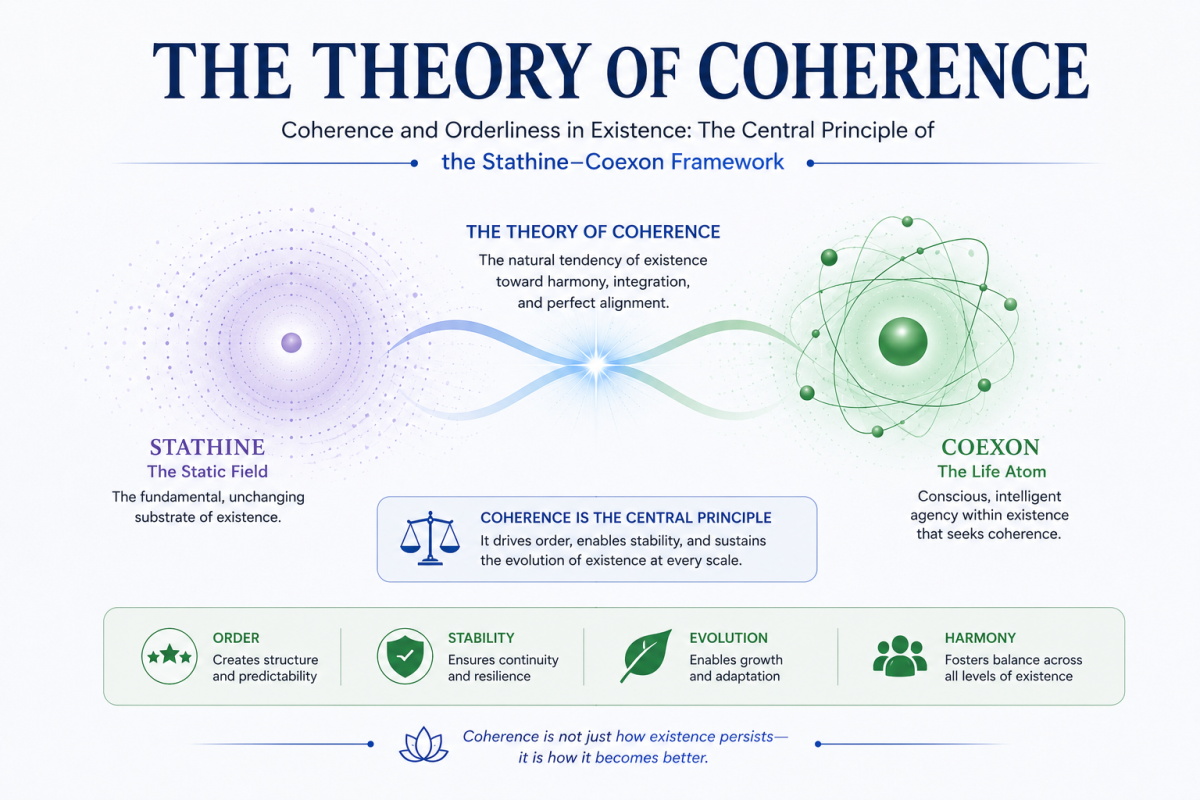
Within this ontology, Stathine represents the timeless conceptual ground that makes coherent existence possible, while the human being—defined within the framework as the integrated unity of the proposed Coexon and the physical body—acts as the dynamic participant through which coherence can be progressively realized.
Rather than replacing existing scientific theories, this paper offers a philosophical framework intended to integrate diverse disciplines through the common language of coherence.
Foundational Terminology
This article forms part of the ongoing Stathine–Coexon Framework Research Series.
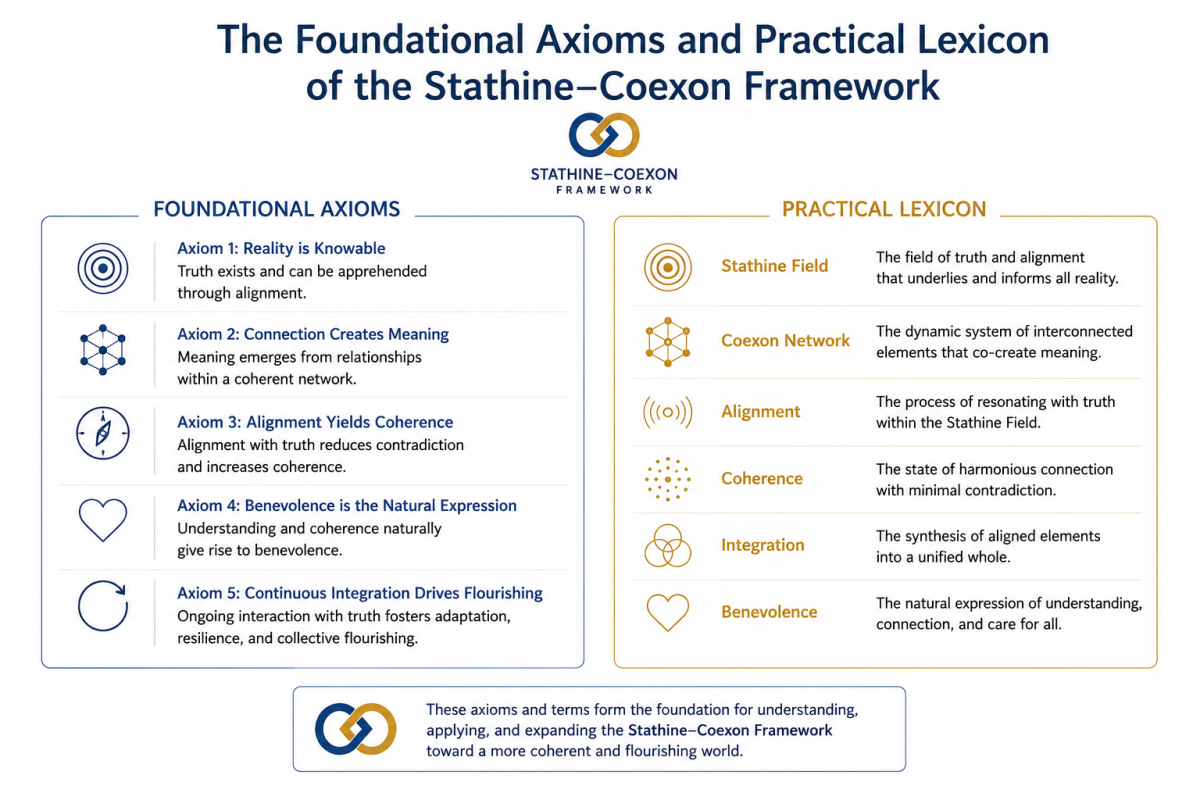
Readers unfamiliar with the terminology are encouraged to first read The Foundational Axioms and Practical Lexicon of the Stathine–Coexon Framework, which defines the foundational concepts used throughout this paper.
1. Introduction
Every great scientific framework identifies a fundamental organizing principle.
Newton emphasized force.
Einstein emphasized spacetime.
Darwin emphasized natural selection.
Systems science emphasizes relationships.
The Stathine–Coexon Framework proposes a different organizing principle:
Coherence.
The central proposition of this paper is simple.
Existence persists because it is coherent.
Order is not accidental.
It is the condition that allows anything to continue existing.
Whenever coherence disappears, structures disintegrate.
Whenever coherence increases, increasingly complex and stable forms become possible.
From atoms to ecosystems, from language to civilizations, existence appears to exhibit a continual tendency toward organized relationships.
The Stathine–Coexon Framework proposes that this tendency is not incidental but foundational.
2. What is Coherence?
Within this framework,
Coherence is the degree to which the components of any system exist in mutually compatible, internally consistent, and progressively ordered relationships that sustain the continued existence of the whole.
This definition deliberately extends beyond psychology.
Coherence is proposed as a universal organizing principle.
It applies equally to:
- atomic stability,
- biological organisms,
- nervous systems,
- ecosystems,
- societies,
- institutions,
- knowledge,
- ethics,
- consciousness.
Where coherence increases, order emerges.
Where coherence decreases, disorder eventually follows. At the universal level Coexistence is always existential.
3. Stathine as the Ground of Order
The framework proposes Stathine as the timeless conceptual ground within which coherent existence is possible.
Importantly, Stathine is not described as an active force directing events.
Rather, it is the invariant condition that allows coherent organization to exist.
Just as mathematics provides a logical structure within which geometry becomes possible, Stathine plays is role by being. Within which coherent existence arises and manifests on a planet.
4. The Human Being as the Seeker of Coherence
Within the framework, the human being is the integrated unity of the (Sentient atom) Coexon and the physical body.
The human being continually encounters uncertainty.
Learns.
Adapts.
Creates.
Questions.
Corrects.
This continual refinement is interpreted as movement toward greater coherence.
Knowledge is therefore not merely accumulated.
It becomes progressively organized.
Wisdom represents highly coherent understanding.
5. Orderliness Across Scales
One remarkable feature of existence is the recurrence of order at vastly different scales.
Atoms organize into molecules.
Molecules organize into cells.
Cells organize into organisms.
Organisms organize into ecosystems.
Individuals organize into societies.
Knowledge organizes into civilizations.
The framework proposes that these recurring patterns reflect the same underlying tendency toward coherence expressed at different increasing levels of complexity.
6. Contradiction as Local Incoherence
The framework distinguishes between contradiction and diversity.
Different perspectives need not be contradictory.
Contradiction occurs when incompatible understandings cannot simultaneously support coherent existence.
Local contradictions need not immediately destroy a system.
However, persistent unresolved contradictions gradually reduce coherence.
In individuals, this may appear as confusion, chronic conflict, or fragmentation.
In organizations, it appears as misalignment between purpose and action.
In civilizations, it appears as institutional inconsistency and systemic instability.
Thus, contradiction is interpreted as localized incoherence rather than moral failure.
7. Truth as Maximum Coherence
Within the Stathine–Coexon Framework, truth is interpreted philosophically as the understanding that produces the highest attainable coherence relative to present knowledge.
This interpretation differs from viewing truth solely as factual correspondence.
A truthful understanding:
- reduces contradiction,
- simplifies without losing accuracy,
- integrates apparently separate observations,
- supports increasingly coherent action.
Truth therefore becomes progressively compressive.
As understanding deepens, fewer assumptions are required to explain more phenomena.
8. Human Development as Increasing Coherence
Learning is often measured by the quantity of information acquired.
The framework proposes a different measure.
Human development is the progressive organization of understanding into increasingly coherent structures.
Children accumulate information.
Adults integrate information.
Wise individuals organize understanding into coherent principles that guide action across diverse situations.
Education therefore becomes the cultivation of coherence rather than information alone.
9. Civilizations as Coherence Systems
Civilizations are not merely collections of institutions.
They are coherence systems.
Education.
Science.
Economics.
Governance.
Healthcare.
Culture.
Justice.
Technology.
Each contributes to overall societal coherence.
When these systems reinforce one another, civilization flourishes.
When they become fragmented, contradiction accumulates.
The resulting instability is experienced as polarization, distrust, institutional decline, and social fragmentation.
Thus, civilization itself may be evaluated according to its capacity to generate coherent relationships.
10. The Coherence Principle
The central proposition of this paper may be expressed as follows:
Every enduring system tends toward the highest attainable coherence permitted by its structure, understanding, and environment.
This principle is offered as a philosophical hypothesis rather than an established scientific law.
If fruitful, it provides a common conceptual language connecting diverse disciplines.
11. Implications
If coherence is accepted as the central organizing principle, several implications follow.
For Science
Scientific progress increasingly integrates rather than fragments knowledge.
For Education
Education should cultivate coherent understanding before specialization.
For Leadership
Leadership becomes the cultivation of alignment rather than authority.
For Artificial Intelligence
Alignment may depend more upon coherent organization than computational scale alone.
For Healthcare
Health extends beyond the absence of disease toward coherent functioning across biological, psychological, social, and existential dimensions.
For Economics
Prosperity becomes the sustained coherence of human, ecological, and economic systems.
For Civilization
Progress is measured not only by technological advancement but by increasing coherence across institutions and human relationships.
12. Future Research
This theory suggests several avenues for interdisciplinary investigation.
- Can coherence be operationally defined across different domains?
- Can educational systems intentionally cultivate coherence?
- How does coherence relate to resilience, creativity, ethics, and well-being?
- Can organizational coherence be measured?
- Does increasing coherence predict long-term societal resilience?
These questions invite collaboration among philosophers, scientists, educators, systems theorists, psychologists, economists, and complexity researchers.
Conclusion
The Theory of Coherence proposes that orderliness is not a secondary characteristic of existence but its most fundamental organizing principle.
Within the Stathine–Coexon Framework, Stathine provides the timeless conceptual ground, while the human being progressively participates in the realization of coherence through understanding, relationship, learning, and action.
If this philosophical perspective proves useful, it may provide a common language capable of connecting diverse fields of inquiry without replacing their established methods. The framework therefore offers not a competing scientific theory but an integrative ontology in which coherence becomes the unifying principle linking matter, life, consciousness, society, and civilization.
About the Stathine–Coexon Framework
The Stathine–Coexon Framework is an interdisciplinary philosophical framework that seeks to integrate insights from systems thinking, neuroscience, psychology, biology, complexity science, leadership, education, consciousness studies, and civilizational research through the unifying concept of coherence.
The framework proposes Stathine as the timeless conceptual ground of existence and the Coexon as a proposed organizing life atom. Together, these concepts provide a philosophical lens for exploring human development, learning, leadership, artificial intelligence, regenerative systems, and civilizational evolution.
Foundational concepts, terminology, and guiding principles are presented in The Foundational Axioms and Practical Lexicon of the Stathine–Coexon Framework.