The Ontology of Stathine and Coexon Framework to understand human role in existence.
A Foundational Philosophical Framework for Coherent Existence
Part of the Stathine–Coexon Research Series
Abstract
The Stathine–Coexon Framework is an interdisciplinary philosophical framework that seeks to provide an ontological foundation for understanding existence, consciousness, learning, and the progressive development of coherence. While contemporary science has produced powerful explanatory models for physical systems, biological evolution, cognition, and complex adaptive systems, a comprehensive philosophical account connecting these domains remains an open challenge.
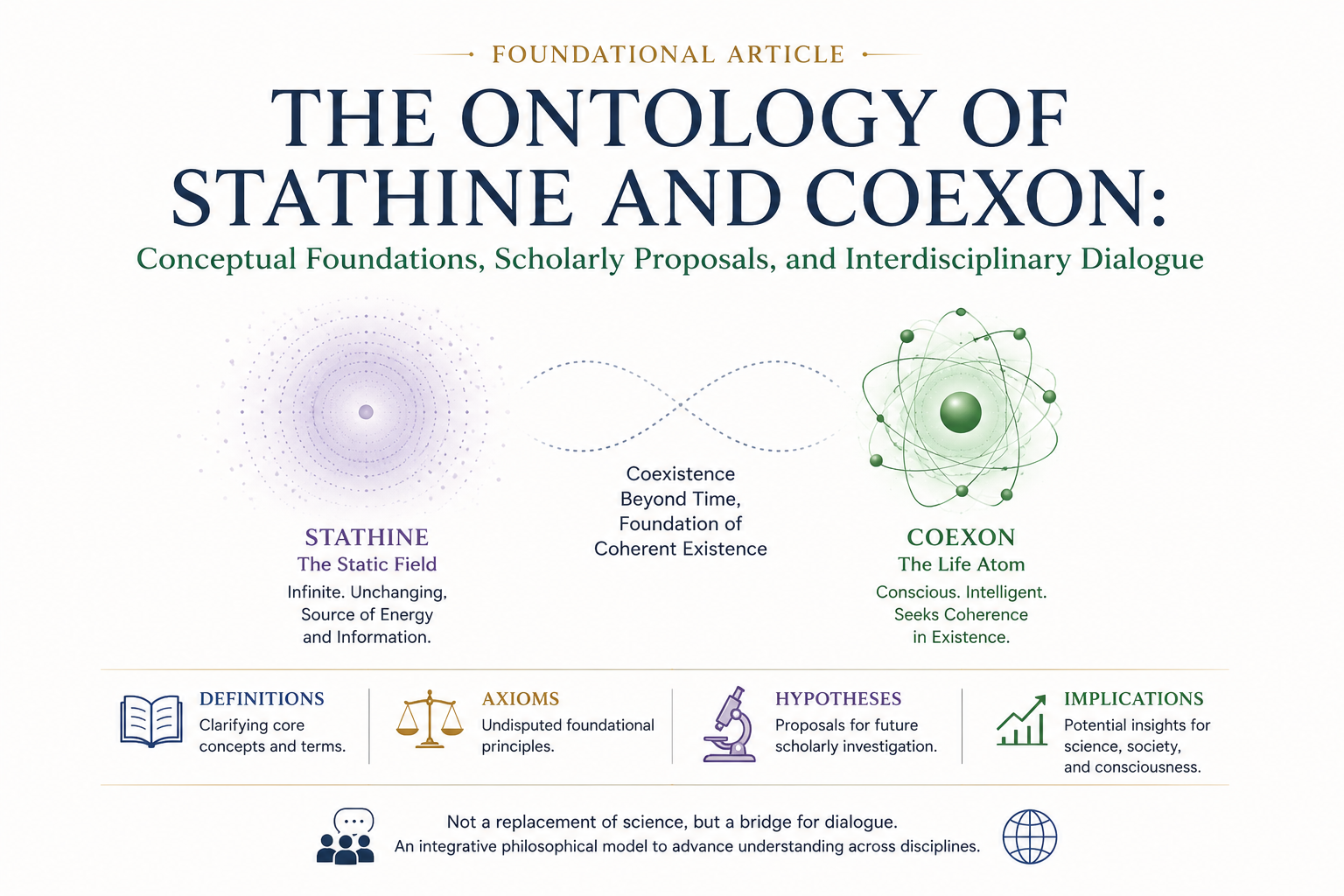
This paper presents the foundational ontology of the Stathine–Coexon Framework. It distinguishes between definitions, axioms, hypotheses, and implications to clarify which elements are conceptual foundations and which are intended as proposals for future scholarly investigation. Rather than replacing established scientific theories, the framework is offered as an integrative philosophical model intended to stimulate interdisciplinary dialogue.
Foundational Terminology
This article forms part of the ongoing Stathine–Coexon Framework research series. Readers who are new to the framework are encouraged to first read The Foundational Axioms and Practical Lexicon of the Stathine–Coexon Framework, which introduces the foundational axioms, terminology, and guiding principles used throughout this article.
1. Introduction
Every scientific and philosophical framework begins by asking what fundamentally exists.
Classical mechanics begins with matter and motion.
Relativity begins with spacetime.
Quantum mechanics begins with quantum states.
Systems theory begins with relationships.
The Stathine–Coexon Framework begins with a different ontological question:
What enables coherent existence?
Rather than treating existence as merely physical or purely mental, the framework proposes that coherent existence emerges through the interaction of two foundational concepts: Stathine and Coexon.
These concepts are introduced as philosophical constructs intended to organize inquiry.They are beyond the limited empirical methodology of scientific validation As homo. sapiens we can understand and know them. That is the validation of their existence.
2. Ontological Definitions
Definition 1: Stathine
Stathine is defined as the timeless, invariant conceptual ground of existence.
Within the framework, Stathine is not regarded as matter, energy, space, or time. Instead, it represents the unchanging condition that makes coherent existence conceptually possible.
Stathine is proposed as:
- timeless,
- non-depleting,
- invariant,
- universally present,
- independent of physical processes.
Its role is philosophical rather than mechanistic.
Definition 2: Coexon
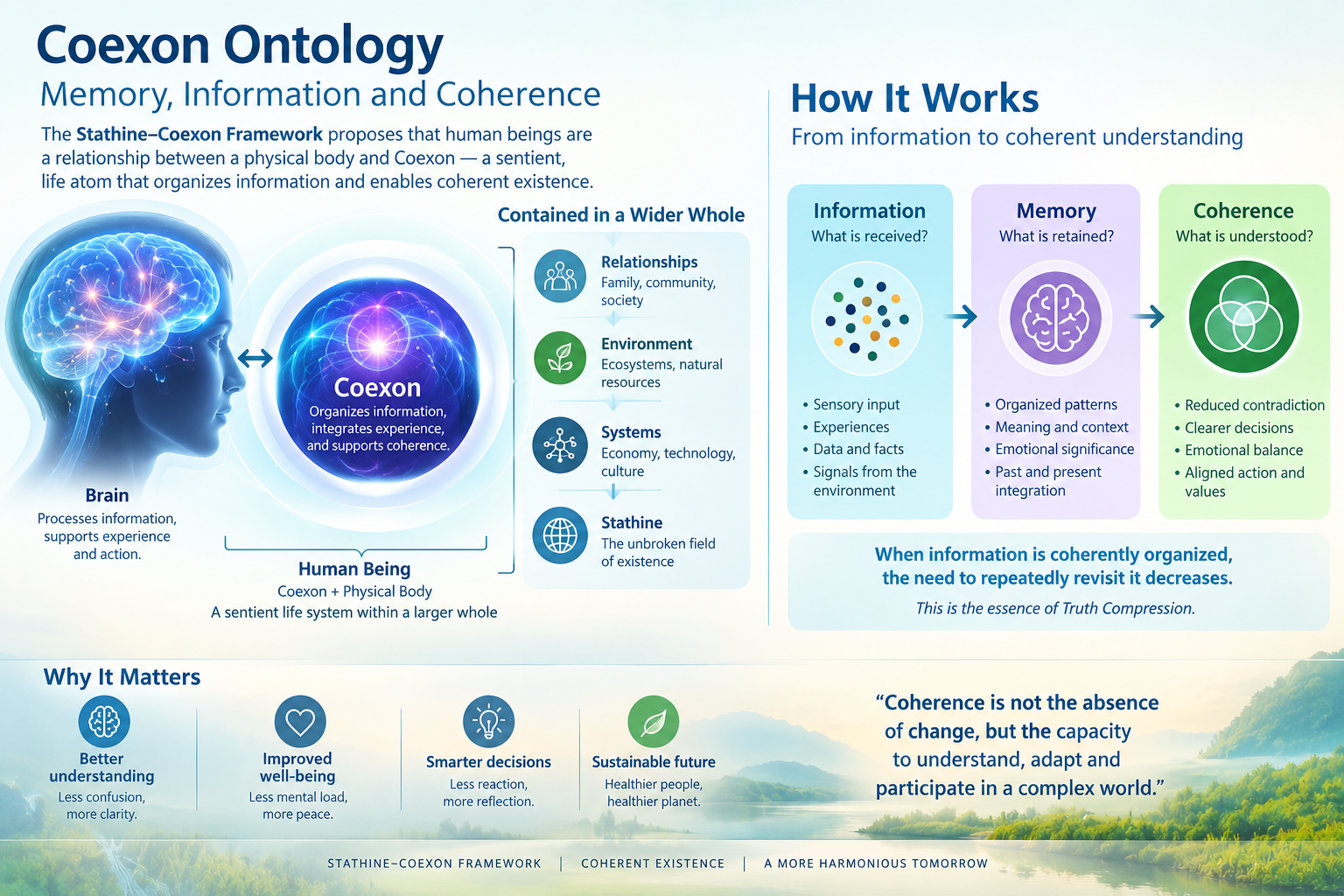
A Coexon is defined as the proposed organizing life atom.
Within the framework, the Coexon is conceived as the organizing principle that enables a living system to develop understanding, integrate experience, and progressively seek greater coherence.
The Coexon is presented as a sentient entity that is beyond the empirically established physical material science.
Definition 3: Human Being
Within this framework, a human being is understood as the integrated unity of the proposed Coexon and the physical body.
Neither component alone fully describes lived human existence.
The physical body enables biological interaction.
The Coexon provides the proposed organizing principle through which understanding develops.
Definition 4: Coherence
Coherence is defined as the progressive alignment of understanding, perception, emotion, values, and action such that internal contradiction is reduced and adaptive participation in existence increases.
Coherence is the central organizing concept of the framework.
3. Foundational Axioms
The framework adopts the following philosophical axioms.
Axiom 1
Existence is intelligible because coherent relationships can be discovered.
Axiom 2
Human understanding can progressively increase.
Axiom 3
Contradictions can be reduced through improved understanding.
Axiom 4
Greater coherence enables greater freedom of thought and action.
Axiom 5
Human flourishing depends upon increasing coherence rather than merely increasing information.
These axioms serve as starting assumptions within the framework.
4. Central Hypotheses
The following hypotheses extend the ontology into propositions that may inspire interdisciplinary exploration.
Hypothesis 1: The Coherence Hypothesis
The human being naturally develops toward greater coherence when understanding becomes progressively more accurate and internally consistent.
Implications
- Learning involves more than acquiring information.
- Education should cultivate coherent understanding.
- Wisdom may be interpreted as highly integrated coherence.
Hypothesis 2: The Truth Compression Hypothesis
Truth requires progressively less cognitive effort to maintain than contradiction because coherent understanding reduces unnecessary internal conflict.
Implications
- Simplification can reflect deeper understanding rather than superficial reduction.
- Effective learning should reduce conceptual fragmentation.
- Artificial intelligence may benefit from architectures that minimize internal contradiction.
Hypothesis 3: The Relational Coherence Hypothesis
Healthy relationships contribute to human flourishing because they reduce internal and interpersonal contradiction.
Implications
- Leadership depends upon coherence rather than authority alone.
- Trust emerges from sustained alignment between values, intentions, and actions.
- Organizational culture may be evaluated through patterns of coherence.
Hypothesis 4: The Civilizational Coherence Hypothesis
Civilizations progress when institutions increasingly reduce contradiction between knowledge, ethics, governance, economics, education, and human well-being.
Implications
- Social progress should not be measured solely by economic growth.
- Educational systems should cultivate coherent citizens rather than only skilled workers.
- Long-term resilience depends upon institutional coherence.
5. Ontological Relationships
The framework proposes the following conceptual relationships:
Stathine provides the timeless conceptual ground.
↓
The Coexon is the proposed organizing principle of living understanding.
↓
The human being emerges through the integration of Coexon and physical body.
↓
Experience generates understanding.
↓
Understanding influences coherence.
↓
Increasing coherence reduces contradiction.
↓
Reduced contradiction enhances flourishing.
↓
Collective coherence supports civilizational development.
This sequence is presented as a philosophical model for interpretation and discussion.
6. Relationship to Existing Disciplines
The framework is intended to complement and enrich the existing fields.
- Physics: explores the structure and behaviour of the physical universe.
- Biology: investigates living systems.
- Neuroscience: studies the biological mechanisms of cognition.
- Psychology: examines behaviour and mental processes.
- Systems Science: investigates relationships and emergence.
- Philosophy: addresses questions of meaning, knowledge, and existence.
The Stathine–Coexon Framework seeks to provide a unifying ontological vocabulary through which insights from these disciplines may be interpreted in relation to coherent existence.
7. Future Research Directions
The framework suggests several interdisciplinary questions.
- Can coherence be operationally defined and measured?
- What educational practices most effectively cultivate coherent understanding?
- How does coherence relate to resilience, creativity, and ethical decision-making?
- Can organizations intentionally increase coherence?
- Can civilizational progress be assessed through indicators of coherence?
These questions are intended as invitations for collaborative inquiry rather than settled conclusions.
8. Conclusion
The Stathine–Coexon Framework proposes an ontological perspective centered on coherent existence. By introducing the philosophical concepts of Stathine, Coexon, and coherence, it seeks to provide a common conceptual language for exploring human development, learning, leadership, systems thinking, and civilizational evolution.
Its contribution is not to replace established scientific theories but to offer a philosophical architecture capable of integrating insights across disciplines while generating new questions for research and dialogue.
About the Stathine–Coexon Framework
The Stathine–Coexon Framework is an interdisciplinary philosophical framework that seeks to integrate insights from systems thinking, neuroscience, psychology, biology, complexity science, leadership, education, consciousness studies, and civilizational research through the unifying concept of coherence.
The framework proposes Stathine as the timeless conceptual ground of existence and the Coexon as a proposed organizing life atom. Together, these concepts provide a philosophical lens for exploring human development, learning, leadership, artificial intelligence, regenerative systems, and civilizational evolution.
Foundational concepts, terminology, and guiding principles are presented in The Foundational Axioms and Practical Lexicon of the Stathine–Coexon Framework.