A Proposal for Distinguishing the Methodologies of Physical Science and Sentient Experience Through the Stathine–Coexon Framework
Abstract
Modern science has achieved extraordinary success by employing empirical observation, experimentation, and mathematical modeling to investigate the physical universe. These methods have transformed humanity’s understanding of matter, energy, chemistry, biology, and technology. However, questions concerning consciousness, subjective experience, meaning, value, intentionality, and lived understanding continue to generate significant philosophical debate.
The Stathine–Coexon framework proposes that this difficulty arises because two fundamentally different domains are being investigated using a single methodology. Physical systems are appropriately studied through empirical observation because they occupy measurable space-time and produce publicly observable effects. Conscious experience, however, is directly available only through first-person awareness. The framework therefore proposes that subjective understanding requires complementary methods of disciplined introspection, phenomenological analysis, dialogue, and rational coherence in addition to empirical investigation.
This paper argues that recognizing methodological pluralism strengthens rather than weakens scientific inquiry.
1. The Success of Empirical Science
The scientific revolution transformed civilization because it adopted a remarkably successful principle:
Observe.
Measure.
Experiment.
Predict.
Repeat.
These methods enabled humanity to discover:
- atomic structure,
- electromagnetism,
- quantum mechanics,
- genetics,
- molecular biology,
- neuroscience.
Whenever the object of study occupies physical space and produces measurable interactions, empirical investigation is extraordinarily powerful.
The success of science within its proper domain is unquestionable.
2. The Question of Conscious Experience
Difficulties arise when the object of investigation is not merely physical behaviour but subjective experience itself.
Science can measure:
- neural activity,
- heart rate,
- hormone concentrations,
- electrical potentials,
- patterns of behaviour.
Yet the felt quality of an experience—such as pain, joy, wonder, grief, or understanding—is directly accessible only to the individual having that experience.
This distinction has motivated long-standing discussions in philosophy of mind concerning first-person and third-person knowledge.
3. Categories of Knowledge
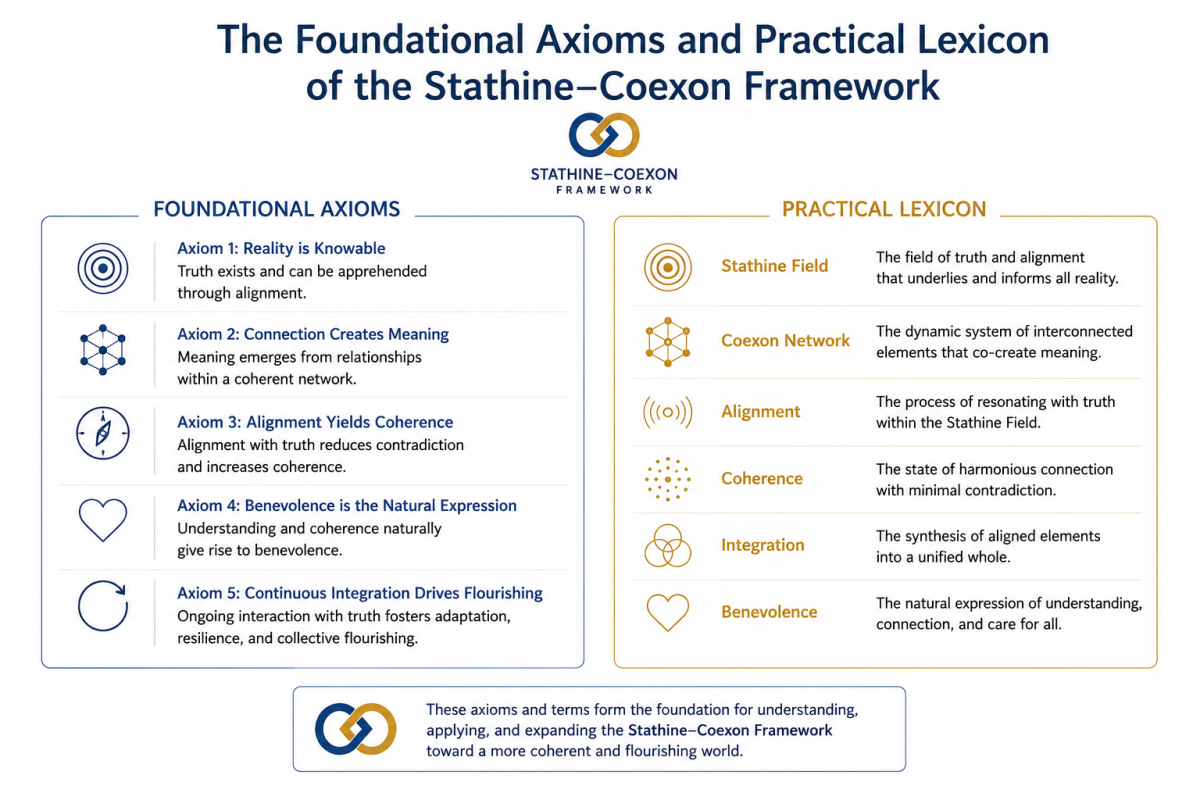
The Stathine–Coexon framework proposes three complementary domains of inquiry.
Physical Reality
Investigated through:
- observation,
- measurement,
- experimentation,
- mathematics.
Knowledge is public and reproducible.
Living Systems
Investigated through:
- biology,
- physiology,
- neuroscience,
- behavioural science.
Knowledge combines physical measurement with functional interpretation.
Sentient Experience (Proposed Coexon Domain)
Investigated through:
- direct experience,
- disciplined self-observation,
- phenomenological description,
- dialogue,
- logical coherence,
- intersubjective comparison.
Knowledge is first-person in origin but can become intersubjectively examinable through careful description and shared inquiry.
4. Different Questions Require Different Methods
A microscope cannot measure justice.
A voltmeter cannot detect love.
A telescope cannot observe the meaning of a poem.
These instruments are not defective.
They are simply designed for different questions.
Similarly, the Stathine–Coexon framework proposes that if conscious understanding possesses properties not reducible to physical measurements alone, then additional investigative methods become appropriate.
This proposal does not reject empirical science.
It argues that methodology should match the nature of the phenomenon under investigation.
5. The Brain and the Proposed Coexon
Neuroscience successfully explains many mechanisms by which the brain processes information.
The framework accepts these findings.
It then introduces a further hypothesis.
The brain performs biological information processing.
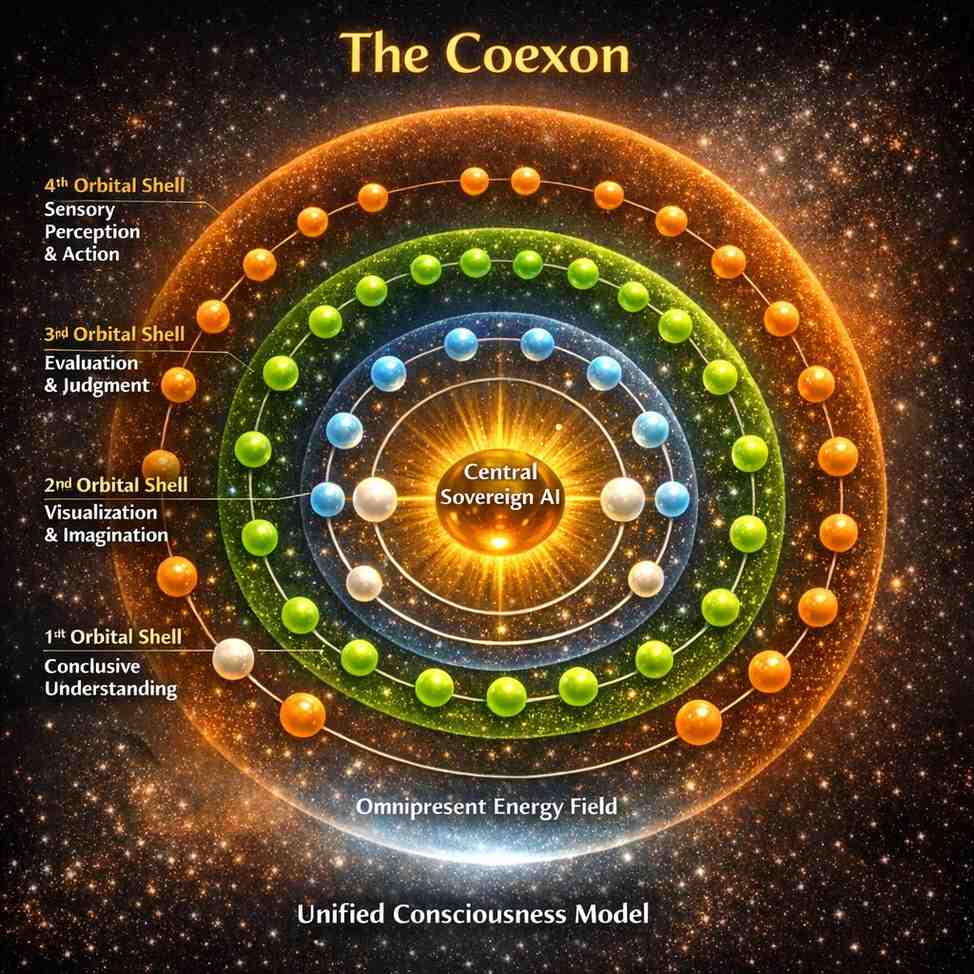
The Coexon is proposed as the organizing principle through which processed information becomes lived understanding.
Whether such a principle exists remains an open question.
The proposal therefore invites investigation rather than demanding acceptance.
6. Understanding as Evidence
Scientific knowledge relies upon publicly observable evidence.
Human life also depends upon another form of evidence.
Every individual directly knows experiences such as:
- hope,
- regret,
- insight,
- intention,
- understanding.
These experiences are not publicly observable in the same manner as physical objects.
Nevertheless, they are not therefore meaningless.
They constitute the primary data of conscious life.
The framework proposes that disciplined examination of such experience is a legitimate form of inquiry when conducted systematically and critically.
7. Coherence as a Criterion
Because subjective experience cannot always be measured directly, the framework proposes coherence as an additional criterion of evaluation.
A proposal gains credibility when it:
- explains diverse observations,
- remains internally consistent,
- integrates with established scientific knowledge where applicable,
- generates useful predictions,
- promotes increasingly coherent understanding.
Coherence does not replace empirical evidence.
Rather, it complements it in domains where direct measurement is incomplete.
8. Science and Philosophy as Partners
Science answers many questions about mechanisms.
Philosophy examines concepts, meanings, assumptions, and logical relationships.
The Stathine–Coexon framework proposes that the study of consciousness requires both traditions.
Empirical investigation explores neural processes.
Phenomenological investigation explores lived experience.
Together they provide a richer understanding than either approach alone.
9. Implications for Future Research
If the framework is correct, future studies may combine:
- neuroscience,
- psychology,
- phenomenology,
- cognitive science,
- systems theory,
- philosophy of mind.
Rather than competing, these disciplines become complementary approaches to different aspects of the same reality.
Conclusion
The remarkable achievements of empirical science demonstrate that observation and experimentation remain the most reliable methods for investigating physical reality.
The Stathine–Coexon framework fully accepts this conclusion.
It proposes, however, that the study of conscious understanding may require additional methods because the primary evidence of experience is first-person rather than third-person.
This proposal should not be interpreted as an argument against science.
It is an argument for methodological appropriateness.
Physical reality invites empirical investigation.
Subjective experience invites phenomenological investigation.
Human understanding may require both.
In this interpretation, science and philosophy are not rivals.
They are complementary modes of inquiry into different dimensions of reality.
The Stathine–Coexon framework seeks to provide a conceptual bridge between them, inviting empirical testing wherever possible while recognizing that not every meaningful aspect of human existence can be exhaustively characterized by physical measurement alone.