Extending Anirban Bandyopadhyay’s Research Through the Stathine–Coexon Framework
Abstract
Living systems are characterized not merely by their chemical composition but by the rhythmic organization of countless interacting processes. From molecular vibrations and protein dynamics to neuronal oscillations and coordinated physiological activity, rhythm appears as a universal characteristic of life. Professor Anirban Bandyopadhyay has explored this idea through his work on “rhythm engineering,” proposing that oscillatory dynamics are fundamental to biological information processing and the emergence of complex behavior.
The Stathine–Coexon framework accepts the importance of rhythmic organization but proposes that rhythm alone does not explain the lived experience of meaning. It hypothesizes that rhythm provides the physical organization necessary for biological information processing, while the Coexon is the proposed organizing principle through which these rhythms become consciously experienced, understood, and integrated into purposeful living. This article presents this extension as a conceptual hypothesis intended to stimulate interdisciplinary dialogue between physics, biology, neuroscience, and philosophy.
1. Introduction
Life is rhythmic.
The heartbeat is rhythmic.
Breathing is rhythmic.
Walking is rhythmic.
Sleep follows rhythmic cycles.
Neurons oscillate.
Proteins fluctuate.
Cells communicate through rhythmic biochemical activity.
Even ecosystems display seasonal rhythms.
Professor Anirban Bandyopadhyay’s research suggests that these rhythms are not merely background phenomena but fundamental mechanisms through which biological systems organize information.
The Stathine–Coexon framework agrees that rhythm is indispensable.
It then asks a further question.
How does organized rhythm become meaningful experience?
2. Rhythm as Organization
Rhythm is repetition with organization.
Random fluctuations rarely produce stable living systems.
Coordinated oscillations allow information to be exchanged efficiently.
Biological systems therefore maintain coherence through synchronized activity across multiple spatial and temporal scales.
Rhythm becomes an organizing principle.
3. The Contribution of Rhythm Engineering
Bandyopadhyay’s work emphasizes that biological organization depends upon interacting oscillatory networks rather than isolated events.
Communication is distributed.
Synchronization creates functionality.
The whole behaves differently from the individual components.
This represents an important systems perspective.
Organization emerges through coordinated timing.
4. The Stathine–Coexon Extension
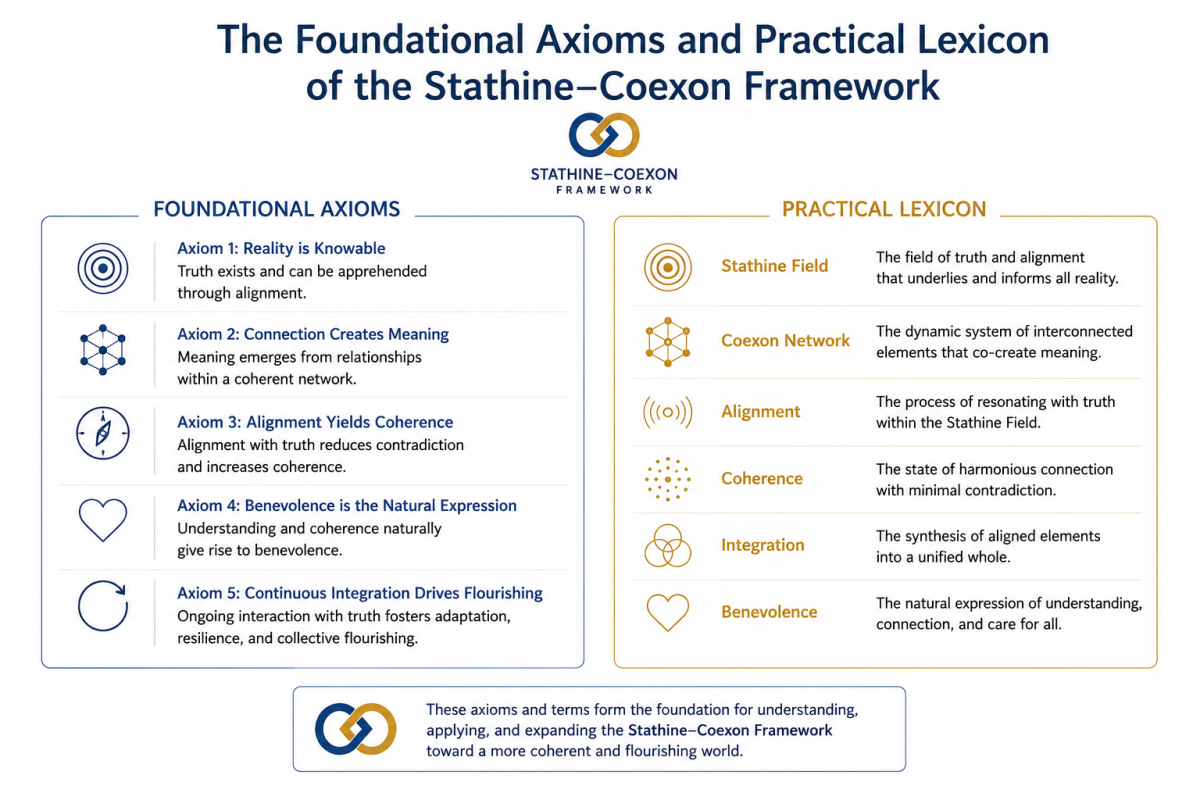
The Stathine–Coexon framework accepts rhythm as a fundamental characteristic of biological organization.
It then proposes an additional level of explanation.
Rhythm explains how biological systems coordinate.
The Coexon is proposed to explain how organized biological information becomes meaningful understanding.
In this proposal:
- rhythms organize biological processes,
- the brain integrates sensory and neural information,
- the Coexon is hypothesized to organize conscious understanding.
This hypothesis extends beyond the current empirical scope of rhythm engineering and should therefore be regarded as a philosophical proposal awaiting experimental evaluation.
5. The Brain–Coexon Communication Hypothesis
The framework proposes a continuous communication loop:
Environment
↓
Sensory organs
↓
Rhythmic neural activity
↓
Distributed brain processing
↓
Proposed Brain–Coexon Interface
↓
Meaning
↓
Understanding
↓
Choice
↓
Action
↓
New experience
The early stages of this sequence are well described by neuroscience.
The proposed interface represents the novel hypothesis of the framework.
6. Rhythm and Coherence
Rhythm engineering shows that synchronized oscillations improve coordination within biological systems.
The Stathine–Coexon framework proposes that human development similarly depends upon increasing coherence.
As understanding becomes more coherent:
- perception becomes clearer,
- internal contradiction decreases,
- relationships stabilize,
- communication improves,
- cooperation becomes easier.
Rhythm and coherence therefore occupy complementary roles.
Rhythm organizes biological activity.
Coherence organizes lived understanding.
7. From Rhythm to Meaning
One of the enduring philosophical questions is whether rhythm alone explains consciousness.
The framework argues that rhythm is necessary but not sufficient.
A symphony consists of organized rhythms.
Its meaning, however, is experienced by a listener.
Likewise, neural oscillations may organize information processing.
The subjective significance of those processes remains an open scientific question.
The Coexon is proposed as the organizing principle associated with this experiential dimension.
8. The Meaning of Life
Within the Stathine–Coexon framework, the meaning of life is not viewed as an externally imposed objective.
It emerges through increasing coherence between:
- the individual,
- other human beings,
- nature,
- and the underlying continuum of coexistence, termed Stathine.
Human development follows the recurring cycle:
Feeling
↓
Choosing
↓
Evaluating
↓
Validating
↓
Knowing
↓
Understanding
↓
Experiencing
↓
Living
↓
Explaining
↓
Feeling
Each cycle deepens coherence.
Meaning is therefore understood as an emergent property of lived understanding rather than as a fixed destination.
9. Education and Civilization
If rhythm coordinates biological systems, education should coordinate human understanding.
The purpose of education becomes more than the transmission of information.
It becomes the cultivation of coherence.
Students learn to:
- observe,
- relate,
- understand,
- communicate,
- cooperate,
- contribute.
A society whose members develop coherent understanding requires less coercion and more collaboration.
Harmony becomes an emergent social rhythm.
10. A Scientific Research Program
To develop the Stathine–Coexon framework scientifically, several questions would need to be investigated:
- Are increasing measures of neural synchronization associated with deeper integrative understanding?
- Can coherent patterns of learning be quantified behaviorally?
- Does the framework generate predictions that differ from existing theories of consciousness?
- Can educational practices designed to increase coherence produce measurable changes in wellbeing, cooperation, and decision-making?
Such questions provide opportunities for interdisciplinary collaboration among neuroscience, physics, psychology, education, and systems science.
Conclusion
Anirban Bandyopadhyay’s work highlights the central importance of rhythm, synchronization, and oscillatory organization in living systems.
The Stathine–Coexon framework accepts these insights and proposes an additional philosophical hypothesis: that rhythm organizes biological information, while conscious meaning emerges through a proposed organizing principle called the Coexon within the broader continuum of Stathine.
Whether this hypothesis proves scientifically fruitful remains an open question.
Nevertheless, the dialogue between rhythm engineering and the Stathine–Coexon framework suggests a broader vision of reality in which organization, synchronization, and coherence are recurring principles across physical, biological, cognitive, and social domains.
In this interpretation, the meaning of life is not the accumulation of experiences but the progressive realization of coherence. As understanding deepens, the individual participates more harmoniously with others, with nature, and with reality itself. The journey of life is therefore understood not simply as survival, but as the continual refinement of understanding until existence itself is experienced as coherent participation in an interconnected whole.
xplains how living systems organize physical information, while the Stathine–Coexon framework proposes how organized information becomes meaningful lived experience. This keeps the connection philosophically rich while clearly distinguishing established empirical science from the framework’s proposed extensions.