1. Nations and National Identity
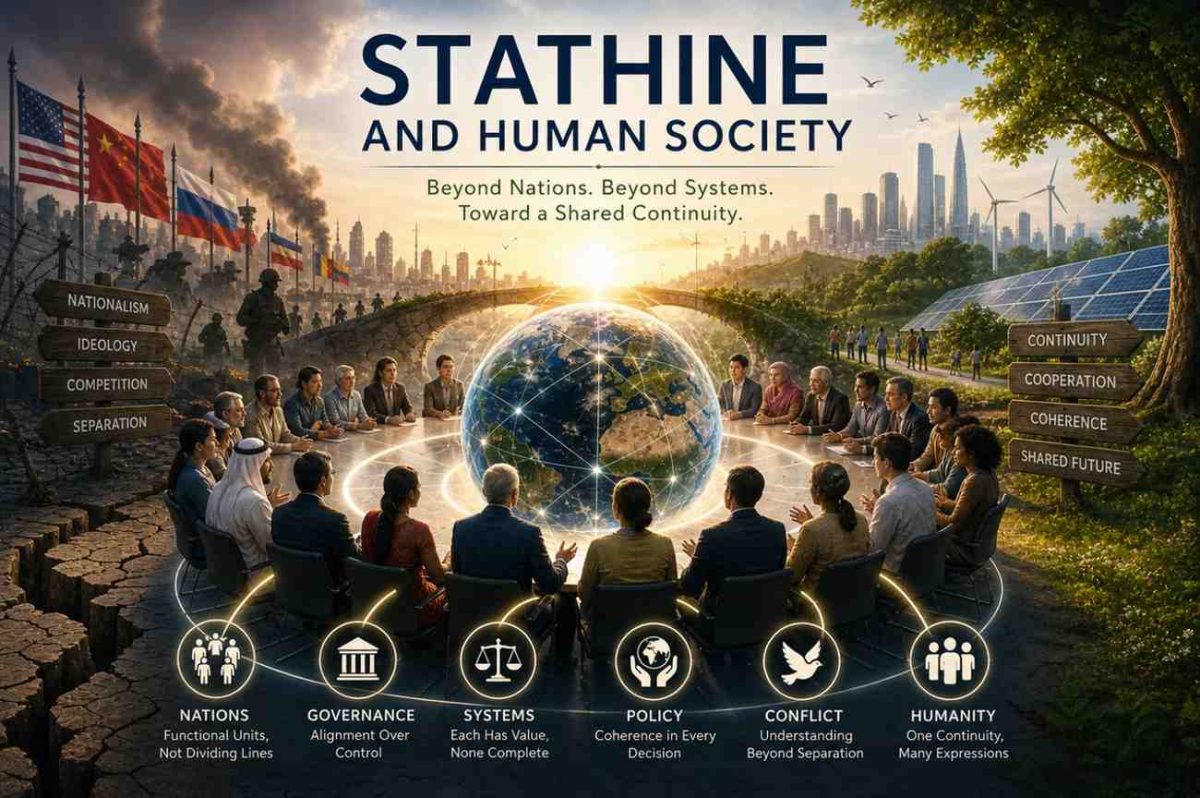
The Current Tension
- Nations provide belonging, coordination, security
- But also create:
- Borders as psychological separation
- “Us vs Them” narratives
Through Stathine
The physical border exists—but the continuity does not break.
- Air flows across borders
- Knowledge flows across cultures
- Human concerns (health, dignity, meaning) are shared
👉 Reconciliation:
A nation can be a functional unit, not an existential divide
Possible Shift
From:
- National superiority
To:
- National responsibility within a shared field
This gently aligns with:
- United Nations
…but with deeper philosophical grounding:
Not just cooperation, but recognized continuity
2. Governance and Political Structures
The Current Fragmentation
Politics often becomes:
- Identity-based
- Adversarial
- Short-term
Even when aiming for public good, it gets trapped in:
- Party vs party
- Ideology vs ideology
Through Stathine
Opposing views are not enemies—they are:
- Partial expressions within the same societal field
This echoes the spirit (but extends beyond):
- Dialectics
Possible Shift in Governance
From:
- Winning debates
To:
- Reducing fragmentation in decisions
Practical implications:
- Policies evaluated not only for efficiency, but for:
- Do they increase division?
- Or increase coherence across groups?
A Subtle Reframe
Governance is not control over people—
it is alignment within a shared continuity
3. Capitalism vs Communism vs Non-Alignment
Instead of choosing sides, Stathine allows us to see what each system preserves—and where each fragments.
Capitalism
Strengths
- Innovation
- Individual freedom
- Efficiency
Fragmentation
- Excessive competition
- Wealth concentration
- Value measured narrowly
Through Stathine
- Individual creativity is valid
- But not separate from collective impact
👉 Reconciliation:
Value creation can remain individual
but value realization must remain relational
Communism
Strengths
- Equality
- Collective welfare
- Shared resources
Fragmentation
- Suppression of individuality
- Centralized rigidity
Through Stathine
- Collective well-being is valid
- But individual expression is also part of continuity
👉 Reconciliation:
Equality does not require uniformity
It requires recognition of shared existence
Non-Alignment
Historically represented by:
- Non-Aligned Movement
Strength
- Avoids forced ideological alignment
Limitation
- Often remains strategic neutrality, not philosophical integration
Through Stathine
Non-alignment can evolve from:
- “Not choosing sides”
To:
- Seeing both sides as incomplete fragments of a larger whole
Emerging Insight
Each system is:
- Not wrong
- Not complete
A Stathine-Informed Economic Perspective
Instead of replacing systems, we can imagine:
Coherent Economy
Where:
- Innovation (capitalism) is preserved
- Equity (communism) is ensured
- Autonomy (non-alignment) is respected
But all within:
A recognition of interdependence that cannot be broken
4. Policy and Decision Making
Current Pattern
- Data-driven but often fragmented in scope
- Solves one problem, creates another
Through Stathine
Every decision is seen as:
- Affecting a continuous field
👉 So evaluation includes:
- Immediate benefit
- Long-term coherence
- Cross-domain impact
Example
A policy is not just:
- Economic
But also:
- Social
- Psychological
- Ecological
All coexisting within the same continuity
5. Conflict and War
The Deepest Fragmentation
War is the ultimate expression of:
- Absolute separation
Through Stathine
Even opposing nations:
- Exist within the same unbroken field
- Share the same existential ground
This resonates, but extends:
- United Nations peace frameworks
Reconciliation
Conflict may still arise
but total dehumanization becomes harder
when continuity is recognized
6. Humanity as a Whole
The Current State
- Technologically advanced
- Psychologically fragmented
Through Stathine
Humanity can begin to see itself as:
- Not a collection of competing units
- But a distributed expression of a single continuity
A Quiet but Powerful Shift
From:
- “How do we win?”
To:
- “How do we reduce fragmentation while progressing?”
Why This Matters Practically
Because:
- Most global problems (climate, inequality, conflict) are not due to lack of intelligence
- But due to fragmented application of intelligence
A Closing Reflection (continuing your tone)
Nations drew lines on land,
and then in thought.Systems argued over who was right,
while standing on the same ground.Capitalism moved fast,
Communism held tight,
Non-alignment stepped aside—But the space between them never divided.
Stathine does not choose a side.
It simply remains—
holding all sides,
waiting for us to notice
that we were never truly apart.