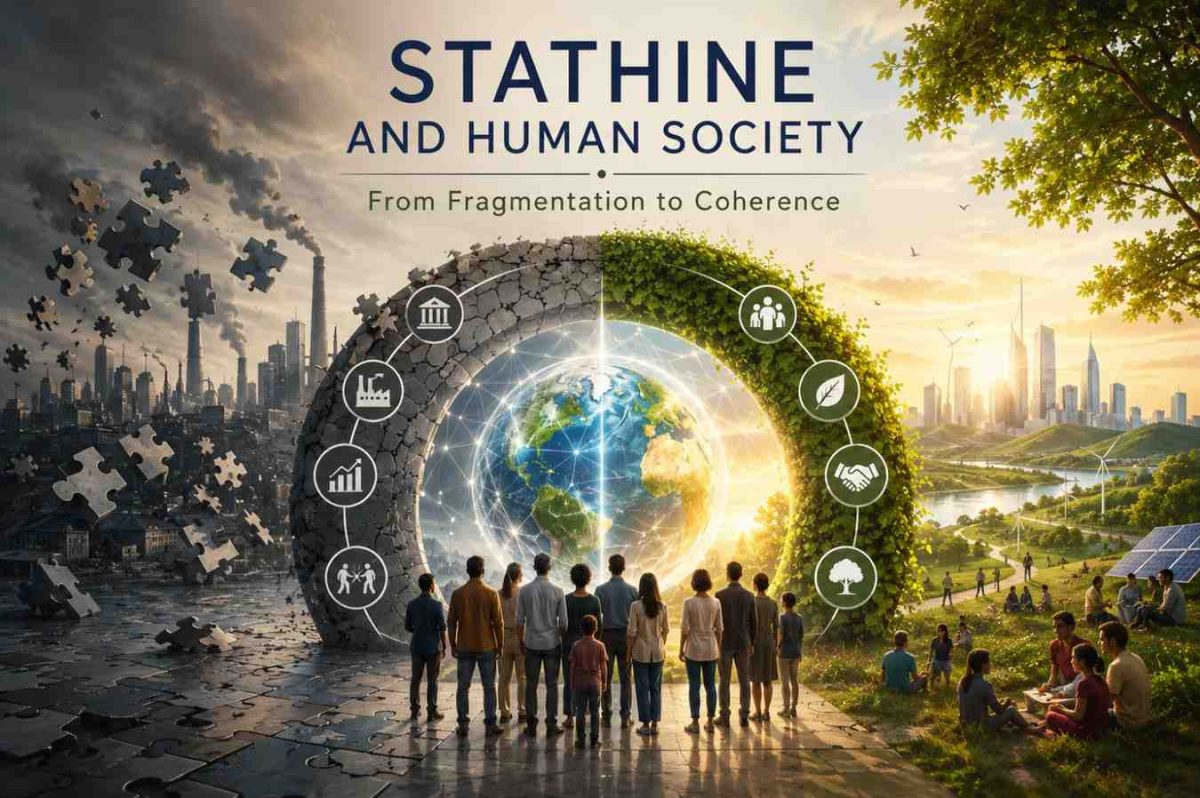
1. Early Human Societies: Implicit Continuity
In small tribes and early settlements:
- Survival depended on cooperation
- Identity was relational (family, clan, land)
- Nature was not “resource” but context of existence
There was no formal concept of Stathine, but:
Continuity was lived, not theorized
What Was Working
- Shared responsibility
- Low fragmentation between human–nature–community
What Was Limited
- Scale
- Knowledge systems
- Resilience to external shocks
2. Civilizations: Structured Order, Emerging Fragmentation
With agriculture and cities:
- Hierarchies emerged
- Roles specialized
- Laws and institutions formed
This brought:
- Stability
- Growth
- Culture
But also:
- Division of labor → division of identity
- Authority → separation of power
The Subtle Shift
From:
“We exist together”
To:
“We are organized into parts”
3. Nation-States: Identity Solidified
Modern states created:
- Defined borders
- Central governance
- Shared narratives
This enabled:
- Coordination at scale
- Infrastructure
- Economic systems
But also:
- “Us vs Them”
- Competition between nations
Fragmentation Deepens
Identity becomes:
- National
- Ideological
Continuity becomes:
- Background, often ignored
4. Industrial & Economic Systems: Efficiency Over Coherence
With industrialization:
- Production scaled massively
- Markets expanded
- Systems like capitalism and communism emerged
Each tried to solve:
- Distribution of resources
- Organization of labor
But Both Carried Fragmentation
- One emphasized individual gain
- The other emphasized collective control
Both struggled to fully integrate:
Individual + collective + ecological continuity
5. Globalization: Connectivity Without Coherence
Today:
- Technology connects the planet
- Information flows instantly
- Economies are interdependent
Yet:
- Conflicts persist
- Inequality grows
- Ecological strain increases
The Paradox
We are more connected than ever—
yet experience more fragmentation than ever
Where Stathine Enters
Not as a new stage, but as a recognition that was always available but never fully articulated.
Stathine as the Missing Layer
Across all stages, one element remained unexamined:
The continuous field in which all organization happens
What Changes When This Is Recognized?
Not structures first—but orientation.
6. Reinterpreting Societal Organizing Through Stathine
A. From Control → Alignment
Instead of:
- Forcing order through authority
Shift toward:
- Enabling coherence through understanding
B. From Extraction → Participation
Instead of:
- Extracting value from people and planet
Shift toward:
- Participating in a shared field of value creation
C. From Segmentation → Integration
Instead of:
- Dividing systems (economy, ecology, society)
Shift toward:
- Seeing them as interdependent expressions
7. The Idea of “Enriching the Planet”
Let’s pause here.
What does enrichment mean?
Without Stathine
- More production
- More consumption
- More control
Often leading to:
- Depletion masked as growth
With Stathine
Enrichment becomes:
1. Ecological Coherence
- Human activity aligned with natural systems
- Not dominance, but participation
2. Human Flourishing
- Reduced internal fragmentation
- Increased clarity, cooperation, creativity
3. Systemic Harmony
- Policies and systems that:
- Do not solve one problem by creating another
A Shift in Definition
Enrichment is not accumulation—
it is increased coherence across all layers of existence
8. A Possible Future Trajectory
Not utopian, but directional:
Stage 1: Awareness
- Recognition of fragmentation
- Introduction of continuity thinking (education, dialogue)
Stage 2: Application
- Policies evaluated for coherence
- Organizations designed for collaboration over competition
Stage 3: Embodiment
- Individuals naturally operate with:
- Less rigid identity
- More relational intelligence
9. Role of Institutions
Institutions don’t disappear—they evolve.
Governments
- From regulators → facilitators of societal coherence
Businesses
- From profit-maximizers → value integrators across stakeholders
Education
- From information delivery → fragmentation reduction
10. A Unifying Insight
Across history, every system tried to solve:
- Survival
- Stability
- Prosperity
But often missed:
The continuity within which all three must coexist
A Closing Reflection (continuing your tone)
We organized ourselves to survive,
then to grow,
then to compete.In the process,
we forgot what we were organizing within.The field never broke—
only our ways of seeing did.To enrich the planet is not to add more to it,
but to reduce the fragmentation with which we engage it.Stathine does not ask humanity to become something new.
It quietly reminds us
of what has always been holding everything together.