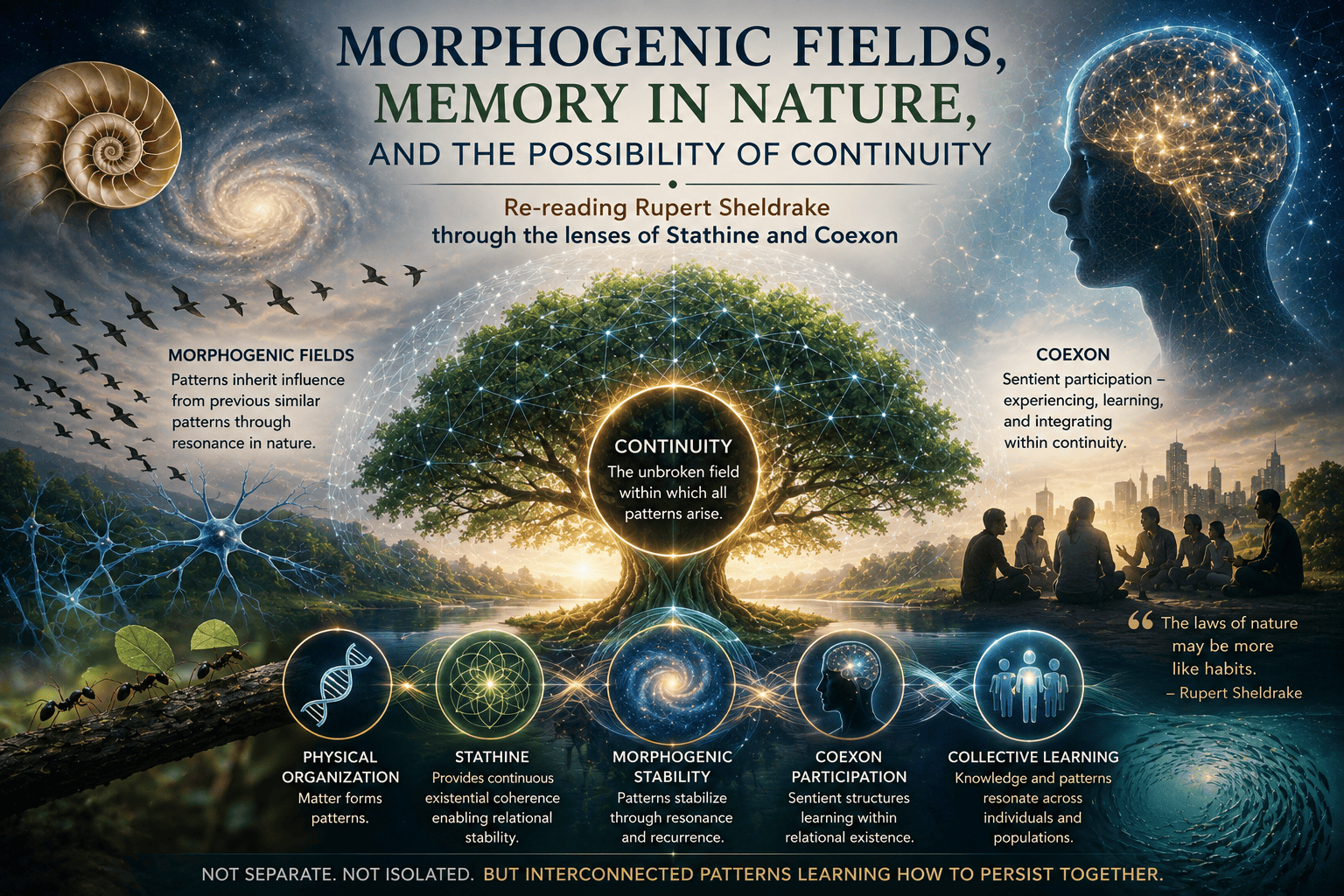
Morphogenic Fields, Memory in Nature, and the Possibility of Continuity
Re-reading Rupert Sheldrake through the lenses of Stathine and Coexon
“The laws of nature may be more like habits.” — Rupert Sheldrake
Few scientific thinkers have generated as much fascination and controversy as Rupert Sheldrake.
His proposal of morphic resonance and morphogenic fields challenged one of the deepest assumptions of modern science:
that nature is governed only by fixed laws acting locally through matter and energy.
Instead, Sheldrake proposed something provocative:
that patterns in nature may inherit influence from previous similar patterns.
In simple terms:
once something happens repeatedly,
future similar systems may become more likely to organize in that way.
Not through direct physical contact alone—
but through a kind of resonance across time and form.
Mainstream science remains skeptical.
The theory is debated and not broadly accepted as established empirical science.
Yet it continues to intrigue many because it attempts to address persistent mysteries:
- biological form
- instinct
- collective learning
- memory-like behavior in nature
- unexplained coordination patterns
This article does not attempt to validate or reject Sheldrake’s theory.
Instead, it explores a curiosity:
Could the ideas of Stathine and Coexon provide a conceptual framework that makes morphogenic fields more intelligible?
Not as proof.
As philosophical synthesis.
1. What Are Morphogenic Fields?
Rupert Sheldrake proposed that living systems are shaped not only by genes and chemistry,
but also by organizing fields.
These “morphogenic” or “morphic” fields supposedly help guide:
- biological form
- behavioral patterns
- collective habits
- memory-like organization in nature
For example:
If one population learns a new behavior,
similar populations elsewhere may learn it more easily.
Again:
controversial.
But conceptually intriguing.
At the heart of the theory lies a deep intuition:
Nature may contain continuity beyond direct physical interaction.
2. Why Did This Idea Attract Attention?
Because standard material explanations often struggle with questions such as:
- How does biological form organize so reliably?
- Why do certain patterns recur across scales?
- How do collective behaviors emerge so coherently?
- Why do some forms seem “attracted” toward stable organization?
Sheldrake proposed:
perhaps systems inherit influence from prior similar systems.
Nature remembers.
A radical suggestion.
3. Stathine as Continuous Existential Background
Now let us introduce Stathine.
Suppose Stathine is understood as:
- a continuous, static, unbroken field
- underlying all physical existence
- enabling relation without itself changing
Then Stathine is not another force.
Not another signal.
It is the continuity within which all patterns coexist.
This creates an interesting possibility.
Perhaps what Sheldrake calls “morphic continuity”
could be reinterpreted as:
patterns stabilizing within a deeper continuity already shared by existence.
Not information traveling magically—
but organization emerging within continuity.
4. Coexon and the Experience of Pattern
Now consider Coexon.
Coexon represents:
- sentience
- learning
- interpretation
- experiential integration
If Coexon participates within continuity,
then learning may not be isolated to disconnected individuals.
Rather:
each Coexon exists within relational coexistence.
This does not mean minds merge.
But it suggests:
learning may resonate through shared structures of existence.
Interesting possibility.
5. A Simpler Analogy: Resonance in Music
Consider musical resonance.
A vibrating string can influence another nearby tuned string.
Not through direct pushing—
but through shared resonance conditions.
Perhaps Sheldrake’s intuition points toward something analogous in existence.
Not supernatural transfer.
But structural resonance within continuity.
Stathine provides the continuity.
Coexon experiences and learns within it.
6. Reframing Morphogenic Fields Through Stathine
Instead of imagining mysterious invisible “memory fields,”
consider another interpretation:
Stathine as Existential Continuity
A static field allowing persistent relational organization.
Morphogenic Stability
Patterns that stabilize because continuity permits resonance and recurrence.
Coexon Participation
Sentient structures learning within relational existence.
This interpretation shifts the emphasis:
from hidden forces
to continuity-enabled organization.
7. Why Patterns Repeat in Nature
Nature repeatedly generates:
- spirals
- branching structures
- harmonic ratios
- flocking behavior
- ecological cycles
Why?
Physics explains much of this beautifully.
But perhaps continuity itself also matters.
Stathine suggests:
patterns emerge not in isolation,
but within an already continuous reality.
Thus recurrence may not be accidental.
It may reflect stability within continuity.
8. Could Memory Exist Beyond Brains?
A controversial but fascinating question.
Sheldrake suggested memory-like influence may exist in nature itself.
Within the Stathine framework,
one might cautiously reinterpret this as:
continuity preserving organizational tendencies.
Not “memory” like human recall.
But persistence of relational structure.
Like grooves becoming easier to follow once established.
Again:
speculative.
But conceptually coherent.
9. Coexon and Collective Human Learning
Human societies demonstrate something similar.
Ideas spread.
Behaviors normalize.
Cultural patterns stabilize.
Collective emotional states emerge.
Perhaps Coexon learns not merely individually—
but relationally.
This does not require mysticism.
Human consciousness already functions socially:
through language,
imitation,
trust,
symbolic transmission.
The framework simply expands the scale of continuity.
10. A Three-Layer Interpretation
We can summarize the synthesis like this:
Physical Organization
Matter forms patterns.
Stathine
Provides continuous existential coherence enabling relational stability.
Coexon
Experiences, learns, and participates in evolving patterns.
Morphogenic Fields
May represent stabilized organizational tendencies emerging within continuity.
Not proven science.
But a meaningful philosophical integration.
11. Why This Perspective Interests People
Because it offers an alternative to two extremes:
Pure Mechanism
Everything reduced to isolated interactions.
Pure Mysticism
Unverifiable supernatural explanations.
Instead, this framework suggests:
continuity and relational organization may matter more deeply than currently understood.
That possibility resonates with many people.
12. Questions Worth Exploring
Could continuity itself influence organization?
Why do stable patterns recur across scales?
Can learning become easier collectively?
What role does relation play in emergence?
Could existence be more interconnected than isolated models suggest?
These questions remain open.
And valuable.
Conclusion
Rupert Sheldrake’s theory of morphogenic fields remains controversial,
yet it continues to provoke thought because it asks a profound question:
How does nature remember form?
By introducing Stathine and Coexon,
we gain a possible interpretive framework:
- Stathine as the static continuity enabling coexistence and relational stability
- Coexon as the learning and experiencing participant within that continuity
In this view,
morphic resonance becomes less a mysterious force—
and more an exploration of how continuity, pattern, and participation may intertwine within existence itself.
Closing Reflection
Perhaps nature does not repeat patterns
because reality is mechanically trapped—but because continuity allows resonance.
Perhaps learning is not entirely isolated.
Perhaps form stabilizes within deeper relational order.
And perhaps what we call memory in nature
is existence discovering
how to remain coherent across time.