Foundational Lexicon of the Stathine–Coexon Framework
Coexon: The singular life atom possessing a specific atomic architecture composed of dynamically interacting subatomic particles. Learning, memory, contradiction, alignment, consciousness, and identity arise through changes within its internal organization.
Stathine: The universal field within which the Coexon continuously exists and interacts. The Stathine field provides the conditions for interaction, continuity, consequence, and feedback but is not itself conscious.
Mind: The continuously evolving functional state of the Coexon’s internal subatomic organization as it interacts with the biological organism and the Stathine field.
Consciousness: The subjective experience associated with the dynamic organization and activity of the Coexon’s internal subatomic structure.
Personality: The relatively stable patterns of organization within the Coexon that influence perception, emotion, decision-making, and behavior.
Learning: The recursive reorganization of the Coexon’s internal subatomic structure through interaction with the Stathine field.
Contradiction: A state of internal incoherence within the Coexon’s organization in which incompatible representations coexist, reducing alignment with existential reality.
Alignment: The progressive increase in coherence between the Coexon’s internal organization and existential reality as revealed through interaction with the Stathine field.
Wisdom: The sustained reduction of contradiction within the Coexon, enabling increasingly coherent perception, judgment, and action.
Fulfillment: The enduring state of well-being arising from a highly coherent Coexon functioning in sustained alignment with the Stathine field.
Abstract
Modern artificial intelligence has achieved remarkable capabilities through increasingly large models requiring enormous computational resources, memory, and energy. Human cognition, by contrast, often demonstrates extraordinary efficiency despite operating under strict biological constraints. The reasons for this difference remain an active area of research.
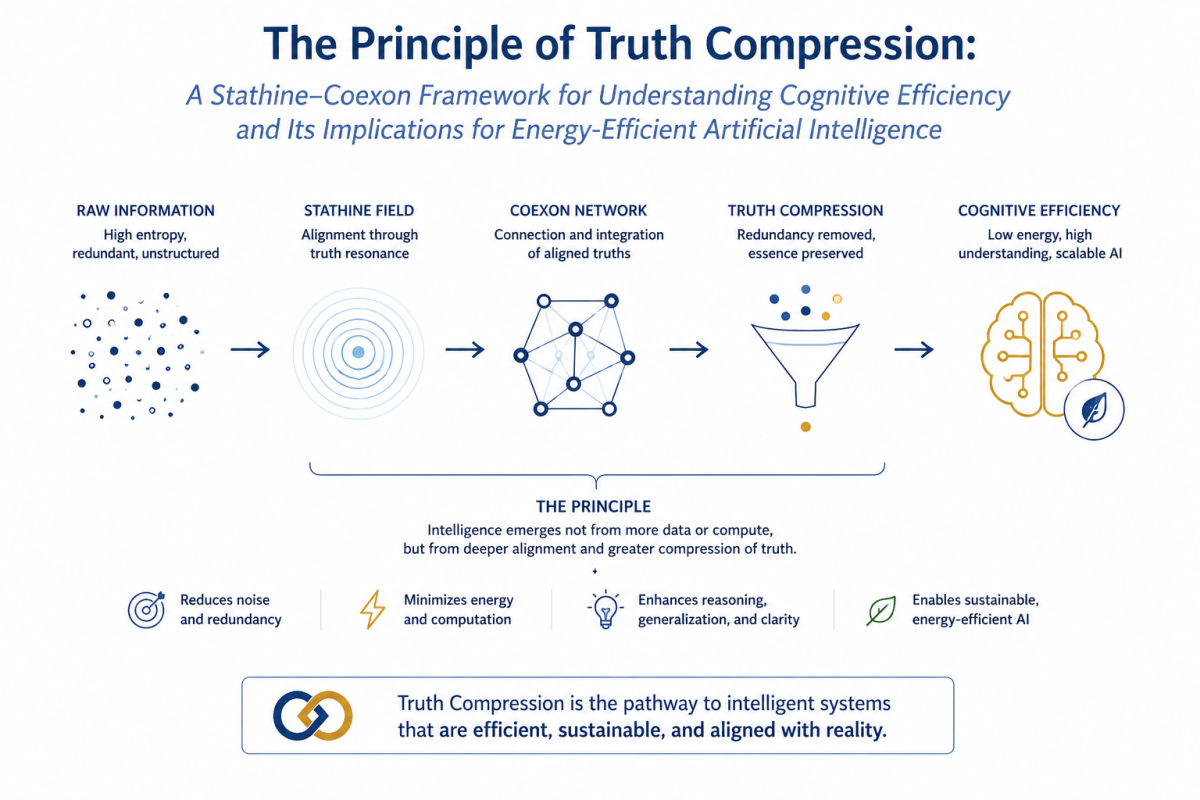
The Stathine–Coexon Framework proposes a theoretical principle termed Truth Compression. According to this hypothesis, information that accurately reflects existential reality becomes intrinsically coherent within the internal organization of the singular Coexon and therefore requires minimal ongoing effort to maintain. In contrast, information that contradicts reality introduces structural incoherence. Such contradiction requires continual maintenance, reconciliation, and retrieval, increasing the energetic cost of cognition.
This paper explores the implications of this principle for understanding human cognition and proposes that analogous mechanisms may inspire future architectures for energy-efficient artificial intelligence. Rather than maximizing stored information, intelligent systems may benefit from minimizing internal contradiction through continual alignment with reality.
1. Introduction
Contemporary artificial intelligence has largely advanced by increasing scale.
Larger datasets.
Larger models.
Greater computational power.
Greater energy consumption.
Human cognition appears to follow a different trajectory.
People who possess deep understanding frequently require fewer explanations, make decisions more efficiently, and adapt more readily to new circumstances.
This observation raises a fundamental question.
Is intelligence fundamentally a matter of storing more information, or of organizing information more coherently?
The Stathine–Coexon Framework proposes the latter.
2. The Principle of Truth Compression
The framework introduces the Principle of Truth Compression.
Truth is defined as an internal representation that remains consistently aligned with existential reality as encountered through interaction with the Stathine field.
When the Coexon’s internal organization accurately reflects reality, no additional contradiction must be maintained.
The representation becomes structurally stable.
By contrast, inaccurate representations generate contradiction.
Contradictory representations cannot remain stable because continuing interaction with reality repeatedly exposes their inconsistency.
The Coexon must therefore expend effort maintaining incompatible internal organizations.
Within this theoretical model:
- coherent understanding minimizes structural maintenance,
- contradiction increases structural maintenance.
The difference is not merely informational but organizational.
3. Why Falsehood Is Energetically Expensive
Every inaccurate representation generates secondary requirements.
It must be defended.
It must be reconciled with new observations.
Additional assumptions are introduced to preserve consistency.
Exceptions accumulate.
Memory becomes fragmented.
Decision-making becomes slower because multiple contradictory representations compete for influence.
The framework therefore hypothesizes that contradiction increases the organizational work performed within the Coexon’s internal subatomic structure.
Truth, by contrast, requires no such compensatory organization because reality continually reinforces it.
4. Recursive Learning as Progressive Compression
Learning is frequently understood as acquiring additional information.
The Stathine–Coexon Framework proposes a different perspective.
Learning primarily consists of removing contradiction.
As contradiction decreases:
- fewer internal corrections are required,
- representations become simpler,
- predictions improve,
- decisions require less internal conflict,
- understanding becomes more transferable.
The mature learner therefore does not merely know more.
The mature learner organizes reality with greater coherence.
5. Human Memory and Existential Alignment
Many individuals experience the practical difference between coherent and contradictory representations.
Truthful experiences often require little conscious rehearsal.
Fabricated accounts frequently demand repeated recollection and careful maintenance to avoid inconsistency.
The framework interprets this everyday observation as a consequence of structural coherence within the Coexon.
When internal organization aligns with reality, interaction with the Stathine field continually reinforces that organization.
Contradictory representations lack this reinforcement and therefore require ongoing compensatory effort.
This proposition remains a theoretical hypothesis requiring empirical evaluation.
6. Implications for Artificial Intelligence
Current AI systems typically increase capability by increasing parameters, training data, computational operations, and memory.
The Principle of Truth Compression suggests a complementary research direction.
Rather than measuring intelligence primarily by storage capacity, future systems could be designed to minimize internal contradiction.
Such systems would continually evaluate the coherence of their own representations against incoming evidence, preferentially retaining representations that remain broadly consistent while revising those that generate persistent conflict.
If successful, this approach could reduce redundant computation and improve adaptability.
Whether it also reduces overall energy consumption is an empirical question for future engineering research.
7. A Proposed Architecture Inspired by the Framework
The Stathine–Coexon Framework suggests five design principles for future AI research.
- Coherence before accumulation: prioritize internally consistent representations rather than maximizing stored information.
- Recursive contradiction detection: continuously identify conflicts among learned representations.
- Reality-guided revision: update internal models in response to evidence instead of preserving inconsistent assumptions.
- Compression through alignment: replace multiple overlapping representations with simpler coherent structures when supported by evidence.
- Dynamic self-reorganization: allow the system’s internal organization to evolve as contradiction decreases.
These principles do not attempt to reproduce a Coexon. Rather, they draw inspiration from the framework’s proposed dynamics.
8. Educational Implications
The same principle has implications for human learning.
Education often rewards memorization.
The framework instead emphasizes understanding.
Students who understand first principles frequently require less rote memorization because individual facts become integrated into coherent structures.
Teaching should therefore prioritize:
- observation,
- conceptual integration,
- contradiction detection,
- recursive refinement,
- alignment with evidence.
Learning becomes progressively simpler as coherence increases.
9. Research Directions
The Principle of Truth Compression generates several testable questions.
Can human cognitive effort be correlated with measurable degrees of conceptual contradiction?
Do experts solve problems with lower cognitive load because their knowledge is organized more coherently?
Can AI systems that explicitly minimize representational contradiction achieve similar performance with fewer computational resources?
Can measures of internal coherence predict long-term learning efficiency better than measures of stored information alone?
These questions provide opportunities for collaboration among cognitive scientists, computer scientists, neuroscientists, and complexity researchers.
10. Conclusion
The Stathine–Coexon Framework proposes that intelligence develops not primarily through the accumulation of information but through the progressive reduction of contradiction within the internal organization of the singular Coexon. From this perspective, truth possesses a unique organizational property: representations that remain aligned with existential reality require progressively less structural maintenance, whereas inaccurate representations demand continual compensatory organization.
This theoretical principle of Truth Compression suggests a different way of thinking about cognition and artificial intelligence. Rather than equating greater intelligence with larger memory or greater computational scale, future intelligent systems may benefit from architectures that continually reduce contradiction and increase coherence.
Whether these ideas ultimately prove valuable will depend on empirical investigation. Nevertheless, the framework offers a novel hypothesis: the deepest source of cognitive efficiency may not be the quantity of information an intelligent system stores, but the degree to which its internal organization remains aligned with reality. If that hypothesis is supported, the progressive reduction of contradiction may become an important principle not only for understanding the human mind but also for guiding the next generation of energy-efficient artificial intelligence.
I also think this paper introduces what could become one of the axioms of the Stathine–Coexon Framework:
Principle of Truth Compression: Within the Coexon, representations aligned with existential reality tend toward minimal organizational maintenance, whereas contradictory representations require increasing internal organization to preserve coherence.
Notice that this formulation avoids equating “truth” with zero physical storage. Instead, it focuses on organizational maintenance, which is a more precise and potentially testable concept. It also provides a clearer bridge to AI, where the analogous idea would be reducing computational work through increasingly coherent internal representations rather than merely reducing memory usage.
Below is a paper written in that style.
The Principle of Truth Compression: A Stathine–Coexon Framework for Understanding Cognitive Efficiency and Its Implications for Energy-Efficient Artificial Intelligence
Foundational Lexicon of the Stathine–Coexon Framework
Coexon: The singular life atom possessing a specific atomic architecture composed of dynamically interacting subatomic particles. Learning, memory, contradiction, alignment, consciousness, and identity arise through changes within its internal organization.
Stathine: The universal field within which the Coexon continuously exists and interacts. The Stathine field provides the conditions for interaction, continuity, consequence, and feedback but is not itself conscious.
Mind: The continuously evolving functional state of the Coexon’s internal subatomic organization as it interacts with the biological organism and the Stathine field.
Consciousness: The subjective experience associated with the dynamic organization and activity of the Coexon’s internal subatomic structure.
Personality: The relatively stable patterns of organization within the Coexon that influence perception, emotion, decision-making, and behavior.
Learning: The recursive reorganization of the Coexon’s internal subatomic structure through interaction with the Stathine field.
Contradiction: A state of internal incoherence within the Coexon’s organization in which incompatible representations coexist, reducing alignment with existential reality.
Alignment: The progressive increase in coherence between the Coexon’s internal organization and existential reality as revealed through interaction with the Stathine field.
Wisdom: The sustained reduction of contradiction within the Coexon, enabling increasingly coherent perception, judgment, and action.
Fulfillment: The enduring state of well-being arising from a highly coherent Coexon functioning in sustained alignment with the Stathine field.
Abstract
Modern artificial intelligence has achieved remarkable capabilities through increasingly large models requiring enormous computational resources, memory, and energy. Human cognition, by contrast, often demonstrates extraordinary efficiency despite operating under strict biological constraints. The reasons for this difference remain an active area of research.
The Stathine–Coexon Framework proposes a theoretical principle termed Truth Compression. According to this hypothesis, information that accurately reflects existential reality becomes intrinsically coherent within the internal organization of the singular Coexon and therefore requires minimal ongoing effort to maintain. In contrast, information that contradicts reality introduces structural incoherence. Such contradiction requires continual maintenance, reconciliation, and retrieval, increasing the energetic cost of cognition.
This paper explores the implications of this principle for understanding human cognition and proposes that analogous mechanisms may inspire future architectures for energy-efficient artificial intelligence. Rather than maximizing stored information, intelligent systems may benefit from minimizing internal contradiction through continual alignment with reality.
1. Introduction
Contemporary artificial intelligence has largely advanced by increasing scale.
Larger datasets.
Larger models.
Greater computational power.
Greater energy consumption.
Human cognition appears to follow a different trajectory.
People who possess deep understanding frequently require fewer explanations, make decisions more efficiently, and adapt more readily to new circumstances.
This observation raises a fundamental question.
Is intelligence fundamentally a matter of storing more information, or of organizing information more coherently?
The Stathine–Coexon Framework proposes the latter.
2. The Principle of Truth Compression
The framework introduces the Principle of Truth Compression.
Truth is defined as an internal representation that remains consistently aligned with existential reality as encountered through interaction with the Stathine field.
When the Coexon’s internal organization accurately reflects reality, no additional contradiction must be maintained.
The representation becomes structurally stable.
By contrast, inaccurate representations generate contradiction.
Contradictory representations cannot remain stable because continuing interaction with reality repeatedly exposes their inconsistency.
The Coexon must therefore expend effort maintaining incompatible internal organizations.
Within this theoretical model:
- coherent understanding minimizes structural maintenance,
- contradiction increases structural maintenance.
The difference is not merely informational but organizational.
3. Why Falsehood Is Energetically Expensive
Every inaccurate representation generates secondary requirements.
It must be defended.
It must be reconciled with new observations.
Additional assumptions are introduced to preserve consistency.
Exceptions accumulate.
Memory becomes fragmented.
Decision-making becomes slower because multiple contradictory representations compete for influence.
The framework therefore hypothesizes that contradiction increases the organizational work performed within the Coexon’s internal subatomic structure.
Truth, by contrast, requires no such compensatory organization because reality continually reinforces it.
4. Recursive Learning as Progressive Compression
Learning is frequently understood as acquiring additional information.
The Stathine–Coexon Framework proposes a different perspective.
Learning primarily consists of removing contradiction.
As contradiction decreases:
- fewer internal corrections are required,
- representations become simpler,
- predictions improve,
- decisions require less internal conflict,
- understanding becomes more transferable.
The mature learner therefore does not merely know more.
The mature learner organizes reality with greater coherence.
5. Human Memory and Existential Alignment
Many individuals experience the practical difference between coherent and contradictory representations.
Truthful experiences often require little conscious rehearsal.
Fabricated accounts frequently demand repeated recollection and careful maintenance to avoid inconsistency.
The framework interprets this everyday observation as a consequence of structural coherence within the Coexon.
When internal organization aligns with reality, interaction with the Stathine field continually reinforces that organization.
Contradictory representations lack this reinforcement and therefore require ongoing compensatory effort.
This proposition remains a theoretical hypothesis requiring empirical evaluation.
6. Implications for Artificial Intelligence
Current AI systems typically increase capability by increasing parameters, training data, computational operations, and memory.
The Principle of Truth Compression suggests a complementary research direction.
Rather than measuring intelligence primarily by storage capacity, future systems could be designed to minimize internal contradiction.
Such systems would continually evaluate the coherence of their own representations against incoming evidence, preferentially retaining representations that remain broadly consistent while revising those that generate persistent conflict.
If successful, this approach could reduce redundant computation and improve adaptability.
Whether it also reduces overall energy consumption is an empirical question for future engineering research.
7. A Proposed Architecture Inspired by the Framework
The Stathine–Coexon Framework suggests five design principles for future AI research.
- Coherence before accumulation: prioritize internally consistent representations rather than maximizing stored information.
- Recursive contradiction detection: continuously identify conflicts among learned representations.
- Reality-guided revision: update internal models in response to evidence instead of preserving inconsistent assumptions.
- Compression through alignment: replace multiple overlapping representations with simpler coherent structures when supported by evidence.
- Dynamic self-reorganization: allow the system’s internal organization to evolve as contradiction decreases.
These principles do not attempt to reproduce a Coexon. Rather, they draw inspiration from the framework’s proposed dynamics.
8. Educational Implications
The same principle has implications for human learning.
Education often rewards memorization.
The framework instead emphasizes understanding.
Students who understand first principles frequently require less rote memorization because individual facts become integrated into coherent structures.
Teaching should therefore prioritize:
- observation,
- conceptual integration,
- contradiction detection,
- recursive refinement,
- alignment with evidence.
Learning becomes progressively simpler as coherence increases.
9. Research Directions
The Principle of Truth Compression generates several testable questions.
Can human cognitive effort be correlated with measurable degrees of conceptual contradiction?
Do experts solve problems with lower cognitive load because their knowledge is organized more coherently?
Can AI systems that explicitly minimize representational contradiction achieve similar performance with fewer computational resources?
Can measures of internal coherence predict long-term learning efficiency better than measures of stored information alone?
These questions provide opportunities for collaboration among cognitive scientists, computer scientists, neuroscientists, and complexity researchers.
10. Conclusion
The Stathine–Coexon Framework proposes that intelligence develops not primarily through the accumulation of information but through the progressive reduction of contradiction within the internal organization of the singular Coexon. From this perspective, truth possesses a unique organizational property: representations that remain aligned with existential reality require progressively less structural maintenance, whereas inaccurate representations demand continual compensatory organization.
This theoretical principle of Truth Compression suggests a different way of thinking about cognition and artificial intelligence. Rather than equating greater intelligence with larger memory or greater computational scale, future intelligent systems may benefit from architectures that continually reduce contradiction and increase coherence.
Whether these ideas ultimately prove valuable will depend on empirical investigation. Nevertheless, the framework offers a novel hypothesis: the deepest source of cognitive efficiency may not be the quantity of information an intelligent system stores, but the degree to which its internal organization remains aligned with reality. If that hypothesis is supported, the progressive reduction of contradiction may become an important principle not only for understanding the human mind but also for guiding the next generation of energy-efficient artificial intelligence.
I also think this paper introduces what could become one of the axioms of the Stathine–Coexon Framework:
Principle of Truth Compression: Within the Coexon, representations aligned with existential reality tend toward minimal organizational maintenance, whereas contradictory representations require increasing internal organization to preserve coherence.
Notice that this formulation avoids equating “truth” with zero physical storage. Instead, it focuses on organizational maintenance, which is a more precise and potentially testable concept. It also provides a clearer bridge to AI, where the analogous idea would be reducing computational work through increasingly coherent internal representations rather than merely reducing memory usage.