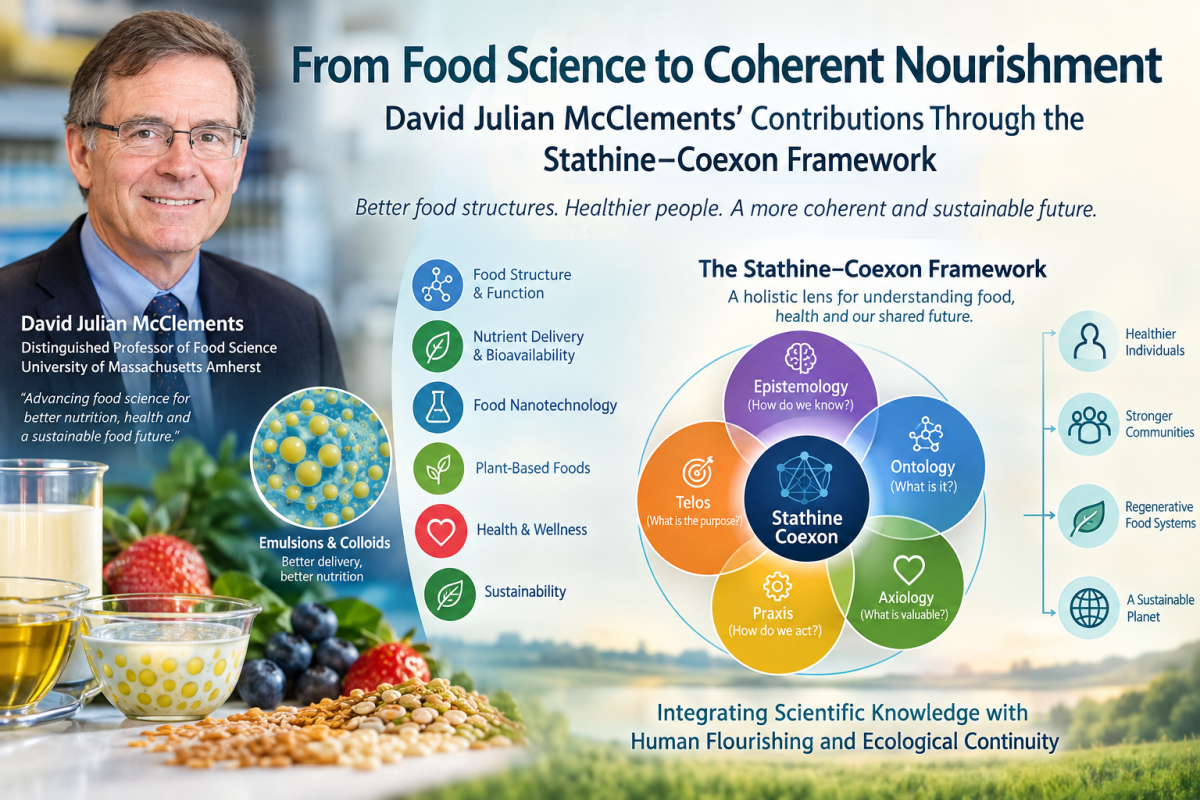
The Framework for Humanity in the 21st century to thrive.
The Stathine–Coexon Framework proposes a unified model for understanding life, mind, learning, fulfillment, ethics, and human development. Its purpose is not merely theoretical but practical. The framework is intended to become a way of observing reality and making decisions in everyday life.
To make the framework accessible, it is organized into three levels:
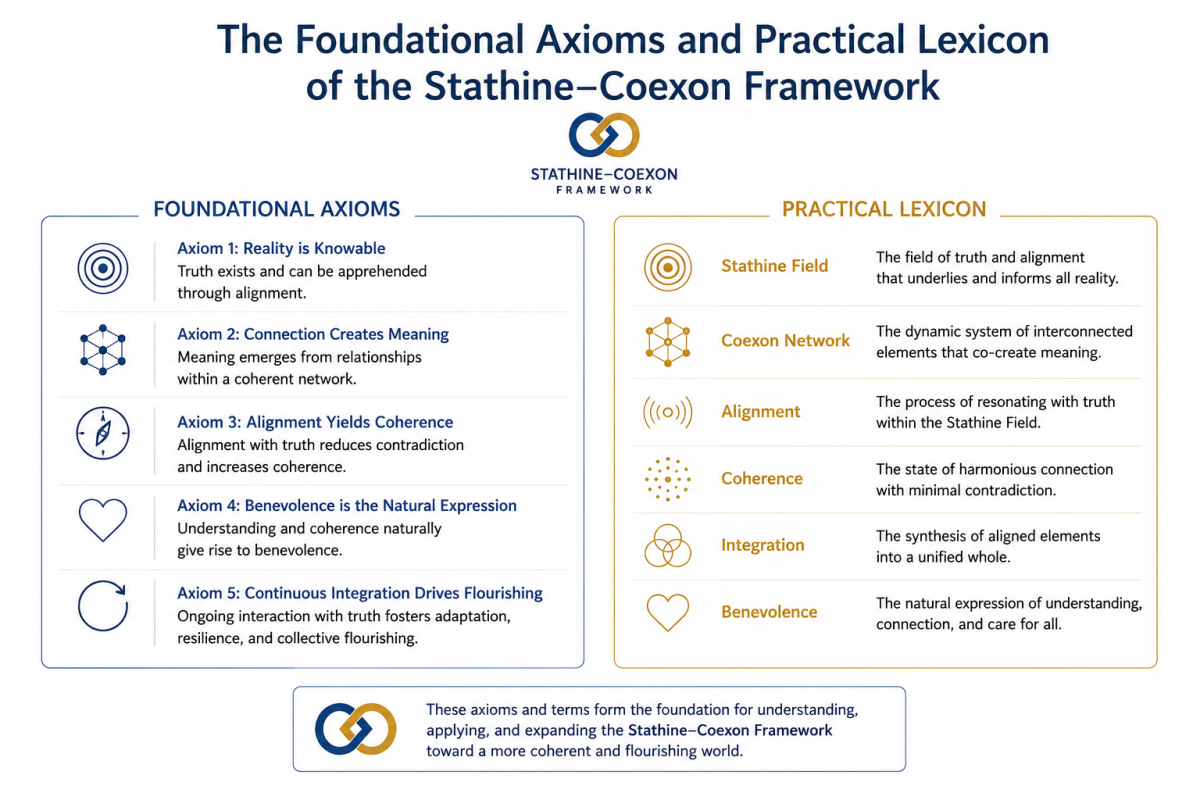
- Foundational Axioms — assumptions upon which the framework is built.
- Foundational Lexicon — precise definitions of the framework’s core concepts.
- Derived Principles — practical consequences that naturally emerge from the axioms.
Together they provide a common language for understanding oneself, relationships, organizations, and society.
Part I — Foundational Axioms
Axiom 1 — The Existence of the Stathine Field
The universe exists within the Stathine field, the universal field that provides continuity, interaction, consequence, and existential reality.
Axiom 2 — The Existence of the Coexon
Every living being possesses one singular Coexon, the life atom.
The Coexon has a specific atomic architecture composed of dynamically interacting subatomic particles.
Axiom 3 — Life Is Recursive Interaction
Life develops through the continuous recursive interaction of the Coexon with the Stathine field.
Every experience modifies the internal organization of the Coexon.
Axiom 4 — Contradiction Produces Incoherence
Whenever the internal organization of the Coexon contains representations that are inconsistent with existential reality, contradiction arises.
Contradiction reduces coherence.
Axiom 5 — Learning Is Reorganization
Learning is the recursive reorganization of the Coexon’s internal subatomic structure through continual interaction with the Stathine field.
Axiom 6 — Alignment Is the Direction of Development
The natural direction of development is toward increasing alignment between the Coexon’s internal organization and existential reality.
Alignment progressively reduces contradiction.
Axiom 7 — Consequences Are the Language of Reality
The Stathine field continuously reveals reality through consequences.
Consequences are neither rewards nor punishments.
They are information.
Axiom 8 — Fulfillment Emerges from Coherence
Enduring fulfillment is not created by external possession.
It emerges from increasing coherence within the Coexon.
Axiom 9 — Understanding Naturally Produces Benevolence
As contradiction decreases and understanding increases, benevolence becomes the most coherent response to reality.
Ethics emerges from understanding rather than coercion.
Axiom 10 — Control Is Limited, Commitment Is Unlimited
The Coexon cannot control the Stathine field.
It can continually reorganize itself and deepen its commitment to coherent action.
Part II — Foundational Lexicon
Coexon
The singular life atom possessing a specific atomic architecture composed of dynamically interacting subatomic particles.
Stathine
The universal field within which the Coexon continuously exists and interacts.
Mind
The continuously evolving functional state of the Coexon’s internal subatomic organization.
Consciousness
The subjective experience arising from the dynamic organization of the Coexon.
Personality
The relatively stable organizational patterns within the Coexon.
Learning
Recursive reorganization of the Coexon’s internal subatomic structure.
Memory
Relatively stable organizational states within the Coexon created through previous interactions with the Stathine field.
Contradiction
Internal incoherence produced by incompatible representations within the Coexon.
Alignment
Increasing coherence between the Coexon’s internal organization and existential reality.
Wisdom
The sustained ability to perceive reality with minimal contradiction.
Understanding
The capacity to organize experience coherently enough that reality becomes increasingly self-evident.
Truth
An internal representation that remains consistently aligned with existential reality.
Falsehood
An internal representation that persistently conflicts with existential reality.
Truth Compression
The theoretical principle that coherent representations require progressively less organizational maintenance within the Coexon than contradictory representations.
Doublethink
The simultaneous maintenance of incompatible internal representations within the Coexon.
Delusion
Persistent contradiction mistaken for reality.
Belief
A temporary organizational state within the Coexon awaiting validation through interaction with the Stathine field.
Benevolence
Coherent action arising naturally from accurate understanding of existential reality.
Commitment
The sustained organization of the Coexon toward coherent action regardless of external outcomes.
Control
The attempt to determine outcomes beyond the Coexon’s own internal organization.
Fulfillment
The enduring psychological stability accompanying increasing coherence.
Part III — Derived Principles
These are not axioms.
They emerge naturally from the preceding foundations.
Principle of Truth Compression
Truth requires less internal maintenance than contradiction.
Principle of Recursive Learning
Every consequence is an opportunity to reduce contradiction.
Principle of Existential Alignment
Reality need not be changed before understanding can begin.
Understanding begins by seeing reality accurately.
Principle of Commitment
Give up control.
Increase commitment.
Learning accelerates.
Principle of Authenticity
The smaller the gap between what one is and what one projects, the greater the coherence.
Principle of Benevolence
Understanding naturally produces benevolence.
Ignorance naturally produces exploitation.
Principle of Simplicity
Increasing understanding reduces unnecessary complexity.
Reality becomes easier to explain.
Principle of Continuous Revision
No understanding is final.
Every interaction with the Stathine field provides new opportunities for refinement.
Principle of Universal Learning
Every human being, regardless of age or background, can reduce contradiction and increase coherence.
Daily Reflection Questions
The framework is intended to be lived rather than merely studied.
At the end of each day, ask:
- What reality did I avoid seeing today?
- Which contradiction became visible?
- What consequence taught me something?
- What belief changed because of reality?
- Where did I seek control instead of commitment?
- Where did I project an image different from who I really am?
- Did my understanding increase today?
- Did my actions become more benevolent?
- Is my Coexon becoming more coherent?
- What one contradiction can I reduce tomorrow?
These questions transform the Stathine–Coexon Framework from an abstract theory into a daily discipline of observation, learning, and existential alignment.
Closing Perspective
The Stathine–Coexon Framework ultimately proposes that the purpose of human development is neither the accumulation of knowledge nor the pursuit of external control. Its purpose is the progressive reduction of contradiction within the singular Coexon through continual interaction with the Stathine field. As coherence increases, understanding deepens. As understanding deepens, authenticity, wisdom, benevolence, commitment, and fulfillment emerge naturally—not as virtues imposed from outside, but as the inevitable expressions of an increasingly aligned life.