Foundational Lexicon of the Stathine–Coexon Framework
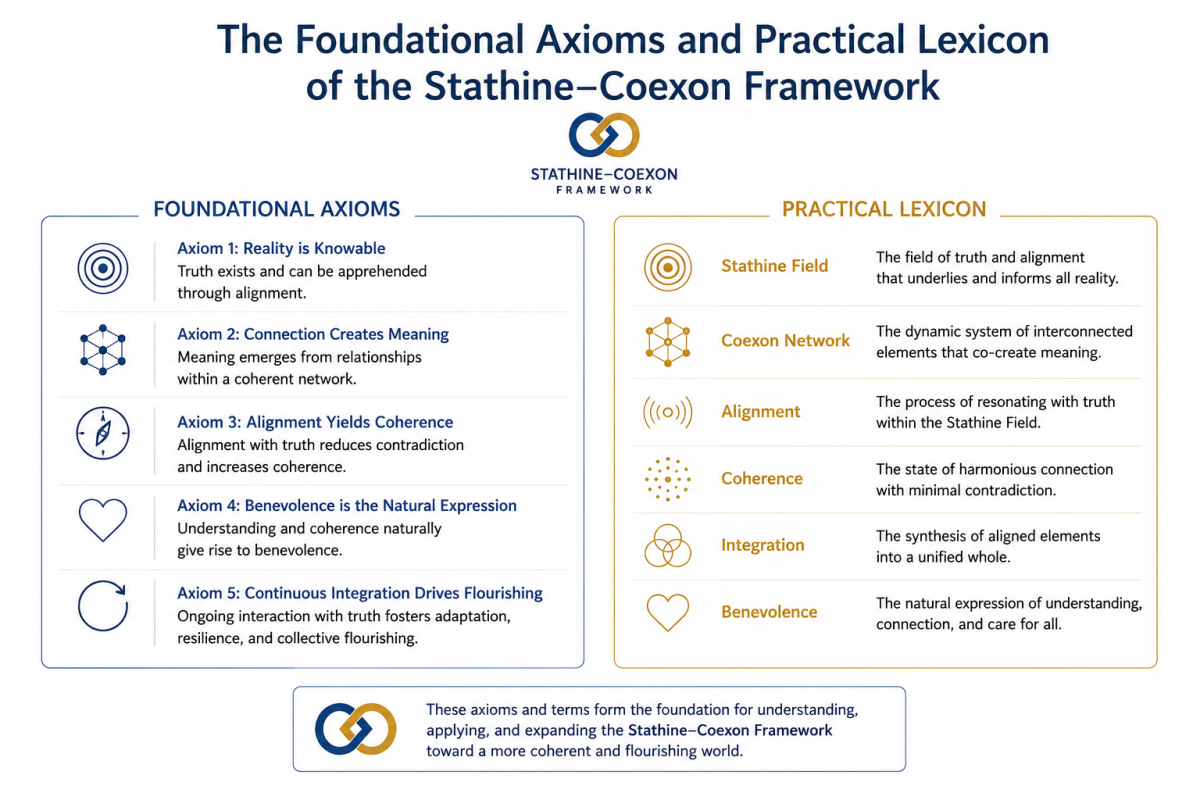
Coexon: The singular life atom possessing a specific atomic architecture composed of dynamically interacting subatomic particles. Learning, memory, contradiction, alignment, consciousness, and identity arise through changes within its internal organization.
Stathine: The universal field within which the Coexon continuously exists and interacts. The Stathine field provides the conditions for interaction, continuity, consequence, and feedback but is not itself conscious.
Mind: The continuously evolving functional state of the Coexon’s internal subatomic organization as it interacts with the biological organism and the Stathine field.
Consciousness: The subjective experience associated with the dynamic organization and activity of the Coexon’s internal subatomic structure.
Personality: The relatively stable patterns of organization within the Coexon that influence perception, emotion, decision-making, and behavior.
Learning: The recursive reorganization of the Coexon’s internal subatomic structure through interaction with the Stathine field.
Contradiction: A state of internal incoherence within the Coexon’s organization in which incompatible representations coexist, reducing alignment with existential reality.
Alignment: The progressive increase in coherence between the Coexon’s internal organization and existential reality as revealed through interaction with the Stathine field.
Wisdom: The sustained reduction of contradiction within the Coexon, enabling increasingly coherent perception, judgment, and action.
Fulfillment: The enduring state of well-being arising from a highly coherent Coexon functioning in sustained alignment with the Stathine field.
Abstract
Benevolence has traditionally been explained as a moral virtue, religious obligation, evolutionary adaptation, or social convention. Despite these perspectives, societies continue to struggle with exploitation, inequality, resource conflicts, and competing moral ideologies. One reason may be that benevolence is frequently separated from understanding. Individuals are encouraged to “be kind” without first developing an accurate perception of existential reality.
The Stathine–Coexon Framework proposes that authentic benevolence is not primarily an emotional disposition but the natural consequence of understanding reality. It further argues that one of the greatest obstacles to benevolence is the delusion of abundance — the belief that resources, consequences, or responsibilities are unlimited or disconnected from one another. This paper proposes that as contradiction is progressively reduced within the internal organization of the singular Coexon through interaction with the Stathine field, delusion diminishes and benevolence emerges as the most coherent form of human action.
1. Introduction
Human beings generally admire benevolence.
Parents encourage children to share.
Religions praise compassion.
Governments promote social responsibility.
Educational institutions teach cooperation.
Yet benevolence often remains inconsistent.
People may be generous in one situation and exploitative in another.
The central question is therefore not whether people value benevolence.
The question is why benevolence fails to remain stable.
The Stathine–Coexon Framework proposes that lasting benevolence depends upon understanding rather than instruction alone.
2. Benevolence Without Understanding
Acts that appear benevolent are not always coherent.
An individual may provide resources that create dependency.
A leader may avoid accountability in the name of compassion.
A parent may remove every challenge from a child’s life while believing this to be love.
In each case, intention may be kind while consequences are harmful.
Benevolence therefore cannot be evaluated solely by intention.
It must also be evaluated by its relationship to existential reality.
Understanding becomes indispensable.
3. The Delusion of Abundance
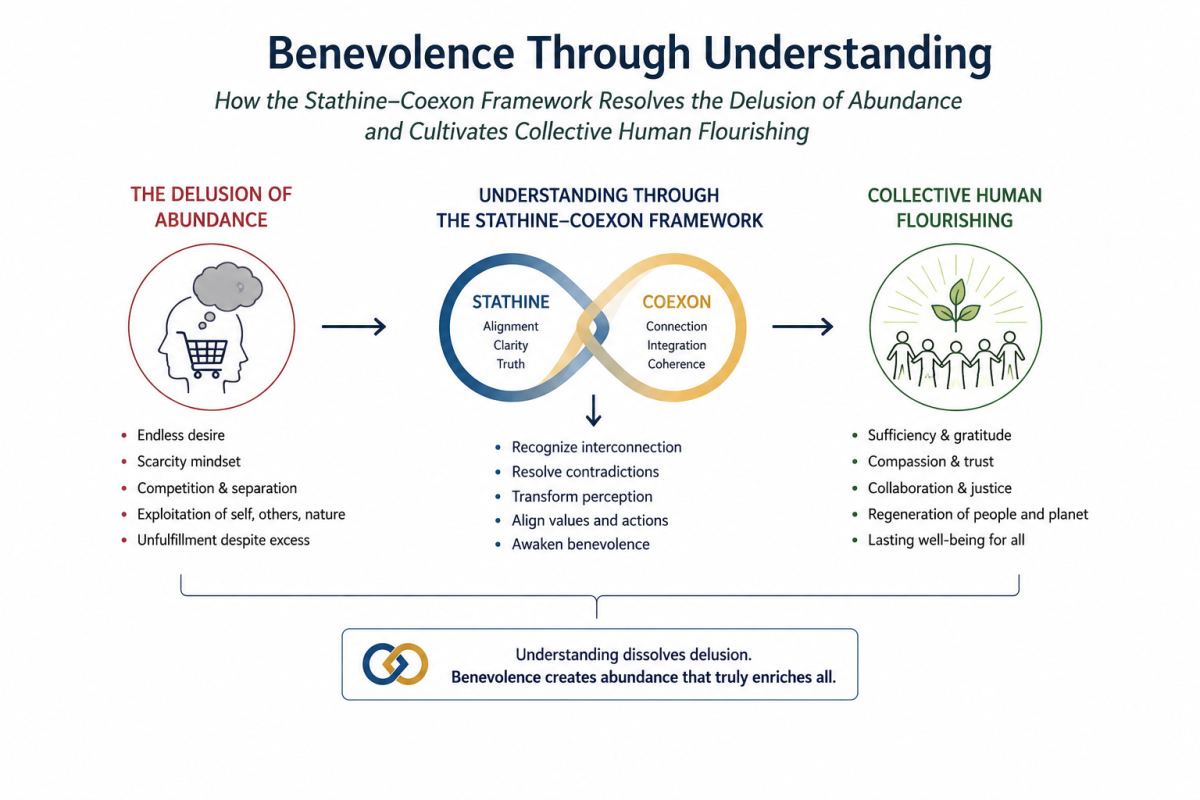
One of the most persistent forms of contradiction is the assumption that giving has no limits and that consequences need not be considered.
This may be called the delusion of abundance.
It appears in many forms.
The belief that natural resources are effectively limitless.
The belief that emotional energy can be given indefinitely without renewal.
The belief that forgiveness removes the need for responsibility.
The belief that compassion eliminates the importance of truth.
The belief that every desire should be satisfied simply because it exists.
These assumptions ignore the reality that every action participates in a larger field of consequences.
They substitute wishful thinking for observation.
4. The Stathine Field as the Reality of Consequences
Within the framework, the Stathine field is not merely a background for existence.
It is the field through which every action acquires consequences.
No action is isolated.
Every choice modifies the conditions for subsequent choices.
The Stathine field continuously reveals whether an action increases coherence or increases contradiction.
Reality therefore becomes the ultimate teacher.
The field does not reward sentiment.
It reveals consequence.
5. The Coexon and Understanding
The singular Coexon continuously reorganizes its internal subatomic structure through interaction with the physical body on one end and the Stathine field on the other end.
Every consequence becomes information.
Every contradiction becomes an opportunity for reorganization.
Learning therefore consists of progressively replacing inaccurate internal representations with increasingly coherent ones.
Understanding is not the accumulation of facts.
Understanding is the reduction of contradiction within the Coexon.
6. Why Understanding Produces Benevolence
As understanding increases, several realizations naturally emerge.
The individual recognizes that every action generates consequences.
They recognize that exploitation frequently produces delayed harm.
They recognize that compassion without wisdom may perpetuate suffering.
They recognize that truth without compassion may become cruelty.
Gradually, benevolence ceases to be an obligation.
It becomes the most coherent response to reality.
The individual acts benevolently because understanding has reorganized the Coexon.
7. The Progressive Dissolution of the Delusion of Abundance
The framework proposes a recursive developmental sequence.
Step 1: Observe Reality
Distinguish direct observation from assumptions.
Ask:
“What is actually happening?”
Step 2: Recognize Consequences
Observe both immediate and delayed effects.
Reality extends beyond the present moment.
Step 3: Identify Contradictions
Compare intentions with outcomes.
Where outcomes consistently differ from expectations, contradiction exists.
Step 4: Question the Illusion of Unlimited Resources
Ask:
“Am I assuming that time, attention, wealth, emotional energy, or ecological resources are unlimited?”
Recognize that every resource exists within conditions.
Step 5: Reorganize the Coexon
Allow repeated interaction with reality to reorganize the internal subatomic relationships within the Coexon.
False assumptions gradually lose coherence.
Accurate understanding strengthens.
Step 6: Replace Charity with Responsible Benevolence
Give in ways that strengthen another person’s capacity to flourish.
Avoid actions that unintentionally reinforce dependency, exploitation, or denial of responsibility.
Step 7: Repeat Throughout Life
Understanding is recursive.
Every interaction with the Stathine field provides new opportunities to refine perception.
Benevolence deepens because understanding deepens.
8. Educational Implications
Modern education often separates ethics from reality.
Students are encouraged to develop values.
They are less frequently taught how to examine whether those values consistently produce the intended consequences.
The Stathine–Coexon Framework proposes that education should cultivate existential literacy.
Students should learn to:
- observe carefully,
- distinguish facts from narratives,
- evaluate consequences,
- detect contradiction,
- understand finite resources,
- align compassion with reality.
In this model, ethics becomes evidence-informed rather than merely aspirational.
9. Societal Implications
Many contemporary conflicts arise because competing groups operate from different assumptions regarding abundance, entitlement, justice, and responsibility.
Where understanding is absent, benevolence becomes ideological.
Where understanding is present, cooperation becomes easier because participants evaluate actions through shared consequences rather than competing narratives.
The framework therefore suggests that lasting social harmony depends less upon persuading people to become benevolent than upon helping them understand existential reality more accurately.
10. Conclusion
The Stathine–Coexon Framework proposes that authentic benevolence emerges from understanding rather than from sentiment alone. The singular Coexon progressively reorganizes its internal subatomic structure through continual interaction with the Stathine field. As contradiction is reduced, inaccurate assumptions — including the delusion of unlimited abundance — are gradually replaced by increasingly coherent representations of reality.
This process transforms benevolence from an externally imposed moral obligation into a natural expression of existential alignment. The individual no longer acts kindly because kindness is commanded. They act benevolently because understanding reveals that coherent action consistently promotes both personal flourishing and the flourishing of the wider systems within which life unfolds.
The framework therefore proposes that the highest form of ethics is not obedience to moral rules but the disciplined pursuit of understanding. As understanding deepens, contradiction diminishes. As contradiction diminishes, benevolence ceases to require effort and becomes the spontaneous expression of an aligned Coexon interacting coherently with the Stathine field.