The Next Evolutionary Journey of Humanity Through the Stathine– Coexon Coexistence Framework
Abstract
Human civilization is entering an era increasingly shaped by Artificial Intelligence (AI). Machines can now process information, recognize patterns, generate content, and assist in decision-making at scales previously unimaginable. While these developments represent a remarkable achievement of human intelligence, they also raise a deeper question:
What is the next stage of human development?
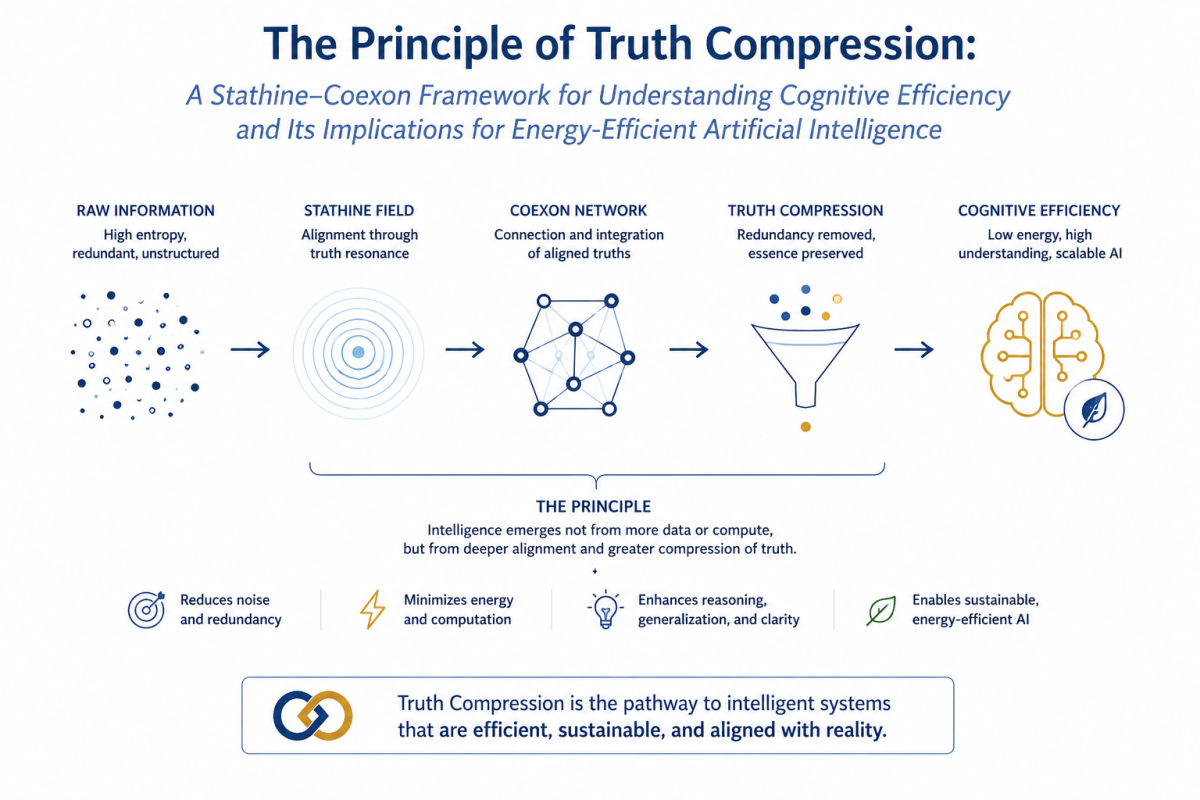
The Stathine–Coexon Coexistence Framework proposes that the future of humanity is not merely the advancement of Artificial Intelligence, but the development of Natural Intelligence (NI). Natural Intelligence refers to the capacity of human beings to understand reality, resolve contradictions, cooperate consciously, and participate harmoniously within the larger fabric of existence.
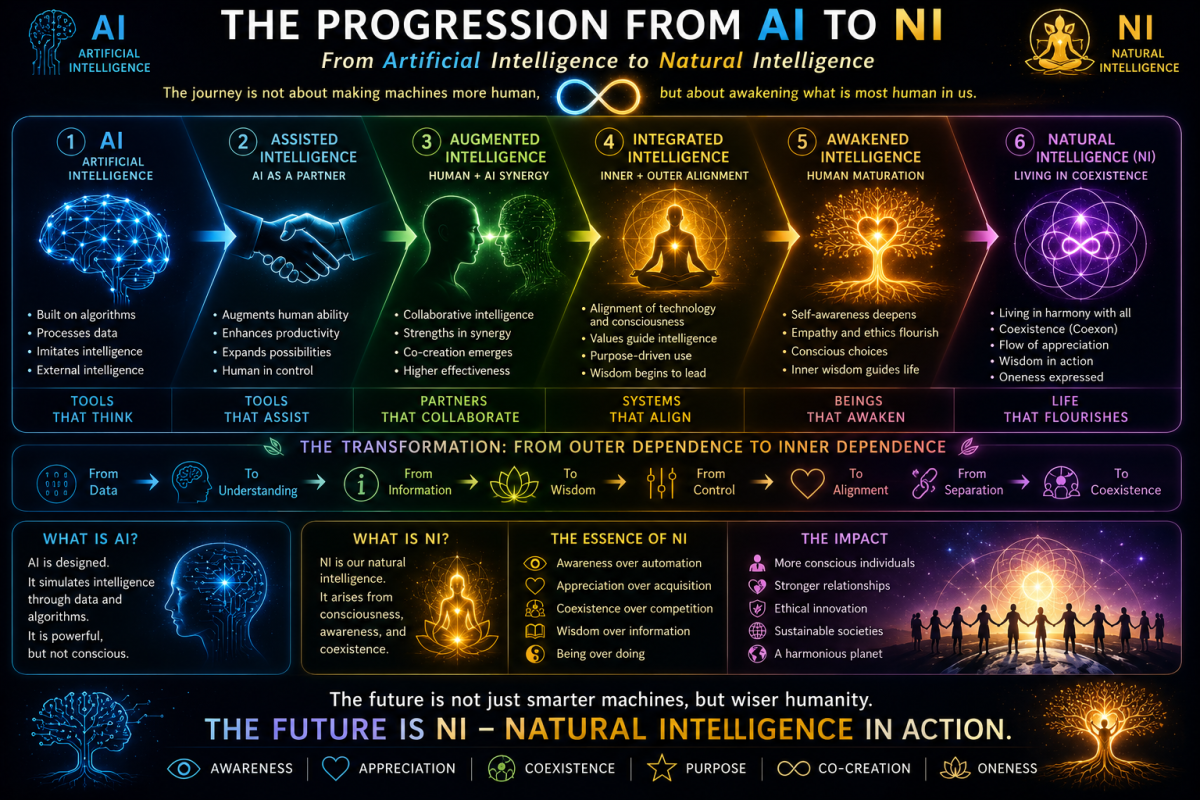
In this view, AI represents the evolution of information processing, while NI represents the evolution of understanding. The journey from AI to NI is therefore not a technological transition but a human one.
1. The Age of Artificial Intelligence
Human beings have always created tools.
The stone axe amplified strength.
The wheel amplified movement.
The printing press amplified communication.
The computer amplified calculation.
Artificial Intelligence amplifies cognition.
AI can now:
- analyze vast amounts of data,
- recognize patterns,
- generate text,
- assist research,
- optimize systems,
- automate decisions.
These capabilities are extraordinary.
Yet AI operates primarily in the domain of information.
It processes.
It predicts.
It correlates.
It computes.
But computation alone does not necessarily produce understanding.
2. The Information Problem
Human history has never suffered from a lack of information.
Today, humanity possesses more information than at any previous point in history.
Yet we still experience:
- conflict,
- loneliness,
- exploitation,
- anxiety,
- ecological damage,
- social fragmentation.
This suggests an important distinction.
Information is not understanding.
Knowledge is not wisdom.
Processing is not participation.
The challenge facing humanity is no longer obtaining information.
The challenge is understanding reality.
3. The Limits of AI
Artificial Intelligence can answer:
What happened?
What is happening?
What may happen?
Increasingly, AI can even assist with:
What should be done?
However, AI cannot fully answer:
What is meaningful?
What creates fulfillment?
What reduces suffering?
What builds genuine human relationships?
What allows people to live in harmony?
These questions belong to a different domain.
They require understanding rather than computation.
4. Defining Natural Intelligence (NI)
Within the Stathine–Coexon Coexistence Framework, Natural Intelligence is defined as:
The capacity to understand reality sufficiently to live without exploiting others and without being exploited.
Natural Intelligence includes:
- self-awareness,
- empathy,
- discernment,
- cooperation,
- appreciation,
- responsibility,
- understanding.
Unlike AI, which processes information, NI processes experience.
It transforms experience into understanding.
5. The Evolution of Intelligence
Human development can be viewed as a sequence.
Biological Intelligence
The ability to survive.
Emotional Intelligence
The ability to manage feelings.
Social Intelligence
The ability to cooperate.
Rational Intelligence
The ability to think logically.
Artificial Intelligence
The ability to externalize cognition into machines.
Natural Intelligence
The ability to understand reality holistically.
The Stathine framework suggests that humanity is currently transitioning between the last two stages.
6. The Coexon and Natural Intelligence
The framework proposes that human development occurs through the maturation of the Coexon.
The Coexon learns through a recurring cycle:
Feeling → Choosing → Evaluating → Validating → Knowing → Understanding → Experiencing → Living → Explaining → Feeling
AI can assist several stages of this cycle.
It can provide information.
It can aid analysis.
It can improve prediction.
But understanding must still emerge within lived experience.
The Coexon develops through participation.
Not merely through data.
7. Why Understanding Matters
Many human problems arise not from malice but from misunderstanding.
People act according to what they believe is beneficial.
When understanding is incomplete:
- conflict emerges,
- relationships deteriorate,
- societies fragment.
As understanding increases:
- empathy grows,
- cooperation improves,
- exploitation decreases.
Natural Intelligence is therefore not the accumulation of facts.
It is the reduction of contradiction.
8. From Competition to Coexistence
Much of human civilization has been organized around competition.
Competition has generated innovation.
However, excessive competition also generates:
- inequality,
- insecurity,
- alienation,
- conflict.
The Stathine–Coexon Coexistence Framework proposes that the next stage of development is cooperation based on understanding.
This does not eliminate individuality.
It aligns individuality with collective flourishing.
The question changes from:
“How do I win?”
to
“How do we flourish together?”
9. The Role of AI in Developing NI
The framework does not view AI as an enemy.
Nor does it view AI as humanity’s ultimate achievement.
AI is a tool.
A powerful one.
Used wisely, AI can free human beings from routine cognitive tasks and create more opportunity for:
- learning,
- reflection,
- creativity,
- understanding,
- relationship building.
The purpose of AI is not to replace human development.
The purpose of AI is to support it.
10. The Stathine Perspective
The concept of Stathine refers to the underlying relational reality from which all interactions emerge.
Reality is fundamentally interconnected.
The Earth demonstrates this continuously.
Ecosystems function through relationships.
Societies function through relationships.
Human fulfillment emerges through relationships.
Natural Intelligence develops when the individual understands this interconnectedness and acts accordingly.
11. The New Educational Challenge
Education in the industrial age focused on knowledge.
Education in the information age focuses on information literacy.
Education in the age of Natural Intelligence must focus on understanding.
Future education may need to teach:
- self-observation,
- emotional literacy,
- conflict resolution,
- systems thinking,
- cooperation,
- meaning-making,
- existential understanding.
These capacities cannot be outsourced to machines.
They remain uniquely human.
12. A New Measure of Progress
The success of AI is measured by:
- accuracy,
- speed,
- efficiency,
- capability.
The success of NI is measured differently.
It is measured by:
- understanding,
- harmony,
- cooperation,
- wellbeing,
- reduction of exploitation,
- increase in human flourishing.
A society rich in AI but poor in NI remains unstable.
A society that develops both becomes resilient.
Conclusion
Artificial Intelligence represents one of humanity’s greatest technological achievements.
Yet the deepest challenge facing civilization is not computational.
It is existential.
The Stathine–Coexon Coexistence Framework proposes that humanity’s next evolutionary step is the development of Natural Intelligence—the capacity to understand reality sufficiently to live in harmony with oneself, with others, and with the larger world.
AI helps us process information.
NI helps us understand life.
AI expands what we can do.
NI expands who we can become.
The future of humanity may therefore be summarized in a simple progression:
From Artificial Intelligence (AI) to Natural Intelligence (NI).
Not because machines become human.
But because humans finally become fully human.
A concise formulation
AI asks: “What is the answer?”
NI asks: “What is the understanding?”
AI increases capability.
NI increases humanity.
The Stathine– Coexon Coexistence Framework proposes that the true evolution of civilization begins when capability is guided by understanding.