A Conceptual Extension of the “Why–How–What” Model
Abstract
Simon Sinek’s Golden Circle has become one of the most influential frameworks in contemporary leadership, organizational development, and strategic communication. Its central proposition—that inspired individuals and organizations begin with Why, proceed through How, and finally express themselves through What—has shaped leadership education across business, government, and nonprofit sectors.
While the Golden Circle effectively explains patterns of leadership and communication, it intentionally remains a practical model rather than a theory of consciousness or human existence.
This article proposes that the Stathine–Coexon Framework offers a complementary philosophical interpretation of the Golden Circle. It suggests that the movement from Why to How to What reflects a deeper process through which the human being progressively expresses coherence within biological, psychological, organizational, and social systems. Rather than replacing the Golden Circle, the framework seeks to explain why beginning with purpose often leads to greater authenticity, trust, and sustained human engagement.
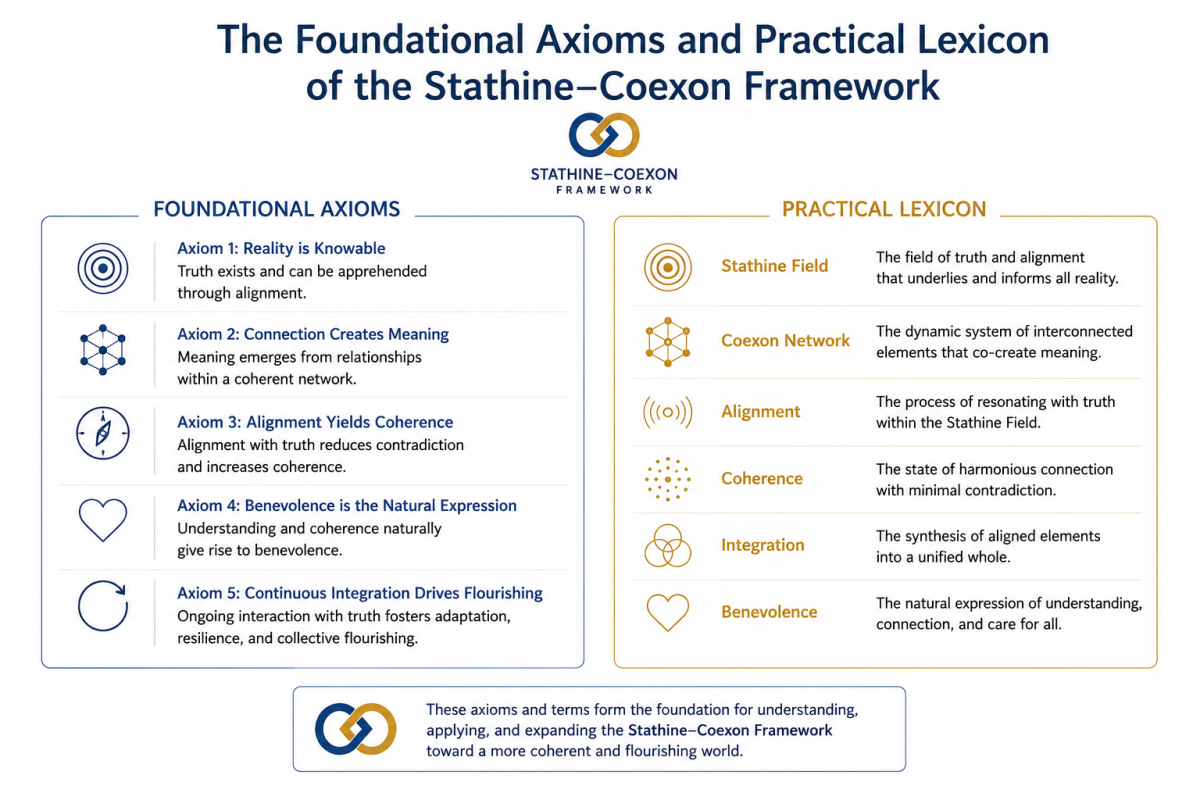
Terminology
Within the Stathine–Coexon Framework, the term human being refers to the integrated unity of the proposed Coexon (the organizing life atom) and the physical body through which it experiences and interacts with the world.
The concepts of Stathine and Coexon are philosophical proposals within this framework rather than established scientific entities. To improve readability, the term human being is used throughout this article unless referring specifically to the theoretical concept of the Coexon itself.
Introduction
Among contemporary leadership models, few have achieved the influence of Simon Sinek’s Golden Circle.
Its simplicity is striking.
Three questions organize the framework:
Why?
How?
What?
Most organizations communicate from the outside inward.
They explain what they do.
Some explain how they do it.
Only a few begin with why they exist.
Sinek argues that leaders who consistently begin with purpose inspire greater trust, loyalty, innovation, and commitment.
The Stathine–Coexon Framework asks an additional question:
Why does beginning with “Why” resonate so deeply with human beings?
Understanding the Golden Circle
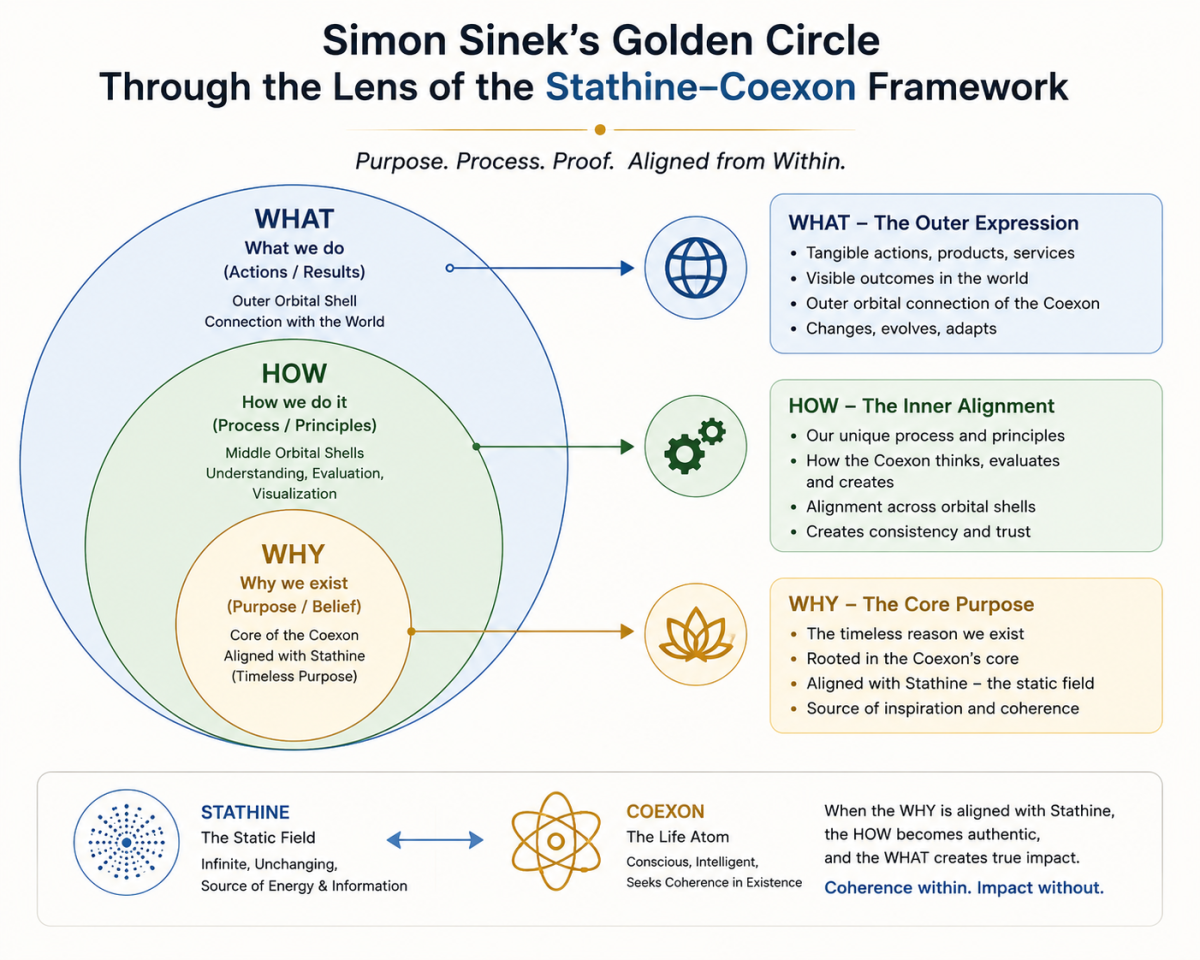
The Golden Circle consists of three concentric levels.
The Outer Circle: What
“What” represents visible activity.
Products.
Services.
Behaviors.
Actions.
Achievements.
Every organization knows what it produces.
Every individual performs observable actions.
The outer circle is therefore the realm of expression.
The Middle Circle: How
“How” represents methods.
Processes.
Values.
Capabilities.
Culture.
Operating principles.
It explains how actions are organized.
The Inner Circle: Why
At the center lies purpose.
Why does this organization exist?
Why does this individual act?
Why should anyone care?
Purpose gives meaning to action.
According to Sinek, lasting inspiration begins here.
The Stathine–Coexon Interpretation
The Stathine–Coexon Framework proposes that these three circles describe not merely organizational communication but successive expressions of coherence.
Rather than viewing the circles only as business strategy, the framework interprets them as three levels through which coherent existence becomes visible.
The Human Being and Purpose
Within the Stathine–Coexon Framework, the human being continuously seeks increasing coherence.
Purpose therefore emerges not simply as a motivational statement but as the deepest expression of coherent understanding.
Purpose answers the question:
What is the direction toward greater coherence?
When purpose is clear, decisions become more consistent.
Relationships become more authentic.
Learning becomes more meaningful.
Leadership becomes more trustworthy.
Thus, the “Why” corresponds to the deepest level of coherent orientation.
How as Organized Coherence
The middle circle represents translation.
Purpose alone does not transform reality.
It requires structure.
Processes.
Habits.
Values.
Disciplines.
The “How” therefore becomes the architecture through which coherence is expressed.
Organizations often mistake procedures for purpose.
The Stathine–Coexon Framework suggests that procedures remain stable only when continuously aligned with the deeper coherence represented by the “Why.”
What as Observable Expression
The outer circle consists of visible outcomes.
Products.
Policies.
Teaching.
Technology.
Leadership behavior.
Social institutions.
Within the framework, these are expressions of internal coherence rather than its source.
Organizations frequently attempt to improve results directly.
The Golden Circle suggests beginning with purpose.
The Stathine–Coexon Framework extends this idea by proposing that purpose itself reflects the degree of coherence attained by the human being.
A Fourth Dimension: Stathine
The Golden Circle begins with “Why.”
The Stathine–Coexon Framework asks whether an even deeper conceptual layer may exist.
Within this framework, Stathine represents the timeless and invariant conceptual ground of existence.
Purpose is therefore not created in isolation.
Rather, the human being continually refines understanding through interaction with this conceptual ground.
In this interpretation:
- Stathine provides the ground of coherent possibility.
- The human being develops coherent purpose.
- “How” organizes coherent action.
- “What” expresses coherent existence.
This additional layer is philosophical rather than empirically established.
Trust Through Coherence
One of Simon Sinek’s central observations is that people trust organizations that communicate from “Why.”
The Stathine–Coexon Framework offers a complementary interpretation.
Trust arises when observable behaviour, operating principles, and stated purpose remain coherent.
Misalignment creates contradiction.
For example:
Purpose speaks of service.
Processes reward exploitation.
Actions produce exclusion.
Such inconsistency reduces perceived coherence and weakens trust.
Conversely, alignment among purpose, process, and action strengthens confidence because people experience fewer contradictions.
Leadership as Coherence
Leadership is often described as influence.
Within the Stathine–Coexon Framework, leadership may be interpreted differently.
Leadership becomes the capacity of the human being to cultivate coherence.
Within oneself.
Within relationships.
Within organizations.
Within society.
Influence follows coherence rather than preceding it.
This interpretation complements Sinek’s observation that people are inspired less by products than by authentic purpose.
Organizational Implications
The integration of the Golden Circle with the Stathine–Coexon Framework suggests several practical questions.
Organizations may ask:
- Is our stated purpose internally coherent?
- Do our operating principles consistently express that purpose?
- Do our daily actions reinforce or contradict our declared values?
- Does every level of the organization reduce or increase contradiction?
These questions extend strategic planning into the domain of coherent organizational development.
Educational Implications
The Golden Circle has become a common tool in leadership education.
The Stathine–Coexon Framework suggests an additional developmental sequence.
Students may first learn:
- systems thinking,
- ethical reasoning,
- reflective practice,
- dialogue,
- emotional literacy.
They may then explore:
- purpose formation,
- coherence development,
- alignment between values and action.
Leadership education thus evolves from teaching effective communication toward cultivating coherent human beings capable of sustaining authentic leadership.
Civilizational Implications
At the scale of civilization, the three circles may also be interpreted collectively.
A civilization’s “What” consists of its institutions, technologies, and visible achievements.
Its “How” consists of governance, education, economics, and cultural norms.
Its “Why” consists of its shared understanding of human purpose.
When these levels become fragmented, societies experience increasing contradiction.
When they become aligned, institutions, communities, and individuals reinforce one another through coherence rather than conflict.
Conclusion
Simon Sinek’s Golden Circle has demonstrated the practical importance of beginning with purpose in leadership and organizational communication. The Stathine–Coexon Framework complements this insight by proposing that purpose is itself an expression of a deeper movement toward coherence within the human being.
Within this interpretation, the progression from Why to How to What reflects not only an effective communication strategy but also a broader developmental process through which coherent understanding becomes organized action and, ultimately, observable contribution.
Whether this interpretation proves valuable will depend on continued interdisciplinary dialogue and empirical exploration. Its contribution lies not in replacing the Golden Circle but in offering a philosophical context through which its enduring influence may be understood as part of humanity’s continuing search for coherent existence.