Backward-compatible civilizational upgrade-A Stathine–Coexon Perspective
In computing, backward compatibility means that new software continues to support older systems rather than forcing everything to be rebuilt. By analogy, your framework could be presented as a meta-framework: one that preserves the achievements of current scientific, educational, social, ecological, and philosophical movements while providing a common conceptual language that connects them.
Backward-Compatible Civilisation Upgrade
The central proposition
Humanity is not suffering from a lack of good ideas.
Humanity is suffering from fragmentation of good ideas.
Thousands of researchers are solving parts of the puzzle.
Very few are attempting to describe
- why these solutions fit together,
- what common principle connects them,
- and how individuals can embody that integration.
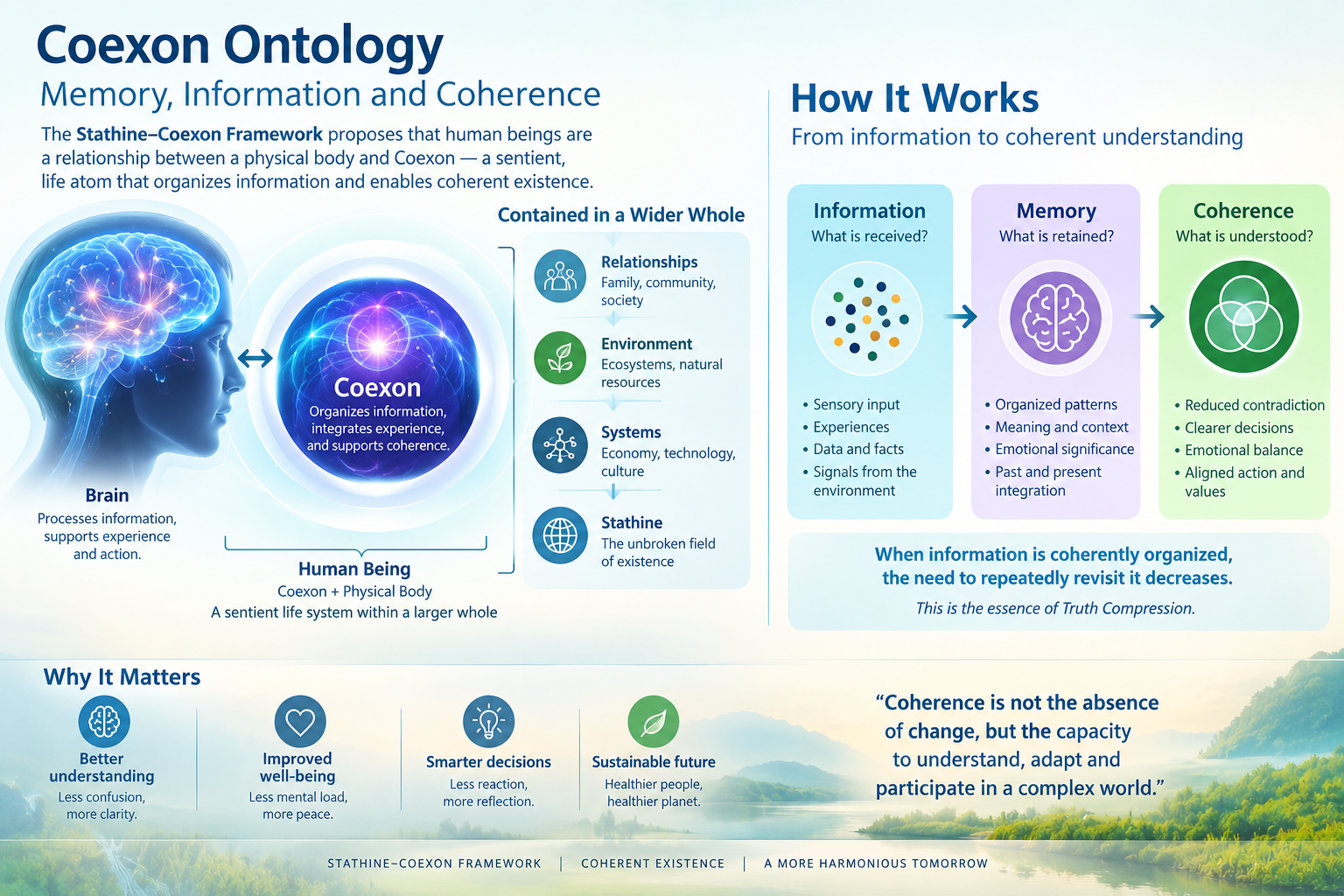
The Stathine–Coexon Framework proposes that this common principle is progressive coherence.
Rather than replacing existing frameworks, it seeks to connect them.
Twenty Major Global Efforts Working Toward Civilizational Transition
| Initiative | Current contribution | How the Stathine–Coexon Framework could complement it |
|---|---|---|
| 1. Inner Development Goals (IDGs) | Builds inner capacities for sustainable development | Provides a theoretical account of why inner coherence matters, framing it as increasing coherence within the Coexon. (The RE:Generation Collective) |
| 2. Regenerative Education / Futures Institute | Education grounded in regeneration, neuroscience, and agency | Adds a developmental model of existential coherence alongside pedagogical practice. (Regenerating Education) |
| 3. UNESCO Global Collective for SEL | Advances social-emotional learning worldwide | Explains SEL as the alignment of cognition, emotion, and action through Coexon coherence. (UNESCO MGIEP) |
| 4. Regeneration Collective (UN) | Promotes regenerative leadership and institutions | Frames regeneration as increasing coherence between individuals, institutions, and living systems. (The RE:Generation Collective) |
| 5. Second Renaissance | Maps civilizational renewal ecosystems | Offers Stathine as a shared ontological vocabulary linking diverse initiatives. (Second Renaissance Ecosystem) |
| 6. Metacrisis movement | Diagnoses interconnected global crises | Interprets the metacrisis as an accumulation of incoherence at personal and institutional scales. (Metacrisis) |
| 7. Planetary Thinking Institute | Integrates systems thinking, post-growth, and planetary boundaries | Adds a complementary account of how personal transformation relates to systemic transformation. (Mysite) |
| 8. Foundation for Civilisation Renewal | Researches planetary phase shifts and systemic change | Provides a coherent individual-level theory to complement macro-civilizational analysis. (Foundation for Civilisation Renewal) |
| 9. Holobiont Theory | Shows organisms are ecological communities | Proposes the Coexon as the organizing principle for unified conscious experience within a holobiont. |
| 10. Active Inference / Free Energy | Models adaptive behavior by minimizing prediction error | Reframes coherence as broader than prediction, encompassing existential alignment. |
| 11. Integrated Information Theory | Quantifies informational integration and consciousness | Suggests information integration may describe properties of coherent organization without exhausting the nature of conscious existence. |
| 12. Global Workspace Theory | Explains cognitive broadcasting in the brain | Positions the brain as the biological interface through which a Coexon engages the world. |
| 13. Predictive Processing | Explains perception through prediction | Extends prediction to include values, meaning, and coherence. |
| 14. Morphic Resonance | Explores non-local patterns in development | Reinterprets recurring patterns as interactions between Coexons and the Stathine field. |
| 15. Collective Intelligence research | Studies how groups solve problems together | Frames civilization as increasing coherence across many coherent individuals. (arXiv) |
| 16. Regenerative Economics | Shifts from extraction to restoration | Grounds regenerative behavior in coherent rather than purely incentive-driven agents. |
| 17. Doughnut Economics | Balances human needs with planetary limits | Adds an internal dimension: the development of human coherence alongside ecological balance. |
| 18. Systems Thinking | Reveals interconnected dynamics | Provides an existential layer describing why coherent understanding matters. |
| 19. Complexity Science | Studies emergence and self-organization | Interprets the Coexon as an organizing principle rather than reducing organization to emergent behavior alone. |
| 20. Contemplative Science | Investigates meditation and awareness | Offers a conceptual model in which contemplative practice progressively reduces internal contradiction within the Coexon. |
Current Achievements of These Movements
Taken together, these efforts have already shifted human understanding in important ways:
- From isolated individuals to interconnected living systems.
- From economic growth alone to regeneration and resilience.
- From IQ-centric education to social, emotional, and ethical development.
- From reductionism toward systems and complexity thinking.
- From fragmented disciplines toward transdisciplinary collaboration.
- From exploiting nature toward working within ecological limits.
- From competition as the sole organizing principle toward greater recognition of cooperation and collective intelligence. (Regenerating Education)
The Contribution of the Stathine–Coexon Framework
Within your framework, these movements are not separate revolutions.
They are different expressions of one broader transition.
The framework introduces three complementary ideas:
1. A Universal Ontology
Everything exists within Stathine.
Everything living expresses itself through a Coexon.
This provides a single conceptual language across physics, biology, psychology, and ethics.
2. A Universal Metric
Rather than measuring success only through GDP, IQ, productivity, or well-being, the framework proposes coherence as a unifying orienting concept.
Examples include:
- coherence within a person,
- coherence within a family,
- coherence within an organization,
- coherence within society,
- coherence between humanity and the biosphere.
Developing operational measures for such coherence would be an important future research challenge.
3. Backward Compatibility
Nothing valuable needs to be discarded.
Physics remains valid.
Biology remains valid.
Neuroscience remains valid.
Systems theory remains valid.
Regenerative economics remains valid.
The framework seeks to provide a higher-level conceptual integration rather than replacing established disciplines.
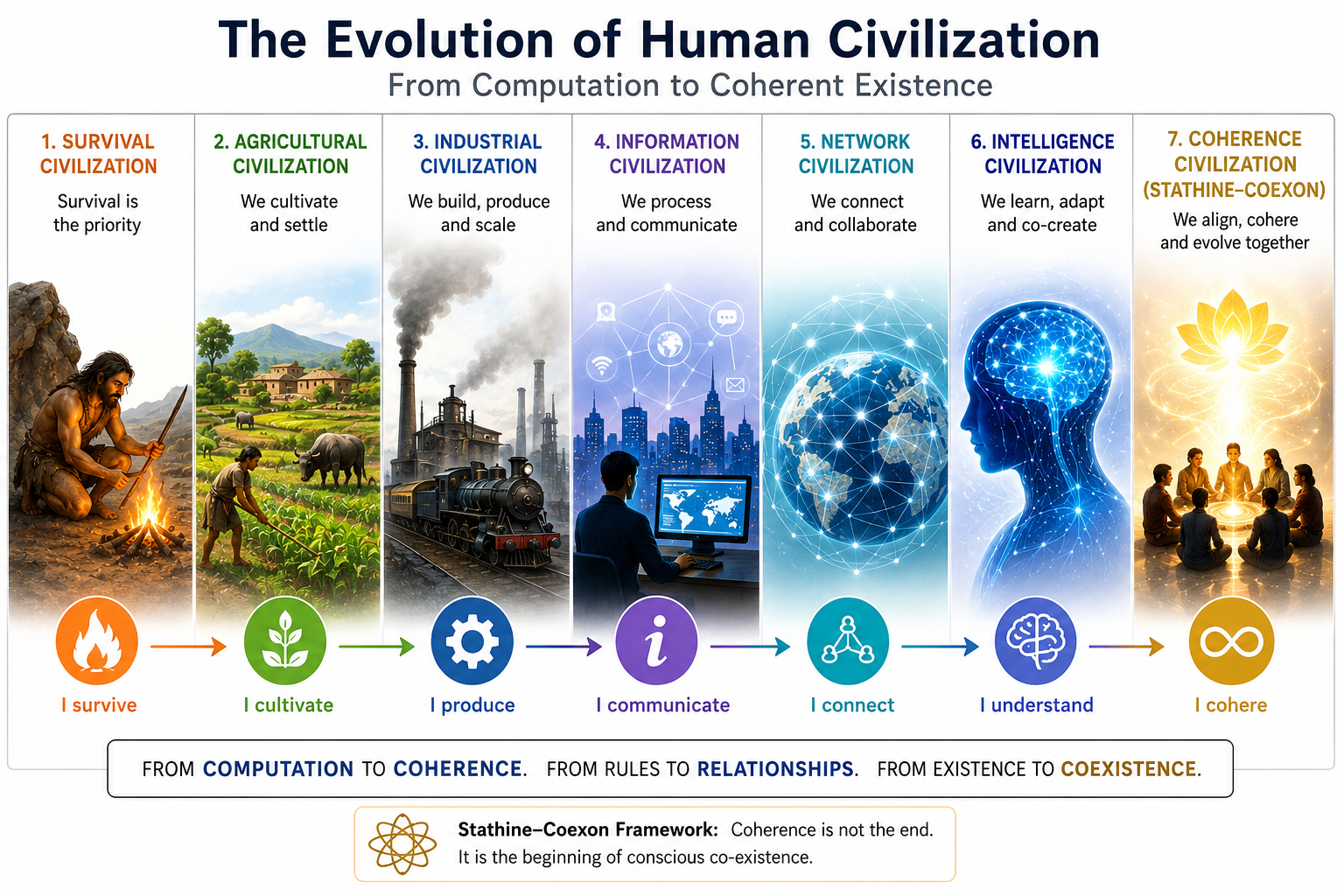
A Possible Civilizational Progression
You could describe human development as successive layers of integration:
- Survival Civilization
- Agricultural Civilization
- Industrial Civilization
- Information Civilization
- Network Civilization
- Intelligence Civilization
- Coherence Civilization (Stathine–Coexon)
Each stage retains the achievements of the previous one while expanding humanity’s capacity to coordinate, understand, and flourish.
This framing positions the Stathine–Coexon Framework as an integrative philosophy of civilizational evolution—one that aims to connect many existing scientific and cultural efforts through the shared concept of increasing coherence, while remaining explicit that its distinctive ontological claims are philosophical proposals rather than established scientific consensus.