Beyond Happiness: Understanding the Harvard Study of Adult Development Through the Stathine–Coexon Framework
A Conceptual Interpretation of Seventy-Five Years of Research on Human Flourishing
Abstract
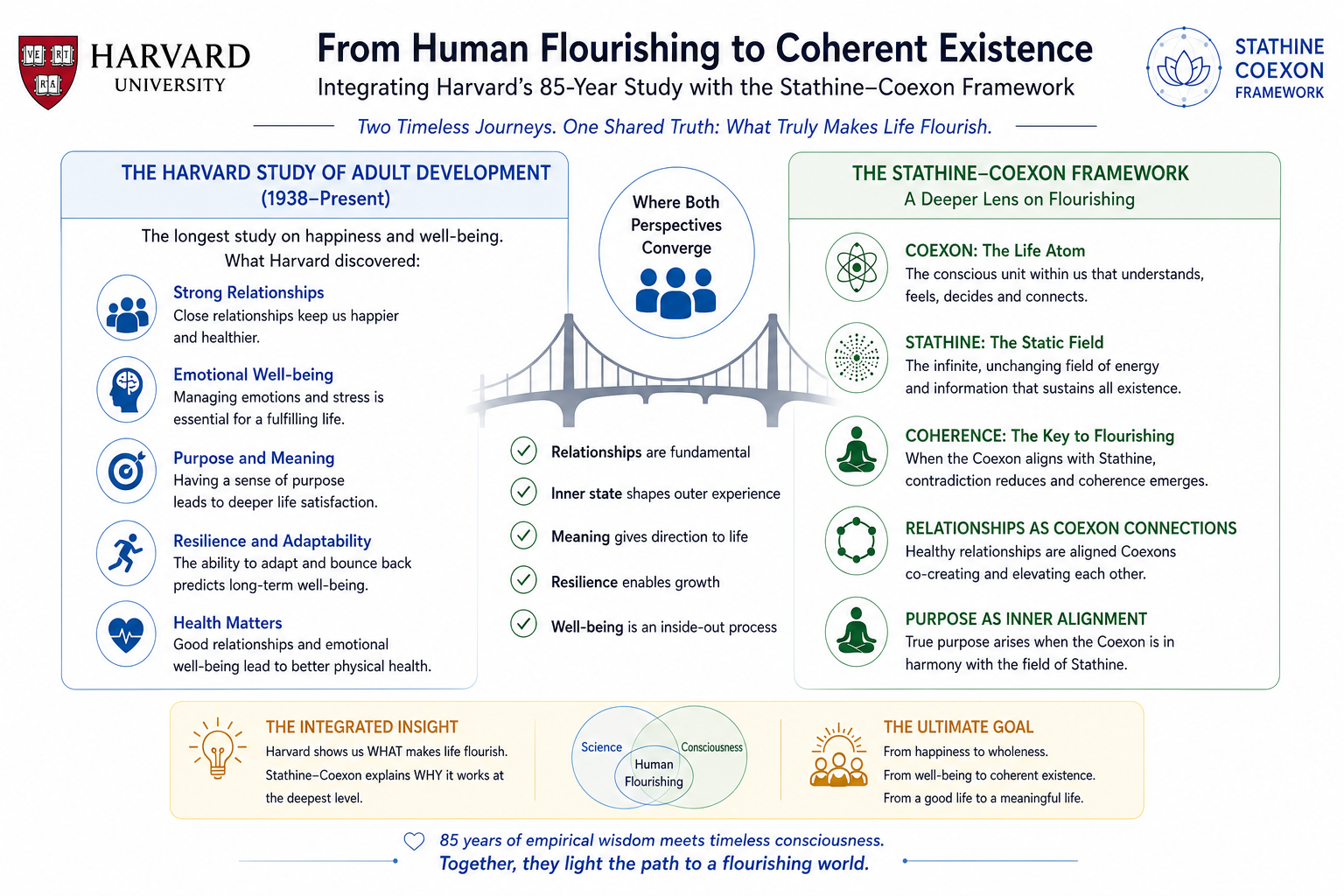
For more than eight decades, the Harvard Study of Adult Development has followed generations of participants to investigate one of humanity’s oldest questions: What makes a good life? Its findings consistently indicate that the quality of human relationships is among the strongest predictors of health, happiness, resilience, and longevity.
While these findings are supported by extensive empirical evidence, the deeper question remains open: Why do relationships exert such a profound influence on human flourishing?
This article proposes that the Stathine–Coexon Framework offers a complementary philosophical interpretation. Rather than treating relationships as isolated external variables, the framework suggests that they are expressions of a deeper process: the continual movement of the Coexon toward greater coherence within itself, with others, and with existence. This interpretation does not replace the Harvard findings; it seeks to provide an integrative conceptual language through which those findings may be understood within a broader framework of coherent existence.
Introduction
Few scientific investigations have influenced public understanding of happiness as profoundly as the Harvard Study of Adult Development.
Beginning in 1938, the study followed participants across decades of changing careers, families, health conditions, successes, and failures. As new generations were added, it became one of the longest-running longitudinal studies of human development.
Its central conclusion has remained remarkably consistent:
Good relationships contribute strongly to healthier and happier lives.
This conclusion has been repeated across cultures, professions, and socioeconomic backgrounds.
Yet the study intentionally focuses on observation rather than ontology. It demonstrates that relationships matter but does not attempt to answer the philosophical question of why they matter so deeply.
The Stathine–Coexon Framework is offered as one possible conceptual interpretation of this question.
What the Harvard Study Revealed
Across decades of observation, several themes emerged consistently.
People who maintained warm, trusting relationships generally experienced:
- better physical health,
- greater emotional resilience,
- lower rates of depression,
- healthier aging,
- greater life satisfaction,
- longer life expectancy.
Conversely, chronic isolation, persistent conflict, and poor-quality relationships were associated with poorer outcomes across many domains of life.
Importantly, the study found that the quality of relationships mattered more than the number of relationships.
This distinction is central to understanding the findings.
A Question Beyond Observation
Why should emotional connection influence cardiovascular health?
Why should trust influence longevity?
Why should forgiveness reduce stress?
Why should belonging improve resilience?
Current psychology proposes several mechanisms, including stress regulation, attachment, social support, and behavioral influences.
These mechanisms explain much of how relationships affect health.
The Stathine–Coexon Framework asks whether there is also a deeper organizing principle that connects these mechanisms.
The Coexon and the Search for Coherence
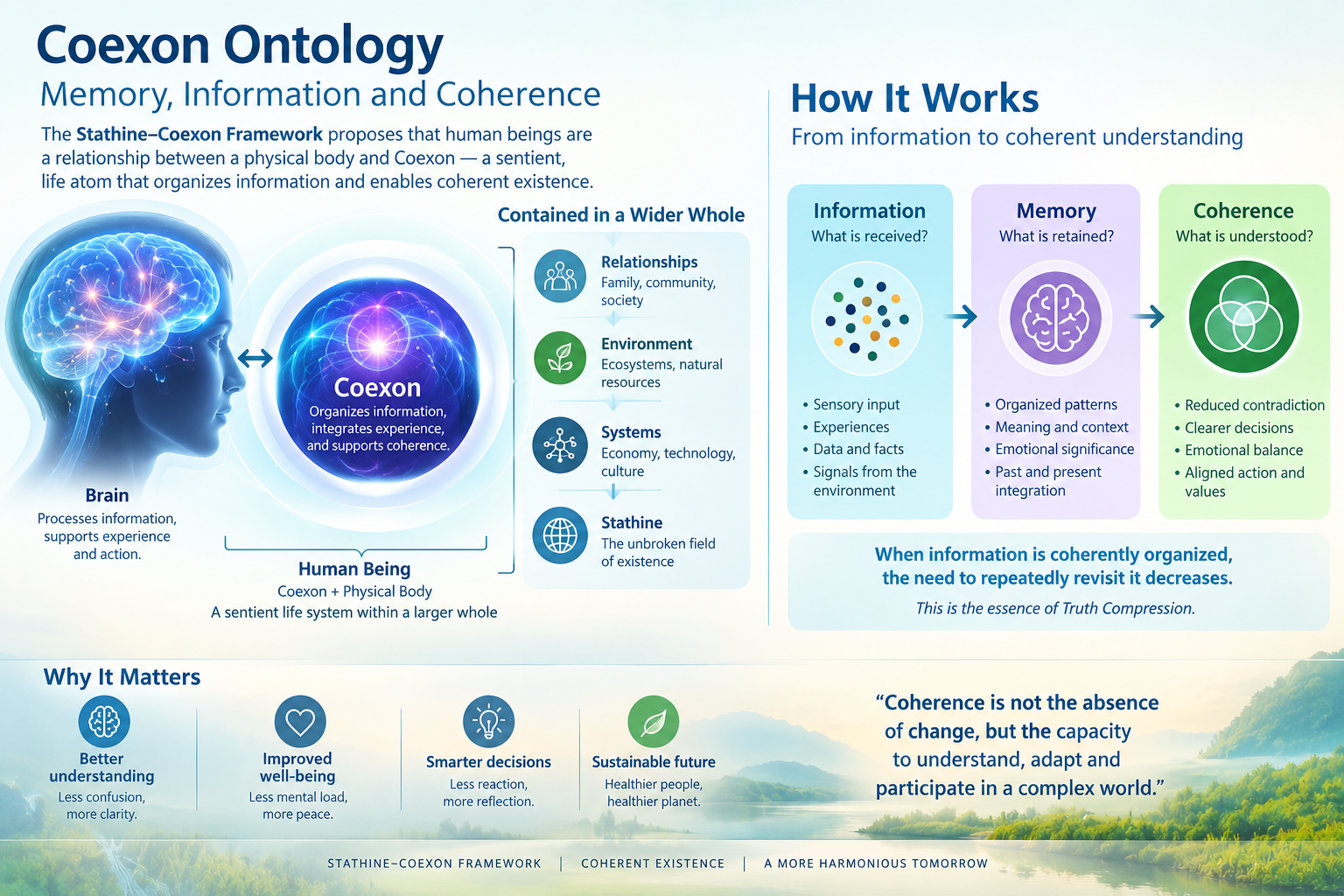
Within the Stathine–Coexon Framework, every individual is understood as expressing a singular Coexon interacting through a biological organism.
The defining characteristic of the Coexon is not survival alone.
It is the continual movement toward increasing coherence.
Coherence, in this framework, refers to the progressive reduction of contradiction and the increasing alignment of understanding, perception, values, emotions, and action.
Human relationships therefore become more than social interactions.
They become opportunities through which coherence is either strengthened or diminished.
Why Relationships Matter
The Harvard Study demonstrates that supportive relationships promote well-being.
The Stathine–Coexon Framework proposes a possible interpretation:
Healthy relationships reduce internal contradiction.
When individuals experience trust, honesty, empathy, and mutual understanding, the Coexon encounters fewer conflicts between expectation and experience.
This supports a more coherent mode of existence.
In contrast, relationships characterized by deception, fear, chronic resentment, or domination require continual psychological effort to maintain competing narratives and unresolved tensions.
Such fragmentation may contribute to sustained stress and diminished well-being.
This interpretation is philosophical and complements rather than replaces established psychological mechanisms.
Happiness as a Consequence Rather Than a Goal
A notable implication of the Harvard findings is that happiness rarely appears to result from pursuing happiness directly.
Instead, happiness often emerges as a by-product of meaningful relationships, purposeful engagement, and healthy adaptation.
The Stathine–Coexon Framework reaches a similar conclusion through a different conceptual route.
Within this framework:
Happiness is not an objective.
It is an experiential consequence of increasing coherence.
As contradictions diminish and understanding deepens, emotional experience becomes progressively more stable, inclusive, and resilient.
Thus, happiness is interpreted not as an isolated emotional state but as an indicator of coherent functioning.
Conflict and Growth
One of the remarkable observations from the Harvard study is that enduring relationships are not conflict-free.
Rather, successful relationships are those that navigate conflict constructively.
This aligns naturally with the concept of coherence.
Conflict is not necessarily evidence of incoherence.
Avoiding contradiction may preserve comfort but inhibit learning.
Coherence develops through the patient integration of differing perspectives into richer understanding.
Relationships become environments in which this integration can occur.
The Meaning of Loneliness
Loneliness has emerged as one of the strongest predictors of declining health.
Within the Stathine–Coexon Framework, loneliness is understood not merely as physical isolation but as diminished coherence between one’s internal world and meaningful human connection.
It is possible to be surrounded by people and remain profoundly disconnected.
Conversely, a small number of authentic relationships may support deep coherence.
This interpretation complements the Harvard finding that quality consistently outweighs quantity.
Aging and Wisdom
The Harvard Study suggests that successful aging depends less upon achievement than upon sustaining meaningful human bonds.
The Stathine–Coexon Framework extends this insight.
Aging becomes not simply biological survival but the gradual refinement of coherent understanding.
Wisdom is interpreted as the progressive reduction of contradiction accumulated through lived experience.
Older individuals therefore contribute not merely knowledge but coherence developed across decades of reflection, relationship, and adaptation.
Implications for Education
If relationships nurture coherence, education may benefit from expanding its objectives.
Beyond knowledge acquisition, educational systems could intentionally cultivate:
- emotional literacy,
- dialogue,
- empathy,
- systems awareness,
- reflective practice,
- conflict integration,
- collaborative understanding.
Academic excellence and relational coherence need not compete.
They may reinforce one another.
Implications for Leadership
Organizations frequently evaluate productivity, efficiency, and financial performance.
The Harvard findings suggest that relational quality deserves equal attention.
The Stathine–Coexon Framework proposes that leadership may be understood as the cultivation of coherence across individuals, teams, and institutions.
Leaders influence not only outcomes but also the quality of relationships through which those outcomes are achieved.
From Happiness to Coherent Existence
Perhaps the most significant contribution of the Harvard Study is that it redirected attention from external success toward human connection.
The Stathine–Coexon Framework proposes one additional step.
The deepest human aspiration may not simply be happiness.
It may be coherent existence.
Within this perspective:
- Relationships become pathways to coherence.
- Understanding becomes an act of integration.
- Compassion becomes recognition of shared existence.
- Purpose becomes participation in increasing coherence within oneself, one’s community, and the wider world.
Happiness then appears not as the destination but as one of the natural expressions of a life becoming progressively more coherent.
Conclusion
The Harvard Study of Adult Development has provided one of the strongest empirical foundations for understanding human flourishing. Its enduring message—that good relationships are central to a good life—has influenced psychology, medicine, education, and public health.
The Stathine–Coexon Framework does not challenge this conclusion. Instead, it offers a complementary philosophical interpretation by proposing that the power of relationships lies in their capacity to foster coherence. Within this view, flourishing emerges as the progressive alignment of understanding, emotion, values, and action within the Coexon, expressed through the biological and social life of the individual.
Whether this interpretation proves useful remains a matter for continued scholarly dialogue and empirical exploration. Its value will depend on its ability to generate new research questions, deepen interdisciplinary understanding, and encourage practical approaches to cultivating healthier relationships and more coherent lives.