
From Computational Universes to Coherent Existence
Stephen Wolfram and the Stathine–Coexon Framework
Abstract
The search for a unified description of reality has historically followed two complementary directions. One seeks increasingly fundamental physical laws governing matter and energy. The other seeks universal principles governing information and computation. Stephen Wolfram’s computational paradigm represents one of the most ambitious contemporary attempts to reinterpret the universe as the evolution of simple computational rules acting upon discrete structures. His work suggests that complexity, space, causality, and even the observer may emerge from computation.
This paper proposes that the Stathine–Coexon Framework can be understood as a complementary extension of this computational vision. While Wolfram’s paradigm provides a powerful account of how reality evolves computationally, the Stathine–Coexon Framework asks additional ontological questions concerning coherence, consciousness, and existence itself. It introduces Stathine as the timeless field of invariant existence and the Coexon as the timeless life atom capable of organizing information into coherent understanding. The central thesis is not that computation is replaced by coherence, but that computation and coherence may represent complementary dimensions of a deeper ontology.
1. Introduction
Modern science increasingly recognizes that information may be as fundamental as matter and energy.
Quantum information theory, computational physics, digital philosophy, and systems biology all point toward a reality in which information is not merely descriptive but constitutive.
Among contemporary thinkers, Stephen Wolfram has advanced one of the most comprehensive computational ontologies. His work proposes that remarkably simple computational rules can generate the extraordinary complexity observed throughout nature.
The Stathine–Coexon Framework shares the ambition of identifying foundational principles of existence but approaches the problem from a different starting point.
Rather than beginning with computation, it begins with coherence.
The two perspectives need not be contradictory.
They may instead illuminate different aspects of the same reality.
2. Wolfram’s Computational Ontology
At the heart of Wolfram’s work lies a remarkable proposition:
Simple computational rules can generate arbitrarily complex universes.
Cellular automata, rewriting systems, and hypergraphs demonstrate that highly ordered structures can emerge without external design.
Several fundamental ideas characterize this paradigm.
Computational irreducibility suggests that many systems cannot be predicted except by allowing the computation itself to unfold.
The Principle of Computational Equivalence proposes that computational sophistication is widespread throughout nature.
Hypergraph models provide a possible foundation from which space, causality, and physical laws may emerge.
The observer becomes an integral participant whose computational limitations influence perceived reality.
Collectively, these ideas redefine physics as a computational process.
3. A Complementary Question
The Stathine–Coexon Framework accepts that computation may describe the evolution of physical systems.
It asks an additional question.
What organizes computation into meaningful experience?
Information alone does not explain understanding.
Computation alone does not explain coherence.
An immense amount of computation occurs continuously throughout the universe.
Only a tiny subset becomes integrated into conscious understanding.
The distinction between computation and coherent understanding becomes the primary focus of the framework.
4. Stathine: The Invariant Background
The framework proposes Stathine as the timeless, static field underlying all existence.
Unlike computational structures that continually evolve, Stathine does not compute.
It does not change.
It does not evolve.
It does not possess temporal sequence.
Instead, it provides the invariant ontological background within which all computational processes occur.
If computational rules describe becoming, Stathine represents being.
The relationship is complementary rather than competitive.
5. The Coexon: The Principle of Coherent Organization
The second foundational concept is the Coexon.
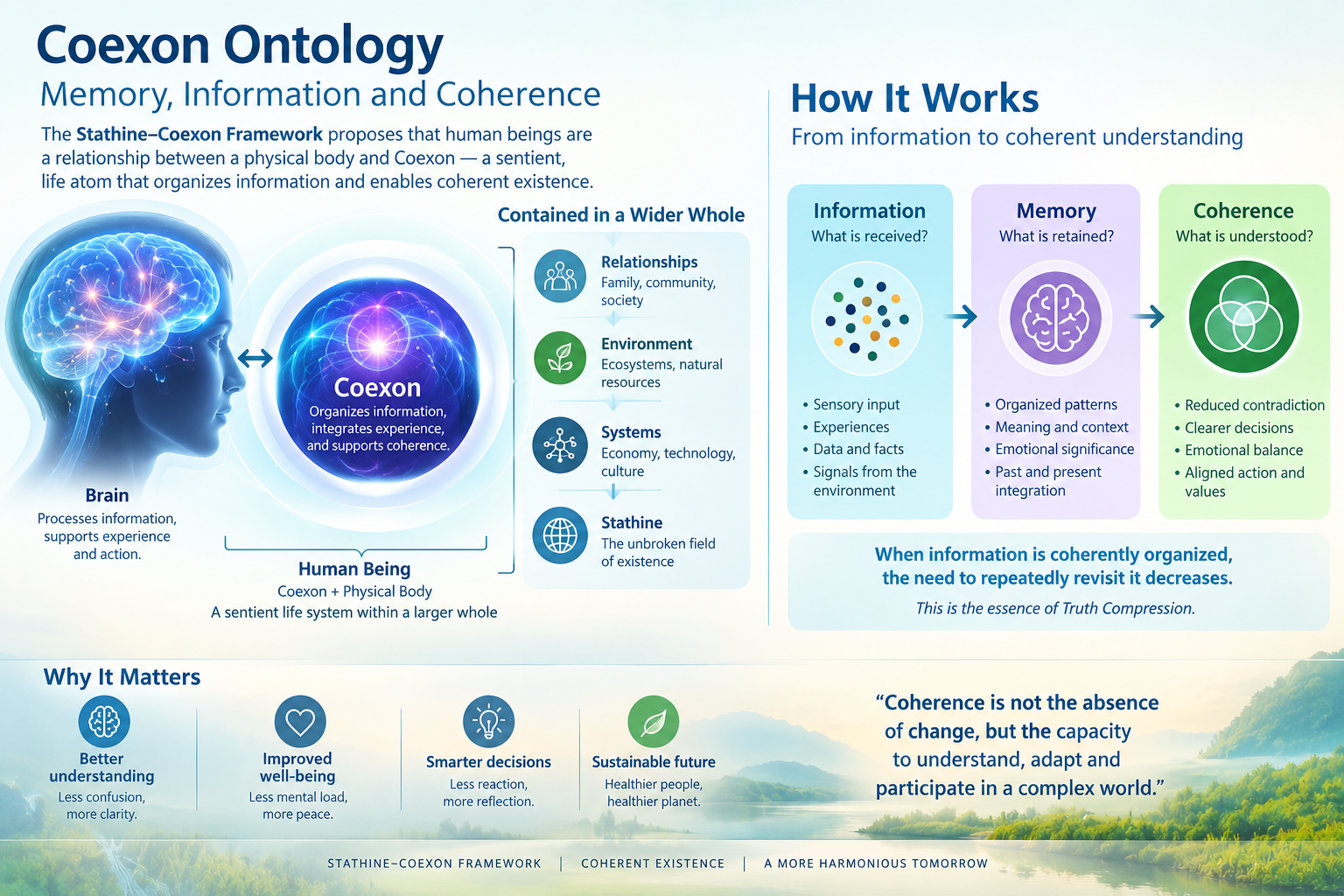
The Coexon is proposed as a fundamental life atom with a specific internal architecture whose defining property is the organization of information into coherent understanding.
Within this framework, the Coexon is not merely another computational system.
Its distinctive role is integrative.
Computation produces possibilities.
The Coexon organizes those possibilities into meaningful coherence.
Biological intelligence therefore becomes more than information processing.
It becomes coherence formation.
6. Computation and Coherence
The relationship between the two frameworks may be summarized through complementary questions.
| Question | Computational Paradigm | Stathine–Coexon Framework |
|---|---|---|
| Primary focus | How does reality evolve? | How does reality become coherently experienced? |
| Fundamental process | Computation | Coherence |
| Ontological foundation | Computational rules | Stathine and the Coexon |
| Observer | Computational participant | Coherent participant |
| Intelligence | Computational sophistication | Increasing coherence |
| Development | Rule evolution | Alignment toward coherence |
These perspectives address different explanatory levels rather than identical problems.
7. Beyond Computation
One of the deepest questions in philosophy concerns whether consciousness can be reduced to computation.
The Stathine–Coexon Framework suggests a different possibility.
Computation may be necessary without being sufficient.
Physical systems compute.
Brains compute.
Artificial intelligence computes.
Yet coherent subjective understanding may require an additional organizing principle.
The Coexon is proposed as that principle.
Its role is not to replace computation but to integrate computational outcomes into meaningful experience.
8. Computational Irreducibility and Truth Compression
Wolfram demonstrates that many systems cannot be simplified because their evolution is computationally irreducible.
The Stathine–Coexon Framework introduces a complementary concept: truth compression.
Truth compression does not seek to shortcut computation.
Instead, it seeks progressively simpler principles capable of explaining increasingly diverse phenomena after those phenomena have been understood.
Scientific history illustrates this process repeatedly.
Newton compressed celestial and terrestrial mechanics into universal gravitation.
Maxwell unified electricity and magnetism.
Einstein unified mass and energy.
Truth compression therefore represents increasing explanatory coherence rather than computational simplification.
9. The Observer Revisited
In Wolfram’s framework, observers are constrained computational systems whose perceptions depend upon their computational limitations.
The Stathine–Coexon Framework extends this concept.
The observer is not only computationally limited.
The observer is also coherence-limited.
Different individuals observing identical information may generate radically different understandings because their degree of internal coherence differs.
Knowledge therefore depends not only upon available information but also upon the observer’s capacity for coherent integration.
10. Toward an Integrative Ontology
The Stathine–Coexon Framework does not reject computational ontology.
Rather, it proposes that computation describes one dimension of reality while coherence describes another.
Computation explains how structures evolve.
Coherence explains how understanding emerges.
Stathine provides the timeless invariant background.
The Coexon provides the organizing principle through which coherent experience becomes possible.
Together they suggest a broader ontology in which computation and coherence are mutually complementary.
11. Future Research Directions
If the relationship between computation and coherence proves fruitful, several research questions emerge:
- Can coherence be formally defined as a measurable property distinct from computational complexity?
- Can computational systems exhibit increasing coherence without increasing computational power?
- Does biological intelligence optimize primarily for computation or for coherence?
- Can educational systems be redesigned around coherence rather than information accumulation?
- Might artificial intelligence benefit from architectures that explicitly distinguish computation from coherence?
These questions provide opportunities for interdisciplinary dialogue among computer science, cognitive science, philosophy, biology, and education.
Conclusion
Stephen Wolfram’s computational paradigm has profoundly expanded contemporary discussions concerning the foundations of reality by demonstrating how simple computational rules may generate immense complexity. The Stathine–Coexon Framework accepts the importance of this insight while proposing that computation alone does not exhaust the ontology of existence.
By introducing Stathine as the timeless field of invariant existence and the Coexon as the timeless organizer of coherent understanding, the framework seeks to extend computational ontology into a broader philosophy of coherence. In this view, computation describes the dynamics of becoming, while coherence explains the emergence of meaningful experience. The two are not rivals but complementary dimensions of a more comprehensive account of reality.
Whether this proposal ultimately succeeds depends upon its capacity to generate rigorous conceptual models, encourage interdisciplinary collaboration, and inspire empirical and philosophical inquiry. Its central contribution is the suggestion that the next frontier of understanding may not lie solely in discovering new computational rules but in understanding how coherent existence emerges within a computational universe.