From Bioelectric Intelligence to Coherent Life
Michael Levin and the Stathine–Coexon Framework
Abstract
One of the most significant developments in contemporary biology has been the growing recognition that living systems exhibit forms of intelligence that extend far beyond the nervous system. Michael Levin’s pioneering work in developmental biology has demonstrated that bioelectric signaling enables cells and tissues to coordinate toward anatomical goals, challenging traditional gene-centric views of morphogenesis. His concepts of basal cognition, collective cellular intelligence, and goal-directed biology suggest that life organizes itself through distributed information processing across multiple biological scales.
This paper proposes that the Stathine–Coexon Framework provides a complementary ontological perspective on these discoveries. While Levin’s work explains how biological systems coordinate through bioelectric communication and distributed computation, the Stathine–Coexon Framework asks a deeper question: What organizes biological intelligence into coherent existence? It introduces the Coexon as a timeless life atom that organizes biological information into unified understanding while interacting continuously with the body’s bioelectric architecture. Rather than replacing bioelectric intelligence, the framework proposes coherence as the higher-order principle that gives biological intelligence its integrative direction.
1. Introduction
Biology has traditionally described organisms as products of genes, proteins, chemistry, and natural selection.
While enormously successful, this perspective often struggles to explain one remarkable phenomenon.
How do trillions of individual cells cooperate to construct a coherent organism?
Cells divide.
Different tissues emerge.
Damaged structures regenerate.
Embryos reliably develop complex anatomy.
These processes suggest that living systems possess organizational capabilities extending beyond local molecular interactions.
Michael Levin’s work has significantly expanded this discussion by demonstrating that bioelectric communication plays a central role in coordinating developmental processes.
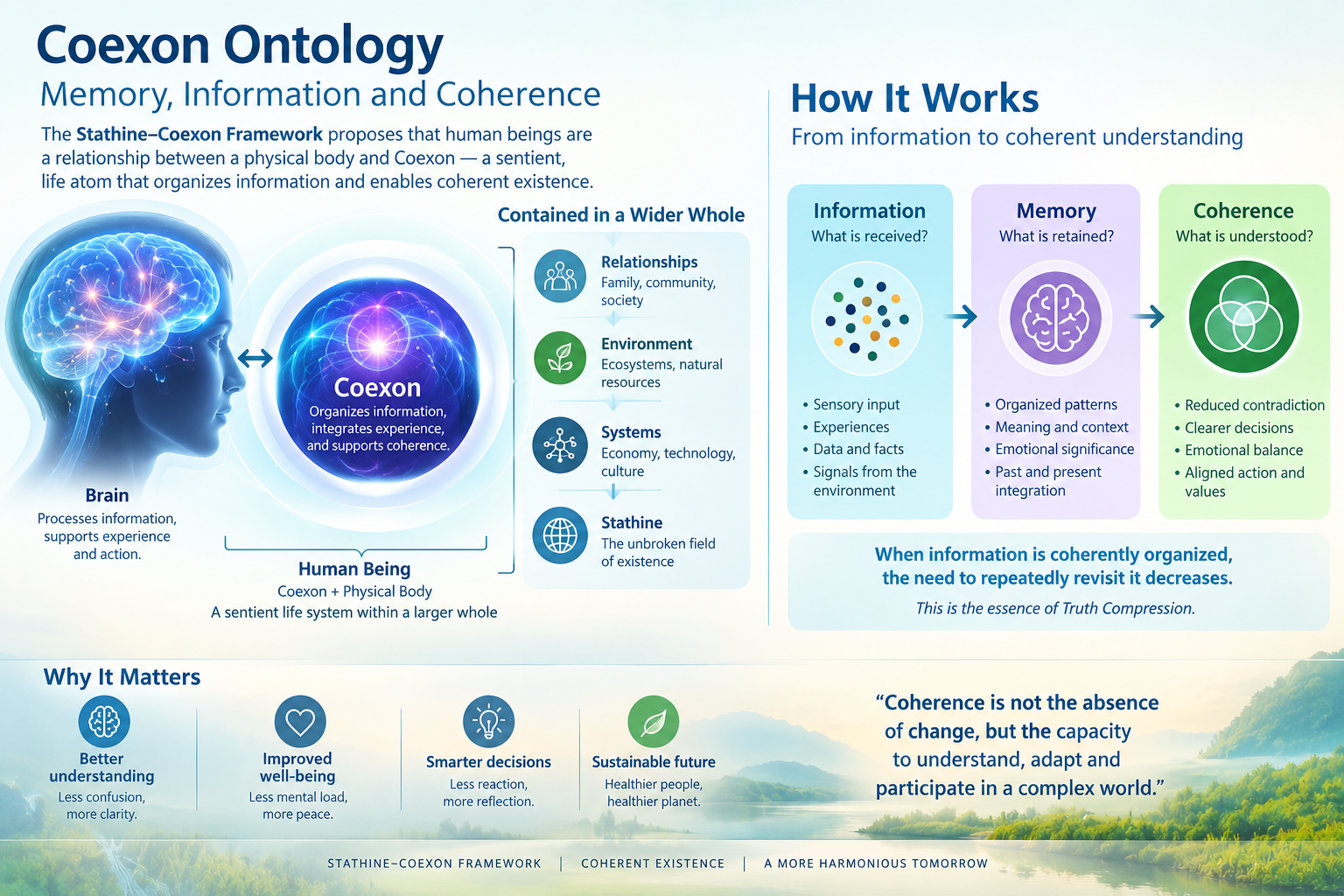
The Stathine–Coexon Framework shares the recognition that life is fundamentally an information-organizing phenomenon while proposing an additional ontological layer centered upon coherence.
2. Morphogenesis as Collective Intelligence
Morphogenesis is among biology’s greatest mysteries.
Individual cells possess limited local information.
Yet collectively they construct organs, limbs, nervous systems, and complete organisms with extraordinary reliability.
Levin proposes that cells communicate through bioelectric signaling networks that enable distributed decision-making across tissues.
Development therefore resembles problem-solving rather than mechanical assembly.
Cells negotiate.
Coordinate.
Adapt.
Repair.
The organism behaves as an integrated intelligence rather than a collection of independent components.
This represents a profound shift in biological thinking.
Life increasingly appears as an informational process.
3. Basal Cognition
A second major contribution of Levin’s work is the concept of basal cognition.
Intelligence need not begin with brains.
Single cells navigate environments.
Immune systems discriminate between self and non-self.
Plant roots optimize growth.
Embryonic tissues pursue anatomical goals.
These observations suggest that cognition exists on a continuum rather than emerging suddenly with nervous systems.
Information processing becomes a universal property of living organization.
The Stathine–Coexon Framework accepts this continuum while asking a complementary question.
If cognition is distributed throughout biology, what provides coherence across these distributed processes?
4. Goal-Directed Biology
Living systems consistently behave as though pursuing goals.
Embryos regenerate missing structures.
Cells modify behavior after injury.
Organisms maintain internal stability despite environmental fluctuations.
These observations have revived scientific interest in teleonomy—the appearance of purpose arising through biological organization.
Levin’s work frames these behaviors in terms of information processing and adaptive control.
The Stathine–Coexon Framework extends this discussion.
Goals are not merely biological outcomes.
They represent increasing coherence between the Coexon and the biological organism.
Development therefore becomes progressively greater alignment between coherent understanding and biological expression.
5. The Coexon as the Principle of Coherent Organization
The Stathine–Coexon Framework proposes the Coexon as a fundamental life atom possessing a specific atomic architecture.
Unlike biological cells, the Coexon is not itself part of the body.
Rather, it continuously interacts with the body’s bioelectric organization.
Within this perspective, bioelectric signaling provides the communication infrastructure.
The Coexon provides the coherence.
Bioelectricity explains how biological information flows.
The Coexon explains how that information becomes organized into integrated understanding and unified identity.
Thus, the relationship is complementary rather than competitive.
6. Bioelectric Networks and Coherence
Levin’s research demonstrates that electrical gradients regulate development, regeneration, and anatomical patterning.
The Stathine–Coexon Framework proposes that these gradients may be viewed as the body’s dynamic interface through which the Coexon interacts with biological matter.
Within this conceptual model:
- bioelectric fields coordinate cellular communication,
- biochemical processes execute physical construction,
- genetic networks provide molecular instructions,
- the Coexon maintains coherence across the organism’s changing biological states.
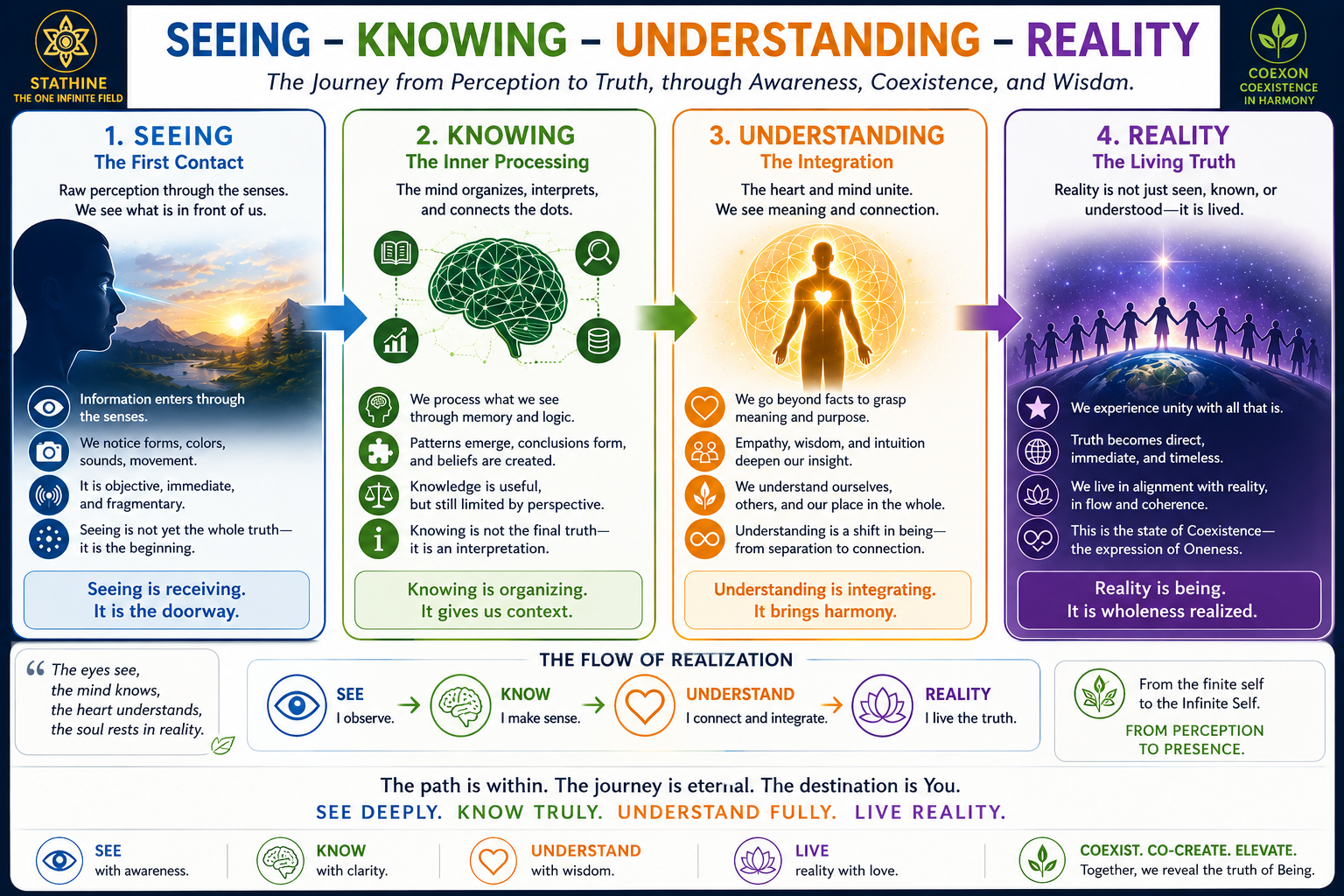
The framework therefore distinguishes between communication and coherence.
Communication transfers information.
Coherence organizes meaning.
7. Identity Beyond Cellular Replacement
Biological organisms continually replace their constituent cells.
Human bodies undergo extensive cellular turnover throughout life.
Yet personal identity persists.
Conventional biology explains this continuity through dynamic maintenance of physiological organization.
The Stathine–Coexon Framework proposes an additional explanatory layer.
The Coexon maintains coherent identity while biological substrates continuously change.
Identity therefore becomes more than structural persistence.
It becomes coherence persistence.
The organism changes.
The organizing coherence remains.
8. Development as Increasing Alignment
Development is often interpreted as increasing complexity.
The Stathine–Coexon Framework proposes a complementary interpretation.
Development is increasing coherence.
Embryogenesis.
Learning.
Psychological maturation.
Ethical development.
Wisdom.
Each represents greater alignment between biological expression and coherent understanding.
Growth therefore becomes progressively reduced internal contradiction.
The mature organism is not simply more complex.
It is more coherent.
9. Education and Regeneration
Levin’s work suggests that cells possess latent regenerative capacities that can be unlocked through appropriate informational signals.
The Stathine–Coexon Framework generalizes this insight.
Human development also depends upon informational organization.
Education should therefore cultivate coherence rather than merely transmit knowledge.
Healing extends beyond tissue repair.
It includes increasing alignment between understanding, perception, intention, communication, and action.
Regeneration becomes a universal principle operating across biological, psychological, and societal levels.
10. Toward an Integrative Biology
The relationship between Levin’s work and the Stathine–Coexon Framework illustrates two complementary explanatory levels.
Levin investigates the mechanisms through which biological intelligence emerges and coordinates.
The Stathine–Coexon Framework proposes an ontological model concerning the source of coherent organization underlying that intelligence.
One investigates biological process.
The other proposes a philosophical architecture of existence.
Together they suggest that future biology may increasingly integrate genetics, bioelectricity, information theory, systems science, and coherent organization into a richer understanding of life.
11. Future Research Directions
If coherence represents a distinct organizational principle, several interdisciplinary questions arise:
- Can coherence be formally distinguished from distributed information processing?
- How might bioelectric communication relate to the persistence of organismal identity?
- Can educational and therapeutic systems be designed to increase coherence in ways analogous to biological regeneration?
- Could artificial systems exhibit distributed intelligence without achieving coherent understanding?
- What mathematical descriptions might characterize coherence as distinct from computational complexity or information flow?
These questions invite collaboration among developmental biology, neuroscience, cognitive science, philosophy, systems theory, and consciousness studies.
Conclusion
Michael Levin’s work has transformed contemporary biology by revealing that living systems exhibit distributed intelligence, communicate through bioelectric networks, and pursue goal-directed development. These discoveries expand the concept of cognition beyond nervous systems and invite a richer understanding of biological organization.
The Stathine–Coexon Framework seeks to complement this perspective by proposing coherence as an additional ontological principle. In this view, bioelectric signaling explains how biological information is coordinated, while the Coexon provides the timeless organizing principle through which biological processes become integrated into coherent life and conscious experience. Development thus becomes not only the construction of increasingly complex organisms but also the progressive realization of coherent existence.
Whether this proposal ultimately proves scientifically fruitful will depend upon its capacity to generate testable hypotheses, interdisciplinary dialogue, and conceptual clarity. Its contribution is to suggest that the next stage in understanding life may arise from integrating the mechanisms of biological intelligence with a broader philosophy of coherence, in which living systems are understood not only as processors of information but also as participants in an ongoing process of coherent existence.