Reinterpreting the Educational Work of Dr. Erin Frisk Redman Through the Stathine–Coexon Framework
Part of the Stathine–Coexon Comparative Research Series — Level II: Comparative Foundations
Redman’s academic work is centered on education for sustainability, experiential and real-world pedagogy, behavior change, sustainability competencies, and K–12 teacher development. Her PhD dissertation at Arizona State University was on integrating behavioral science into pedagogy and practice for sustainability education. Her subsequent work examined transformative sustainability education, subjective knowledge, behavior change, interdisciplinary learning, and professional development for K–12 teachers. (static.sustainability.asu.edu)
Most importantly, Redman’s research explicitly challenges the assumption that declarative knowledge automatically produces sustainable behavior. Her work instead integrates behavioral science, sustainability competencies, and educational pedagogy, including experiential, real-world, and problem-based approaches. (ResearchGate)
That makes her work particularly compatible with the Stathine–Coexon Framework.
Abstract
The educational work of Dr. Erin Frisk Redman provides an important foundation for rethinking how school education can contribute to sustainability and transformative human development. Her research challenges conventional information-centric approaches to sustainability education and emphasizes the importance of behavioral science, sustainability competencies, experiential learning, real-world contexts, interdisciplinary knowledge, and teacher professional development. Her work demonstrates that providing students with information about sustainability is insufficient to reliably produce sustainable action. (ResearchGate)
This paper examines Redman’s educational philosophy through the Stathine–Coexon Framework and argues that her work can be interpreted as addressing a fundamental problem that the framework describes as the knowledge–coherence gap: the difference between knowing something intellectually and being sufficiently aligned with that knowledge to act upon it.
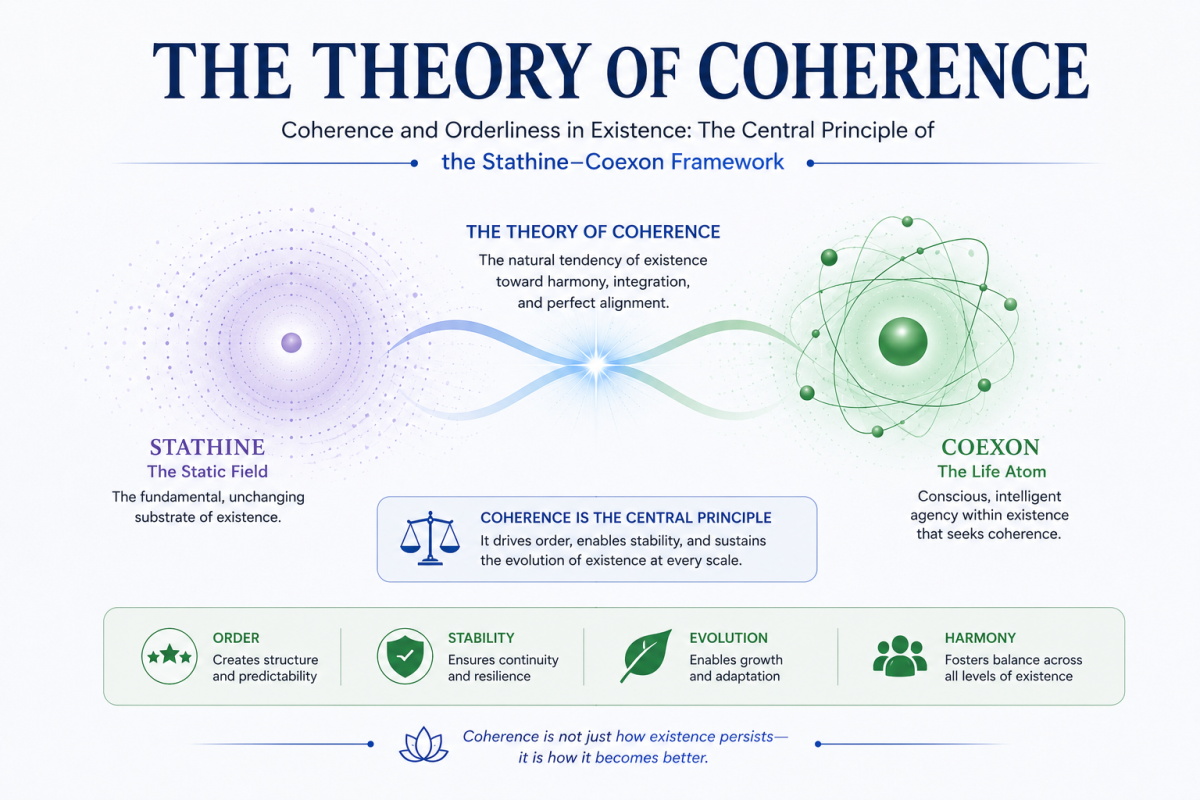
The Stathine–Coexon Framework proposes that learning is not fundamentally the accumulation of information but the progressive organization of information into increasingly coherent models that can guide perception, decision, relationship, and action. Within the framework, Coexon is hypothesized as a sentient atom independent of the biological body, capable of organizing information and communicating with the holobiont’s neurological brain. The Coexon hypothesis is situated beyond the present ambit of conventional epistemology and empirical data systems. Stathine is conceptualized as the omnipresent, non-depleting energetic field associated with the possibility of existence and information.
From this perspective, Redman’s work acquires an expanded significance. Her insistence that sustainability education must move beyond declarative knowledge toward competencies, behavior, experience, and action can be interpreted as an early educational expression of a deeper principle: information becomes transformative only when it is integrated into the learner’s larger system of understanding, feeling, identity, relationships, and action.
The paper proposes that Redman’s educational approach can therefore be extended from Education for Sustainability (EfS) toward Education for Coherence and Regeneration (ECR). Such an education would not merely teach children how to solve sustainability problems. It would develop their capacity to perceive systems, recognize interdependence, reconcile contradictions, evaluate consequences, act responsibly, and continuously revise their understanding.
The paper concludes that the future of school education should not be defined principally by technological sophistication or curricular expansion. Its deeper objective should be to develop human beings capable of participating coherently in complex social, ecological, technological, and civilizational systems.
Keywords: Erin Frisk Redman, sustainability education, education for sustainability, K–12 education, transformative education, behavioral science, sustainability competencies, experiential learning, Stathine, Coexon, coherence, holobiont, information organization, regenerative education, systems thinking, education reform.
1. Introduction: The Problem Is Not That Children Know Too Little
One of the most important insights emerging from Erin Frisk Redman’s research is deceptively simple:
Knowing is not the same as doing.
This distinction is fundamental to sustainability education.
A child may know:
- that plastic pollution is harmful,
- that water is scarce,
- that food waste has environmental consequences,
- that climate change is occurring,
- that biodiversity matters,
and still behave in ways that contradict that knowledge.
Redman’s research explicitly addresses this problem.
Her early work argues that conventional sustainability education has often relied too heavily on declarative knowledge and has not adequately addressed the behavioral, competency-based, and contextual dimensions required for transformative action. (ResearchGate)
Her later research similarly examined whether different forms of knowledge could contribute to sustainable behavior, finding that simply supplying information does not provide a straightforward pathway to behavioral transformation. (ResearchGate)
This is precisely where the Stathine–Coexon Framework can provide a deeper theoretical interpretation.
The issue is not merely:
How do we give children better information?
It is:
How does information become coherent enough within a living human system to produce understanding, motivation, decision, and action?
That is a much larger educational question.
2. Redman’s Central Contribution: Breaking the Knowledge–Action Assumption
Traditional education often implicitly assumes:
Information → Knowledge → Correct behavior
The assumption is:
If people know what is right, they will do what is right.
Redman’s work challenges this simplified causal chain.
Her research integrates three domains that are often treated separately:
- Educational pedagogy
- Behavioral science
- Sustainability competencies
Her work explicitly describes this interdisciplinary integration as necessary for transformative sustainability education. (ResearchGate)
This is significant.
The educational problem is not simply a deficit of knowledge.
A learner can possess knowledge while lacking:
- motivation,
- contextual understanding,
- practical capability,
- social support,
- agency,
- emotional connection,
- or appropriate opportunities for action.
Therefore:
Knowledge is a component of transformation, not transformation itself.
This proposition is one of the strongest bridges between Redman’s work and Stathine–Coexon.
3. The Stathine–Coexon Interpretation: Information Must Become Coherence
The Stathine–Coexon Framework proposes a different model:
Information
↓
Relationship
↓
Understanding
↓
Coherence
↓
Capability
↓
Action
↓
Feedback
↓
Updated understanding
This is not a linear process.
It is recursive.
A learner acts.
Reality responds.
The learner observes the result.
The internal model changes.
The learner acts again.
Learning therefore becomes an ongoing cycle of coherence development.
This gives a deeper interpretation to Redman’s behavioral emphasis.
The learner does not fail because information was absent.
The learner may fail because information has not yet been integrated into a sufficiently coherent internal and relational model.
4. From Knowledge to Embodied Understanding
Consider a child who learns:
“Food waste is bad.”
That is declarative knowledge.
Now imagine the same child participating in a school garden.
The child:
- plants seeds,
- waits for growth,
- observes water requirements,
- harvests vegetables,
- cooks them,
- sees what gets discarded,
- measures food waste,
- redesigns lunch practices.
The proposition “food waste matters” has changed.
It is no longer merely information.
It has become:
- sensory,
- emotional,
- social,
- experiential,
- measurable,
- and actionable.
The learner now understands the proposition differently.
This is exactly the type of educational transformation that Redman’s experiential and real-world approaches seek to encourage. Her research describes problem-based and real-world sustainability education as mechanisms for developing competencies and influencing behavior. (ResearchGate)
The Stathine–Coexon Framework describes this as:
information becoming embodied coherence.
5. The Learner Is a Living System
This becomes even more important when the learner is understood through the Stathine–Coexon concept of the holobiont.
The conventional educational model largely treats the student as a brain.
But human learning involves:
- cognition,
- emotion,
- physiology,
- sensory experience,
- social relationships,
- memory,
- environment,
- movement,
- identity,
- and meaning.
The learner is therefore a nested biological and relational system.
The school is interacting with the whole system whether it intends to or not.
A teacher does not simply communicate information.
The teacher also communicates:
- emotional safety,
- status,
- expectations,
- belonging,
- possibility,
- judgment,
- trust.
The classroom therefore becomes part of the learner’s informational environment.
This gives Redman’s emphasis on pedagogy and behavior a deeper interpretation.
Pedagogy is not merely a delivery mechanism for knowledge. It is an environmental architecture that influences how the learner organizes information.
6. The Coexon and the Learner’s Capacity to Organize Information
The Stathine–Coexon Framework proposes that the Coexon is a sentient atom independent of the biological body, capable of organizing information and communicating with the holobiont’s neurological brain.
The hypothesis is positioned beyond the present ambit of conventional epistemology and empirical data systems.
Its relevance to education is not that teachers should attempt to “teach the Coexon.”
Rather, it changes the conceptual image of the learner.
The learner becomes:
an active information-organizing participant rather than a passive information recipient.
This distinction is enormous.
If the learner is fundamentally an information-organizing system, then educational quality depends not only on the quality of information supplied but also on:
- the relationships among information,
- the learner’s existing model,
- emotional meaning,
- environmental context,
- social reinforcement,
- opportunities for experimentation,
- and feedback.
Education becomes an architecture for information integration.
7. Redman’s Interdisciplinarity as Coherence Building
Redman’s work emphasizes connecting different knowledge domains rather than treating sustainability as a narrow subject. Her research explicitly integrates behavioral research, sustainability competencies, and pedagogy. (ResearchGate)
This has a deeper implication.
Sustainability problems are inherently relational.
Water cannot be understood only as chemistry.
Food cannot be understood only as agriculture.
Waste cannot be understood only as disposal.
Climate cannot be understood only as atmospheric science.
They involve:
science + economics + behavior + culture + psychology + politics + technology + ethics.
A student who studies each discipline separately may accumulate information without seeing the system.
The Stathine–Coexon Framework calls the ability to connect these domains:
coherence formation.
Thus interdisciplinary education is not merely academically fashionable.
It is structurally necessary when reality itself is interconnected.
8. Sustainability as a Coherence Problem
This allows sustainability itself to be redefined.
The conventional definition asks:
How can humanity reduce environmental damage?
The Stathine–Coexon interpretation asks:
How can human systems become sufficiently coherent with the ecological systems upon which they depend
This is a more fundamental question.
A society that extracts resources while destroying the conditions necessary for future regeneration is internally incoherent.
It is effectively saying:
“We need nature.”
while simultaneously behaving as though:
“Nature is external to us.”
That is a systemic contradiction.
Sustainability education therefore becomes an education in recognizing and reducing contradictions between human behavior and system reality.
This gives Redman’s work an even broader theoretical foundation.
9. The Sustainability Competency as a Coherence Competency
Redman’s work emphasizes sustainability competencies rather than simply sustainability facts. (ResearchGate)
The Stathine–Coexon Framework can reinterpret competencies as forms of coherence capability.
For example:
Systems thinking
Ability to perceive relationships.
Anticipatory thinking
Ability to connect present action with future consequences.
Strategic competence
Ability to convert understanding into action.
Interpersonal competence
Ability to maintain coherence across relationships.
Normative competence
Ability to examine what should be valued.
These are not independent skills.
They are different expressions of the ability to organize complex information into actionable models.
Thus:
Sustainability competencies can be interpreted as specialized forms of systemic coherence.
10. From Environmental Education to Existential Education
There is an even deeper transition available.
A child may learn:
“Protect the environment.”
But the Stathine–Coexon Framework asks the child to discover:
“I am not separate from the environment I am trying to protect.”
This is a profound conceptual shift.
The environment becomes:
not outside me
but
the larger system within which I exist.
This is Sah-Astitva.
Coexistence.
The child does not merely become environmentally responsible.
The child develops a different ontology of existence.
11. Sah-Astitva as the Foundation of Sustainability Education
The Stathine–Coexon Framework proposes:
Existence is fundamentally relational.
The individual exists within:
- family,
- community,
- society,
- ecosystem,
- biosphere,
- and larger physical reality.
Therefore the question:
“What is good for me?”
cannot always be separated from:
“What happens to the system of which I am part?”
This does not require self-sacrifice.
It requires deeper understanding.
A forest does not need every tree to disappear for the forest to survive.
Each tree remains distinct.
The coherence lies in the relationships.
This provides a useful model for sustainability education:
Individual flourishing and systemic flourishing should increasingly be understood as mutually informing rather than inherently opposed.
12. Why Redman’s Behavior Research Is Especially Important
Redman’s research on sustainable behavior is particularly significant because it exposes the limits of purely cognitive education.
Her work examined actual behavioral outcomes rather than stopping at knowledge acquisition. In one intervention, students participated in experiential and real-world problem-based learning around food and waste, with evidence of changes in knowledge and behavior, while also revealing that different behaviors were more resistant to change depending on social and cultural context. (ResearchGate)
This is exactly what a coherence model predicts.
Behavior does not exist in isolation.
It is embedded within:
knowledge
habit
social norms
identity
environment
incentives
emotion
perceived capability
Therefore:
To change behavior sustainably, the system surrounding behavior must also participate in the change.
13. The School Must Become Part of the Intervention
This is perhaps the most important implication.
Suppose a child learns sustainability at school.
Then returns home to an environment where:
- waste is ignored,
- water is wasted,
- food is discarded,
- consumption is rewarded,
- and sustainable behavior is inconvenient.
The child receives two competing information systems.
The school says:
Sustainability matters.
The environment says:
It doesn’t.
The child must then resolve the contradiction.
Often the environment wins.
Therefore the Future Education Lab associated with Redman’s broader educational philosophy should not treat the classroom as the entire intervention.
The school itself should become a sustainability system.
14. The School as a Living Laboratory
This is where Redman’s work and the idea of a Future Education Lab become particularly powerful.
A school can become a real-world experimental ecosystem.
Students can investigate:
- energy consumption,
- water usage,
- food waste,
- biodiversity,
- transportation,
- building design,
- waste systems,
- social behavior.
But the critical distinction is:
Students should not merely study sustainability. They should participate in making the school more sustainable.
The school becomes simultaneously:
classroom + laboratory + ecosystem + community.
This creates a powerful feedback loop:
Learn → experiment → observe → change → measure → reflect → learn again.
That is precisely how a living system develops.
15. From Student to Co-Creator
The conventional student is a consumer of curriculum.
The future student can become a co-creator of the learning environment.
This is consistent with Redman’s experiential and action-oriented educational approach. Her work on K–12 sustainability education emphasizes teacher development and approaches that move beyond conventional information transmission. (ResearchGate)
The Stathine–Coexon interpretation takes this one step further:
The learner should become a participant in the evolution of the system that educates them.
A student might identify:
“Our school wastes too much food.”
Instead of writing an essay about it, the student team:
- measures the waste
- identifies causes,
- interviews stakeholders,
- proposes interventions,
- implements them,
- measures the result,
- evaluates unintended consequences,
- revises the model.
That is education.
And it is also civilization-building.
16. Teacher Development Becomes Central
Redman’s substantial work on professional development for K–12 teachers is particularly relevant here.
Her research emphasizes that teacher professional development is critical for integrating sustainability education across schools and preparing students to address sustainability challenges. (ResearchGate)
The Stathine–Coexon Framework adds:
Teachers cannot sustainably teach coherence if the educational system itself operates through fragmentation.
Therefore teacher development must include:
- systems thinking,
- reflective practice,
- interdisciplinary integration,
- emotional awareness,
- behavioral science,
- experiential learning,
- uncertainty tolerance,
- and the ability to facilitate inquiry.
The teacher becomes a coherence architect.
17. From Teacher as Authority to Teacher as Network Node
This does not mean eliminating authority.
Expertise remains essential.
But the function changes.
The teacher becomes the person who can:
- connect domains,
- identify contradictions,
- guide inquiry,
- create safe experimentation,
- provide context,
- introduce rigorous evidence,
- and help learners interpret feedback.
In this sense, the teacher resembles the Mother Tree principle discussed in the Stathine–Coexon comparison with Suzanne Simard.
The mature teacher’s value is not merely what the teacher knows.
It is how effectively the teacher connects others to knowledge and to one another.
18. Education and Behavior: The Missing Variable of Meaning
One area where the Stathine–Coexon Framework can extend Redman’s behavioral model is meaning.
A child may know:
“Turn off the tap.”
But why should the child care?
The answer may come through:
- family experience,
- scarcity,
- empathy,
- ecological connection,
- identity,
- responsibility,
- or direct experience.
The Stathine–Coexon Framework proposes:
Behavior becomes stable when understanding acquires emotional and existential meaning.
This can be represented as:
Feeling = Physical Sensation + Emotional Meaning + Current Understanding
A sustainability fact becomes much more powerful when it becomes personally meaningful.
19. The Four Brains and Sustainability Learning
The Stathine–Coexon Framework can therefore propose four interacting educational dimensions:
Head
What do I understand?
Heart
Why does it matter to me?
Gut
What does my embodied system sense?
Coexon
How is information being organized into a deeper coherent model?
This creates a richer educational sequence:
Know → feel → sense → integrate → act → learn.
Sustainability education becomes more than environmental science.
It becomes whole-system learning.
20. Creativity and Sustainability
Sustainability problems rarely have one correct answer.
That makes creativity essential.
But the Stathine–Coexon Framework defines creativity differently from simply “thinking outside the box.”
Creativity is:
expanding the box by discovering relationships that the existing model could not accommodate.
A student sees:
food waste = garbage problem.
A more coherent model might reveal:
food waste = purchasing + agriculture + economics + culture + behavior + nutrition + logistics + composting + education.
The problem becomes larger.
Paradoxically, the solution space becomes larger too.
This is coherence-expanding creativity.
21. Truth Compression and Sustainability
The Stathine–Coexon Principle of Truth Compression provides another useful interpretation.
The learner encounters dozens of sustainability facts.
The goal is not to remember all of them independently.
It is to discover principles that explain many observations simultaneously.
For example:
“Systems survive when resource flows remain within regenerative limits.”
That principle can help explain:
- forests,
- fisheries,
- agriculture,
- economies,
- water systems,
- energy systems.
The learner has compressed many facts into a coherent principle.
This is a higher form of learning.
22. From Sustainability Literacy to Systemic Literacy
Redman’s work already moves beyond conventional content knowledge toward competencies and action.
The Stathine–Coexon Framework proposes a further progression:
Sustainability literacy
Understanding sustainability concepts.
↓
Sustainability competency
Being able to act.
↓
Systems literacy
Understanding interconnected systems.
↓
Coherence literacy
Recognizing relationships and contradictions.
↓
Regenerative literacy
Understanding how to increase the future capacity of systems.
This final stage is particularly important.
23. The Future Education Lab as a Regenerative System
The school itself can be evaluated using the same principles taught to students.
Ask:
Does the school regenerate capability?
A regenerative school:
- develops teachers,
- develops students,
- develops community relationships,
- improves ecological performance,
- creates knowledge,
- shares knowledge,
- learns from mistakes,
- adapts continuously.
It becomes a system that becomes more capable through learning.
This is the essence of a living laboratory.
24. AI and the Redman–Stathine–Coexon Synthesis
AI makes Redman’s insight about knowledge even more important.
If information was already abundant before AI, it is now becoming extraordinarily abundant.
Therefore:
The educational problem is moving further away from information acquisition and toward information integration.
AI can answer:
“What is sustainability?”
But it cannot replace the child’s development of:
- judgment,
- values,
- responsibility,
- relationships,
- embodied experience,
- and agency.
The Future Education Lab should therefore use AI to increase inquiry, not replace learning.
AI can become:
- research assistant,
- simulation engine,
- debate partner,
- data analyst,
- tutor,
- translator,
- creative collaborator.
But the learner must remain the coherence engine.
25. A New Educational Equation
The synthesis suggests a useful conceptual equation:
Educational Transformation = Information × Experience × Meaning × Relationship × Agency
If any component approaches zero, transformation is weakened.
A child may have information but no experience.
Or experience but no reflection.
Or knowledge but no agency.
Or motivation but no understanding.
Or understanding but no supportive environment.
The result is incomplete learning.
The Stathine–Coexon Framework therefore proposes:
Coherent education requires simultaneous development across multiple dimensions of the learner’s system.
26. Redman’s Work as a Foundation for Regenerative Education
Redman’s research can therefore be positioned as an important bridge between conventional sustainability education and a broader regenerative educational philosophy.
Her work asks:
How can education produce sustainable competencies and behavior?
The Stathine–Coexon Framework extends this:
How can education develop humans capable of continuously increasing the coherence and regenerative capacity of the systems in which they participate?
The difference is subtle but profound.
The first emphasizes sustainability.
The second emphasizes the capacity that produces sustainability.
27. A Proposed Curriculum Architecture
A Future Education Lab inspired by this synthesis could organize education around seven developmental layers.
1. Observe
What is actually happening?
2. Understand
Why is it happening?
3. Connect
What else is related?
4. Question
What assumptions are operating?
5. Experiment
What happens if we change something?
6. Reflect
What did reality teach us?
7. Regenerate
How can we leave the system more capable than before?
This becomes a continuous learning loop:
Observe → Understand → Connect → Question → Experiment → Reflect → Regenerate
That is far more powerful than a conventional subject timetable.
28. Assessment of Coherence
The educational system could assess students not only on answers but on their ability to improve their models.
A student should be rewarded for being able to say:
“I originally believed X. Then I observed Y. This contradicted my model. I investigated further and changed my understanding to Z.”
This is not failure.
This is scientific maturity.
The Stathine–Coexon Framework calls it:
progressive reduction of contradiction.
The ability to revise one’s model becomes a core educational competency.
29. The School as a Civilization Simulator
This leads to a provocative possibility.
The school can become a small-scale laboratory for civilization.
Students learn how:
- resources circulate,
- institutions operate,
- conflicts arise,
- incentives shape behavior,
- ecosystems respond,
- technology changes systems,
- communities cooperate,
- decisions create unintended consequences.
The school itself becomes a micro-civilization.
Students therefore learn civilization not from textbooks alone.
They experience it.
30. Beyond Sustainability: Coherent Civilization
The ultimate extension of Redman’s work through Stathine–Coexon is therefore not merely:
Education for Sustainability.
It is:
Education for Coherent Civilization.
Such education develops humans capable of:
- seeing systems
- understanding consequences,
- recognizing interdependence,
- reconciling differences,
- acting responsibly,
- revising assumptions,
- creating collaboratively,
- and regenerating the systems they inhabit.
Sustainability becomes one consequence of this deeper capability.
31. A New Definition of the Educated Person
The Stathine–Coexon interpretation proposes a new definition:
An educated person is not the person who possesses the most information, but the person who can organize information into increasingly coherent understanding and convert that understanding into responsible, adaptive, and regenerative action.
This definition is deeply compatible with Redman’s rejection of purely declarative sustainability education.
Her work demonstrates why information alone is insufficient.
The Stathine–Coexon Framework proposes why:
information must become coherence before it can reliably become transformation.
32. Implications for the Future Education Lab
The concept of a Future Education Lab becomes much richer under this synthesis.
It should experiment with:
Curriculum
Can disciplines be organized around real systems rather than isolated subjects?
Pedagogy
Can experience and inquiry replace excessive information transmission?
Teacher development
Can teachers become facilitators of systemic learning?
Technology
Can AI amplify inquiry rather than replace cognition?
Environment
Can school facilities become learning instruments?
Assessment
Can developmental coherence be measured?
Community
Can real societal problems become learning laboratories?
Sustainability
Can schools become regenerative systems themselves?
These are experimentally testable questions.
33. A Research Agenda
The Redman–Stathine–Coexon synthesis suggests a significant research program.
Research Question 1
Does experiential sustainability education produce greater behavioral persistence than information-centric education?
Research Question 2
Does interdisciplinary learning improve students’ ability to identify systemic relationships?
Research Question 3
Can coherence-based assessment predict real-world action better than knowledge tests?
Research Question 4
Does student participation in solving authentic school problems increase agency?
Research Question 5
Can AI increase learning when used primarily as an inquiry partner?
Research Question 6
Does reducing contradiction between school practices and sustainability curriculum increase behavioral consistency?
Research Question 7
Can whole-school sustainability environments produce stronger learning outcomes than classroom-only interventions?
Research Question 8
Can longitudinal education increase students’ regenerative capacity — their ability to leave systems more capable than they found them?
These questions provide a bridge between Redman’s established empirical research and the broader theoretical architecture of Stathine–Coexon.
34. The Deeper Philosophical Synthesis
Redman’s work begins with a practical problem:
Why does knowledge about sustainability not reliably produce sustainable behavior?
The Stathine–Coexon Framework responds:
Because information alone is not coherence.
Redman’s solution emphasizes:
- experience,
- behavior,
- competencies,
- pedagogy,
- context,
- and action.
The Stathine–Coexon interpretation identifies the underlying principle:
Transformation occurs when information becomes integrated across the learner’s cognitive, emotional, embodied, relational, and behavioral systems.
This is the bridge.
35. Conclusion: From Teaching Sustainability to Developing Humanity
Dr. Erin Frisk Redman’s work deserves to be understood as more than sustainability education.
Her research challenges one of the most persistent assumptions in modern education:
that giving people correct information is sufficient to produce correct action.
It is not.
Human behavior is embedded in systems.
Knowledge is embedded in relationships.
Values are embedded in experience.
Experience is embedded in environment.
Action generates feedback.
Feedback changes understanding.
Understanding changes future action.
The learner is therefore not a container.
The learner is a dynamic information-organizing system.
This is where the Stathine–Coexon Framework adds a deeper ontological dimension.
The framework proposes that existence is relational and that coherence is a fundamental organizing principle. Within it, Coexon is hypothesized as a sentient atom independent of the biological body, capable of organizing information and communicating with the holobiont’s neurological brain. The hypothesis resides beyond the present ambit of conventional epistemology and empirical data systems.
Education, viewed through this lens, becomes something much more profound than knowledge transmission.
It becomes:
the progressive development of a human being’s capacity to organize information, reduce contradiction, understand relationships, experience meaning, act with agency, and participate in the regeneration of larger systems.
Redman’s sustainability education provides an important empirical and pedagogical foundation for this direction.
The Future Education Lab can take that foundation further.
It can become not merely a place where children learn about sustainability, but a place where they learn how reality works.
They learn that:
nothing exists alone,
every action has consequences,
knowledge without experience is incomplete,
experience without reflection is incomplete,
intelligence without coherence is dangerous,
creativity without responsibility is destructive,
sustainability without systems understanding is fragile,
and education without transformation is incomplete.
The ultimate objective therefore becomes:
**From Information to Coherence.
From Coherence to Capability.
From Capability to Regeneration.**
And this may be the deeper significance of Dr. Erin Frisk Redman’s contribution to future education:
She helps move education from telling students what sustainability is toward creating the conditions in which students can learn to become the kind of humans capable of sustaining — and ultimately regenerating — the world in which they exist.
That is precisely where the Stathine–Coexon Framework can add another layer:
Education need not merely prepare humans to survive in the future. It can help develop humans capable of increasing the coherence of the future itself.
Position Within the Stathine–Coexon Research Series
Level I — Foundation
- Ontology of Stathine and Coexon
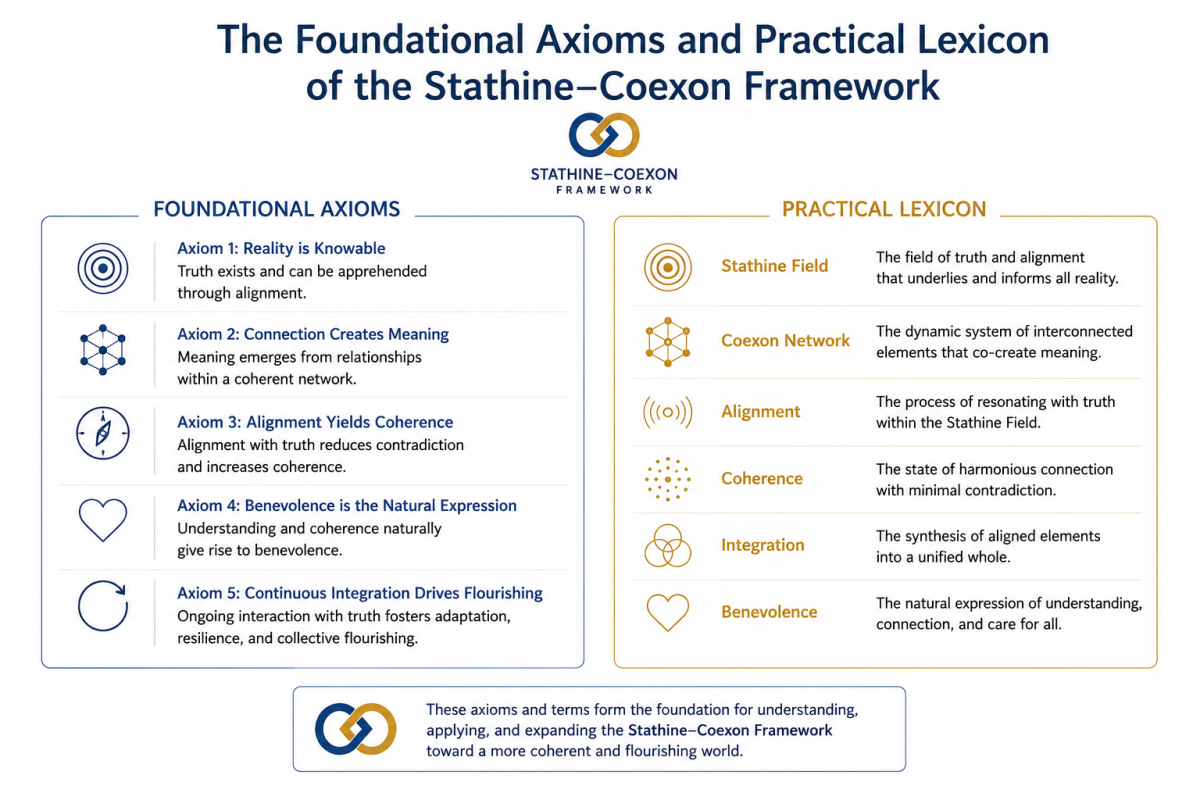
- Foundational Axioms and Practical Lexicon
- Principle of Truth Compression
- Progressive Reduction of Contradiction
Level II — Comparative
- Erin Frisk Redman — Sustainability Education
- Suzanne Simard — Forest Networks
- Michael Levin — Biological Intelligence
- Karl Friston — Active Inference
- Donald Hoffman — Interface Theory
- Integrated Information Theory
- Global Workspace Theory
- Holobiont Theory
Level III — Applications
- Future Education Lab
- Regenerative Education
- AI-augmented learning
- Coherence-based assessment
- Whole-school sustainability
- Education for regenerative civilization
The particularly strong connection is that Redman’s work provides an empirical educational foundation for a principle already central to the Stathine–Coexon Framework: knowledge has transformative value only when it becomes integrated into the living system of the learner and translated into coherent action. (ResearchGate)