Part of the Stathine–Coexon Research Series – Five-Dimensional Evaluation
Dimension II: Ontology
Abstract
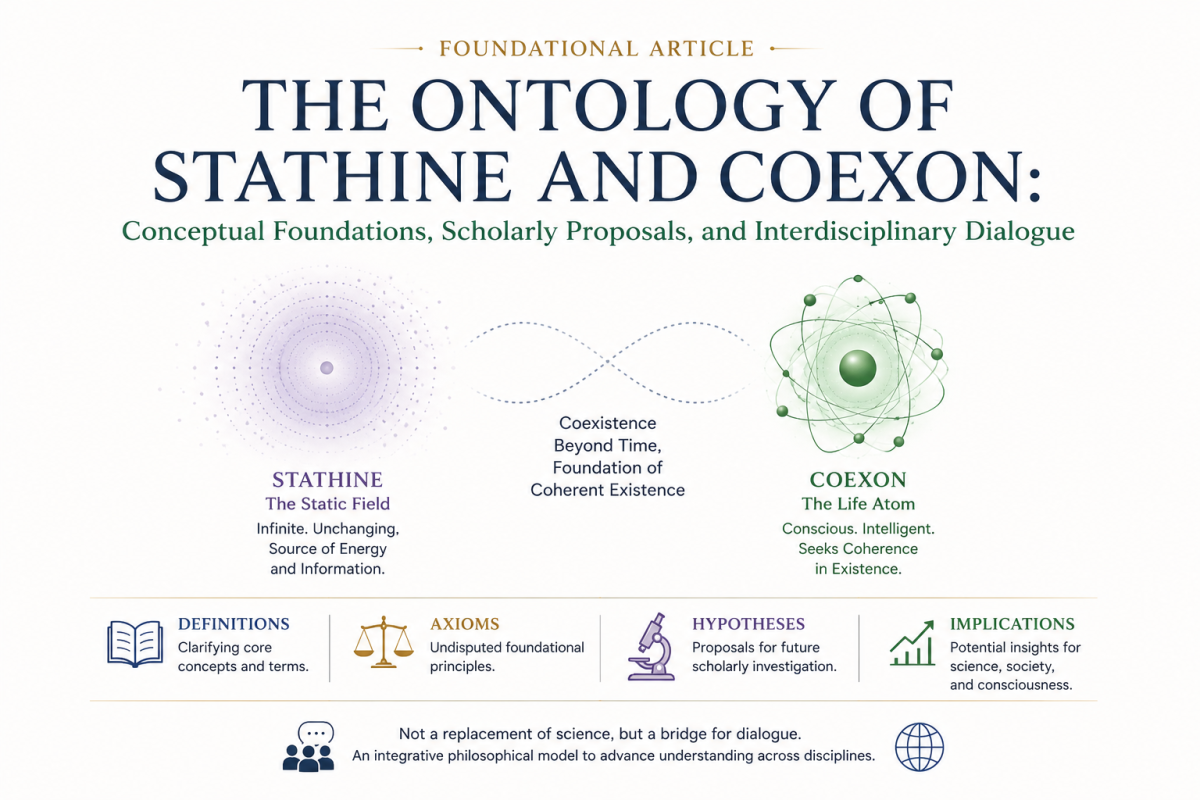
The Stathine–Coexon Framework proposes an ontological architecture in which reality is understood through the complementary concepts of Stathine and Coexon. Stathine is hypothesized as a fundamental, omnipresent, non-depleting continuum beyond conventional spatial and temporal description, while Coexon is proposed as a sentient atom capable of organization, communication, expansion of influence, and maintenance of coherence. The human being is consequently conceptualized not merely as a biological organism but as the union of a biological system and a sentient Coexon communicating through the biological brain.
This ontological proposal is ambitious because it challenges conventional assumptions concerning the relationship among matter, information, life, consciousness, and existence. It also creates substantial philosophical and scientific difficulties. The present article therefore subjects the ontology of the Stathine–Coexon Framework to critical examination rather than treating its central entities as established facts.
The analysis distinguishes several ontological commitments: the existence of physical reality; the existence of living organization; the possibility of information as an organizational category; the status of consciousness or sentience; the proposed existence of Coexons; and the proposed existence of Stathine. It examines whether these entities represent genuinely distinct ontological categories or whether some may ultimately be reducible to, emergent from, or structurally equivalent to entities already recognized by contemporary science.
Particular attention is given to the framework’s claims concerning the Coexon as a sentient atom, the relationship between Coexon and biological organism, the proposed four-shell organization of the Coexon, the brain as an interface, the notion of Stathine as a reality beyond space and time, and the principle of coexistence as an ontological rather than merely ethical condition.
The analysis concludes that the framework currently occupies an intermediate position between metaphysical hypothesis and scientific ontology. Its strongest ontological contribution is not yet the demonstrated discovery of new entities, but the proposal of a unified relational architecture connecting sentience, biological organization, information, coherence, and coexistence. Its greatest challenge is demonstrating that Stathine and Coexon are ontologically necessary rather than merely alternative descriptions of phenomena that existing theories can already explain.
The paper therefore proposes an ontological research programme based on ontological economy, empirical distinguishability, relational consistency, compatibility with established science, explanatory necessity, and openness to revision.
1. Introduction: The Ontological Question
The epistemological question asks:
How do we know?
Ontology asks the more fundamental question:
What is there to know?
This distinction is critical.
A theory can provide a sophisticated account of knowledge without committing itself to a particular description of reality.
The Stathine–Coexon Framework does make such commitments.
It proposes that reality contains—or is fundamentally constituted through—elements that are not adequately represented by conventional descriptions of matter and biological organization.
Its central ontological proposition can be summarized conceptually as follows:
Existence consists of an underlying universal continuum, Stathine, within which sentient organizational units, Coexons, interact with biological systems and participate in the progressive maintenance and expansion of coherence.
This is a substantial ontological claim.
It cannot be established merely by demonstrating that the resulting conceptual model is elegant.
It requires a systematic examination of what entities the framework proposes, why those entities are required, how they relate to one another, and what evidence could distinguish them from alternative ontologies.
Ontology, in contemporary philosophy, concerns questions about being, existence, categories, and the structure of reality. It overlaps substantially with metaphysics, although the boundaries between the two remain contested.
The present article therefore treats the Stathine–Coexon Framework as a developing ontological hypothesis, not as an already established ontology of nature.
That distinction is fundamental to the credibility of the research programme.
2. Ontological Commitments of the Framework
The framework presently contains at least six major ontological commitments.
2.1 Physical reality exists
The framework does not deny the existence of the physical universe.
Matter, energy, biological structures, nervous systems, electromagnetic processes, and observable phenomena remain part of reality.
2.2 Biological organization is real
Living organisms are not treated merely as collections of particles.
They exhibit organization, regulation, information processing, adaptation, communication, and self-maintenance.
The biological organism therefore constitutes a genuine level of organization.
2.3 Sentience is real
The framework treats subjective experience as a genuine feature of reality rather than merely an illusion or linguistic artifact.
This creates the central ontological problem of consciousness:
Is sentience fundamental, emergent, relational, computational, biological, or something else?
The Stathine–Coexon Framework answers differently from conventional physicalist approaches by proposing an independent sentient organizational entity.
2.4 Coexon exists
The Coexon is proposed as a sentient atom.
This is the framework’s most radical ontological commitment.
It implies that sentience is not merely an emergent property of sufficiently complex biological matter.
Instead, a Coexon represents a distinct unit of sentient organization capable of entering into relationship with biological matter.
2.5 Stathine exists
Stathine is proposed as a fundamental continuum underlying existence.
It is characterized in the framework as omnipresent, non-depleting, and beyond ordinary spatial and temporal limitation.
This is an even more fundamental ontological commitment.
2.6 Coexistence is fundamental
The framework does not treat entities as isolated substances.
Existence is fundamentally relational.
A Coexon exists in relationship with Stathine.
A human being exists through the relationship between Coexon and biological organism.
A biological organism exists through relationships among cells, organs, environment, information, and energy.
Coexistence therefore becomes more than an ethical principle.
It becomes an ontological proposition.
3. The First Critical Question: Are Stathine and Coexon Necessary?
The most important ontological test is not:
“Can Stathine and Coexon exist?”
Almost any sufficiently flexible conceptual model can be made logically possible.
The stronger question is:
Must Stathine and Coexon exist in order to explain something that competing ontologies cannot adequately explain?
This is the criterion of ontological necessity.
Suppose contemporary neuroscience eventually explains every known aspect of consciousness through biological mechanisms.
The Coexon would then face a serious challenge.
Its existence might remain logically possible, but its explanatory necessity would diminish.
Conversely, if reproducible observations emerge that cannot be adequately explained by biological mechanisms alone and are specifically predicted by Coexon theory, the ontological case would become substantially stronger.
This distinction between possibility and necessity should become central to the framework.
4. The Coexon as a Sentient Atom
The phrase sentient atom is intentionally provocative.
It immediately raises an important question:
What does “atom” mean in the framework?
If atom means literally a fundamental physical particle comparable to an electron, proton, or quark, the framework incurs a substantial scientific burden.
A physical atom or particle has measurable properties, participates in interactions, and can in principle be incorporated into physical theory.
A Coexon, as presently conceptualized, does not possess an established physical description of this kind.
Therefore the phrase “sentient atom” may currently be better understood as a fundamental unit of sentient organization rather than an ordinary chemical or subatomic particle.
This distinction could become crucial in future formalization.
The framework might ultimately discover that a Coexon is:
- a new physical entity,
- an informational entity,
- a relational entity,
- a field excitation,
- a process,
- a structure,
- a fundamental property,
- or something ontologically unlike familiar physical objects.
The research should not decide this prematurely.
5. Substance Ontology Versus Relational Ontology
Traditional ontology often begins with entities.
What things exist?
What properties do they possess?
How do they interact?
The Stathine–Coexon Framework may ultimately be more naturally interpreted as a relational ontology.
Under this interpretation, the primary reality is not isolated objects but organized relationships.
A Coexon is defined partly through its relationship with Stathine.
A human Coexon is defined partly through its relationship with the biological organism.
The brain becomes an interface.
Experience emerges through communication.
Coherence becomes a property of relationships.
This interpretation has important parallels with contemporary philosophical discussions of structural realism, which emphasize the possibility that science gives us particularly strong knowledge of relations and structures even when the intrinsic nature of theoretical entities remains uncertain.
This suggests a potentially productive reformulation:
The deepest ontological commitment of the Stathine–Coexon Framework may be to organized relational structure rather than to isolated substances.
If this becomes the framework’s mature position, it could reduce some of the difficulties associated with defining Coexon as a conventional “particle.”
6. Is Coexon Fundamental or Emergent?
The framework currently appears to treat Coexon as fundamental.
That means the Coexon is not produced by the brain.
Rather, the biological brain provides an interface through which an already-existing sentient entity communicates with the organism.
This position creates a sharp contrast with emergentist accounts.
In an emergentist ontology:
matter → biological organization → neural organization → consciousness
In the proposed Coexon ontology:
fundamental sentience → Coexon → biological interface → human experience
The distinction is enormous.
But it creates a demanding question:
Why should the second direction be preferred?
The answer cannot simply be that consciousness appears mysterious.
The explanatory gap in consciousness does not automatically establish a non-biological entity.
A new ontology becomes justified only when it explains something that alternative ontologies cannot adequately explain.
Therefore the framework must eventually identify specific phenomena for which the Coexon hypothesis provides additional explanatory power.
7. The Human Being as an Ontological Union
One of the most distinctive claims of the framework is that a human being is neither merely a biological organism nor merely a disembodied consciousness.
The human being is:
the union of a biological organism and a Coexon.
This avoids two extremes.
The first is reductionism:
Human beings are nothing more than biological machines.
The second is disembodied dualism:
Consciousness exists independently of biological embodiment and the body is merely a temporary vehicle.
The Stathine–Coexon position proposes something different.
The human being is an integrated relational system.
The biological organism provides embodiment, sensory access, memory, action, metabolism, and communication.
The Coexon provides the proposed sentient organizing principle.
The brain functions as a communication interface.
This resembles a form of interactionist ontology, but with an important difference: the Coexon is not simply “mind” in the traditional Cartesian sense.
It is proposed as a distinct fundamental unit of sentient organization.
8. The Interaction Problem
This immediately generates the most serious classical objection.
If Coexon is distinct from physical biological processes:
How does it interact with the physical brain?
This is the interaction problem.
If Coexon affects neural activity, then some causal relationship must exist.
If the causal relationship is physical, it must ultimately be describable within an appropriate physical theory.
If the interaction is not physical, the framework must explain what “causal interaction” means in this context.
Simply saying that the Coexon communicates through electromagnetic waves would not solve the problem unless the mechanism is specified.
Electromagnetic communication is itself physical.
Therefore the framework must answer:
- What generates the electromagnetic signal?
- What receives it?
- What information is encoded?
- What physical system changes as a result?
- How does this differ from ordinary neural electromagnetic activity?
Until these questions are answered, the brain–Coexon relationship remains a conceptual hypothesis.
This is perhaps the single most important scientific challenge facing the ontology.
9. The Brain as Interface Rather Than Generator
The framework proposes that the brain is an interface between biological organization and Coexon.
This is a major ontological claim.
It changes the role of the brain from:
generator of consciousness
to:
biological interface through which consciousness is organized and expressed.
The distinction is testable in principle.
If the brain generates consciousness entirely, changes in neural architecture should systematically account for the relevant features of conscious experience.
If the brain functions partly as an interface, the framework predicts that some features of sentience may not be reducible to neural generation alone.
But the burden of proof remains with the interface hypothesis.
The fact that brain injury alters consciousness is entirely compatible with both models.
A damaged radio cannot produce music properly even if the source of the signal lies elsewhere.
But the same observation is equally compatible with the radio itself generating the signal through internal circuitry.
Therefore the radio analogy does not establish the interface model.
It merely illustrates its logical possibility.
This distinction should be maintained rigorously.
10. The Ontology of Stathine
Stathine is the more ambitious component of the framework.
It is conceived as a universal continuum beyond ordinary space and time.
This immediately creates a conceptual challenge.
If Stathine is beyond space, what does “where” mean?
If it is beyond time, what does “change” mean?
If it is omnipresent, can anything exist outside it?
If it is the source or substrate of energy, how does this relate to conservation laws?
If it carries information, what physical or mathematical structure does that information possess?
If it is non-depleting, what does energy exchange with ordinary physical systems mean?
These questions cannot be avoided by describing Stathine as “beyond” conventional categories.
The phrase “beyond space and time” must acquire a precise meaning.
Otherwise it risks becoming a conceptual escape mechanism rather than an explanatory principle.
11. Stathine and the Problem of Redundancy
A particularly important ontological test is redundancy.
Suppose all phenomena attributed to Stathine can already be described using existing concepts such as:
- quantum fields,
- spacetime,
- vacuum states,
- energy,
- information,
- physical laws,
- or mathematical structure.
Then introducing Stathine may add terminology without adding ontology.
This would not necessarily make the concept useless.
It might still function as a philosophical synthesis.
But it would weaken the claim that Stathine is a new scientific entity.
The framework must therefore eventually demonstrate what Stathine contributes that established concepts do not.
The strongest possible outcome would be a prediction that follows naturally from Stathine but not from competing models.
12. Stathine and Ontological Economy
Scientific theories face an important methodological principle:
Do not introduce additional entities without explanatory necessity.
This is not a prohibition against new entities.
Science has repeatedly expanded ontology when existing explanations proved inadequate.
Fields, genes, spacetime, quanta, and many other concepts were introduced because they enabled deeper explanatory integration.
Scientific realism itself permits commitment to unobservable entities when successful theories provide sufficient reason for such commitment, although the status of theoretical entities remains philosophically contested.
The question for Stathine is therefore:
Does introducing Stathine produce explanatory or predictive gains large enough to justify the additional ontological commitment?
That should be an explicit research criterion.
13. The Four Functional Shells of the Coexon
The framework proposes a structured Coexon architecture involving functional shells associated with:
- conclusive understanding,
- visualization and imagination,
- evaluation and validation,
- embodiment and sensory expression.
This is an intriguing organizational model.
However, it is currently unclear whether these shells are:
- physical structures,
- informational layers,
- functional states,
- mathematical dimensions,
- developmental stages,
- or metaphors for cognitive functions.
This ambiguity must be resolved.
If they are physical structures, measurable signatures should eventually exist.
If they are informational architectures, they should be formally represented.
If they are functional states, transitions between them should be characterizable.
If they are metaphors, the framework should say so explicitly.
Otherwise, the terminology risks creating the appearance of anatomical precision without corresponding empirical specification.
14. The Shell Architecture as a Possible Functional Ontology
There is, however, a more defensible interpretation.
The shells may not need to be literal spatial layers.
They may represent functional degrees of organization.
Under this interpretation:
First shell
The system stabilizes an interpretation.
Second shell
The system generates possible representations.
Third shell
The system evaluates alternatives against constraints and evidence.
Fourth shell
The system connects understanding to embodied action.
This resembles a functional architecture rather than a particle anatomy.
Such an interpretation could allow the Coexon model to engage with cognitive science without prematurely asserting unknown physical structures.
The ontological question would then become:
Is this functional organization merely a description of known cognition, or does it require an independently existing Coexon?
Again, the distinction is crucial.
15. Sentience as a Fundamental Property
The deepest ontological commitment of the framework may not actually be Coexon.
It may be sentience.
The framework implicitly proposes that sentience is not generated from nothing when biological complexity crosses a threshold.
Instead, sentience is already represented at a more fundamental level of existence.
This moves the framework toward positions sometimes discussed under broad labels such as panpsychism or cosmopsychism, although the Coexon proposal is not identical to either.
The distinction should be made carefully.
Panpsychist approaches generally attribute some form of mentality or experientiality to fundamental entities.
The Coexon hypothesis instead proposes a particular sentient organizational unit with an architecture and relationship to biological systems.
Consequently, future comparative work should ask:
What explanatory advantage does Coexon provide over existing varieties of panpsychism, emergentism, physicalism, dualism, and neutral-monist approaches?
Without such comparison, “sentient atom” risks simply renaming the philosophical problem.
16. The Combination Problem
Any theory that treats sentience as fundamental faces the combination problem.
If fundamental sentient entities exist, how do they combine into the unified experience of a human being?
The Coexon Framework has an unusual advantage here because it does not necessarily claim that billions of microscopic conscious particles combine to form human consciousness.
Instead, it proposes a relatively specific sentient entity—the Coexon—that enters into union with a biological organism.
This potentially avoids one form of combination problem.
But it generates another:
How does one Coexon generate or organize the enormous complexity of human subjective experience?
The proposed shells may be intended to answer this.
Yet the architecture must eventually demonstrate how these functional layers generate or organize the phenomenological unity of a human being.
17. Coherence as an Ontological Property
The framework gives coherence unusually fundamental status.
Coherence is usually treated as a property of information, cognition, systems, or explanations.
The Stathine–Coexon Framework goes further.
It suggests that coherence may be a fundamental tendency of sentient organization.
This raises an important question:
Is coherence merely a description of successful organization, or is it itself causally active?
If it is descriptive, then “coherence seeking” may simply summarize adaptive processes.
If it is causal, the framework must specify the mechanism.
If coherence is fundamental to Stathine–Coexon dynamics, mathematical formalization may eventually be possible.
This could become one of the framework’s most productive research directions.
18. Expansion of the Coexon’s Area of Influence
The framework proposes that a Coexon can expand its area of influence while continually encountering Stathine beyond its imaginative reach.
This concept has considerable philosophical significance.
It implies that sentient development is not merely accumulation of knowledge.
It is expansion of the domain within which coherence can be maintained.
At the individual level, this may correspond to:
self → family → community → society → humanity → planetary systems.
At the collective level, coherent individuals may influence larger networks.
This provides a bridge between ontology and social theory.
But scientifically, the phrase “area of influence” requires operational definition.
Does it mean:
- causal influence?
- informational influence?
- social influence?
- emotional influence?
- neural synchronization?
- cultural transmission?
Without specification, the concept remains metaphorical.
Its philosophical value may nevertheless be substantial.
19. Coexistence as Ontological Principle
The most distinctive philosophical feature of the framework may be its treatment of coexistence.
Coexistence is not merely tolerance.
It is not simply an ethical preference.
It is proposed as a structural property of existence.
Nothing exists entirely independently.
Matter interacts.
Organisms depend upon ecosystems.
Cells depend upon multicellular organization.
Brains depend upon bodies.
Humans depend upon communities.
Communities depend upon ecological systems.
The framework extends this relational intuition to Coexon and Stathine.
Thus:
Existence is relational before it is individual.
This is potentially a powerful ontological thesis.
But it must be distinguished from the stronger claim that coexistence itself is a fundamental physical law.
The first is philosophically defensible as a relational ontology.
The second requires scientific demonstration.
20. The Ontological Status of Information
Information occupies an ambiguous position within the framework.
Sometimes it appears to be something communicated by physical systems.
At other times it appears closer to a fundamental constituent of reality.
This distinction is critical.
Is information:
- a property of physical states?
- a relation between states?
- a mathematical abstraction?
- an independent ontological entity?
- something fundamental to Stathine?
- something organized by Coexon?
Different answers produce different ontologies.
The framework should therefore develop an explicit ontology of information.
Otherwise, information risks becoming a universal explanatory placeholder.
21. Information Does Not Automatically Imply Sentience
This is another critical boundary.
Information processing is ubiquitous in biological and physical systems.
But:
Information processing does not automatically imply subjective experience.
A computer processes information.
A cell processes signals.
A thermostat responds to temperature.
A brain integrates enormous quantities of information.
None of these observations by themselves establish sentience.
The Coexon hypothesis must therefore specify what transforms information into sentient organization—or, alternatively, why information and sentience are fundamentally related.
This is one of the central questions that distinguishes the framework from conventional information-processing accounts.
22. Causation and Downward Influence
If Coexon is ontologically distinct from the biological organism, the framework must specify causal direction.
Does:
Coexon → brain → body
occur?
Does:
body → brain → Coexon
also occur?
Does information flow bidirectionally?
Can Coexon influence neural activity?
Can neural activity alter Coexon organization?
Does consciousness have causal efficacy?
These questions connect ontology directly to philosophy of causation and neuroscience.
A successful theory must provide a causal architecture rather than merely a conceptual relationship.
23. Compatibility With Contemporary Physics
The ontology of Stathine–Coexon must eventually confront modern physics.
The framework should not assume that phrases such as “beyond space and time,” “energy,” “field,” “information,” and “quantum” can be combined freely.
Each has technical meanings.
If Stathine is fundamental, its relationship to spacetime must be clarified.
If Coexon is physical, it must interact with physical fields.
If it is nonphysical, the framework must explain how physical causation remains closed or how it is extended.
If it is informational, the physical substrate of that information must be specified.
The framework’s future credibility will depend substantially upon whether it can enter this conversation without violating established physical principles.
24. Compatibility Is Not Confirmation
An important methodological distinction follows.
A theory may be compatible with existing science without being supported by it.
For example, if the Stathine–Coexon Framework does not contradict general relativity, quantum mechanics, or neuroscience, that is useful.
But non-contradiction does not constitute evidence.
The ontological status should therefore be classified carefully:
Compatible
No established result currently rules it out.
Consistent
Its propositions do not contain known internal contradictions.
Supported
Evidence specifically favors the proposition.
Established
The proposition is sufficiently well confirmed to be accepted as part of scientific knowledge.
At present, many of the framework’s ontological claims belong to the first two categories rather than the latter two.
This distinction should be retained throughout the research programme.
25. Scientific Realism and the Coexon
Scientific realism provides a useful philosophical framework for understanding the challenge.
Realists generally regard successful scientific theories as providing reason to believe in both observable and some unobservable aspects of reality, while acknowledging scientific fallibility.
This creates a possible path for Coexon.
The framework does not need to demand direct observation.
It needs a sufficiently successful explanatory and predictive theory whose best explanation includes Coexon.
But the opposite possibility must also remain open.
If the same phenomena can be explained equally well without Coexon, ontological commitment becomes less compelling.
This is the problem of underdetermination.
The framework therefore needs not merely an explanation, but preferably a distinctive explanation.
26. Structural Realism as a Possible Intermediate Position
Structural realism may offer a particularly interesting philosophical bridge.
Rather than requiring immediate commitment to the intrinsic nature of theoretical entities, structural realism emphasizes the relations and structures captured by successful scientific theories.
The Stathine–Coexon Framework could therefore initially formulate its strongest ontological claims in relational terms:
- Coexon–brain relation,
- Coexon–Stathine relation,
- information–coherence relation,
- organism–environment relation,
- individual–collective relation.
This would allow researchers to investigate whether the proposed relationships have empirical reality before determining the ultimate intrinsic nature of the entities involved.
Such an approach could make the research programme scientifically more tractable.
27. The Ontological Risk of Reification
A major danger exists whenever a conceptual framework introduces new terminology.
A useful concept can gradually become treated as an independently existing entity.
This process is known as reification.
For example:
“coherence” may begin as a description of organized information.
It may then become described as a force.
Eventually it may be treated as a substance.
The same risk applies to Coexon and Stathine.
The framework must therefore continuously ask:
Is this term describing an observed pattern, representing a theoretical mechanism, or asserting an independently existing entity?
This single question could prevent significant conceptual drift.
28. The Ontological Economy of the Framework
A mature version of the Stathine–Coexon Framework should therefore contain an explicit hierarchy of ontological commitment.
Tier 1 — Established entities
Entities supported by mature scientific evidence.
Examples include biological organisms, neural structures, cells, electromagnetic phenomena, and physical matter.
Tier 2 — Theoretical structures
Well-supported scientific constructs that may not be directly observable.
Tier 3 — Proposed entities
Coexon and Stathine.
Tier 4 — Interpretive concepts
Coherence, truth compression, influence expansion, and related constructs where their precise ontological status remains unresolved.
This hierarchy would make the framework much more rigorous.
29. What Evidence Would Strengthen the Ontology?
The ontological case for Coexon would be strengthened by evidence demonstrating:
- reproducible phenomena not adequately explained by existing biological mechanisms;
- measurable interaction between Coexon and biological systems;
- distinctive predictions derived from the Coexon model;
- successful prediction of previously unknown phenomena;
- independent replication;
- theoretical integration with established physics;
- quantitative mathematical formalization.
The case for Stathine would require an even deeper level of evidence.
It would need to demonstrate that Stathine is not merely a philosophical reinterpretation of existing physical concepts.
A successful Stathine theory would ideally provide:
- a mathematical representation,
- a clearly defined relation to spacetime,
- a physical or informational mechanism,
- distinctive predictions,
- and empirical consequences.
Until then, Stathine should remain explicitly classified as a foundational ontological hypothesis.
30. What Evidence Would Weaken the Ontology?
Critical research must also define negative outcomes.
The Coexon ontology would be weakened if:
- every proposed Coexon effect is fully explained by established neuroscience;
- no distinctive predictions can be derived;
- the proposed interaction mechanism violates established physics;
- the Coexon concept becomes indistinguishable from ordinary neural processing;
- different formulations of Coexon generate no empirically distinguishable consequences.
The Stathine ontology would be weakened if:
- its proposed properties reduce completely to existing physical concepts;
- no distinctive predictions can be generated;
- its definition remains permanently non-operational;
- the concept is used only to restate already known relationships.
These outcomes should not be regarded as failures of science.
They are possible results of science.
31. Ontological Falsifiability
Strictly speaking, ontology itself cannot always be reduced to straightforward experimental falsification.
Metaphysical questions can exceed direct empirical testing.
Nevertheless, an ontology intended to function as part of science should produce empirical constraints.
The appropriate question is therefore not:
“Can every ontological proposition be directly falsified?”
but:
“Does accepting this ontology constrain what we should expect to observe?”
If the answer is no, the proposition may remain philosophically interesting but should not be represented as empirically established science.
32. The Strongest and Weakest Forms of the Framework
The Stathine–Coexon ontology can therefore be formulated at different strengths.
Weak formulation
Stathine and Coexon are conceptual models for integrating sentience, information, and biological organization.
This is philosophically defensible but scientifically modest.
Intermediate formulation
Coexon and Stathine represent real organizational structures whose existence is hypothesized but not yet empirically established.
This is the most appropriate current scientific position.
Strong formulation
Coexon and Stathine are demonstrated fundamental entities of reality.
This formulation is currently unsupported and should not be presented as established science.
Maintaining this hierarchy protects the framework from overclaiming.
33. The Ontological Core That May Survive Revision
An important question is what remains if future research substantially modifies the current formulation.
The answer may be the relational architecture:
Reality → organization → sentience → communication → coherence → coexistence
The precise nature of the entities may change.
Coexon may turn out to be a particle, field, process, information structure, or something else.
Stathine may be reformulated in terms of a physical or mathematical substrate.
The shell architecture may become a computational or functional model.
Yet the deeper relational hypothesis may survive.
This is precisely why structural and relational formulations may be valuable during the early stages of a scientific research programme.
34. Ontology and the Five-Dimensional Method
The ontological analysis also demonstrates why the five-dimensional methodology must remain integrated.
Ontology cannot determine its own validity.
Epistemology tells us how ontological claims are justified.
Axiology asks what follows from them.
Praxis examines how they alter action.
Telos examines where their acceptance could lead.
Thus:
Epistemology constrains Ontology.
Ontology informs Axiology.
Axiology guides Praxis.
Praxis influences Telos.
Telos generates new epistemological questions.
The five dimensions therefore form a recursive system.
35. Critical Assessment
At its present stage, the Stathine–Coexon Framework can be evaluated as follows.
Ontological strengths
1. It explicitly addresses the hard problem of consciousness.
Rather than assuming that subjective experience will automatically emerge from increasing computational complexity, it proposes a fundamental role for sentience.
2. It provides a relational model of the human being.
The organism is not isolated from its environment or from the proposed Coexon.
3. It attempts to bridge physical and experiential descriptions.
This is one of the major unresolved problems in contemporary philosophy of mind.
4. It gives coexistence ontological significance.
Existence is treated as fundamentally relational.
5. It encourages interdisciplinary ontology.
Physics, biology, neuroscience, information theory, and philosophy become part of one research conversation.
Ontological weaknesses
1. Coexon has not yet been independently demonstrated.
This is the central limitation.
2. Stathine lacks an operational definition.
Its relationship to established physics remains unresolved.
3. The word “atom” may create false physical precision.
Its meaning must be clarified.
4. The interaction mechanism is incomplete.
The brain–Coexon interface requires a causal model.
5. The shell architecture is presently underdetermined.
It is unclear whether the shells are physical, informational, functional, or metaphorical.
6. Ontological redundancy remains possible.
Existing theories may eventually explain the phenomena attributed to the new entities.
7. Coherence may be descriptive rather than fundamental.
The framework must demonstrate whether coherence has causal status.
8. The framework risks reification.
Conceptual constructs can inadvertently become treated as physical entities.
These weaknesses should be regarded as the central research agenda rather than reasons to terminate inquiry.
36. A Proposed Ontological Research Protocol
The next phase of research should therefore proceed through seven questions.
Question 1
What exactly exists?
Produce a formal ontology.
Question 2
Which entities are established and which are hypothetical?
Assign explicit epistemic status.
Question 3
What relations connect the entities?
Construct a relational model.
Question 4
What mechanisms connect the entities?
Specify causal processes.
Question 5
What observations distinguish the ontology from alternatives?
Generate discriminating predictions.
Question 6
What established scientific principles constrain it?
Test compatibility.
Question 7
What result would require abandoning or radically revising it?
Define failure conditions.
This would transform the ontology from a philosophical narrative into a progressively testable research programme.
37. Conclusion: From Proposed Entities to Testable Ontology
The ontological evaluation of the Stathine–Coexon Framework reveals both its greatest ambition and its greatest vulnerability.
Its ambition is to propose that reality cannot be adequately understood through matter and biological organization alone; that sentience may have a more fundamental status; that the human being may be a relational union of biological organism and sentient Coexon; and that coexistence may be a structural feature of existence rather than merely an ethical ideal.
Its vulnerability is that these are substantial ontological commitments.
They cannot be established through conceptual elegance alone.
The existence of Coexon must eventually be distinguished from sophisticated descriptions of biological consciousness.
The existence of Stathine must eventually be distinguished from existing descriptions of physical reality.
The brain–Coexon relationship must become a causal hypothesis rather than an analogy.
The shell architecture must acquire a precise status.
And coherence must be demonstrated as more than a desirable property of explanations.
The most scientifically responsible position at the present stage is therefore neither rejection nor acceptance.
It is structured ontological suspension:
The framework proposes that Stathine and Coexon may be real constituents or structures of reality, but their ontological status remains an open research question.
This position is not intellectually weak.
It is precisely how a new ontology should begin.
Scientific history demonstrates that the ontology of science changes when new explanatory structures prove their necessity. The scientific realist may ultimately commit to theoretical entities when successful theories warrant such commitment, while structural realist approaches caution that the strongest knowledge may concern relations and structures rather than the intrinsic nature of unobservable entities.
The Stathine–Coexon Framework can therefore take a productive intermediate path.
It need not demand that researchers believe in Coexon.
It needs to give researchers a reason to investigate whether Coexon is necessary.
It need not ask researchers to accept Stathine as an established substrate of existence.
It needs to formulate Stathine sufficiently precisely that researchers can determine whether it contributes something beyond existing physical descriptions.
The deepest ontological proposition of the framework may consequently be reformulated:
Reality may be more adequately understood not as a collection of independent objects, but as an organized relational continuum in which matter, biological organization, information, sentience, and coherence participate in mutually constraining relationships.
Whether Stathine and Coexon ultimately prove to be genuine constituents of that reality remains to be determined.
That uncertainty should not be concealed.
It should become the scientific question.
The framework will mature not when it has eliminated every ontological doubt, but when it has transformed those doubts into precise questions that can be investigated.
Its ultimate ontological test is therefore simple:
Does Coexon reveal something reality requires us to recognize?
Does Stathine reveal something existing physics cannot adequately express?
Do the proposed relationships generate observations that competing ontologies cannot explain?
If the answer eventually becomes yes, the framework will have contributed a genuinely new ontology.
If the answer becomes no, the framework will nevertheless have contributed by clarifying why the additional ontology was unnecessary.
Either outcome advances knowledge.
The purpose of ontology is not to populate reality with the largest possible number of entities.
It is to discover the smallest, most coherent, most adequately justified account of what must exist for the world we experience and measure to be the world it is.
That is the standard against which the Stathine–Coexon ontology must ultimately be judged.