Part of the Stathine–Coexon Research Series – Methodological Foundations
Abstract
Scientific frameworks are often evaluated by their empirical adequacy, mathematical consistency, or explanatory power within a specific discipline. Yet the most enduring frameworks in human intellectual history have been judged by broader criteria. They have not only explained observations but have also clarified what can be known, what exists, what is valuable, how knowledge should be applied, and toward what ends human inquiry ought to be directed.
The Stathine–Coexon Framework is proposed as an interdisciplinary scientific hypothesis concerning the relationship between biological organization, sentient organization, coherent understanding, and coexistence. Because of its scope, its evaluation cannot be confined to neuroscience, biology, or philosophy of mind alone. It requires a broader methodological examination that considers its internal coherence, philosophical foundations, practical implications, and long-term purpose.
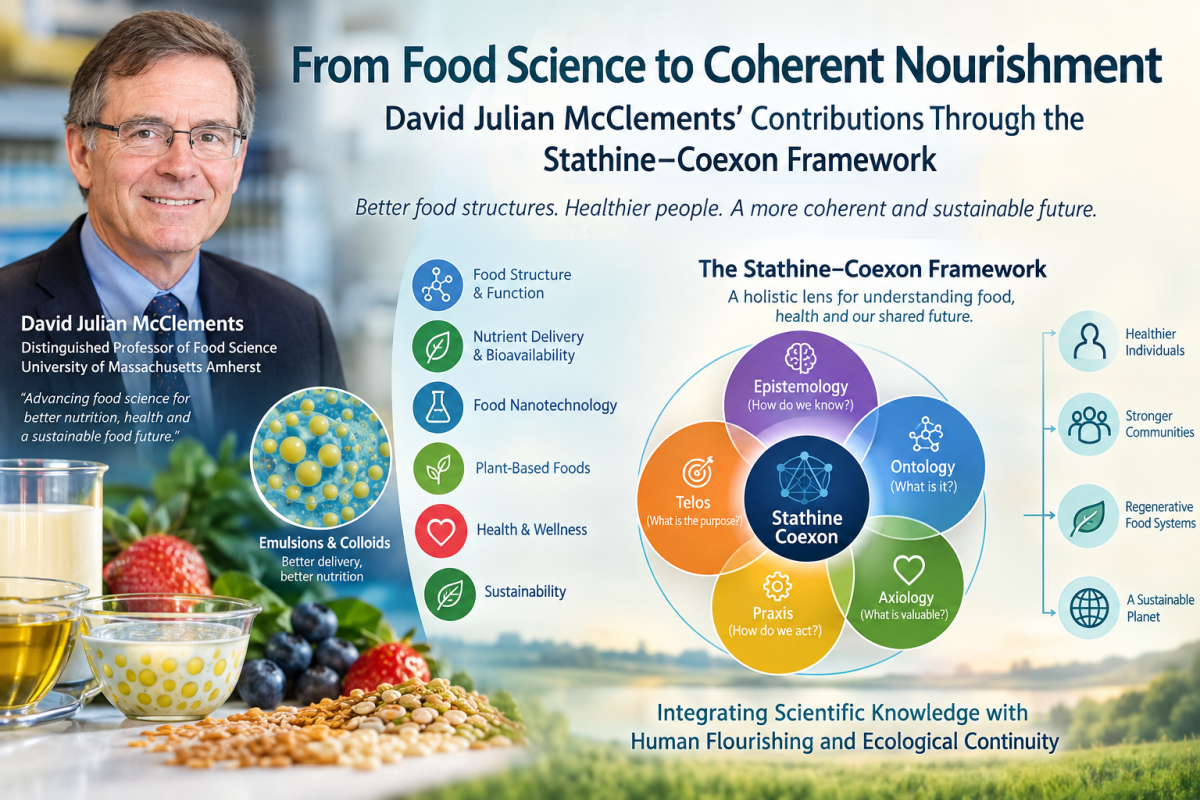
This introductory article proposes a five-dimensional framework for evaluating the Stathine–Coexon hypothesis through epistemology, ontology, axiology, praxis, and telos. Rather than seeking final answers, this approach establishes a structured research programme capable of guiding future interdisciplinary inquiry. The objective is not to defend the framework from criticism but to provide a systematic method through which it may be strengthened, refined, or, where necessary, revised. In doing so, the framework aspires to contribute to the progressive clarification of human knowledge through the continual reduction of conceptual contradiction and the expansion of coherent understanding.
1. Introduction: Why Comprehensive Evaluation Matters
Every major intellectual framework eventually reaches a point where it must answer questions that extend beyond its original domain.
A biological theory must eventually address philosophical implications.
A philosophical system must confront empirical evidence.
A scientific model must demonstrate conceptual coherence.
A practical framework must justify its ethical consequences.
History shows that the longevity of a theory depends not only upon its ability to explain observations but also upon its capacity to integrate multiple dimensions of human understanding.
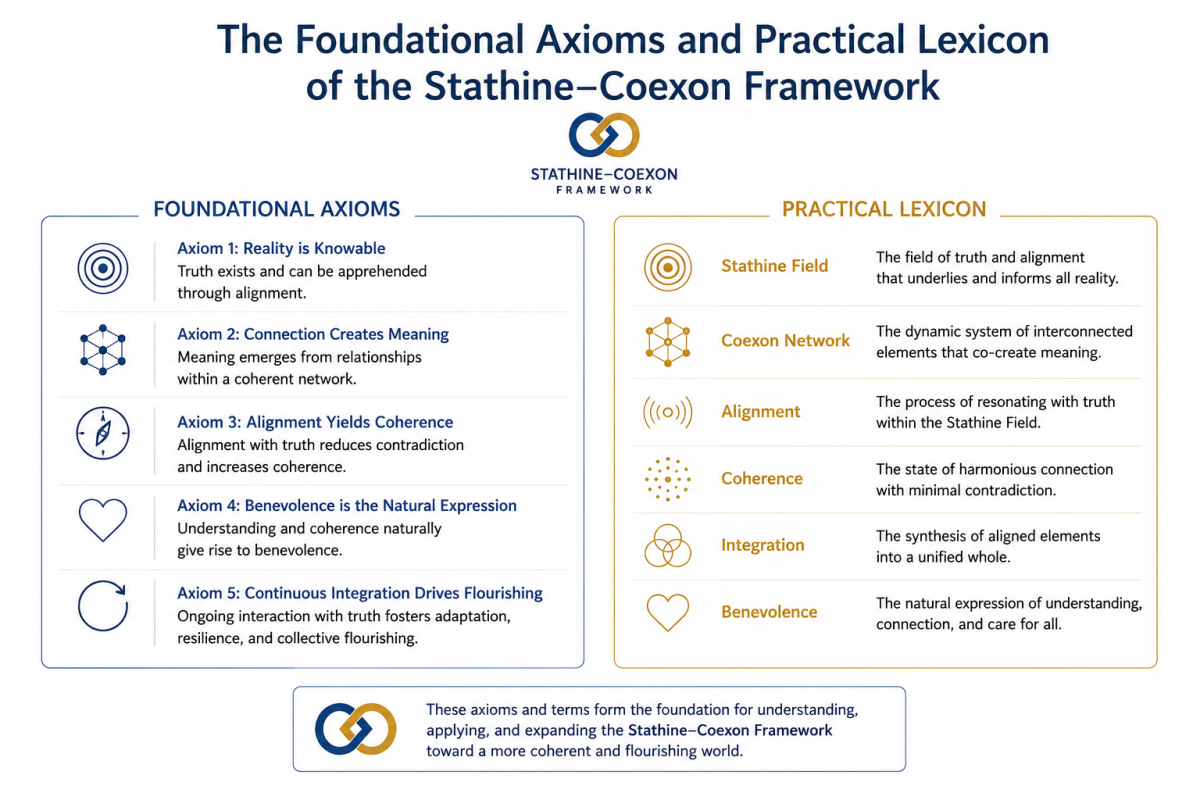
The Stathine–Coexon Framework has been developed as an interdisciplinary hypothesis proposing that the human being is the dynamic union of a biological organism and a hypothesized sentient organizer—the Coexon—communicating through the biological architecture of the brain while participating within the universal continuum termed Stathine.
Such a proposal inevitably raises questions extending far beyond neuroscience.
What kind of knowledge does the framework claim to generate?
What is its understanding of reality?
What values naturally emerge from its ontology?
How should those insights influence education, leadership, science, healthcare, and civilization?
Toward what long-term direction does the framework orient human development?
These questions cannot be answered within a single scientific discipline.
They require a broader methodological architecture.
2. Why Five Dimensions?
Throughout the history of philosophy and science, five recurring dimensions have guided comprehensive evaluation.
Epistemology examines the nature, limits, and justification of knowledge.
Ontology investigates what exists and how reality is organized.
Axiology explores value, ethics, and the conditions of flourishing.
Praxis concerns the application of knowledge in lived experience.
Telos examines purpose, direction, and the long-term trajectory of development.
Although these dimensions emerged within philosophy, they remain highly relevant to contemporary interdisciplinary science.
Artificial intelligence raises epistemological questions about understanding.
Systems biology raises ontological questions concerning organization.
Environmental science raises axiological questions regarding responsibility.
Education and leadership concern praxis.
Civilizational sustainability inevitably invokes questions of telos.
The Stathine–Coexon Framework therefore proposes that these five dimensions together provide an appropriate structure for evaluating any integrative theory of sentience and human development.
3. Evaluation as an Instrument of Refinement
Evaluation is often misunderstood as an attempt either to validate or invalidate a theory.
Scientific progress demonstrates a different reality.
The most productive evaluations refine rather than merely judge.
The purpose of evaluating the Stathine–Coexon Framework is therefore not to demonstrate that every aspect is correct.
Rather, it is to identify where concepts remain incomplete, where assumptions require clarification, where interdisciplinary dialogue can strengthen explanations, and where entirely new questions emerge.
A research programme grows through disciplined criticism.
Each evaluation becomes an opportunity to increase explanatory coherence.
This process mirrors one of the central principles proposed by the framework itself: progress occurs through the continual reduction of contradiction rather than the accumulation of unquestioned assertions.
4. The Five Dimensions as Complementary Lenses
The five dimensions should not be interpreted as independent categories.
They continually interact.
Our understanding of what exists influences what we believe can be known.
Our conception of knowledge shapes our ethical priorities.
Our values influence our actions.
Our actions collectively determine the direction toward which civilizations evolve.
The Stathine–Coexon Framework proposes that increasing coherence requires these dimensions to remain mutually consistent.
A contradiction between ontology and ethics, or between epistemology and practice, reduces explanatory integrity.
Conversely, increasing alignment across these dimensions indicates increasing conceptual coherence.
The objective is therefore not merely to answer five separate questions but to understand how the answers reinforce one another.
5. The Proposed Research Programme
The articles following this introduction will examine each dimension in depth.
The epistemological study will investigate the nature of coherent understanding, the relationship between information and knowledge, the role of contradiction in learning, and the distinction between empirical observation and conceptual organization.
The ontological study will examine the proposed realities of Stathine, the Coexon, biological organisms, and coexistence while exploring how these concepts relate to contemporary scientific and philosophical accounts of existence.
The axiological study will investigate how values emerge from coherent participation rather than external prescription, examining ethics, responsibility, freedom, creativity, and human flourishing.
The praxis study will explore how the framework may influence education, healthcare, organizational leadership, scientific inquiry, technological development, and civilizational design.
The teleological study will examine the direction of human development, asking whether increasing coherence provides a meaningful account of individual and collective purpose without requiring predetermined metaphysical conclusions.
Each study will remain open to revision as new scientific evidence, philosophical argument, and interdisciplinary collaboration become available.
6. Toward a More Coherent Knowledge Architecture
Modern knowledge has achieved extraordinary depth through specialization.
The sciences have advanced by developing increasingly sophisticated methods within individual disciplines.
This specialization has generated remarkable discoveries.
At the same time, it has made conceptual integration progressively more challenging.
Questions concerning consciousness, meaning, ethics, education, sustainability, and human flourishing frequently extend beyond the explanatory scope of any single discipline.
The Stathine–Coexon Framework proposes that coherence itself may serve as an organizing principle through which specialized knowledge can be integrated without diminishing disciplinary rigor.
This aspiration does not replace existing sciences.
Rather, it seeks to strengthen communication among them.
Such integration requires continual identification of conceptual contradictions, hidden assumptions, category errors, and incomplete explanatory models.
Reducing these limitations does not eliminate uncertainty.
Instead, it increases the coherence with which uncertainty is investigated.
7. Future Research and the Progressive Clarification of Knowledge
No comprehensive framework should be regarded as complete.
Scientific understanding evolves through continual dialogue between theory, observation, criticism, and revision.
Accordingly, the Stathine–Coexon Framework is presented as a living research programme.
Its concepts remain open to refinement.
Its terminology may evolve.
Its hypotheses may be expanded, modified, or rejected in light of future evidence.
This openness is not a weakness but a defining characteristic of scientific inquiry.
The ultimate measure of the framework will not be whether every proposition remains unchanged.
It will be whether it encourages clearer questions, more coherent interdisciplinary dialogue, and more productive investigations into the nature of sentience, learning, organization, and coexistence.
8. Conclusion
The evaluation proposed in this series marks an important transition in the development of the Stathine–Coexon Framework.
Until now, the Foundation Series has articulated its principal hypotheses concerning biological communication, the Coexon, Stathine, coherence, and coexistence.
The next stage asks a different question.
How should these ideas themselves be evaluated?
By examining the framework through epistemology, ontology, axiology, praxis, and telos, the present research programme seeks not merely to assess a single theory but to explore whether greater coherence can be achieved across the broader architecture of human knowledge itself.
If successful, this process will contribute to a continuing tradition that defines the scientific enterprise at its best: the disciplined, collaborative, and self-correcting pursuit of increasingly coherent understanding.
The five dimensions are therefore not simply categories of analysis. Together they form a methodological compass for the ongoing evolution of the Stathine–Coexon Framework and an invitation to future researchers to participate in its critical examination, refinement, and development. The goal is not intellectual certainty but progressively deeper coherence—an understanding that remains open to evidence, responsive to critique, and committed to the shared human endeavor of expanding knowledge through coexistence.