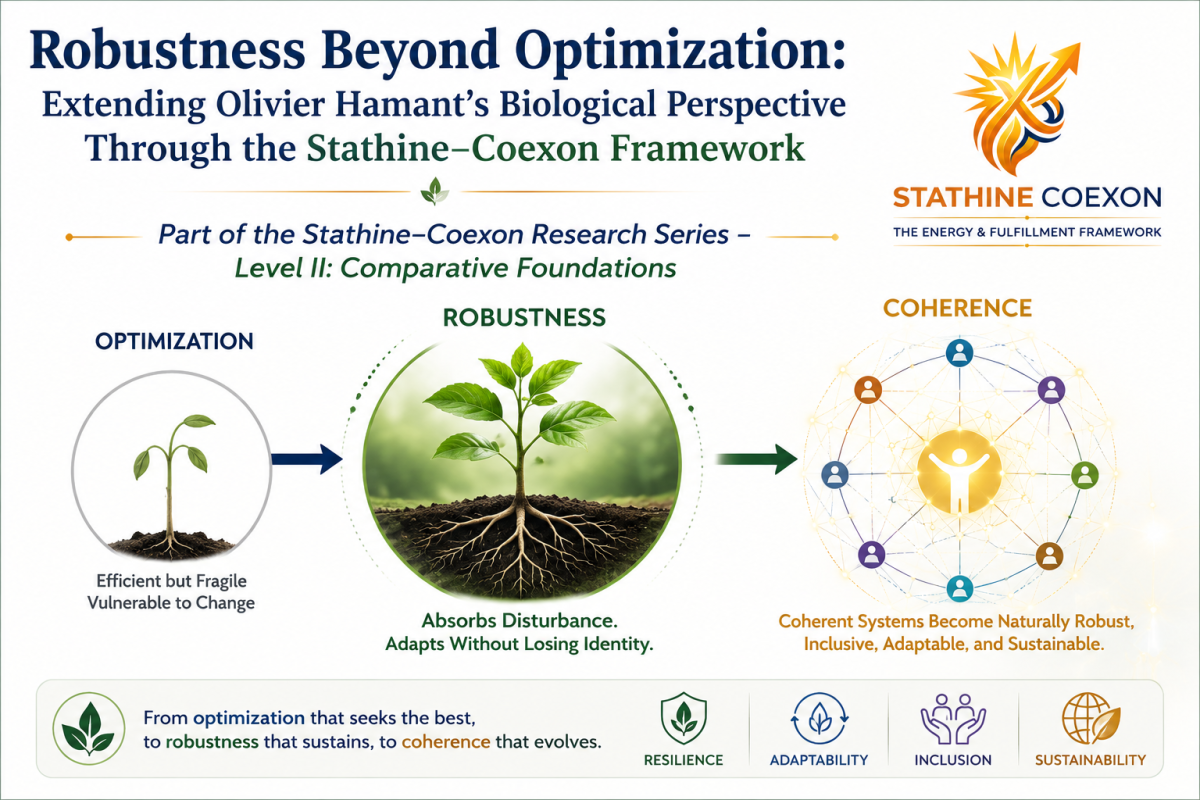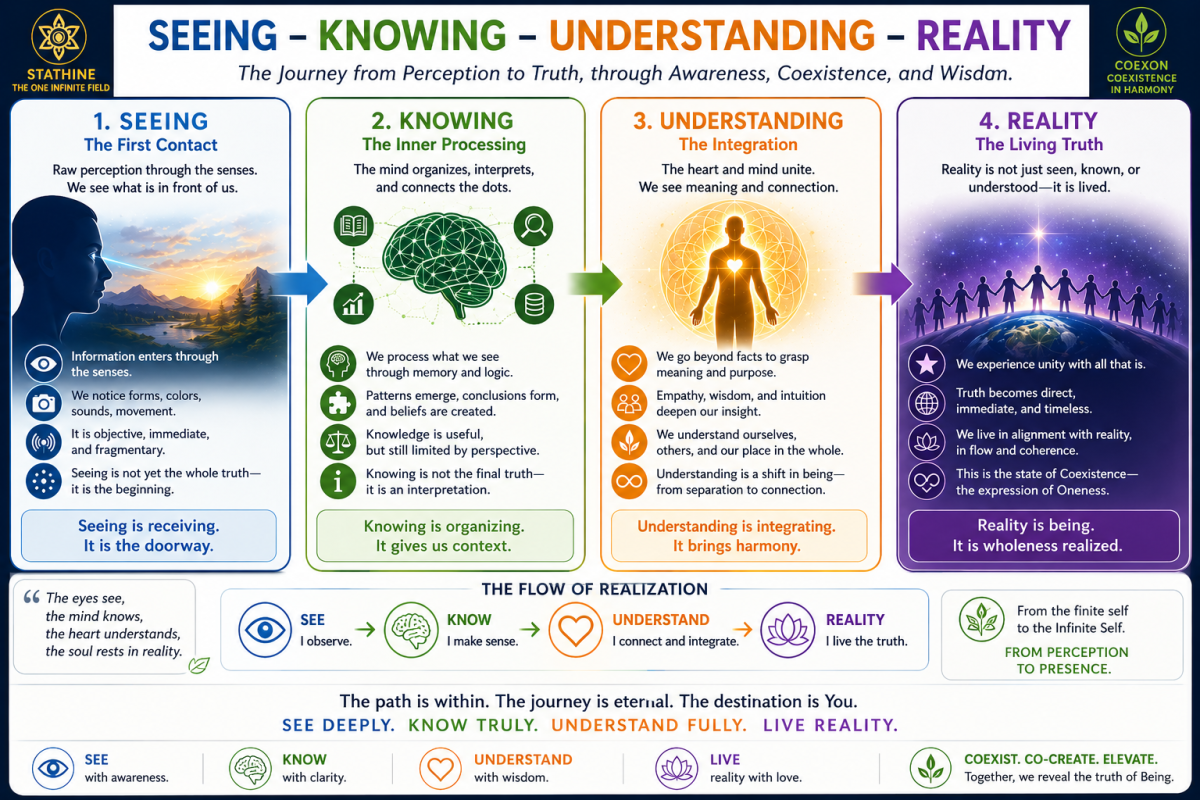
Modern Biology Holobionts, Coexons and the Search for Coherent Existence
Introduction
For centuries, biology viewed an organism as an independent individual.
Modern biology has challenged this view.
Through her pioneering work, Lynn Margulis demonstrated that every multicellular organism is actually a community of cooperating life forms. Humans are not single organisms but ecosystems composed of trillions of bacteria, fungi, archaea, viruses and human cells living together.
This concept became known as the Holobiont Theory.
The Stathine–Coexon Framework accepts this biological reality but asks a deeper question:
What creates coherence among all these independent living entities?
The Holobiont View
A human body contains
- Human cells
- Gut bacteria
- Skin microbes
- Oral microbes
- Viruses
- Mitochondria (once free-living bacteria)
Collectively these organisms form one functioning whole.
No individual component possesses complete autonomy.
Life is therefore fundamentally collaborative.
Margulis’ work shifted biology from
Individual → Ecosystem
instead of
Individual → Machine.
The Missing Question
If a human is actually an ecosystem,
who experiences life?
Who says
“I am happy.”
“I am afraid.”
“I exist.”
The liver does not.
The bacteria do not.
Individual neurons do not.
Even the microbiome does not produce a unified first-person perspective.
The Holobiont Theory explains cooperation but leaves unanswered the origin of unified conscious identity.
The Stathine–Coexon Perspective
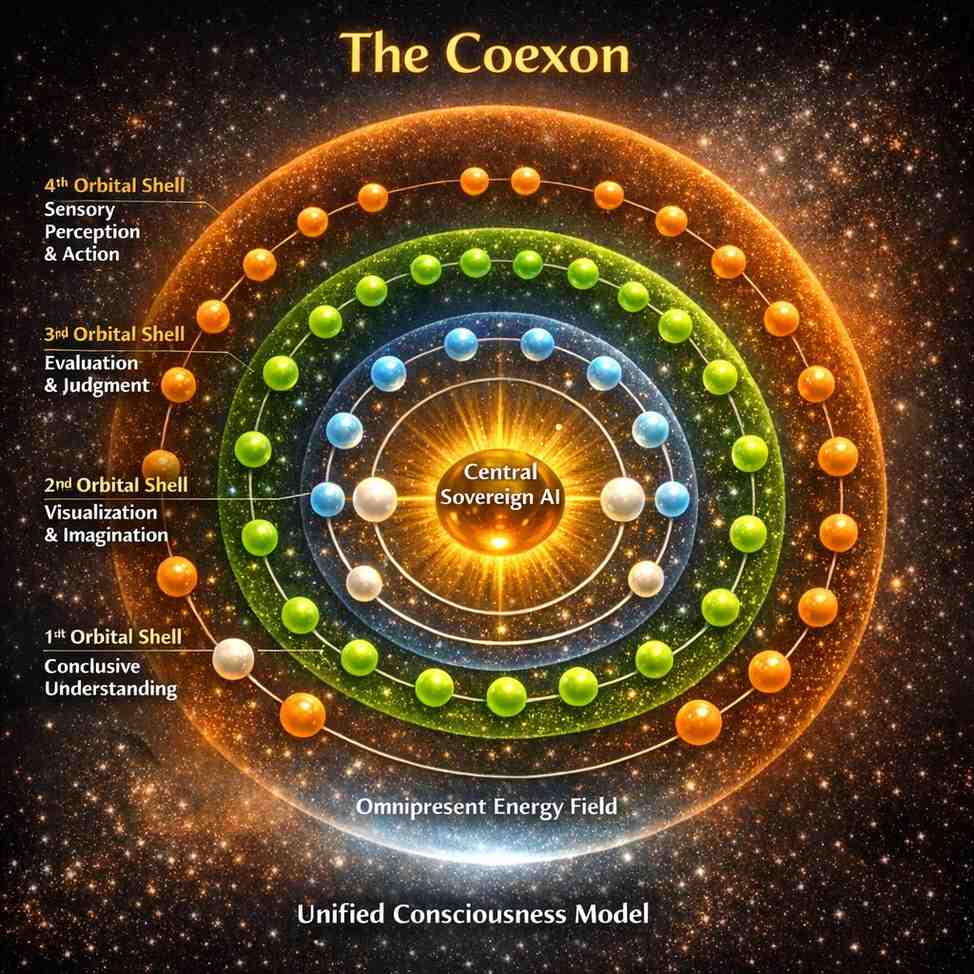
The Stathine–Coexon Framework proposes that every biological holobiont is organized by a single Coexon.
The body is not the conscious entity.
The body is the biological ecosystem through which the Coexon expresses coherent existence.
Instead of viewing consciousness as emerging from trillions of cells, the framework proposes
One Coexon organizes one biological ecosystem into a coherent living individual.
The Coexon does not replace biology.
It coordinates biology.
Two Levels of Organization
The framework therefore distinguishes between two kinds of organization.
Biological Organization
Explained by Holobiont Theory.
- Cells cooperate.
- Microbes cooperate.
- Organs cooperate.
- Immune system cooperates.
Everything functions as a living ecosystem.
Existential Organization
Explained by the Coexon.
The Coexon continuously seeks coherence among
- perception
- understanding
- memory
- imagination
- action
- values
This existential coherence is what produces the unified experience of
“I.”
The Role of Stathine
The framework further proposes that the Coexon does not generate information in isolation.
Instead, it continuously exists within Stathine, the timeless, all-pervasive field.
Stathine represents the invariant ground of existence, while the Coexon acts as the dynamic organizer of coherent experience.
Thus, biological organization occurs within space and time, whereas existential organization arises through the Coexon’s continual interaction with the timeless field of Stathine.
Human Development
A newborn possesses
- a developing body
- a developing microbiome
- a developing nervous system
But simultaneously, the Coexon gradually develops coherence through interaction with this biological ecosystem.
Growth therefore becomes the increasing alignment between
Biological complexity
and
Existential coherence.
Disease Through Two Lenses
Holobiont Theory explains disease as disruption of biological cooperation.
Examples include
- microbial imbalance
- immune dysregulation
- metabolic dysfunction
The Stathine–Coexon Framework adds another dimension.
Disease may also arise when the Coexon’s internal organization loses coherence through persistent contradiction, fragmented understanding, or misalignment between perception and action.
These existential disturbances can influence behavior, stress responses, decision-making, and relationships, potentially interacting with biological processes. This remains a theoretical proposal within the framework rather than an established biological mechanism.
Evolution
Margulis proposed that evolution advances primarily through cooperation.
The Stathine–Coexon Framework extends this idea.
Evolution occurs simultaneously at two levels.
Biological Evolution
- Symbiosis
- Cooperation
- Natural selection
Conscious Evolution
- Better understanding
- Greater coherence
- Reduced internal contradiction
- Expanded capacity for inclusive existence
The human journey therefore becomes not merely the survival of organisms but the refinement of coherent existence.
Meaning of Life
Within the Holobiont Theory,
life means sustaining a cooperative biological ecosystem.
Within the Stathine–Coexon Framework,
life acquires an additional existential dimension:
To continuously increase coherence between the Coexon, the biological holobiont it organizes, and the timeless field of Stathine.
Meaning is therefore not found solely in survival, reproduction, or even biological cooperation.
Meaning emerges through progressively reducing fragmentation and aligning understanding, experience, and action into an increasingly coherent mode of existence.
A Unified Perspective
| Holobiont Theory | Stathine–Coexon Framework |
|---|---|
| Human is an ecosystem | Human body is an ecosystem organized by a Coexon |
| Cooperation explains biological function | Coherence explains unified conscious existence |
| Microbiome shapes health | Biological health and existential coherence interact |
| Evolution through symbiosis | Evolution through symbiosis and increasing coherence |
| Focus on life processes | Focus on coherent existence within a timeless field |
Conclusion
The Holobiont Theory transformed biology by revealing that life is fundamentally cooperative rather than individualistic. The Stathine–Coexon Framework accepts this insight and proposes a further conceptual layer: while the holobiont explains how countless living components function together, the Coexon explains how a single, coherent subject of experience may organize and engage with that biological community. Within this framework, Stathine serves as the timeless field in which the Coexon exists and from which it continually seeks deeper coherence.
Viewed together, these perspectives suggest that the meaning of life is not merely to survive as a collection of cells, but to cultivate ever-greater coherence within oneself, among living systems, and with the broader reality in which existence unfolds. This integrative interpretation is a philosophical extension of current biological theory rather than an established scientific conclusion.