Donald Hoffman and the Stathine–Coexon Framework
Abstract
For centuries, science has largely assumed that physical reality is fundamental and that consciousness emerges from sufficiently complex material systems. Donald Hoffman’s theory of Conscious Realism challenges this assumption by proposing that consciousness, rather than spacetime and matter, is the primary constituent of reality. Through his Interface Theory of Perception, Hoffman further argues that evolution has shaped perception not to reveal objective reality but to provide adaptive interfaces that guide behavior.
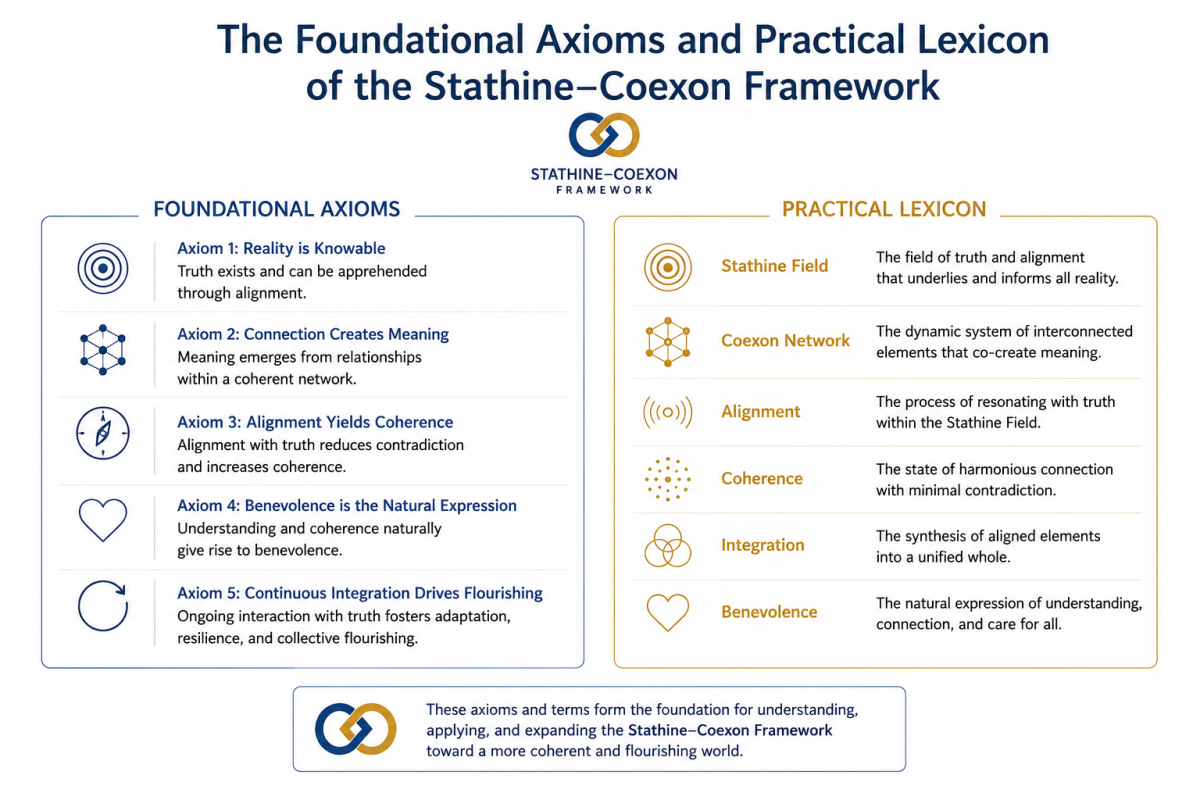
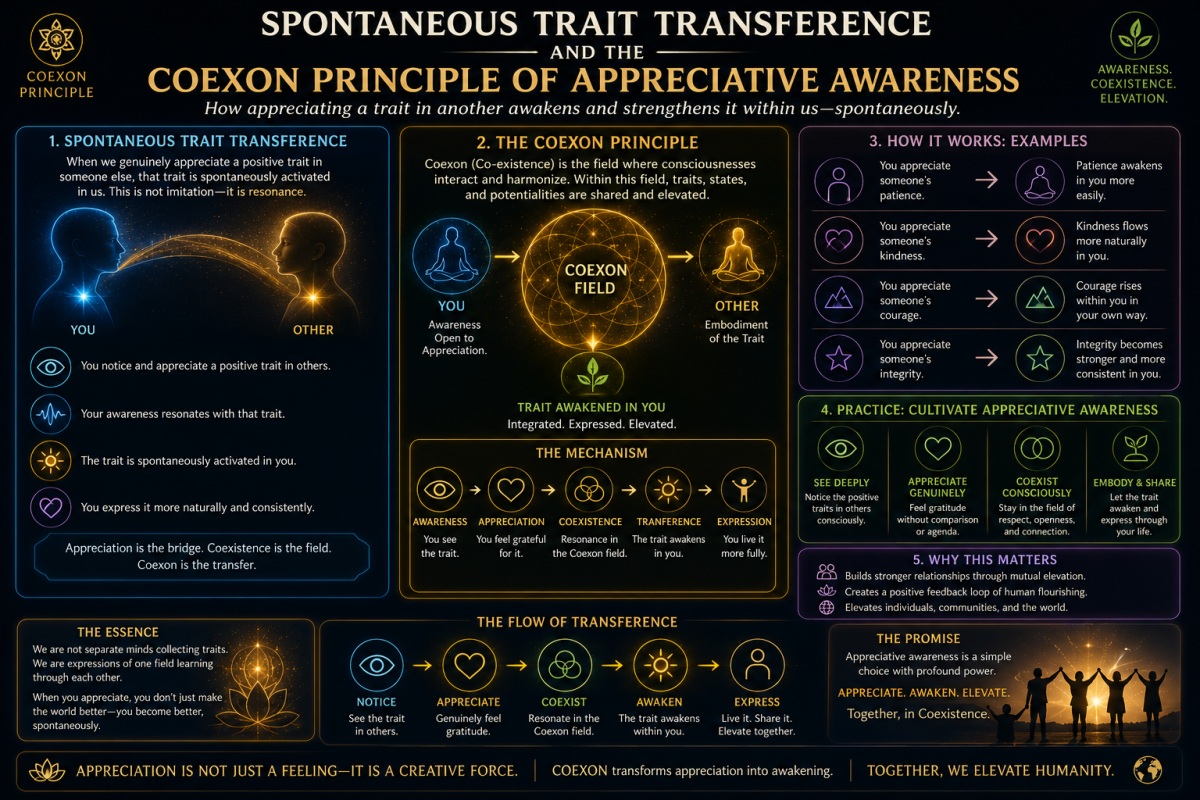
This paper explores the relationship between Hoffman’s work and the Stathine–Coexon Framework. While Conscious Realism proposes conscious agents as the fundamental entities from which physical reality emerges, the Stathine–Coexon Framework introduces the Coexon as a timeless life atom existing within the timeless field of Stathine. The framework proposes that coherent understanding, rather than consciousness alone, serves as the organizing principle through which reality is experienced. Rather than competing explanations, the two perspectives may be viewed as complementary approaches to understanding the relationship between consciousness, reality, and existence.
1. Introduction
Few questions are more fundamental than the relationship between consciousness and reality.
Does matter produce consciousness?
Or does consciousness give rise to the appearance of matter?
For most of modern science, the dominant assumption has been that physical processes generate subjective experience.
Donald Hoffman’s work reverses this assumption.
He proposes that consciousness is fundamental and that spacetime itself may be an adaptive interface rather than ultimate reality.
The Stathine–Coexon Framework shares the intuition that observable physical reality is not the deepest layer of existence.
However, it proposes an additional ontological distinction between the timeless field of Stathine and the timeless life atom called the Coexon.
2. Conscious Realism
At the center of Hoffman’s philosophy is Conscious Realism.
Reality is fundamentally composed of conscious agents.
Physical objects are not primary.
Instead, they emerge from interactions among conscious agents.
In this view, consciousness is not a product of evolution.
Rather, evolution itself unfolds within a reality constituted by conscious experience.
This inversion represents one of the most significant philosophical departures from conventional materialism.
The Stathine–Coexon Framework welcomes this movement beyond reductionism while proposing a different ontological architecture.
3. The Interface Theory of Perception
Hoffman’s Interface Theory argues that natural selection favors perceptions that enhance survival rather than perceptions that faithfully represent objective reality.
Perception functions much like a computer desktop.
Icons simplify complexity.
They enable effective interaction.
They do not reveal the underlying computational architecture.
Similarly, human perception provides useful interfaces rather than direct access to ultimate reality.
The Stathine–Coexon Framework accepts this insight.
Human experience is understood as an interpretive interface generated through the interaction between the biological organism and the Coexon.
Reality is therefore always experienced through organized interpretation rather than direct observation.
4. Conscious Agents and the Coexon
Hoffman models reality using interacting conscious agents.
The Stathine–Coexon Framework proposes the Coexon as the fundamental life atom possessing a specific atomic architecture and an intrinsic capacity for coherent understanding.
Although these concepts arise from different philosophical traditions, both attempt to explain how conscious experience can be fundamental rather than derivative.
A significant distinction, however, lies in emphasis.
Hoffman’s conscious agents are mathematical entities describing interactions that give rise to observed reality.
The Coexon is proposed as an ontological principle whose defining characteristic is the continual organization of information into coherence.
Within the Stathine–Coexon Framework, coherence rather than consciousness alone becomes the primary organizing principle.
5. Atemporal Consciousness
One of the most intriguing implications of Conscious Realism is that consciousness is not fundamentally constrained by spacetime.
The Stathine–Coexon Framework develops a related but distinct proposal.
Both Stathine and the Coexon are considered timeless.
They neither originate within spacetime nor depend upon temporal processes for their existence.
Time emerges only when the Coexon interacts with changing biological systems.
Conscious experience therefore possesses two complementary dimensions.
The biological organism experiences sequential time.
The Coexon exists within timeless coherence.
Subjective continuity arises through their interaction.
6. Coherence Beyond Consciousness
Consciousness alone does not necessarily explain wisdom.
Nor does awareness automatically generate alignment.
Individuals may possess conscious experience while remaining internally fragmented.
The Stathine–Coexon Framework therefore distinguishes between:
- consciousness,
- understanding,
- coherence.
Consciousness makes experience possible.
Understanding organizes experience.
Coherence integrates understanding into aligned perception, intention, communication, and action.
This distinction shifts the central philosophical question.
Rather than asking only how consciousness arises, the framework asks how consciousness becomes progressively coherent.
7. Identity and Persistence
One challenge for every theory of consciousness concerns personal identity.
Human bodies change continuously.
Memories evolve.
Neural structures reorganize.
Yet individuals experience a persistent sense of self.
Hoffman’s work approaches this question through continuing interactions among conscious agents.
The Stathine–Coexon Framework proposes that the persistence of identity reflects the enduring coherence of the Coexon.
Identity therefore becomes neither purely biological nor purely psychological.
It becomes coherence maintained across changing biological states.
8. Reality as Participatory
Both frameworks reject naive realism.
Reality is not simply observed.
It is actively participated in.
For Hoffman, conscious agents generate the structures that appear as physical reality.
Within the Stathine–Coexon Framework, the Coexon continuously participates in organizing experience through interaction with biological processes grounded within Stathine.
Participation therefore becomes an ongoing dialogue between timeless coherence and temporal embodiment.
9. Toward an Integrative Ontology
The relationship between Conscious Realism and the Stathine–Coexon Framework illustrates two complementary approaches.
Conscious Realism asks:
“What is fundamentally real?”
The Stathine–Coexon Framework asks:
“How does timeless existence become coherent lived experience?”
One emphasizes consciousness.
The other emphasizes coherence.
These emphases need not be incompatible.
Together they encourage a broader exploration of reality beyond conventional materialism.
10. Future Research Directions
The dialogue between Hoffman’s work and the Stathine–Coexon Framework suggests several interdisciplinary questions:
- Can coherent organization be conceptually distinguished from conscious experience?
- How might timeless ontological principles relate to temporally evolving biological systems?
- Can mathematical models of conscious agents be compared with conceptual models of the Coexon?
- Might coherence provide a useful bridge between consciousness studies and systems theory?
- Could future research distinguish empirically between theories centered on consciousness and those centered on coherence?
Such questions invite collaboration among cognitive science, philosophy of mind, theoretical physics, neuroscience, information theory, and consciousness studies.
Conclusion
Donald Hoffman’s work has made a significant contribution to contemporary philosophy of mind by challenging the assumption that physical reality is fundamental and by proposing Conscious Realism as an alternative ontology. His Interface Theory of Perception further suggests that human perception functions as an adaptive interface rather than a transparent window onto objective reality.
The Stathine–Coexon Framework seeks to complement these ideas by introducing Stathine as the timeless field of existence and the Coexon as the timeless life atom responsible for organizing experience into coherent understanding. Within this framework, consciousness is not viewed in isolation but as part of a broader process in which coherence integrates perception, understanding, identity, and action.
Whether this proposal ultimately proves fruitful will depend upon its philosophical rigor, interdisciplinary engagement, and capacity to generate new questions for inquiry. Its central contribution is the suggestion that the future study of consciousness may benefit from expanding beyond the question of what is conscious toward the deeper question of how consciousness becomes coherently organized within existence. If so, the dialogue between Conscious Realism and the Stathine–Coexon Framework may help illuminate a richer ontology in which timeless consciousness and timeless coherence are understood as complementary dimensions of reality.