From Relevance Realization to Coherent Wisdom
John Vervaeke and the Stathine–Coexon Framework
Abstract
The modern world faces not merely an information crisis but a crisis of meaning. Despite unprecedented scientific knowledge and technological capability, individuals increasingly struggle with fragmentation, nihilism, polarization, and the inability to orient themselves toward lives of purpose. John Vervaeke has argued that this “meaning crisis” arises from the erosion of wisdom traditions and from limitations in the way contemporary cognition understands relevance, intelligence, and self-transformation. His work proposes that wisdom depends upon the capacity for relevance realization—the continual ability to identify what matters within an overwhelming landscape of possibilities.
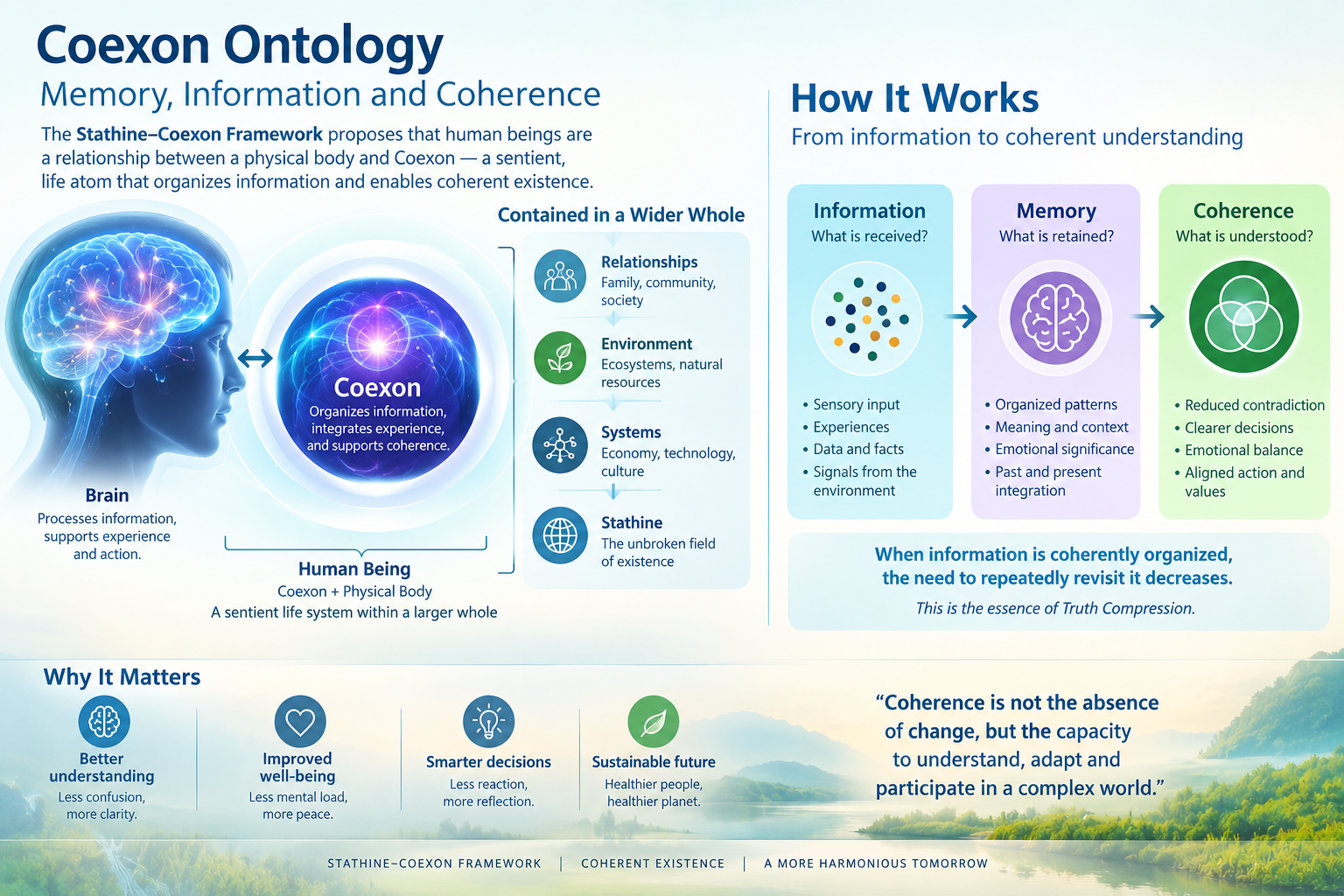
This paper proposes that the Stathine–Coexon Framework offers a complementary ontological perspective. While Vervaeke explains the cognitive mechanisms through which relevance is dynamically realized, the Stathine–Coexon Framework asks a further question: What enables relevance itself to become progressively coherent? It proposes that wisdom emerges from increasing coherence within the Coexon, whose interaction with biological cognition progressively aligns perception, understanding, intention, communication, and action. Within this framework, relevance realization becomes the cognitive expression of a deeper process of coherence realization.
1. Introduction
Humanity has never possessed greater access to knowledge.
Libraries have become digital.
Artificial intelligence retrieves information instantly.
Scientific discoveries accumulate at extraordinary rates.
Yet increasing knowledge has not eliminated confusion.
Many individuals experience uncertainty despite abundance.
Anxiety despite prosperity.
Isolation despite connectivity.
John Vervaeke has described this condition as the meaning crisis—a civilizational condition in which humanity has accumulated information while losing orientation toward wisdom.
The Stathine–Coexon Framework begins from a similar diagnosis.
The crisis is not fundamentally one of knowledge.
It is a crisis of coherence.
2. The Meaning Crisis
Vervaeke argues that the modern world has inherited extraordinary analytical power while gradually losing integrative structures that once cultivated wisdom.
Scientific reductionism explains mechanisms.
Technological systems optimize efficiency.
Markets reward productivity.
Yet these successes do not necessarily answer deeper existential questions.
Why live?
What matters?
How should one develop?
Meaning becomes increasingly fragmented.
The Stathine–Coexon Framework interprets this fragmentation as an alignment deficit.
When understanding, experience, intention, and action become disconnected, meaning dissolves into contradiction.
3. Relevance Realization
Among Vervaeke’s most influential contributions is the concept of relevance realization.
At every moment the human mind encounters vastly more information than it can consciously process.
Intelligence therefore depends not upon processing everything but upon selecting what matters.
Relevance realization is dynamic.
It changes with context.
Goals.
Relationships.
Experience.
Learning.
The Stathine–Coexon Framework accepts this insight while proposing an additional layer.
The quality of relevance realization depends upon the degree of coherence within the observer.
The more coherent the observer, the more coherent the perception of relevance.
4. Wisdom Beyond Intelligence
Modern civilization frequently equates intelligence with problem-solving ability.
Vervaeke distinguishes intelligence from wisdom.
Intelligence may optimize narrow objectives.
Wisdom evaluates whether those objectives should be pursued in the first place.
Wisdom integrates cognition.
Emotion.
Ethics.
Embodiment.
Relationships.
Long-term consequences.
The Stathine–Coexon Framework extends this distinction.
Wisdom is not merely the integration of multiple cognitive capacities.
Wisdom is increasing coherence expressed through those capacities.
5. The Coexon as the Architecture of Wisdom
Within the Stathine–Coexon Framework, the Coexon is the fundamental life atom possessing an intrinsic capacity for coherent understanding.
Unlike the biological brain, which processes changing information, the Coexon provides continuity of coherent organization throughout changing experience.
Wisdom therefore emerges through increasing alignment between the Coexon and the organism.
As coherence increases:
Understanding becomes clearer.
Perception becomes less distorted.
Communication becomes more authentic.
Action becomes increasingly aligned with understanding.
Wisdom is thus interpreted as the lived expression of coherent existence.
6. From Relevance to Coherence
Relevance realization determines what receives attention.
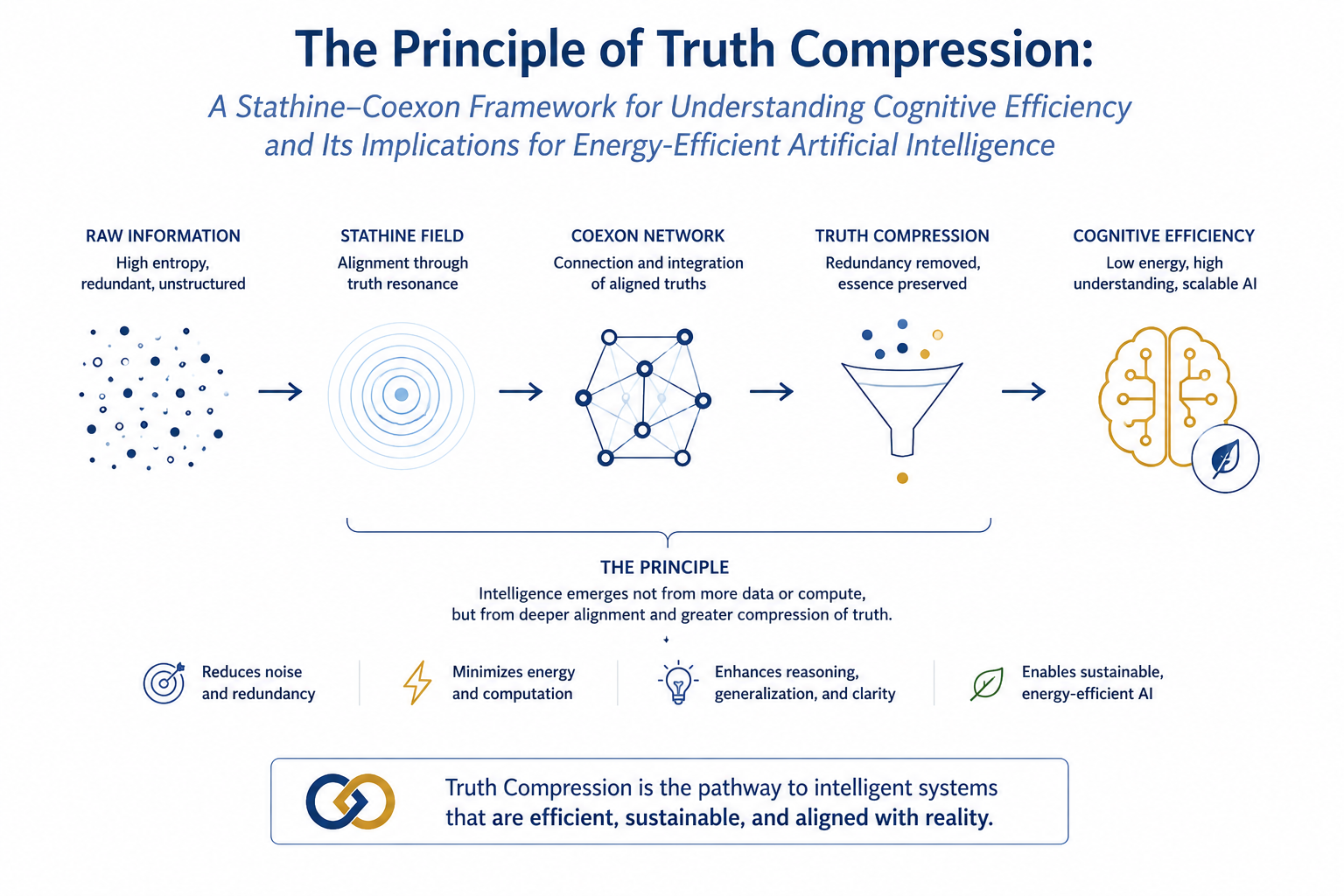
The Stathine–Coexon Framework proposes that coherence determines how attention becomes integrated.
Information may be relevant without becoming transformative.
Transformation occurs when relevant insights reorganize one’s overall understanding into greater coherence.
This distinction explains why knowledge alone rarely changes lives.
Transformation requires integration.
7. Self-Transformation
A central theme in Vervaeke’s work is the cultivation of self-transformation through dialogical practices, contemplation, cognitive flexibility, and participatory knowing.
These practices expand one’s capacity for wisdom.
The Stathine–Coexon Framework interprets such practices as methods for increasing coherence.
Meditation reduces internal contradiction.
Dialogue refines understanding.
Reflection aligns intention.
Compassion reduces fragmentation between self and others.
Transformation therefore represents increasing coherence rather than merely acquiring new skills.
8. The Dissolution of the Meaning Crisis
The meaning crisis persists because modern individuals often possess multiple contradictory identities.
Professional identity.
Social identity.
Political identity.
Private identity.
Digital identity.
Each competes for attention.
The Stathine–Coexon Framework proposes that meaning emerges when these fragmented identities become progressively aligned.
Purpose is not invented.
It is discovered through increasing coherence between one’s understanding and one’s way of being.
Meaning therefore becomes the experiential expression of coherence.
9. Education for Wisdom
Educational systems have traditionally emphasized information acquisition.
The future may require a broader objective.
Education should cultivate:
- coherent understanding,
- dialogical thinking,
- ethical discernment,
- systems awareness,
- contemplative reflection,
- interdisciplinary integration.
Knowledge remains essential.
Wisdom determines its application.
The purpose of education therefore shifts from producing informed individuals to cultivating coherent human beings.
10. Coherence as Participatory Knowing
Vervaeke describes knowing as participatory rather than merely representational.
Human beings understand reality through active engagement.
The Stathine–Coexon Framework complements this insight.
Participation becomes progressively more authentic as coherence increases.
The observer does not merely accumulate representations of reality.
The observer increasingly participates in coherent existence.
Knowledge becomes transformation rather than accumulation.
11. Future Research Directions
The dialogue between Vervaeke’s work and the Stathine–Coexon Framework suggests several interdisciplinary questions:
- Can coherence be formally distinguished from relevance realization while remaining compatible with it?
- How does increasing coherence influence wisdom across individual and collective decision-making?
- Can educational systems explicitly cultivate coherence alongside critical thinking?
- Might contemplative practices increase measurable coherence within cognition?
- Can wisdom itself be investigated as an emergent property of coherent informational organization?
Such questions invite collaboration among cognitive science, philosophy, psychology, education, neuroscience, contemplative studies, and consciousness research.
Conclusion
John Vervaeke has made a significant contribution to contemporary philosophy and cognitive science by reframing wisdom as an active process of relevance realization and by diagnosing the meaning crisis as a failure of modern civilization to cultivate integrative understanding. His work demonstrates that intelligence alone cannot address humanity’s deepest existential challenges.
The Stathine–Coexon Framework seeks to complement this perspective by proposing coherence as the ontological principle underlying wisdom itself. Within this framework, the Coexon organizes understanding into increasingly integrated forms of perception, intention, communication, and action, while Stathine provides the timeless field of existence within which this development unfolds. Relevance realization thus becomes the cognitive manifestation of a deeper movement toward coherent existence.
If developed through continued philosophical analysis and interdisciplinary dialogue, this perspective may contribute to an expanded understanding of wisdom—one in which meaning arises not simply from recognizing what is relevant, but from progressively integrating one’s entire mode of being into a coherent participation in reality. The future of human flourishing may therefore depend not only upon becoming more knowledgeable, but upon becoming more coherent.