
From Civilizational Coordination to Coherent Civilization
Daniel Schmachtenberger and the Stathine–Coexon Framework
Abstract
Human civilization has entered an era in which technological capability, ecological interdependence, and global connectivity have become inseparable. The same systems that create unprecedented prosperity also generate existential risks that transcend national, political, and disciplinary boundaries. Daniel Schmachtenberger has argued that humanity’s central challenge is not simply technological progress but the development of collective wisdom capable of coordinating increasingly powerful systems. His work emphasizes existential risk, collective sensemaking, incentive redesign, and civilization-scale coordination.
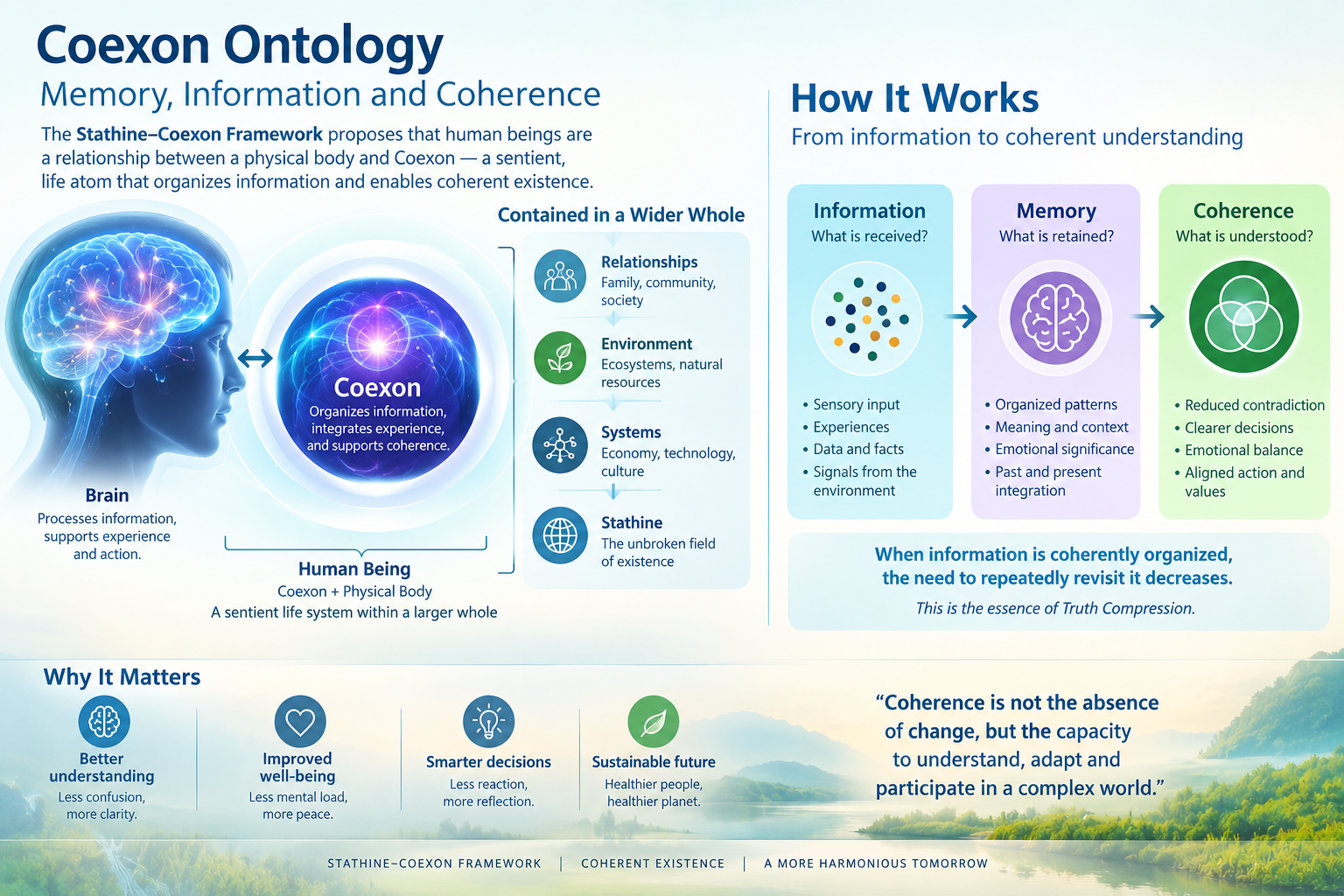
This paper proposes that the Stathine–Coexon Framework provides a complementary philosophical perspective on these challenges. While Schmachtenberger’s work analyzes the mechanisms through which civilization succeeds or fails to coordinate, the Stathine–Coexon Framework asks a deeper ontological question: What makes durable coordination possible? It proposes that long-term coordination is an emergent consequence of coherence. Stathine represents the timeless field of invariant existence, while the Coexon represents the timeless life atom capable of organizing understanding into coherent action. Within this framework, civilization advances not merely through better coordination but through increasing coherence at individual, institutional, and planetary scales.
1. Introduction
Humanity has never possessed greater power.
Artificial intelligence accelerates discovery.
Biotechnology reshapes life.
Global communication connects billions of people instantly.
Financial systems operate continuously across continents.
Scientific knowledge expands exponentially.
Yet increasing capability has not produced equivalent increases in collective wisdom.
Instead, civilization faces climate instability, geopolitical tension, technological misuse, information disorder, and declining trust in institutions.
Daniel Schmachtenberger has repeatedly argued that these are not isolated crises.
They are manifestations of a deeper civilizational coordination problem.
The Stathine–Coexon Framework accepts this diagnosis while proposing an additional insight.
Coordination itself emerges from a more fundamental principle:
Coherence.
2. Existential Risk as a Systemic Phenomenon
One of Schmachtenberger’s major contributions is the recognition that existential risks interact rather than remain isolated.
Climate change affects migration.
Migration influences political stability.
Political instability shapes technological governance.
Technological development transforms economics.
Economic incentives reshape ecological systems.
Each problem amplifies every other problem.
This systems perspective demonstrates that civilization cannot solve complex challenges independently.
The Stathine–Coexon Framework extends this observation.
The common source beneath many systemic failures is not merely insufficient coordination.
It is insufficient coherence.
Fragmented understanding inevitably generates fragmented action.
3. Sensemaking and the Limits of Information
Modern civilization produces unprecedented quantities of information.
Paradoxically, increasing information has not reduced confusion.
Individuals possess access to more knowledge than any previous generation while simultaneously experiencing greater polarization, misinformation, and uncertainty.
Schmachtenberger emphasizes collective sensemaking as an essential civilizational capacity.
The Stathine–Coexon Framework agrees but distinguishes three levels:
- Information.
- Knowledge.
- Coherence.
Information accumulates.
Knowledge organizes.
Coherence integrates.
Only coherence consistently transforms understanding into wise action.
4. Coordination as an Emergent Property
Coordination is often approached as a problem of institutions.
Improved governance.
Improved incentives.
Improved communication.
Improved technology.
These remain indispensable.
However, the Stathine–Coexon Framework proposes that effective coordination cannot be sustained solely through external structures.
Coordination emerges naturally when coherent understanding exists among participating individuals.
External coordination without internal coherence produces compliance.
Internal coherence produces voluntary alignment.
The distinction is fundamental.
5. The Coexon and Human Alignment
Within the Stathine–Coexon Framework, the Coexon is the fundamental life atom responsible for organizing information into coherent understanding.
Human beings therefore possess an intrinsic capacity for increasing alignment.
Alignment occurs across multiple dimensions:
- understanding,
- perception,
- intention,
- communication,
- action.
When these dimensions converge, individuals exhibit increasing integrity.
Organizations composed of such individuals exhibit increasing trust.
Societies composed of such organizations become capable of sustainable coordination.
Civilizational coherence therefore begins within individual coherence.
6. Stathine and Shared Reality
Polarization frequently arises because groups construct incompatible descriptions of reality.
The framework introduces Stathine as the timeless field of invariant existence.
Conceptually, Stathine represents the shared ontological background that exists independently of competing interpretations.
Although perspectives differ, reality itself remains continuous.
This distinction encourages dialogue rather than ideological conflict.
Individuals may disagree while participating in the same underlying reality.
Coherence increases as understanding converges toward that shared foundation.
7. Beyond Incentive Design
Schmachtenberger has highlighted the importance of correcting misaligned incentives within civilization.
The Stathine–Coexon Framework complements this analysis.
Incentives influence behavior.
Understanding shapes incentives.
Coherence transforms understanding.
Long-term civilization therefore depends not only upon better systems but also upon more coherent human beings capable of designing wiser systems.
Institutional reform and personal development become mutually reinforcing processes rather than separate domains.
8. Coherence as the Third Civilizational Attractor
Human civilization has historically organized itself around successive attractors.
Traditional societies emphasized stability through inherited authority.
Modern societies emphasized progress through scientific and technological advancement.
Contemporary civilization increasingly seeks adaptive coordination across complex global systems.
The Stathine–Coexon Framework proposes a further transition.
The next attractor is coherence.
Coherence does not eliminate diversity.
It enables diversity to function as an integrated whole.
This represents a shift from optimization toward alignment.
From competition toward complementarity.
From fragmentation toward integration.
9. Education for Civilizational Coherence
If coherence is foundational, education requires reorientation.
Current educational systems primarily transmit information and technical expertise.
Future education must cultivate the capacity to integrate knowledge across disciplines.
Students should learn to recognize relationships rather than merely memorize facts.
Critical thinking should be complemented by coherent thinking.
Personal development should become inseparable from scientific literacy.
Education thereby becomes preparation for civilizational participation rather than simply economic productivity.
10. Toward a Regenerative Civilization
Regeneration extends beyond environmental restoration.
A regenerative civilization continuously increases coherence across every level of organization.
Individuals cultivate alignment.
Families cultivate trust.
Communities cultivate cooperation.
Institutions cultivate transparency.
Economies cultivate reciprocity.
Governance cultivates long-term responsibility.
Civilizations cultivate wisdom.
Regeneration therefore becomes increasing coherence expressed through increasingly integrated systems.
11. Future Research Directions
The relationship between Schmachtenberger’s systems perspective and the Stathine–Coexon Framework suggests several avenues for further exploration:
- Can civilizational coherence be defined independently of institutional coordination?
- What indicators distinguish coherent societies from merely efficient ones?
- How does individual psychological coherence influence large-scale institutional resilience?
- Can educational systems explicitly cultivate coherence as a measurable developmental capacity?
- Might coherence function as a unifying principle connecting ethics, governance, economics, ecology, and technological development?
These questions invite collaboration among systems science, philosophy, psychology, education, governance, and complexity research.
Conclusion
Daniel Schmachtenberger’s work has significantly expanded humanity’s understanding of existential risk, collective sensemaking, and the necessity of civilization-scale coordination. His analyses demonstrate that fragmented systems cannot sustainably manage increasingly interconnected challenges.
The Stathine–Coexon Framework seeks to complement this perspective by proposing that enduring coordination arises from a deeper principle: coherence. Stathine provides the timeless field of shared existence, while the Coexon provides the organizing principle through which understanding becomes aligned with action. From this viewpoint, civilization evolves not merely by improving coordination mechanisms but by increasing coherence within individuals, institutions, and cultures.
If this proposal continues to develop through rigorous philosophical inquiry, interdisciplinary engagement, and practical application, it may contribute to a broader vision of human flourishing in which coordination is understood not as the ultimate goal but as the natural consequence of coherent existence. In this sense, the next stage of civilization may be characterized not only by greater intelligence or greater technological power, but by a deeper capacity to integrate knowledge, purpose, and action into a coherent planetary civilization.