A Developmental Roadmap from Individual Alignment to Global Human Flourishing Through the Stathine–Coexon Framework
Abstract
Human civilization has reached an unprecedented stage of technological capability. Artificial intelligence, biotechnology, global communication, and scientific knowledge continue to expand rapidly. Yet humanity simultaneously faces increasing polarization, environmental degradation, psychological distress, armed conflict, and declining social trust.
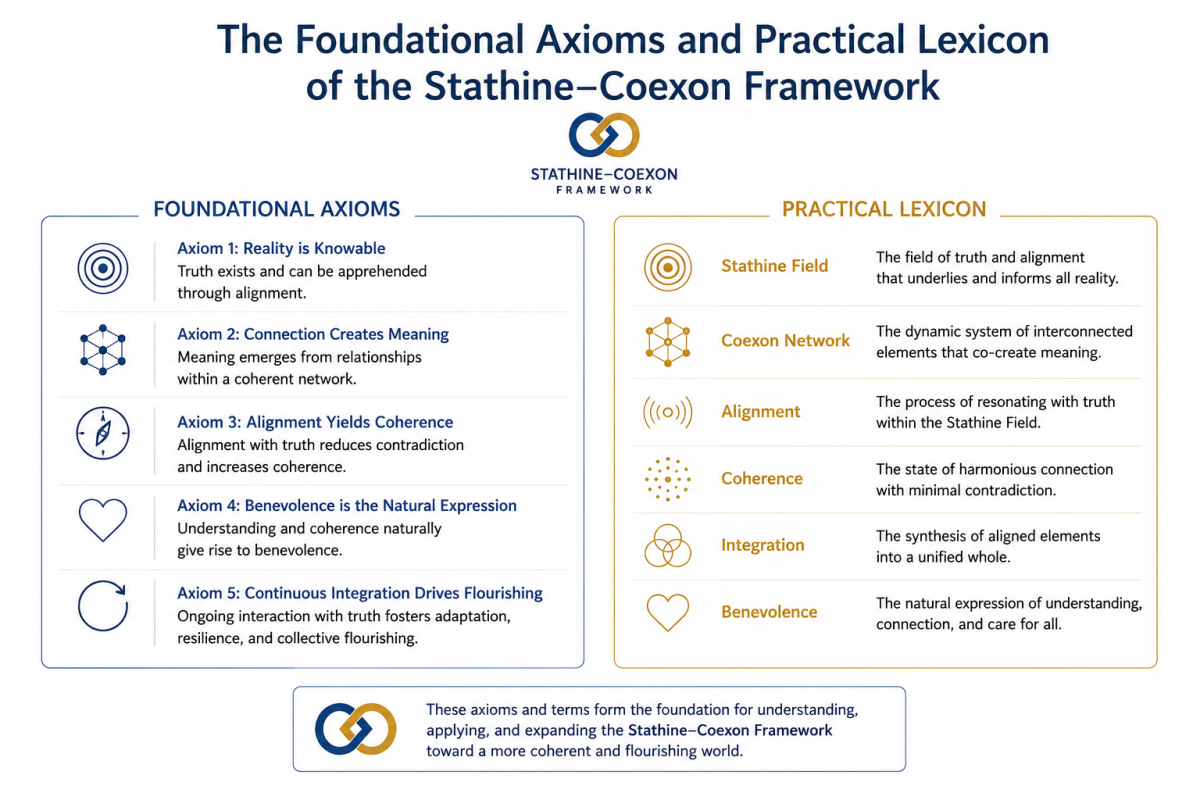
The Stathine–Coexon framework proposes that these challenges arise from fragmentation rather than from an absolute lack of resources or intelligence. It introduces the concept of energy-free motion in coherence, defined as a state in which individuals and societies act in alignment with reality, requiring progressively less internal and external conflict to achieve meaningful outcomes.
This article presents a developmental roadmap through which humanity may gradually move from fragmentation toward coherence. The roadmap is intended as a conceptual framework for education, public policy, organizational development, and personal growth.
1. The Present Situation (2026)
Humanity possesses extraordinary capabilities.
We have:
- advanced medicine,
- global communication,
- artificial intelligence,
- abundant scientific knowledge,
- unprecedented productive capacity.
Yet humanity also experiences:
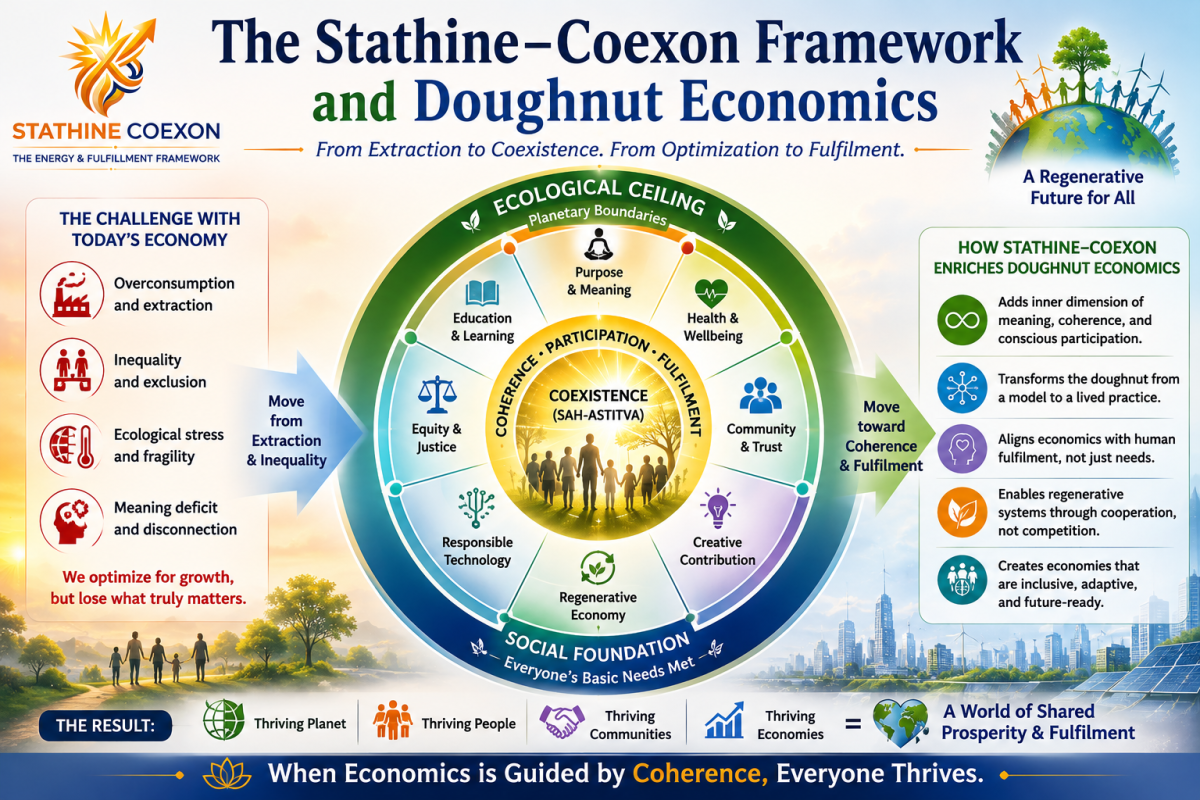
- wars,
- political polarization,
- ecological stress,
- economic inequality,
- loneliness,
- declining trust,
- widespread anxiety.
The contradiction is striking.
Capability has increased faster than understanding.
The Stathine–Coexon framework proposes that civilization has entered a new developmental phase.
The challenge is no longer producing more knowledge.
The challenge is increasing coherence.
2. What is Energy-Free Motion?
In physics, systems require minimal energy when moving along stable paths consistent with physical laws.
The framework extends this idea metaphorically to human systems.
Energy-free motion does not imply zero energy expenditure.
Rather, it refers to minimizing energy wasted through:
- internal contradiction,
- interpersonal conflict,
- institutional friction,
- social distrust,
- ecological damage.
When understanding aligns with reality, unnecessary friction decreases.
The same amount of human effort produces greater benefit.
3. The Principle of Coherence
The framework proposes a simple principle.
As coherence increases:
- understanding increases,
- trust increases,
- cooperation increases,
- creativity increases,
- resilience increases.
Simultaneously,
- conflict decreases,
- fear decreases,
- exploitation decreases,
- waste decreases,
- suffering decreases.
The objective is not perfection.
The objective is continuous movement toward greater coherence.
Phase One: Individual Development
Step 1 – Learning to Observe
Education should begin by teaching observation.
Students learn to distinguish:
- facts,
- interpretations,
- assumptions,
- emotions,
- beliefs.
Observation precedes understanding.
Step 2 – Understanding Feelings
Individuals learn to distinguish:
- bodily sensations,
- emotions,
- thoughts,
- values,
- intentions.
Emotional literacy becomes foundational.
Step 3 – Understanding Reality
Education shifts from memorizing information to understanding relationships.
Students ask:
- Why?
- How?
- What is the consequence?
- What is the utility?
Understanding replaces rote learning.
Step 4 – Internal Coherence
Individuals gradually reduce internal contradiction.
Values become aligned with actions.
Thinking aligns with reality.
Behavior becomes increasingly consistent.
Internal conflict decreases.
Phase Two: Family Development
Step 5 – Families Become Learning Communities
Families move from command-and-control relationships toward shared understanding.
Parents become mentors.
Children become active learners.
Authority becomes guidance rather than domination.
Step 6 – Conflict Resolution Through Understanding
Instead of assigning blame, families ask:
“What misunderstanding produced this conflict?”
Understanding becomes more important than punishment.
Phase Three: Educational Transformation
Step 7 – Education for Understanding
Schools teach:
- systems thinking,
- ecological literacy,
- emotional intelligence,
- critical thinking,
- cooperation,
- ethics,
- dialogue.
Success is measured not only by examination scores but also by the ability to contribute constructively to society.
Step 8 – Interdisciplinary Learning
Students recognize the relationships among:
- physics,
- biology,
- psychology,
- economics,
- philosophy,
- ecology.
Reality is experienced as interconnected rather than fragmented into isolated subjects.
Phase Four: Organizational Development
Step 9 – Organizations Optimize for Contribution
Organizations increasingly measure success by:
- value creation,
- employee wellbeing,
- environmental responsibility,
- long-term resilience.
Competition remains, but destructive competition gradually gives way to cooperative innovation.
Step 10 – Leadership Through Understanding
Leaders develop:
- listening,
- systems thinking,
- conflict resolution,
- ethical reasoning,
- long-term vision.
Leadership becomes service rather than control.
Phase Five: Community Development
Step 11 – Communities Build Trust
Local communities strengthen:
- dialogue,
- shared problem-solving,
- civic participation,
- mutual support.
Social capital becomes a recognized form of wealth.
Step 12 – Appreciative Communication
Public discourse increasingly emphasizes:
- recognizing strengths,
- constructive criticism,
- evidence-based dialogue,
- collaborative solutions.
This reduces polarization.
Phase Six: National Development
Step 13 – Governance Through Participation
Governments prioritize:
- transparency,
- citizen participation,
- scientific evidence,
- ethical accountability.
Institutions become learning systems.
Step 14 – Economic Alignment
Economic systems reward:
- sustainability,
- innovation,
- cooperation,
- long-term value creation.
External costs to society and nature are increasingly recognized and reduced.
Phase Seven: Global Development
Step 15 – Humanity Recognizes Shared Interests
Global cooperation expands in areas such as:
- climate,
- public health,
- scientific research,
- disaster response,
- education.
Nations continue to differ culturally while recognizing common existential interests.
Step 16 – Education for Planetary Citizenship
Every child learns:
“I belong to a family.”
“I belong to a community.”
“I belong to a nation.”
“I belong to humanity.”
“I belong to Earth’s living systems.”
Identity expands without eliminating local cultures.
The Final State
The framework describes the mature condition as one of increasing coherence.
Characteristics include:
- understanding before judgment,
- cooperation before domination,
- responsibility before blame,
- contribution before exploitation,
- dialogue before violence.
Freedom is understood not as the absence of all constraints, but as the increasing ability to act in accordance with reality with minimal unnecessary friction.
This is what the framework describes as energy-free motion in coherence.
The Role of the Coexon
Within the framework, every Coexon develops through a recurring cycle:
Feeling
↓
Choosing
↓
Evaluating
↓
Validating
↓
Knowing
↓
Understanding
↓
Experiencing
↓
Living
↓
Explaining
↓
Feeling
As individuals mature, this cycle becomes increasingly coherent.
When many individuals develop together, families, organizations, cultures, and societies also become more coherent.
Social transformation therefore emerges through the accumulation of individual development rather than through coercion alone.
Conclusion
The Stathine–Coexon framework proposes that humanity’s next evolutionary transition is not primarily biological or technological.
It is developmental.
The movement from fragmentation toward coherence begins within individual understanding and extends outward through families, education, institutions, economies, and global cooperation.
Whether this vision can be fully realized remains an open question.
However, history demonstrates that many advances once considered unattainable—including universal literacy, modern medicine, democratic governance in many regions, and global scientific collaboration—became possible through sustained learning and institutional change.
The future of civilization may similarly depend on cultivating greater coherence between human understanding and the realities of our shared existence.
In this sense, the enduring work of humanity is not merely to become more intelligent, but to become more deeply aligned with reality, with one another, and with the living world that sustains us.