There is something strange about the way we talk about children.
We say, my child, my son, my daughter, my baby. The words are so ordinary that we rarely stop to notice what sits underneath them. Sometimes they express nothing more than tenderness. Sometimes they express responsibility. But sometimes, almost without anyone noticing, the language of love begins to acquire the language of ownership.
A child becomes my achievement, my legacy, my future, my family name.
And once a child becomes something we think we own, a peculiar expectation can follow: that the life we helped bring into the world should somehow belong to the life we imagined for ourselves.
That thought came to me from a direction that may seem, at first, to have very little to do with people who live without children.
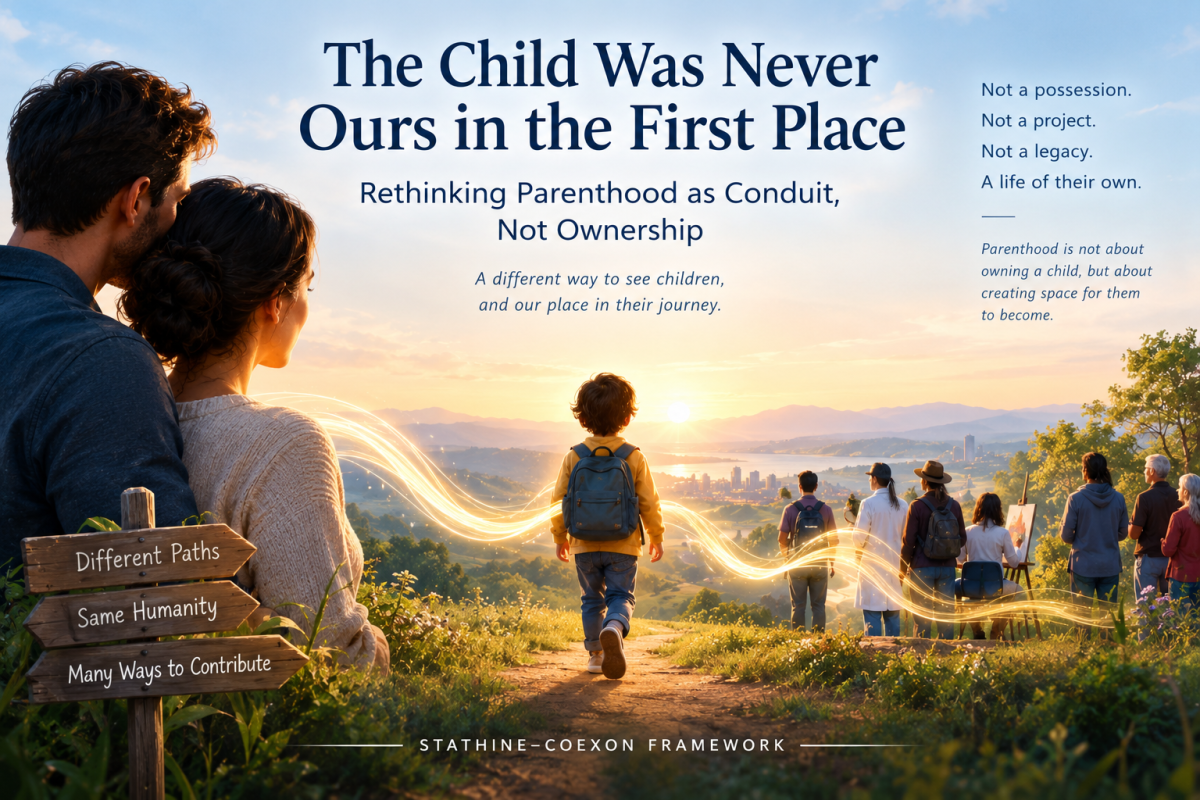
The Stathine–Coexon Framework begins with a deceptively simple proposition about existence: when a child comes into the world through procreation, the parents participate in that emergence, but they do not acquire ownership of the person who emerges. They are, in the framework’s language, conduits through which another human existence comes into being.
The word conduit can sound cold when applied to something as intimate as having a child. But perhaps it becomes warmer when we ask what the alternative really means.
A conduit allows something to pass through without claiming to possess what passes through it.
The parents, of course, are not merely biological instruments. They may spend decades caring, feeding, protecting, educating, worrying, sacrificing and loving. Their relationship with the child can be one of the deepest relationships human beings experience. But none of that necessarily requires ownership.
In fact, perhaps love becomes more beautiful when ownership is removed from it.
Imagine a couple holding their newborn for the first time. They look at this tiny person and instinctively begin imagining a future. Perhaps they see a doctor, a musician, a scientist, an entrepreneur, a wonderful parent. Perhaps they imagine the child carrying the family name forward. Perhaps they imagine the child living a life that somehow validates all the sacrifices they have made.
Yet the newborn has arrived without signing any of those agreements.
The parents may have created the biological conditions for this new life. They may have contributed genes, nourishment and an extraordinary amount of care. But they did not create the child’s eventual preferences, convictions, relationships, imagination or understanding of the world.
Those things will unfold through a life that belongs to the person experiencing it.
And that distinction becomes particularly interesting when we look at people who do not have children.
Much of the social pressure surrounding childlessness and childfreedom comes from an assumption that having children is the natural completion of adulthood. The absence of children is then treated as an absence of something: an unfinished life, an incomplete family, a missing legacy.
The resources gathered by Life Without Children itself reveal how much more complicated the reality is. People arrive at lives without children through choice, circumstance, infertility, relationships, finances, health, timing and many other paths. The community deliberately makes room for those different experiences rather than reducing them to one story. (Life Without Children)
That complexity matters because the question “Why don’t you have children?” often hides another question:
“What will your life amount to if you don’t?”
But perhaps that question is built upon the wrong assumption.
Perhaps human contribution was never meant to be measured primarily by biological continuation.
A teacher can leave something alive in another person’s mind. A friend can change the direction of a life. A scientist can leave an idea behind. An artist can give people a language for something they could not previously express. Someone caring for an ageing parent can transform another person’s final years. Someone without children can build a community, nurture other people’s children, create something beautiful, repair something broken or simply become the person someone else needed at a difficult moment.
Legacy does not have to travel through a surname.
And this is where the idea of children as conduits rather than possessions unexpectedly brings us back to people without children.
If parents do not own the lives they helped bring into existence, then perhaps people without children are not missing an ownership role that everyone else is expected to fulfil.
They simply have a different relationship with the continuation of life.
That possibility also changes the way we might look at parenthood itself.
If a child is mine, I can begin to think that my expectations should govern the child’s life. If the child is a person whose existence came through me but does not belong to me, my responsibility changes. I am no longer trying to manufacture a particular future. I am accompanying someone whose future I cannot own.
That difference may be especially important when the child grows older.
The toddler who once needed everything from a parent becomes a teenager who wants privacy. The teenager becomes an adult who chooses a partner, a profession, a city, perhaps a country. Eventually that adult may disagree profoundly with the values of the parents who raised them.
At each stage, the temptation to say “After everything I have done for you…” can become stronger.
But the phrase itself reveals the hidden transaction.
If parenting was an investment, what is the expected return?
If parenting was ownership, when does ownership expire?
If parenting was love, however, there may be no transaction at all.
This is one reason I find the Stathine–Coexon idea of contained existence relevant here. The framework proposes that existence is relational: every individual exists within conditions and relationships that make that individual life possible. Yet being contained within a relationship does not mean being possessed by it. The distinction is explored more fully in The Axiom of Contained Existence.
The parent contains the child for a time, in the most literal and then emotional sense. The family contains the growing person. Society contains the family. The ecosystem contains society. None of those relationships necessarily means ownership.
Containment can instead mean creating conditions in which another existence can flourish.
That thought makes the word conduit less mechanical.
A conduit does not mean someone who does nothing.
It means someone through whom something becomes possible.
And perhaps that is one way of thinking about parenthood without turning it into either a pedestal or a burden.
Parents matter enormously.
Their children matter enormously.
But neither fact requires the child to be property.
The same insight may also offer something liberating to people who live without children. If the purpose of a human life were simply to reproduce itself biologically, then everyone who does not become a parent would necessarily be living an incomplete version of existence.
But if human life is about participating in existence rather than possessing its continuation, the possibilities become much wider.
You do not have to produce a biological descendant to participate in what comes next.
You can pass something on without passing on your genes.
You can create without reproducing.
You can nurture without parenting.
You can leave a legacy without leaving a child.
And perhaps, once we remove the idea of ownership from the parent-child relationship, we can also remove some of the strange hierarchy that surrounds people with and without children.
The parent is not more complete because they have reproduced.
The childfree person is not less generous because they have not.
The childless person is not a failed parent waiting for life to begin.
They are simply human beings following different paths through existence.
That may sound like a small philosophical distinction, but small distinctions can change the questions we ask.
Instead of asking a person without children, “Who will carry on your legacy?”, perhaps we could ask, “What would you like to leave in the world?”
Instead of asking parents, “What will your child become?”, perhaps we could ask, “What kind of conditions are you creating for your child to discover who they are?”
The first questions are about possession and outcome.
The second are about participation and possibility.
And somewhere between those two sets of questions is a quieter understanding of love: I may have been part of your beginning, but your life was never mine to own.
That may be one of the most freeing ideas for a parent.
And perhaps, unexpectedly, it is also one of the most freeing ideas for someone who has never become one.
A useful related reading for the piece: the Stathine–Coexon discussion of contained existence above, and From Homo Sapiens to Human, which explores the broader movement from biological identity toward a fuller understanding of what it means to be human.