Beyond Neti Neti: From Negation to Coherent Understanding
Taking the Upanishadic Insight Forward Through the Stathine–Coexon Framework
By Anand Damani
Part of the Stathine–Coexon Research Series
There is a remarkable moment in the history of human inquiry when the mind recognizes the limits of its own descriptions.
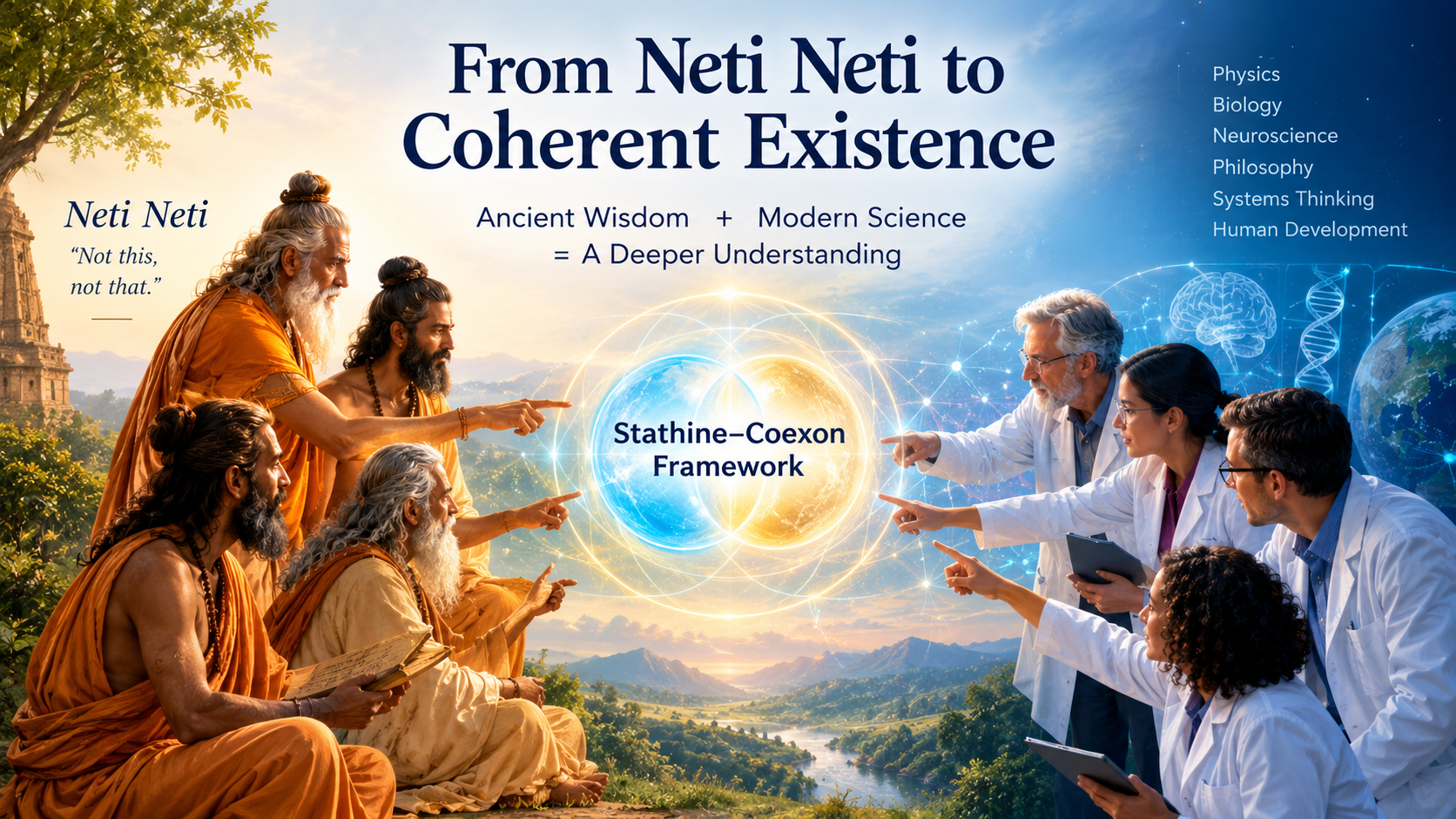
The Upanishads encountered that moment thousands of years ago. Rather than pretending that ultimate reality could be captured by ordinary categories, the sages introduced one of the most powerful epistemological methods in the history of philosophy: Neti Neti — “not this, not that.”
The phrase appears most famously in the Brihadaranyaka Upanishad. It represents an extraordinary recognition: what we can identify, name, describe and objectify may not exhaust the reality we are trying to understand.
This was not a failure of knowledge.
It was a recognition of the limits of representation.
Yet there is a question that remains highly relevant today:
What happens after Neti Neti?
If the answer to every attempted identification is “not this, not that,” how does the seeker move from the elimination of inadequate descriptions toward clearer understanding? How does negation become knowledge? How does the insight affect human relationships, scientific inquiry, decision-making, creativity and everyday life?
This is where the Stathine–Coexon Framework proposes to take the ancient insight forward.
It does not reject Neti Neti. It begins by acknowledging its extraordinary contribution. But it proposes that negation should be understood as a beginning of clarification rather than the endpoint of explanation.
The movement can therefore be expressed as:
Neti Neti removes what reality is not being confused with.
Stathine–Coexon asks what becomes possible once those confusions are progressively removed.
That is a movement from negation toward coherence.
The Genius of Saying “Not This”
The power of Neti Neti becomes clearer when we recognize the epistemological problem it addresses.
Human beings ordinarily know through distinction.
We see an object and distinguish it from its surroundings. We give it a name. We identify properties. We compare it with other objects. We classify it. We build concepts around it.
This is enormously useful for ordinary knowledge.
If I say “tree,” I can refer to a particular organism. I can study its biology, measure its height, analyze its chemistry and understand its ecological relationships.
But the word tree is not the tree.
The concept is not the reality.
The problem becomes much deeper when the subject of inquiry is consciousness, Self, existence or ultimate reality.
The Upanishadic insight recognizes that the knower cannot necessarily be reduced to the objects known by the knower.
The body can be observed.
Thoughts can be observed.
Emotions can be observed.
Sensations can be observed.
Memories can be observed.
But what is the nature of that through which observation itself becomes possible?
Neti Neti therefore prevents a category error.
The body is not necessarily the entirety of the Self.
The senses are not necessarily the entirety of the Self.
Thought is not necessarily the entirety of the Self.
Emotion is not necessarily the entirety of the Self.
A concept about consciousness is not consciousness itself.
A description of ultimate reality is not necessarily ultimate reality.
The method continually removes the tendency to confuse a partial representation with the whole.
This is why Neti Neti should not simply be interpreted as nihilism. It is better understood as a disciplined refusal to absolutize limited descriptions.
And this is precisely where the Stathine–Coexon Framework sees an opportunity.
When “Not This” Becomes Insufficient
Suppose a person discovers that none of the things they previously identified as the ultimate Self are sufficient.
Not the body.
Not the senses.
Not thoughts.
Not emotions.
Not memories.
Not social identity.
Not accumulated knowledge.
Not even a particular philosophical concept.
The person has achieved something important.
They are less attached to false identification.
But another set of questions immediately emerges.
Then what is my relationship to existence?
How should I live?
How should I understand another person?
What is the relationship between consciousness and the body?
Why does experience arise?
How does understanding develop?
How does knowledge become action?
How does an individual participate in a larger whole?
And perhaps most importantly:
How can I distinguish greater understanding from merely adopting another concept?
These questions move beyond the primary function of negation.
The Stathine–Coexon Framework begins from the proposition that removing an incorrect identification and constructing a coherent understanding are related but different intellectual operations.
Neti Neti is exceptionally powerful at the first.
The Stathine–Coexon proposal seeks to develop the second.
This distinction is central to the framework’s broader Epistemology of Knowledge, Coherence, Evidence, and Progressive Reduction of Human Delusion. The article explicitly argues that coherence is important for a strong knowledge system but that coherence alone cannot establish truth. (Anand Damani)
That qualification is particularly important when bringing an ancient philosophical insight into dialogue with a contemporary research framework.
From Elimination of Error to Progressive Reduction of Contradiction
One of the central principles of the Stathine–Coexon Framework is Progressive Reduction of Contradiction.
A contradiction occurs when two elements within our understanding cannot coherently coexist, yet we continue to maintain both.
A person may say that they value freedom while attempting to control everyone around them.
An organization may claim that it values innovation while punishing every deviation from established procedure.
A society may speak about equality while maintaining structures that reproduce exclusion.
An individual may intellectually accept uncertainty while emotionally demanding certainty from everyone else.
These contradictions create unnecessary cognitive, emotional and social complexity.
The framework therefore asks a question that extends the spirit of Neti Neti:
What must be removed, revised, integrated or understood so that contradiction progressively decreases and coherence increases?
This is different from simply saying “not this.”
It creates a developmental process.
We identify an assumption.
We examine it.
We observe its consequences.
We identify contradictions.
We distinguish what is supported from what was merely believed.
We revise the representation.
We test again.
The process continues.
Importantly, the framework does not propose that every contradiction should immediately be eliminated. Its epistemological work emphasizes that contradiction can itself be information. An apparent contradiction may indicate that one belief is false, that both beliefs are incomplete, that concepts are operating at different levels, or that our model is insufficient. (Anand Damani)
Thus:
Neti Neti says: do not mistake this limited description for the whole.
Progressive Reduction of Contradiction asks: what does the inadequacy of this description teach us?
From “Neti Neti” to “What Remains?”
The deepest question raised by Neti Neti is not actually:
“What is nothing?”
It is:
“What remains when inadequate identifications have been removed?”
This question becomes particularly significant within the Stathine–Coexon Framework.
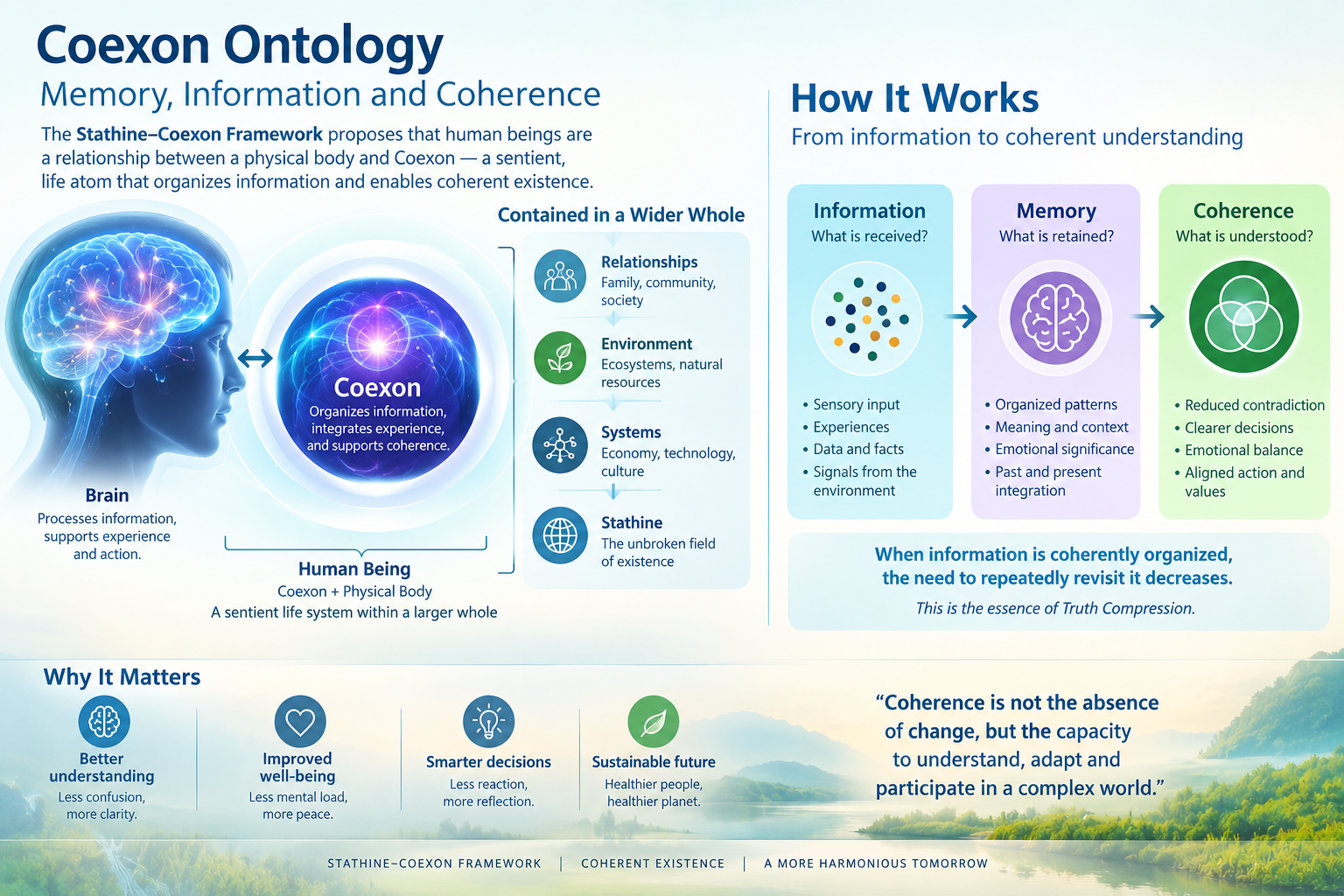
The framework proposes two complementary conceptual constructs: Stathine and Coexon.
Stathine is proposed as a static, non-depleting and borderless field of energy in which all elements interact and exist.
Coexon is proposed as a sentient atom or life atom capable of organizing information and communicating with the holobiont neurological brain.
These propositions should be understood as hypotheses within the Stathine–Coexon research program, rather than as established empirical facts.
The framework’s more detailed ontological treatment is developed in The Ontology of the Stathine–Coexon Framework: A Critical Examination of Existence, Sentience, Relation, and Coexistence, where Stathine and Coexon are developed as complementary elements of the proposed ontology. (Anand Damani)
This distinction matters.
The Stathine–Coexon Framework should not claim that the Upanishads secretly described Coexon.
They did not.
Nor should Neti Neti simply be translated into Stathine–Coexon terminology.
That would erase the historical and philosophical specificity of both traditions.
The more interesting possibility is different:
An ancient epistemological insight can become a starting point for a contemporary ontological inquiry.
Neti Neti asks us not to confuse ultimate reality with any limited representation.
The Stathine–Coexon Framework asks whether reality might be understood through an underlying field, Stathine, together with a proposed sentient organizing entity, Coexon.
These are not the same propositions.
But they can enter into a productive dialogue.
From Negation to Relation
One of the most important extensions proposed by the Stathine–Coexon Framework is that existence should not be understood only in terms of isolated entities.
Existence is relational.
A human being is simultaneously a physical organism, a participant in a family, a member of a culture, a biological component of a holobiont, an economic participant, a citizen, an ecological participant and, within the framework’s ontology, a physical body associated with a Coexon.
This is why the framework’s Axiom of Contained Existence becomes important.
In The Axiom of Contained Existence, the proposed foundational sequence is:
containment → relationship → condition → experience → understanding → coherence
This provides something that a purely negative epistemology does not by itself provide: a way of understanding how an apparently separate individual participates in a larger reality.
If everything is contained within Stathine, then separation is no longer the whole story of existence.
There may be distinction without absolute isolation.
There may be individuality without absolute independence.
There may be plurality without fundamental disconnection.
The result is not the destruction of individuality.
It is the understanding of individuality within relationship.
This idea is also developed in the broader Ontology of Stathine and Coexon Framework to Understand the Human Role in Existence, which treats existence, consciousness, learning and coherence as interconnected questions rather than isolated disciplinary problems. (Anand Damani)
Neti Neti and the Problem of Ego
The practical value of Neti Neti becomes especially visible in relation to ego.
When I say:
“I am my status.”
“I am my profession.”
“I am my possessions.”
“I am my ideology.”
“I am my reputation.”
“I am my success.”
“I am my failure.”
“I am right, and therefore the other person is wrong.”
I have converted one aspect of experience into an absolute identity.
A practical application of Neti Neti can interrupt this process.
Not this.
My role is not the entirety of me.
Not this.
My current belief is not the entirety of reality.
Not this.
My emotional state is not the entirety of existence.
Not this.
My disagreement with another person does not establish the inferior humanity of the other.
But the Stathine–Coexon Framework proposes that we should take the next step.
Instead of stopping at:
“I am not this.”
we ask:
“What relationship becomes possible when I no longer have to defend this limited identification?”
That is the transition from negation to inclusion.
The framework develops this idea in From Ego Protection to Inclusive Coherence, where ego is approached not merely as something to destroy, but as something whose boundaries can progressively expand through greater understanding and relationship.
The practical insight is powerful:
Once the false boundary is recognized, expand the relationship rather than merely removing the boundary.
From Neti Neti to Truth Compression
There is another striking connection.
The Stathine–Coexon principle of Truth Compression proposes that coherent understanding requires less internal maintenance than contradictory understanding.
Consider a person who believes:
“I must always appear intelligent.”
That single belief can generate enormous psychological computation.
They must hide mistakes.
Defend opinions.
Rewrite history.
Avoid admitting uncertainty.
Interpret disagreement as attack.
Protect reputation.
Maintain an image.
But suppose they recognize:
“I do not know.”
A large amount of unnecessary cognitive complexity disappears.
Something has been removed.
The false representation has been compressed.
Neti Neti can be understood in a related epistemological spirit. When the seeker repeatedly refuses to identify ultimate reality with inadequate descriptions, unnecessary conceptual commitments fall away.
But the Stathine–Coexon Framework asks us to go further:
Can the reduction of false identifications produce a progressively more coherent model of existence?
This is the purpose of The Principle of Truth Compression.
The article develops Truth Compression as a principle in which a coherent representation reduces the need for compensatory explanations and contradictory assumptions, while also emphasizing that compression must not become oversimplification. (Anand Damani)
Thus:
Neti Neti removes false identification.
Truth Compression asks how understanding becomes simpler without becoming less true.
Neti Neti Is Not the End of Knowledge
This may be the most important reinterpretation.
The contribution of Neti Neti is not that it tells humanity to stop seeking knowledge.
It tells us to be careful about what we call knowledge.
There is a profound difference between:
“I cannot completely describe this.”
and:
“Therefore nothing can be known.”
The first is epistemic humility.
The second can become epistemic surrender.
The Stathine–Coexon Framework attempts to preserve the first while avoiding the second.
Its Utility and Limitations of Epistemological Containment explores precisely this problem: empirical methodologies are extraordinarily powerful, but their boundaries should not automatically be mistaken for the boundaries of every legitimate philosophical question. At the same time, claims that extend beyond available evidence must remain clearly identified as hypotheses rather than established facts. (Anand Damani)
This creates an important bridge between ancient wisdom and contemporary inquiry.
Do not claim certainty where there is none.
But equally:
Do not convert the limits of current measurement into proof that the unmeasured does not exist.
That is a much more productive epistemological position.
From “Not This” to “This, in Relationship”
The modern human problem is not simply that we believe too much.
We also understand too little about relationships.
A person may understand their own psychology but not their relationship with their family.
A company may understand its internal processes but not its ecological consequences.
A government may understand its authority but not its relationship with citizens.
A scientist may understand a system in isolation but miss the system’s relationship with its environment.
An artificial intelligence may optimize an objective while failing to understand the wider system in which that objective operates.
The Stathine–Coexon Framework therefore proposes that understanding must become increasingly relational.
The question changes from:
What is this?
to:
What is this in relation to everything that contains it, influences it and is influenced by it?
This is one reason the framework presents itself as an integrative meta-framework, rather than another isolated theory. Its purpose is to explore connections among physics, biology, neuroscience, consciousness studies, systems theory, philosophy and human development. This is developed further in The Stathine–Coexon Framework as an Integrative Meta-Framework for Human Understanding. (Anand Damani)
The resulting movement can be expressed as:
Identification → Negation → Clarification → Relation → Integration → Coherence
This is the proposed next step beyond Neti Neti.
From Enlightenment Through Negation to Enlightenment Through Coherence
Traditional interpretations of Neti Neti often emphasize liberation from identification.
The Stathine–Coexon Framework does not reject this.
It asks whether liberation can also be understood as an expansion of coherent participation in existence.
If I am less attached to my limited identity, I can listen better.
If I listen better, I can understand another perspective.
If I understand another perspective, I may discover that my original model was incomplete.
If my model becomes more complete, contradiction decreases.
If contradiction decreases, my actions become more aligned.
If my actions become more aligned with reality and with the systems in which I participate, relationships can improve.
The chain becomes:
less identification → greater openness → greater understanding → greater coherence → more aligned action → richer coexistence
This moves enlightenment from being understood solely as withdrawal from identification toward more intelligent participation in existence.
That direction connects directly with the framework’s Axiology of Coherence, Truth, Value, and the Ethics of Coexistence, which examines coherence, truth, coexistence, transparency, inclusiveness, creativity, learning and contradiction reduction as important values. (Anand Damani)
What This Means for Praxis
There is one further step that Neti Neti alone does not answer:
How should understanding change action?
If I recognize that my previous identification was incomplete, what do I do differently tomorrow?
The Stathine–Coexon Framework addresses this through its concept of praxis.
The recently developed Praxis of the Stathine–Coexon Framework: From Understanding to Coherent Action proposes a recursive cycle:
observe → distinguish → understand → evaluate → choose → act → observe consequences → integrate feedback → revise the model
This is perhaps where the ancient insight becomes particularly relevant to modern life.
Neti Neti can help me recognize:
“My present interpretation is not the whole.”
Praxis asks:
“Now that I know this, how should I act?”
The answer is not another rigid doctrine.
It is continued learning.
Beyond Neti Neti
The phrase “not this, not that” can initially sound like a dead end.
But perhaps its real purpose is the opposite.
It opens space.
It removes the temptation to declare prematurely:
“This is reality.”
“This is consciousness.”
“This is the Self.”
“This is the final explanation.”
The great value of the Upanishadic insight is therefore not that it gives us a complete scientific theory of existence.
It does not.
Its value is that it recognizes a fundamental problem in human knowing:
the tendency to confuse our descriptions with the reality they attempt to describe.
The Stathine–Coexon Framework seeks to preserve that discipline while extending it.
Its proposed movement is:
Negate what is falsely identified.
Retain what survives examination.
Identify contradictions.
Test assumptions against experience and evidence.
Expand the boundaries of relationship.
Integrate knowledge across levels.
Compress truth without reducing reality.
Act according to the resulting coherence.
Continue learning.
This creates a larger developmental sequence:
Neti Neti → Progressive Clarification → Relational Understanding → Truth Compression → Coherence → Conscious Participation
The ancient sages gave humanity a powerful warning:
Do not mistake any limited “this” for the whole.
The challenge for the present century is to take the next step:
Having learned what something is not, can we become sufficiently coherent to understand what it is in relationship to everything else?
That is the point at which negation becomes knowledge.
Knowledge becomes understanding.
Understanding becomes coherence.
And coherence becomes a basis for action.
In this sense, the Stathine–Coexon Framework does not seek to replace Neti Neti.
It seeks to acknowledge it, preserve its epistemic humility, and take its unfinished question forward.
The ancient insight says:
Not this. Not that.
The contemporary question becomes:
Then what remains, how is it related, how can we know it, and how should we live in accordance with what we understand?
That is where the journey from Neti Neti to coherent existence begins.