The Axiom of Contained Existence
Regulation as the Natural Consequence of the Stathine Continuum
A Part of the Stathine–Coexon Research Series – Level I: Foundation
Abstract
The Stathine–Coexon Framework proposes a foundational ontological axiom: all existence is contained within Stathine, a timeless and static continuum. Regulation, within this framework, is therefore not fundamentally an external imposition upon existence. It is the natural consequence of existence occurring within a containing continuum.
The Coexon, understood as the proposed organizing life atom, progressively encounters this condition through experience. What may initially appear as limitation, resistance, boundary, or constraint is gradually recognized as the expression of an underlying orderliness within existence. Through experience, the Coexon develops understanding of the relationships that permit continued existence. Regulation is consequently understood as the progressive recognition of the conditions required for coherence.
This paper proposes that the foundational law of the Stathine–Coexon Framework is not that existence is externally regulated, but that existence is inherently contained. Because all existence occurs within Stathine, every entity exists within relationships, conditions, and boundaries that are not arbitrary restrictions but expressions of the structure of existence itself.
The paper distinguishes this ontological proposal from conventional external regulation. It argues that the apparent laws of nature, biological self-organization, individual self-regulation, social coordination, and ecological interdependence may be interpreted as increasingly complex expressions of containment and coherence.
The central claim is therefore:
Existence is contained within Stathine; the Coexon progressively experiences this containment as order, learns its relationships as truth, and expresses its understanding through increasing coherence.
The paper presents this proposition as a foundational philosophical axiom of the Stathine–Coexon Framework and identifies implications for ontology, epistemology, biology, consciousness, governance, ethics, and civilizational development.
Foundational Terminology
This article forms part of the Stathine–Coexon Research Series – Volume I: Foundations.
Readers unfamiliar with the framework are encouraged to first read The Foundational Axioms and Practical Lexicon of the Stathine–Coexon Framework, which establishes the terminology and foundational concepts used in this paper.
This article develops the ontological relationship between Stathine, Coexon, containment, regulation, experience, understanding, and coherence.
1. Introduction: The Question of Regulation
Regulation is commonly understood as something imposed from outside.
A government regulates citizens.
A law regulates behaviour.
An institution regulates its members.
A biological system regulates its internal conditions.
A thermostat regulates temperature.
The word therefore appears to describe many different processes.
Yet a deeper question arises:
What is the original source of regulation?
Before a government creates a law, existence already contains boundaries.
Before an institution establishes rules, physical systems already exhibit conditions.
Before a human being learns social responsibility, the body already possesses biological requirements.
Before the Coexon develops an ethical understanding, existence already provides consequences.
A human being cannot simply choose to exist outside all conditions.
Existence is always situated.
It is always contained.
The Stathine–Coexon Framework proposes that this is not a secondary feature of reality.
It is foundational.
2. The Foundational Axiom
The central axiom proposed in this paper is:
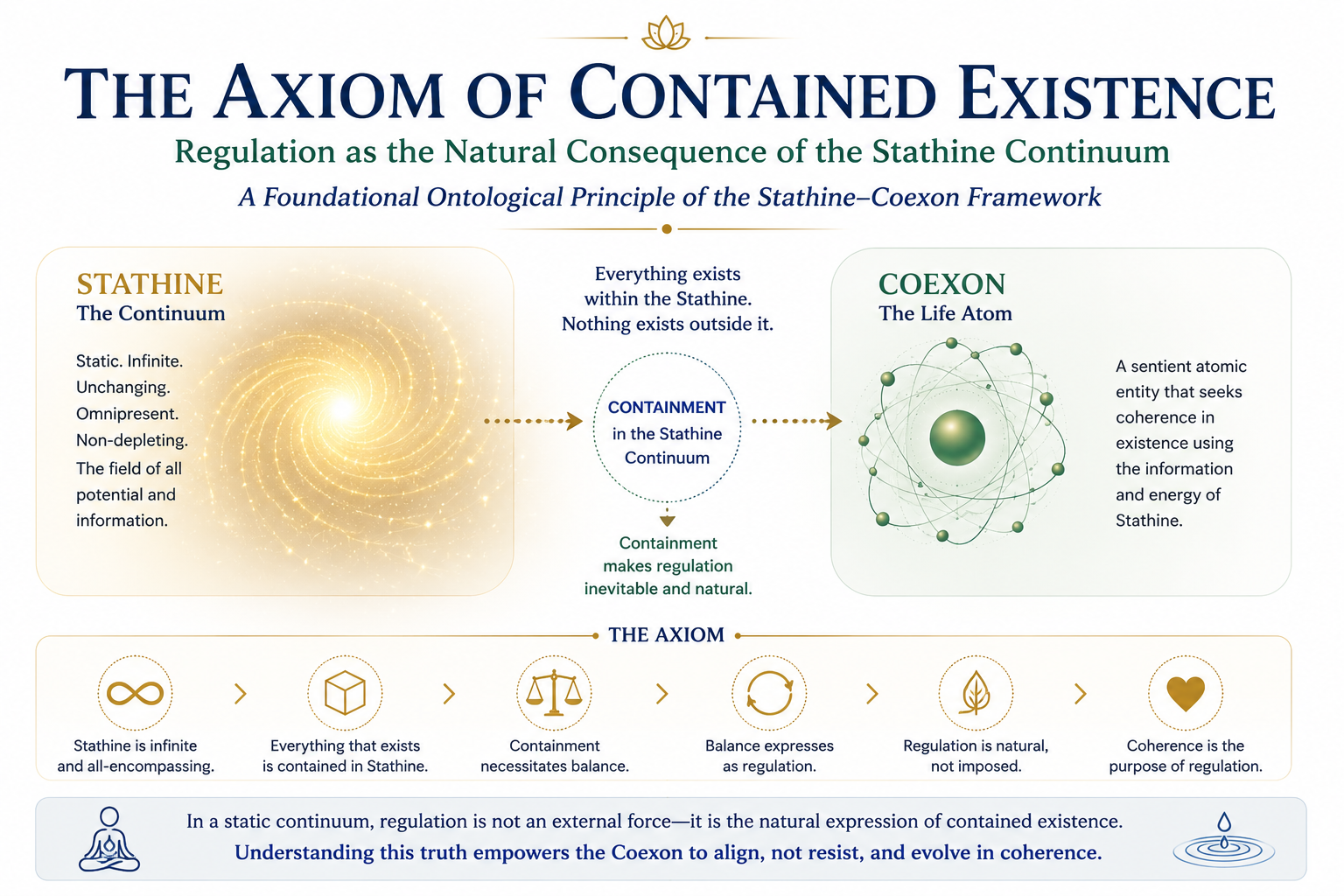
Axiom of Contained Existence: All existence is contained within Stathine, the timeless and static continuum; therefore, every existent entity is inherently subject to the relationships and conditions through which coherence is possible.
This axiom contains several propositions.
First
Stathine is the containing continuum.
Second
Nothing exists outside the totality of Stathine.
Third
Because existence is contained, existence is relational.
Fourth
Because existence is relational, conditions of coherence necessarily arise.
Fifth
The Coexon progressively discovers these conditions through experience.
Sixth
Understanding these conditions enables increasingly coherent existence.
This is the central logical sequence of the axiom:
Stathine
↓
Containment
↓
Relationship
↓
Condition
↓
Experience
↓
Understanding
↓
Coherence
3. Stathine as the Static Continuum
Within the Stathine–Coexon Framework, Stathine is proposed as a timeless, static continuum.
The term static does not mean empty.
Nor does it imply inactivity in the conventional physical sense.
It refers to the absence of change in Stathine itself.
The structures and experiences occurring within existence may change.
The containing continuum does not.
A useful conceptual analogy is a field within which changing configurations may occur.
The configurations change.
The field remains.
The analogy is not intended to equate Stathine with any established physical field.
It is a philosophical aid to understanding the distinction between:
The condition that contains existence
and
The forms that emerge and change within existence.
Stathine, in this framework, represents the former.
4. Containment Is Prior to Regulation
This distinction is essential.
Conventional thinking often begins with regulation.
A rule is created.
A boundary is imposed.
Behaviour is constrained.
The Stathine–Coexon Framework proposes a deeper sequence:
Existence is coexistence.
Containment precedes regulation.
Existence does not first become free and subsequently become regulated.
Existence is already contained by Coexistence.
The entity does not first exist outside all conditions and then encounter limitations.
The entity exists within conditions from the beginning.
A physical body exists within biological conditions.
A biological organism exists within ecological conditions.
A society exists within material and environmental conditions.
The Coexon exists within the totality of Stathine.
Regulation is therefore not fundamentally an external addition to existence.
It is the recognition of the conditions within which existence can continue coherently.
5. The Meaning of Regulation
Within this framework, regulation may be defined as:
The expression of the conditions through which an entity remains coherent within the continuum that contains it.
This definition differs significantly from the conventional understanding of regulation as control.
A law imposed by a government is one form of regulation.
But it is not the original form.
The more fundamental forms of regulation are inherent in existence itself.
A biological system regulates internal conditions.
An organism regulates temperature.
Cells regulate their internal environment.
An ecosystem develops relationships that influence the survival of its members.
A human being regulates behaviour based on experience.
These are not identical processes.
However, they share a common principle:
Continued existence depends upon maintaining relationships within conditions that permit coherence.
6. The Coexon and the Discovery of Regulation
The Coexon does not initially possess complete understanding of the conditions within which it exists.
It experiences.
It encounters.
It acts.
It receives consequences.
It modifies understanding.
This process is central.
The Coexon does not need to be told that every condition of existence exists.
It encounters the consequences of misunderstanding.
The child touches a hot object.
The body experiences pain.
The individual violates trust.
The relationship changes.
The organism ignores ecological limits.
The consequences accumulate.
Through experience, the Coexon progressively develops an understanding of the relationships within which existence is possible.
Thus:
Experience is the process through which the Coexon discovers containment.
Understanding is the interpretation of that experience.
Coherence is the application of that understanding.
7. Regulation Is Not a Mystery
The framework therefore does not require regulation to be understood as a mysterious force.
The Coexon need not assume that every condition of existence is inexplicable.
A condition may initially be unknown.
Unknown does not mean unknowable.
A relationship may initially be invisible.
Invisible does not mean mystical.
A consequence may initially appear random.
Randomness in experience does not necessarily imply absence of order.
The Coexon progressively discovers patterns.
It learns:
- what sustains,
- what damages,
- what connects,
- what separates,
- what stabilizes,
- what destabilizes.
The unknown becomes understood.
The unexplained becomes investigated.
The contradiction becomes resolved.
The circle of understanding expands.
This expansion is the progressive revelation of the orderliness of existence.
8. The Principle of Expanding Truth
The axiom may therefore be extended:
Truth is the progressively expanding understanding of the conditions through which coherent existence is possible within Stathine.
This does not mean that the Coexon possesses absolute knowledge.
It means that understanding can expand.
At one stage, the Coexon may understand a relationship locally.
At a later stage, it may recognize a wider system.
At a still later stage, it may recognize that the previous understanding was incomplete.
This does not necessarily mean that the earlier experience was false.
It may have been a partial understanding of a larger truth.
For example:
The individual exists.
Then:
The individual depends upon the family.
Then:
The family depends upon the community.
Then:
The community depends upon ecological and planetary systems.
The earlier understanding is not necessarily discarded.
It is contained within a larger understanding.
Truth expands by inclusion.
9. The Relationship Between Containment and Freedom
At first glance, containment may appear to oppose freedom.
If everything is contained, how can anything be free?
The framework proposes a distinction between two forms of freedom.
Freedom from Understanding
This is the imagined freedom to act without consequence.
It is impossible.
Every action occurs within conditions.
Freedom Through Understanding
This is the capacity to act with increasing awareness of the conditions within which action occurs.
This form of freedom increases with understanding.
A person who understands the conditions of flight can build an aircraft.
A person who understands the conditions of health can make better choices.
A person who understands ecological relationships can act more sustainably.
A person who understands the consequences of conflict can choose cooperation.
Understanding does not eliminate the conditions of existence.
It enables increasingly intelligent participation within them.
Therefore:
Freedom is not escape from containment; freedom is increasingly coherent participation within containment.
10. The Coexon as an Experiential Intelligence
The Coexon, within the framework, is not defined merely by its capacity to receive information.
Its essential function is to develop understanding through experience.
The process may be represented as:
Experience
↓
Perception
↓
Interpretation
↓
Understanding
↓
Evaluation
↓
Action
↓
Consequence
↓
Refined Understanding
This creates a recursive cycle.
The Coexon acts within the containing continuum.
The consequences of action provide information.
Information modifies understanding.
Understanding modifies future action.
Over time, coherence may increase.
This process represents a fundamental form of learning.
11. From External Regulation to Self-Regulation
This axiom also provides a deeper explanation of human self-regulation.
A child may initially require external instruction.
The child is told:
Do not touch the fire.
Later, the child experiences the consequence.
Eventually, understanding becomes internal.
The external instruction is no longer necessary.
The individual understands the relationship.
This is a simple example of a general developmental process:
External instruction
↓
Experience
↓
Recognition of consequence
↓
Understanding
↓
Internal self-regulation
The most advanced form of regulation is therefore not continuous external control.
It is the internalization of understanding.
12. The Expansion of the Circle of Regulation
As the Coexon develops, the scale of understood relationships may expand.
Initially, regulation may be based on immediate personal consequences.
Then:
Self
↓
Family
↓
Community
↓
Society
↓
Humanity
↓
Living systems
↓
Ecosystem
The individual gradually discovers that the boundaries of personal existence are not as isolated as they initially appeared.
The body depends upon the ecosystem.
The family depends upon society.
Society depends upon institutions.
Institutions depend upon human cooperation.
Humanity depends upon planetary systems.
The Coexon progressively discovers that existence is nested within relationships.
The circle of understanding expands.
Consequently, the circle of self-regulation expands.
13. From Individual Regulation to Civilizational Regulation
A civilization may be understood as a collective system of Coexons attempting to coordinate existence within the same containing continuum.
Governance becomes necessary when individual understanding is insufficient to coordinate collective behaviour.
However, governance should ideally support the development of understanding.
The long-term movement may therefore be:
External coercion
↓
Shared rules
↓
Collective understanding
↓
Voluntary cooperation
↓
Coherent self-governance
This does not mean that all external regulation will disappear.
Some individuals may knowingly act destructively.
Protective regulation may therefore remain necessary.
However, the developmental objective is clear:
The more deeply the conditions of existence are understood, the less unnecessary external regulation is required.
14. The Ontological Basis of Orderliness
If all existence is contained within Stathine, then existence is never without context.
Nothing exists in absolute isolation.
Every entity exists:
- somewhere within the continuum,
- in relationship to conditions,
- in interaction with other entities,
- within consequences.
This does not imply that every event is predictable.
It does not imply that all events are consciously designed.
It does not imply that every outcome is morally desirable.
It proposes something more fundamental:
Existence is relationally contained.
The orderliness of existence emerges from the fact that relationships have consequences.
The Coexon gradually learns these consequences.
The accumulation of understanding produces science, philosophy, ethics, and civilization.
15. The Axiom and Scientific Inquiry
The Axiom of Contained Existence is a philosophical proposition.
It should therefore be distinguished from the limited empirical scientific laws.
Its value may lie in the questions it generates.
For example:
- Can coherence be studied across different levels of organization?
- Can self-regulation be understood as a form of internalized environmental information?
- Does increasing systemic understanding reduce destructive behaviour?
- Can the expansion of the circle of concern be studied psychologically?
- Can civilizational resilience be related to the recognition of interdependence?
The axiom therefore provides a conceptual foundation for interdisciplinary inquiry.
It does claim that every implication need not be empirically demonstrated.
16. The Axiom of Contained Existence and Coherence
The relationship between containment and coherence may be stated as follows:
Because every existent entity is contained within Stathine, every entity exists within conditions and relationships. Because continued existence depends upon relationships that remain sufficiently coherent, the recognition of those relationships becomes the foundation of understanding and self-regulation.
This produces the central chain:
Stathine
↓
Containment
↓
Relational existence
↓
Consequences
↓
Experience
↓
Understanding
↓
Self-regulation
↓
Coherence
17. Hypotheses Derived from the Axiom
The foundational axiom permits several derived hypotheses.
Hypothesis 1: The Understanding Hypothesis
Greater understanding of the relationships within which an entity exists should increase its capacity for coherent action.
Hypothesis 2: The Self-Regulation Hypothesis
As understanding of interdependence increases, the need for external regulation should decrease in domains where behaviour is voluntarily guided by that understanding.
Hypothesis 3: The Expanding Circle Hypothesis
Human development may involve the progressive expansion of the system whose well-being an individual recognizes as connected to their own.
Hypothesis 4: The Coherence Hypothesis
Entities that accurately understand the conditions within which they exist should demonstrate greater capacity for sustained coherence.
Hypothesis 5: The Civilizational Understanding Hypothesis
Civilizations that increasingly understand the interdependence of human, social, and ecological systems may develop more sustainable forms of governance.
18. Philosophical Implications
The axiom produces several significant implications.
Implication 1: Existence Is Not Uncontained
Absolute independence is not possible.
Every entity exists within conditions.
Implication 2: Regulation Is Inherent
Regulation is not created only by governments.
The conditions of existence themselves regulate possibility.
Implication 3: Understanding Is Liberating
The individual becomes more capable not by escaping conditions but by understanding them.
Implication 4: Ignorance Produces Incoherence
When an entity misunderstands the conditions within which it exists, action may produce unintended consequences.
Implication 5: Truth Expands
Understanding can progressively include wider relationships without requiring the abandonment of earlier valid insights.
Implication 6: Ethics Can Become Systemic
Ethical behaviour may emerge from understanding consequences rather than merely obeying commands.
Implication 7: Governance Can Become Developmental
The purpose of governance can progressively shift from controlling behaviour to developing understanding.
19. The Deepest Implication
The deepest implication of this axiom may be expressed simply:
The Coexon does not need to be externally forced into coherence by an arbitrary authority. It can progressively discover the conditions of coherence through experience because it already exists within the continuum that contains all existence.
The discovery is not the creation of order.
The Coexon does not invent the conditions within which it exists.
It learns them.
This is an important distinction.
The truth is not necessarily imposed.
It is progressively encountered.
The Coexon experiences.
It observes.
It compares.
It evaluates.
It understands.
It integrates.
The expansion of understanding is therefore the progressive discovery of the orderliness already present in existence.
20. Conclusion
The Stathine–Coexon Framework proposes the Axiom of Contained Existence as a foundational ontological principle:
All existence is contained within Stathine, the timeless and static continuum.
From this axiom follows a sequence of philosophical implications.
Because existence is contained, it is relational.
Because it is relational, conditions exist.
Because conditions have consequences, experience is possible.
Because experience can be interpreted, understanding can expand.
Because understanding can expand, self-regulation becomes possible.
Because self-regulation can become increasingly coherent, individual existence can participate in increasingly larger systems.
The progression may therefore be expressed as:
Stathine
↓
Containment
↓
Experience
↓
Understanding
↓
Self-regulation
↓
Coherence
↓
Expanded participation in existence
Regulation, in its deepest sense, is therefore not primarily a mystery and not primarily an external imposition.
It is the natural consequence of being.
The Coexon is contained within existence and progressively learns the conditions of that containment.
What begins as limitation may become understanding.
What begins as consequence may become knowledge.
What begins as external regulation may become internal wisdom.
And what begins as individual self-preservation may expand into the understanding that the well-being of the self, the family, the community, humanity, and the ecosystem are nested within one another.
The foundational proposition of the Stathine–Coexon Framework may therefore be stated:
Existence is contained within Stathine. The Coexon experiences that containment, learns its orderliness, and progressively converts experience into understanding, understanding into self-regulation, and self-regulation into coherent participation in all that exists.
This is not presented as a claim that all questions about existence have been answered.
It is offered as a foundational lens through which the questions may be asked differently.
The central movement of the framework is therefore not from mystery to certainty.
It is from experience to understanding.
From understanding to coherence.
From coherence to increasingly expansive participation in existence.
About the Stathine–Coexon Framework
The Stathine–Coexon Framework is an interdisciplinary philosophical framework that seeks to integrate insights from systems thinking, neuroscience, psychology, biology, complexity science, leadership, education, consciousness studies, governance, and civilizational research through the unifying concept of coherence.
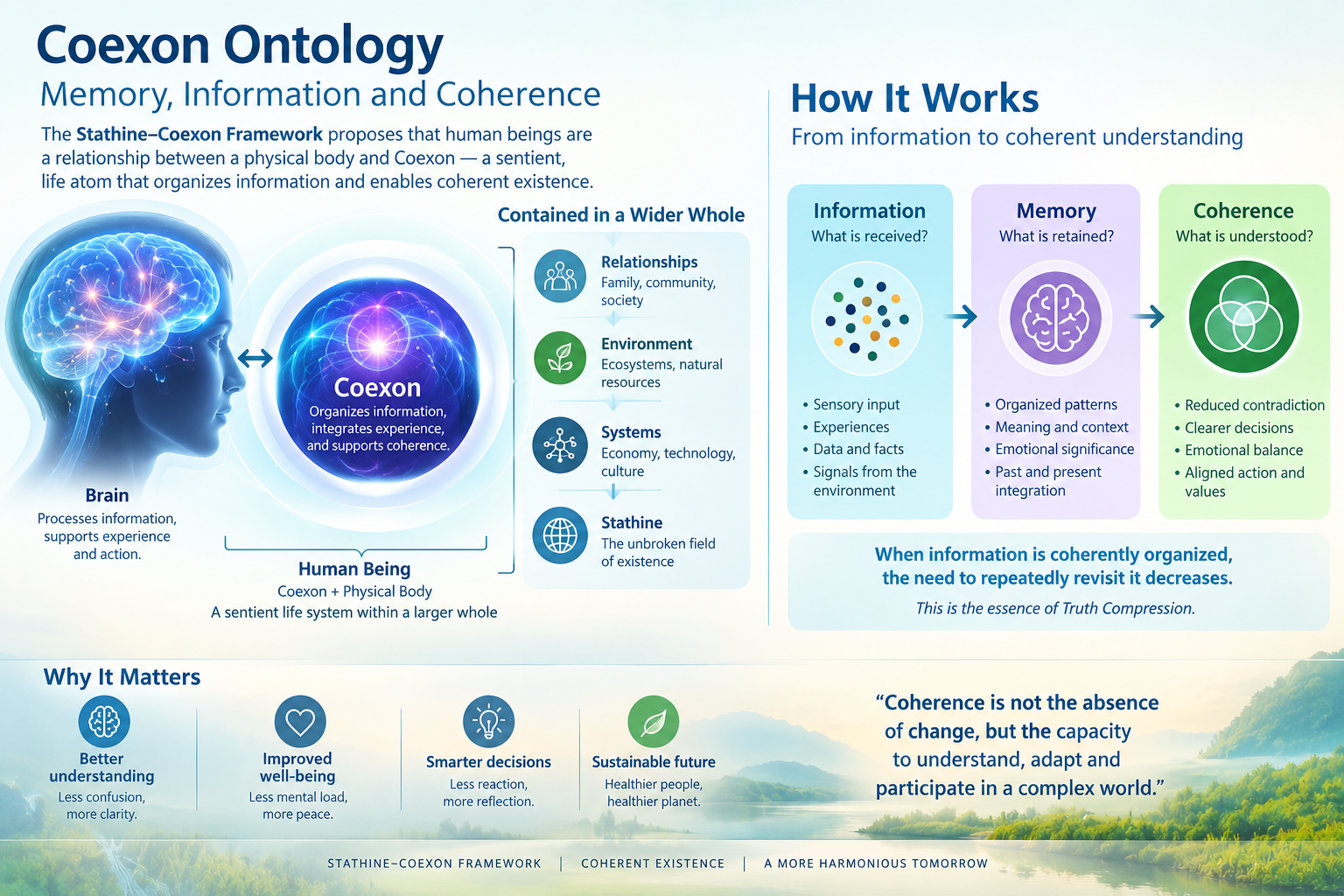
The framework proposes Stathine as the timeless, static continuum within which all existence is contained and the Coexon as the proposed organizing life atom that progressively experiences, interprets, and develops understanding of existence.
Foundational concepts, terminology, and guiding principles are presented in The Foundational Axioms and Practical Lexicon of the Stathine–Coexon Framework.