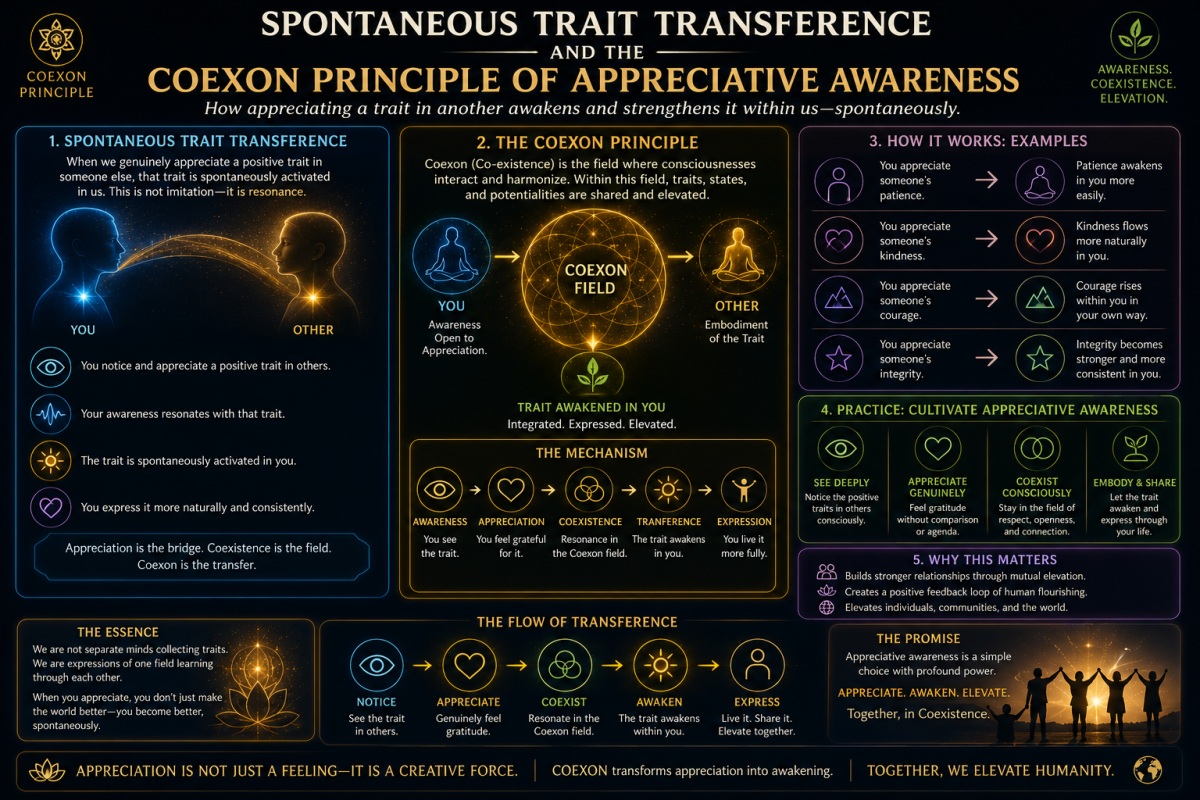
How Seeing the Good in Others Creates Internal Harmony
Abstract
Modern psychology has identified a fascinating phenomenon known as Spontaneous Trait Transference (STT). Research demonstrates that when individuals describe others using particular personality traits, listeners often begin associating those same traits with the speaker. In simple terms, people who consistently speak about kindness are often perceived as kind, while those who frequently emphasize dishonesty in others may themselves become associated with dishonesty. (PubMed)
The Stathine–Coexon framework extends this observation beyond social perception and proposes a deeper principle of consciousness. According to Shri A. A. Nagarajji:
“A Coexon that sees, appreciates, and talks about the coherence (goodness) in other Coexons becomes rid of friction (badness) and moves toward harmony effortlessly.”
This article explores the convergence between contemporary psychological research and the Stathine–Coexon framework, proposing that appreciation is not merely a social virtue but a mechanism for increasing internal coherence and reducing psychological friction.
Introduction
Human beings spend much of their lives talking about other human beings.
We discuss:
- colleagues,
- family members,
- political leaders,
- friends,
- strangers.
Most people assume these conversations primarily affect the person being discussed.
Psychology suggests otherwise.
The act of describing another person also affects the speaker.
The qualities we repeatedly notice, emphasize, and communicate gradually shape how others perceive us and how we perceive ourselves. (PubMed)
The Stathine–Coexon framework proposes that this occurs because attention itself is transformative.
What consciousness repeatedly attends to becomes part of its own organization.
The Discovery of Spontaneous Trait Transference
The concept of Spontaneous Trait Transference was first systematically investigated by psychologists including John J. Skowronski and Donal E. Carlston.
Their research demonstrated a simple but surprising effect:
Communicators are often perceived as possessing the very traits they describe in others. (PubMed)
For example:
If a person repeatedly says:
- “She is generous.”
- “He is trustworthy.”
- “They are compassionate.”
listeners begin associating those characteristics with the speaker.
The reverse is also true.
A person who constantly discusses:
- selfishness,
- dishonesty,
- incompetence,
may become unconsciously associated with those traits. (PubMed)
This occurs even when there is no logical reason to infer those traits belong to the speaker. (PubMed)
Beyond Social Perception
Traditional psychology primarily explains STT as an effect of:
- association,
- attribution,
- impression formation,
- cognitive processing.
These explanations are scientifically valuable.
However, they raise a deeper question:
Why do some individuals naturally focus on strengths while others habitually focus on weaknesses?
The Stathine–Coexon framework attempts to answer this question.
It proposes that attention follows the degree of internal coherence within the observer.
Coherence and Friction
Within the Coexon framework, every conscious system every individual Coexon is on the journey from the friction (imbibed from tradition and society)to establishing coherence in the society.
Coherence
Represents:
- understanding,
- integration,
- appreciation,
- alignment with reality.
Friction
A person in a society dominated by friction naturally notices faults.
A person in a society dominated by coherence naturally notices possibilities.
This does not mean ignoring problems.
It means perceiving reality more completely and holistically.
The Coexistence Principle of Shri A.A Nagarajji
Shri A. A. Nagarajji’s statement provides a concise formulation:
“A Coexon that sees, appreciates, and talks about the coherence (goodness) in other Coexons becomes rid of friction (badness) and moves toward harmony effortlessly.”
This principle contains three stages.
Seeing
The ability to notice strengths.
Appreciating
The ability to value strengths.
Talking About
The ability to reinforce strengths through communication.
The process is cumulative.
Appreciation becomes communication.
Communication strengthens internal organization.
Modern Psychology Supports the Direction
Several contemporary findings support aspects of this proposal.
Positive Attention Shapes Perception
Research on STT shows that positive descriptions influence how speakers are perceived. (PubMed)
Cognitive Schemas Become Reinforced
Repeated attention strengthens mental pathways.
The brain becomes increasingly efficient at noticing what it frequently searches for.
Neuroplasticity
Modern neuroscience demonstrates that repeated patterns of thought reshape neural organization.
The brain literally changes through repeated attention.
The Coexon Interpretation
The Stathine–Coexon framework extends these findings.
It proposes that when a person consistently searches for coherence in others, several things happen simultaneously:
Internal Contradictions Decrease
The mind becomes less occupied by blame.
Empathy Increases
Understanding expands.
Threat Perception Reduces
The nervous system becomes less defensive.
Cooperation Improves
Relationships become easier to sustain.
Identity Evolves
The individual increasingly embodies the qualities they admire.
This is not mystical.
It is a natural consequence of repeated conscious participation.
The Difference Between Appreciation and Blind Positivity
An important distinction must be made.
The framework does not advocate denial.
Noticing goodness does not require ignoring problems.
A physician can recognize disease while appreciating health.
A teacher can correct mistakes while recognizing potential.
A parent can establish boundaries while expressing love.
Coherence is not naïve optimism.
Coherence is complete perception.
Why Criticism Often Creates Isolation
When individuals habitually discuss the faults of others, several processes occur:
- Listeners begin associating negativity with the speaker. (PubMed)
- The speaker strengthens neural patterns focused on deficiency.
- Relationships become increasingly defensive.
- Internal friction grows.
The individual often experiences loneliness and misunderstanding without recognizing the role their own attention patterns play.
Practical Applications
The framework suggests a simple daily practice.
Before discussing another person, ask:
What coherence do I see?
What strength is present?
What contribution has this person made?
What can be appreciated without denying reality?
This shifts attention from fragmentation toward integration.
Over time the habit becomes self-reinforcing.
A New Understanding of Character Development
Traditional moral systems often focus on controlling behavior.
The Coexon framework focuses on directing attention.
Character develops through what consciousness repeatedly notices.
The qualities that receive sustained attention gradually become part of the observer’s own organization.
In this sense:
- appreciation develops appreciation,
- understanding develops understanding,
- kindness develops kindness.
Conclusion
Spontaneous Trait Transference reveals a profound psychological reality:
People become associated with the qualities they repeatedly describe in others. (PubMed)
The Stathine–Coexon framework extends this observation and proposes that the process is not merely social but developmental.
A consciousness that repeatedly seeks coherence gradually becomes more coherent and will lead to a society of coherence.
The practical implication is simple.
If we wish to live in greater harmony, we should train ourselves to see and appreciate the genuine strengths present in others.
Not because it benefits them alone.
But because the observer is transformed by what they choose to observe.
As Shri A. A. Nagarajji proposed:
“A Coexon that sees, appreciates, and talks about the coherence (goodness) in other Coexons becomes rid of friction (badness) and moves toward harmony effortlessly.”
Modern psychology increasingly suggests that this may be more than a philosophical insight.
It may describe a fundamental principle of human development itself.