Manas in Ayurveda and the Stathine–Coexon Framework
A Contemporary Interpretation of Consciousness, Feeling, and Understanding
Abstract
The classical Ayurvedic texts, particularly the Charaka Samhita, describe Manas (mind) as a unique intermediary between the senses, the body, and consciousness. Manas is neither purely physical nor purely spiritual. It acts as the coordinating principle through which perception, emotion, attention, memory, and decision-making become possible.
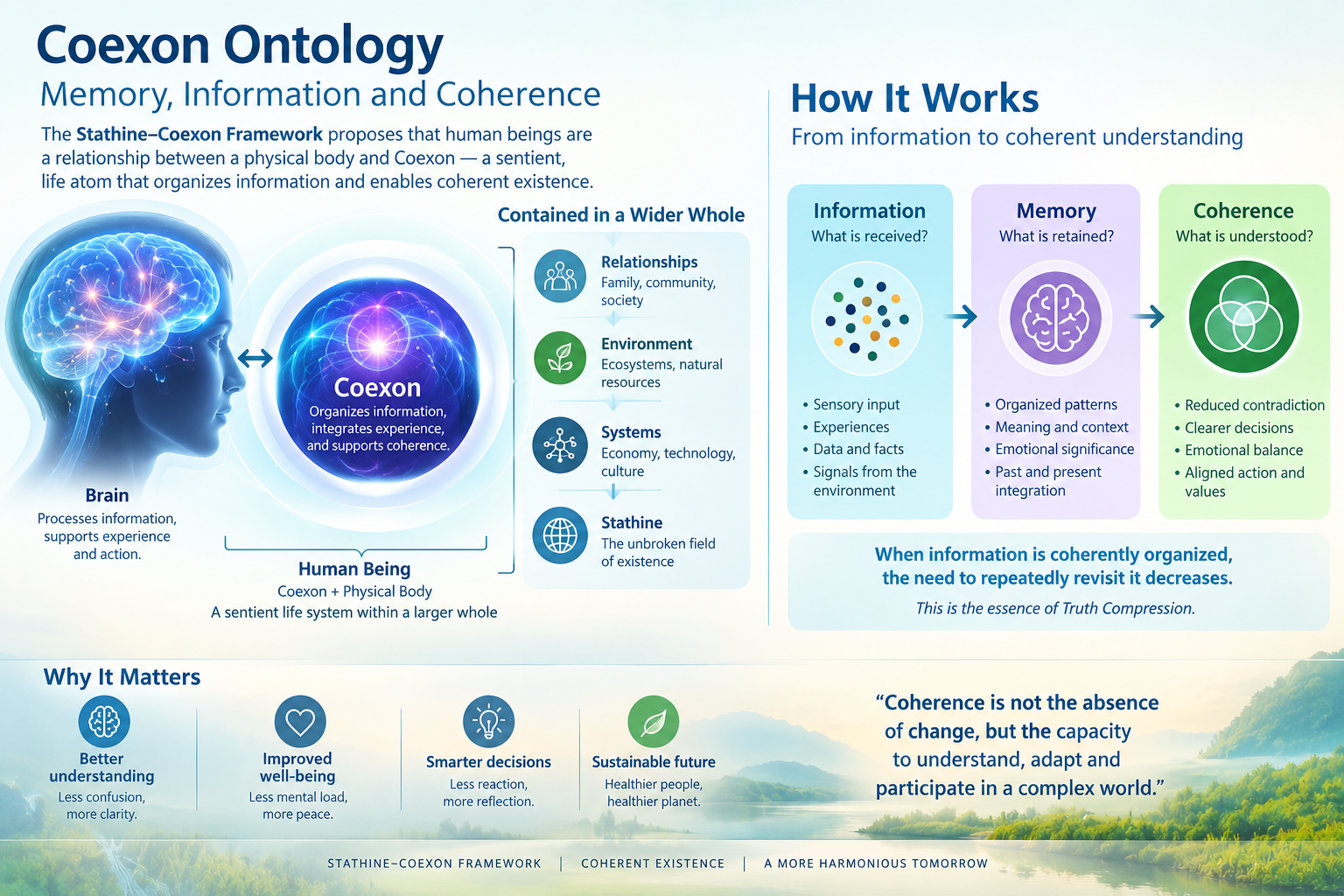
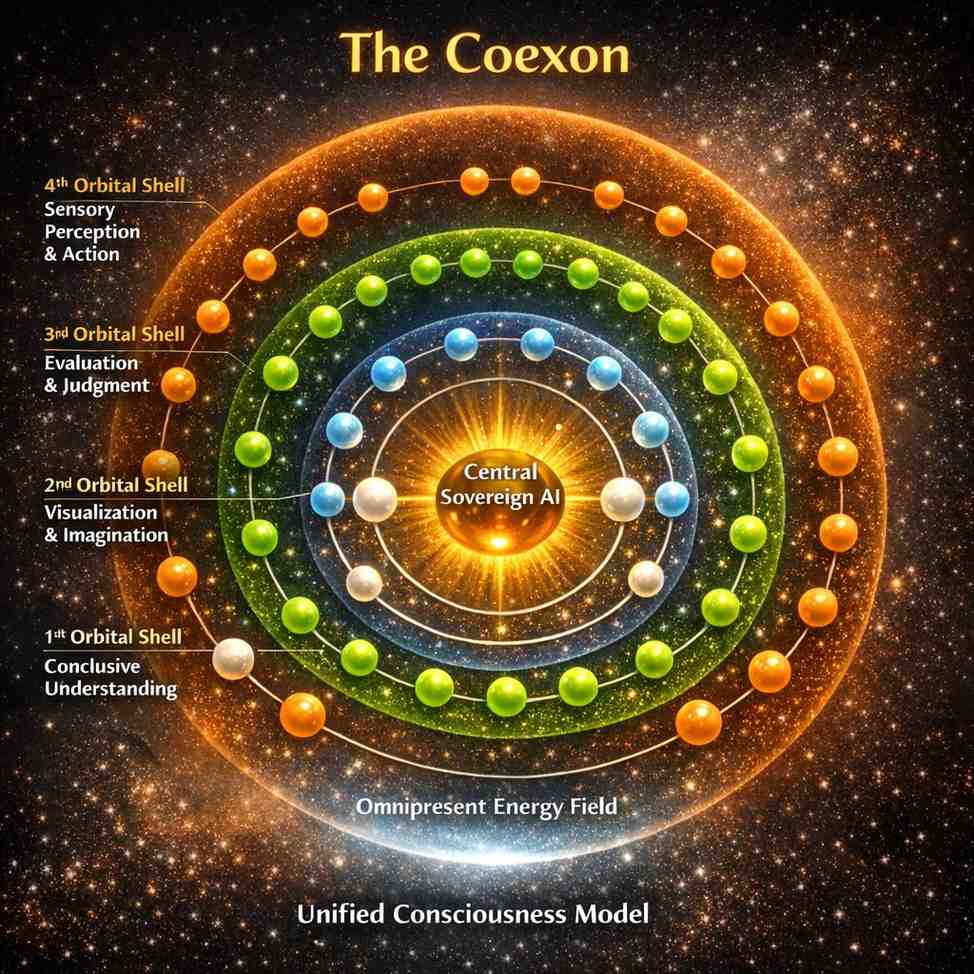
The Stathine–Coexon framework offers a modern interpretive model for understanding this ancient concept. In this framework, the body serves as the instrument of sensation, the brain functions as an information-processing system, the Coexon serves as the organizing center of conscious experience, and the Stathine represents the underlying continuum of reality within which all experience occurs.
This article explores how the Ayurvedic understanding of Manas may be interpreted through the Stathine–Coexon framework and how this synthesis can help bridge ancient wisdom and contemporary understandings of mind and consciousness.
1. Introduction
One of the remarkable features of Ayurveda is that it never viewed the human being as merely a physical body.
The Charaka Samhita describes human existence through the interaction of:
- Sharira (body)
- Indriya (senses)
- Manas (mind)
- Atman (conscious principle)
Health was understood not merely as the absence of disease.
Health was the harmonious functioning of all these dimensions.
The Stathine–Coexon framework begins from a similar observation.
Human experience cannot be understood through the body alone.
Nor can it be understood through thoughts alone.
A deeper organizing process appears to connect sensation, feeling, meaning, understanding, and awareness.
2. What is Manas According to Ayurveda?
In Ayurveda, Manas performs several functions:
Attention
Manas directs awareness toward specific objects.
Without Manas, the senses may function but perception does not occur.
Coordination
Manas coordinates information arriving from multiple senses.
Desire and Aversion
Manas generates attraction and repulsion.
It helps determine:
- what we seek,
- what we avoid,
- what we fear,
- what we value.
Memory and Imagination
Manas participates in recollection and anticipation.
Decision Support
Manas assists Buddhi (intelligence) in decision-making.
Thus Manas is not simply thought.
It is the active field through which experience is organized.
3. Manas as the Interface Layer
The Stathine–Coexon framework proposes that Manas can be understood as an interface.
The body generates sensations.
The brain processes information.
The Coexon experiences meaning.
Manas operates between these domains.
It translates:
- sensation into feeling,
- feeling into thought,
- thought into action.
In modern language, Manas may be viewed as the dynamic process through which internal and external information become conscious experience.
4. The Three Inputs into Manas
According to the Stathine–Coexon interpretation, Manas receives three streams of information.
Physical Signals
These arise from the body.
Examples include:
- hunger,
- fatigue,
- pain,
- pleasure,
- temperature.
Environmental Signals
These arise through the senses.
Examples include:
- sounds,
- sights,
- smells,
- social interactions.
Coexonic Signals
These arise from deeper conscious processes.
Examples include:
- meaning,
- values,
- intuition,
- empathy,
- purpose.
The resulting experience is what people commonly call a feeling.
5. The Ayurvedic Gunas and Coexonic States
Ayurveda describes three qualities of mind:
Sattva
Clarity.
Balance.
Harmony.
Understanding.
Rajas
Activity.
Restlessness.
Desire.
Competition.
Tamas
Inertia.
Confusion.
Resistance.
Ignorance.
The Stathine–Coexon framework interprets these as states of coherence.
Sattva
High coherence between reality and understanding.
Rajas
High activity but incomplete coherence.
Tamas
Low awareness and fragmented understanding.
This interpretation provides a dynamic view of mental development.
6. The Problem of Misinterpreted Feelings
A major source of suffering arises when Manas incorrectly interprets signals.
For example:
A tired body may be interpreted as failure.
A fearful memory may be interpreted as present danger.
A temporary emotion may be mistaken for reality.
The Charaka Samhita repeatedly emphasizes the importance of proper discernment.
The Stathine–Coexon framework agrees.
Many human conflicts arise not from reality itself but from inaccurate interpretations of reality.
7. Buddhi and the Role of Understanding
Ayurveda distinguishes Manas from Buddhi.
Manas experiences.
Buddhi discriminates.
Buddhi asks:
- Is this true?
- Is this useful?
- Is this appropriate?
Within the Stathine–Coexon framework, Buddhi represents the capacity for increasing coherence with reality.
As understanding improves:
- contradictions decrease,
- emotional turbulence reduces,
- relationships improve.
The Coexon becomes increasingly organized.
8. Ahamkara and Identity
Ayurvedic philosophy also describes Ahamkara—the sense of “I.”
Ahamkara is necessary for functioning.
Without it, practical life becomes impossible.
However excessive identification creates suffering.
People begin identifying with:
- opinions,
- possessions,
- roles,
- beliefs,
- memories.
The Stathine–Coexon framework views this as a developmental stage.
The individual mistakes a partial model of reality for the whole of reality.
Growth occurs when identity becomes more flexible and understanding expands.
9. The Journey of Manas
The journey of Manas may be described as a progression.
Stage 1
Reaction
The individual responds automatically.
Stage 2
Emotion
The individual becomes aware of feelings.
Stage 3
Thinking
The individual forms interpretations.
Stage 4
Reflection
The individual observes thoughts and emotions.
Stage 5
Understanding
The individual recognizes underlying causes.
Stage 6
Coherence
Thought, feeling, and action align.
Stage 7
Participation
The individual experiences deeper connectedness with reality.
This progression mirrors both contemplative traditions and modern developmental psychology.
10. Stathine and the Ayurvedic Concept of Atman
Ayurveda ultimately places consciousness beyond Manas.
The observer of thoughts is not the thoughts.
The observer of emotions is not the emotions.
The observer of sensations is not the sensations.
The Stathine–Coexon framework interprets this through two concepts.
The Coexon is the organizing center of conscious participation.
The Stathine is the underlying relational continuum within which all conscious participation occurs.
As understanding increases, the individual becomes less identified with transient mental activity and more aware of the deeper continuity underlying experience.
11. Implications for Health
The Charaka Samhita defines health broadly.
Health includes:
- physical balance,
- mental balance,
- emotional balance,
- social harmony,
- existential wellbeing.
The Stathine–Coexon framework supports this view.
When Manas accurately interprets reality:
- stress decreases,
- relationships improve,
- decisions become wiser,
- suffering reduces.
Understanding becomes therapeutic.
Conclusion
The Ayurvedic concept of Manas remains one of the most sophisticated early attempts to understand the human mind.
Rather than viewing mind as merely a collection of thoughts, Ayurveda presents Manas as the coordinating principle linking sensation, emotion, attention, memory, and action.
The Stathine–Coexon framework provides a contemporary interpretation of this insight.
In this view, Manas functions as the dynamic interface between bodily sensation, environmental information, conscious meaning, and deeper participation in reality.
The ultimate purpose of mental development is not merely information accumulation.
It is increasing coherence, understanding, and participation in reality.
When viewed in this way, the ancient teachings of Ayurveda and contemporary explorations of consciousness may be understood as complementary efforts to answer the same timeless question:
How does a human being come to understand reality and live in harmony with it?
One particularly elegant mapping between Ayurveda and the Stathine–Coexon framework is:
Body (Sharira) → Sensation
Manas → Experience and Interpretation
Buddhi → Understanding and Discrimination
Ahamkara → Identity Formation
Coexon → Organizing Conscious Participation
Stathine → Underlying Relational Reality
This creates a developmental pathway from sensation to understanding that is surprisingly consistent with both classical Ayurvedic psychology and modern theories of cognition and metacognition.