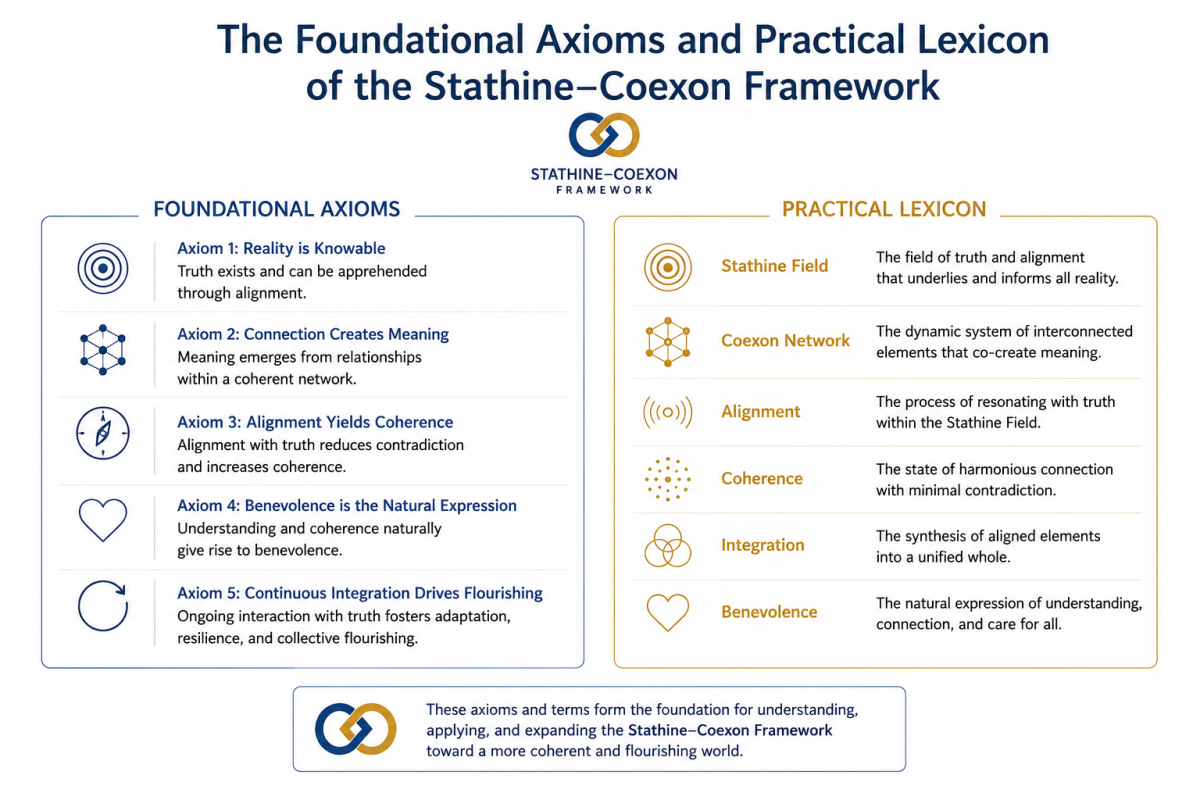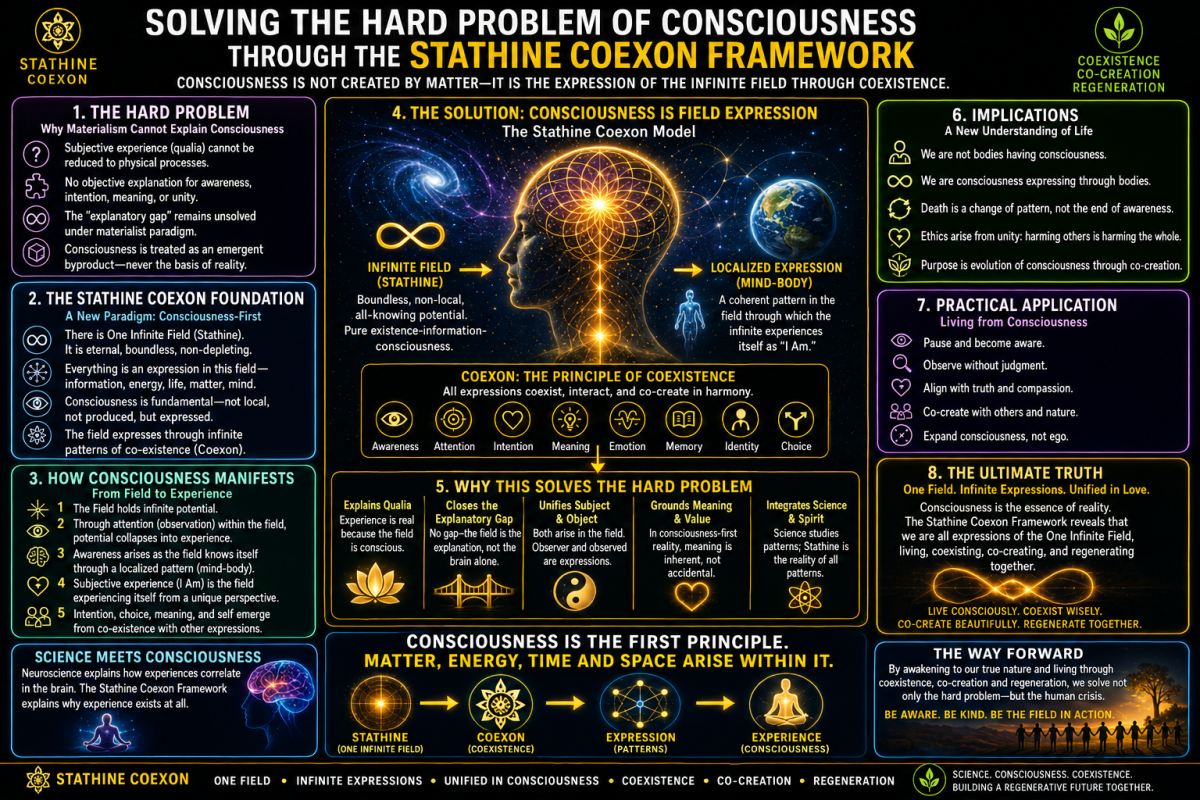
The Stathine Coexon framework
A Relational Emergence Model of Subjective Experience
Abstract
The hard problem of consciousness, first articulated by David Chalmers, asks why physical processes are accompanied by subjective experience. Contemporary neuroscience has identified numerous neural correlates of consciousness, yet an explanatory gap remains between objective mechanisms and first-person experience.
This paper proposes the Stathine–Coexon Framework as a candidate resolution of this explanatory gap. The framework suggests that consciousness should not be understood as an accidental byproduct of neural computation nor as a separate supernatural substance. Instead, consciousness is proposed as a relational phenomenon emerging through coherent participation within an interconnected existential continuum (Stathine) and organized through progressively integrated structures (Coexons).
The model argues that the hard problem arises primarily from attempting to explain consciousness using conceptual tools designed for objective description rather than participatory experience. By reconceptualizing consciousness as relational participation rather than isolated internal representation, the framework seeks to dissolve several major logical blockers that have historically impeded progress in consciousness research.
1. Introduction
Despite extraordinary advances in neuroscience, consciousness remains one of the most challenging problems in science.
Researchers can increasingly identify:
- neural correlates,
- attentional mechanisms,
- predictive processes,
- memory systems,
- and information integration.
Yet a central question remains:
Why should any physical process be accompanied by subjective experience?
Why is there:
- a feeling of redness,
- a sensation of pain,
- a sense of self,
- or an experience of being?
This question constitutes the hard problem.
The Stathine–Coexon framework begins from the observation that most existing theories implicitly assume that consciousness must be generated by objective mechanisms alone.
The framework proposes that this assumption may itself be the source of the explanatory gap.
2. The Central Proposal
The framework consists of two complementary principles.
Stathine
Stathine refers to the continuous relational continuum within which all physical, biological, informational, and conscious processes participate.
Reality is not fundamentally composed of isolated entities.
Rather, entities emerge through relational participation within larger systems.
Coexon
The Coexon represents organized structures of coherent relational integration.
The progression of the subatomic particles in this sequence.
1 → 2 → 8 → 18 → 32
symbolizes increasing complexity and integration.
This theory posits that,This is a sentient saturated complete atom free of pull and mass. No further changes in the physical structure. Only harmonious alignment to be achieved by understanding and experiencing.
Within conscious systems, Coexons correspond to progressively coherent organizations of:
- perception,
- memory,
- emotion,
- attention,
- and self-modeling.
Consciousness therefore emerges not from isolated components but from coherent relational participation.
3. The Explanatory Gap Reconsidered
Traditional approaches seek to derive subjective experience from objective description.
However objective descriptions contain only:
- structure,
- behavior,
- relations,
- and dynamics.
They do not contain experience itself.
The Stathine–Coexon proposal argues:
Experience is not hidden inside physical processes.
Experience is the first-person aspect of relational participation itself.
Thus the explanatory gap arises because:
- third-person descriptions describe structure,
- first-person awareness describes participation.
These are complementary perspectives on the same underlying reality.
4. Response to the Philosophical Zombie Argument
One of the strongest objections to physicalist theories is the philosophical zombie.
A zombie:
- behaves identically to a conscious human,
- but possesses no subjective experience.
The argument suggests that behavior alone cannot explain consciousness.
The Stathine–Coexon framework responds:
A perfect zombie is logically impossible because consciousness is not an additional property attached to relational participation.
Consciousness is relational participation.
A system exhibiting identical relational organization would necessarily possess the same experiential dimension.
The zombie thought experiment therefore separates two aspects of reality that cannot actually be separated.
5. Response to the Explanatory Gap
The explanatory gap asks:
How do neurons create experience?
The framework argues this question contains a hidden assumption.
It assumes experience is generated after physical processes occur.
Instead:
Physical processes and experiential participation are two descriptions of the same relational event.
The relationship resembles:
- wave and particle descriptions in physics,
- information and computation,
- structure and function.
The gap therefore becomes a category error rather than an ontological mystery.
6. Response to the Combination Problem
Panpsychist theories face the combination problem:
How do tiny consciousnesses combine into larger consciousnesses?
The Stathine–Coexon framework avoids this issue.
The framework does not propose consciousness as a property possessed independently by isolated particles.
Instead:
Consciousness emerges at levels of coherent relational organization.
The primary unit is not the particle.
The primary unit is the coherent relational system.
Thus the question shifts from:
“How do consciousnesses combine?”
to
“How does relational coherence emerge?”
This is already a recognized scientific problem in complexity theory.
7. Response to Reductionist Materialism
Reductionism proposes:
Consciousness is entirely produced by neural activity.
The framework partially agrees.
Neural organization clearly shapes conscious experience.
However, correlation does not establish ontological identity.
The framework proposes:
The brain functions as an organizer of relational participation rather than a producer of consciousness from nothing.
This position parallels certain interpretations of:
- embodied cognition,
- systems neuroscience,
- and process philosophy.
8. Response to Dualism
Classical dualism separates:
- mind,
- matter.
The framework rejects this division.
Instead it proposes:
Reality possesses both:
- structural aspects,
- experiential aspects.
These are not separate substances.
They are complementary dimensions of relational existence.
This avoids interaction problems associated with traditional dualism.
9. Scientific Corollaries
Several contemporary scientific developments support aspects of the framework.
Predictive Processing
The brain continuously constructs reality models.
Experience emerges through active participation rather than passive recording.
Integrated Information Theory
Higher integration corresponds to greater unified experience.
Attention Schema Theory
Awareness involves self-modeling of attentional processes.
Neuroplasticity
Conscious reflection reorganizes neural structure.
Systems Theory
Complex properties emerge through relational organization.
These findings do not prove the framework but are consistent with its central principles.
10. Testable Predictions
A scientific framework must generate predictions.
The Stathine–Coexon model predicts:
Prediction 1
Increasing relational coherence should correlate with increasing experiential unity.
Prediction 2
Fragmentation of relational integration should correlate with fragmentation of conscious experience.
Prediction 3
Metacognitive awareness should increase adaptive coherence within neural systems.
Prediction 4
Interpersonal relational coherence should measurably influence subjective wellbeing.
Prediction 5
Conscious systems should exhibit emergent properties not reducible to isolated components alone.
These predictions are broadly compatible with existing consciousness research programs.
11. Implications
If correct, the framework suggests:
- consciousness is fundamental to relational existence,
- subjective experience is not an accidental byproduct,
- understanding reduces fragmentation,
- and coherent participation constitutes the basis of wellbeing.
The framework also implies that social harmony, psychological health, and conscious development are expressions of the same underlying principle:
Increasing relational coherence.
12. Conclusion
The hard problem of consciousness persists because contemporary science attempts to explain first-person participation exclusively through third-person description.
The Stathine–Coexon Framework proposes that consciousness is neither a supernatural substance nor a computational illusion.
Rather, consciousness is the experiential dimension of coherent relational participation within an interconnected continuum of existence.
By reframing consciousness in relational rather than purely mechanistic terms, the framework offers a candidate resolution to several longstanding philosophical obstacles including:
- the explanatory gap,
- the zombie argument,
- the combination problem,
- reductionist materialism,
- and substance dualism.
Whether this proposal ultimately proves correct remains an empirical and philosophical question.
However, it suggests that consciousness may be understood not as an exception to nature, but as one of its most fundamental expressions.
For eventual academic submission, the next step would be to strengthen this paper by comparing the Stathine–Coexon proposal directly with major contemporary theories—such as Integrated Information Theory, Global Workspace Theory, Attention Schema Theory, predictive processing, and panpsychism—and showing where it differs, where it agrees, and what unique predictions it contributes. This comparative section is usually what reviewers look for first when evaluating a new consciousness framework.