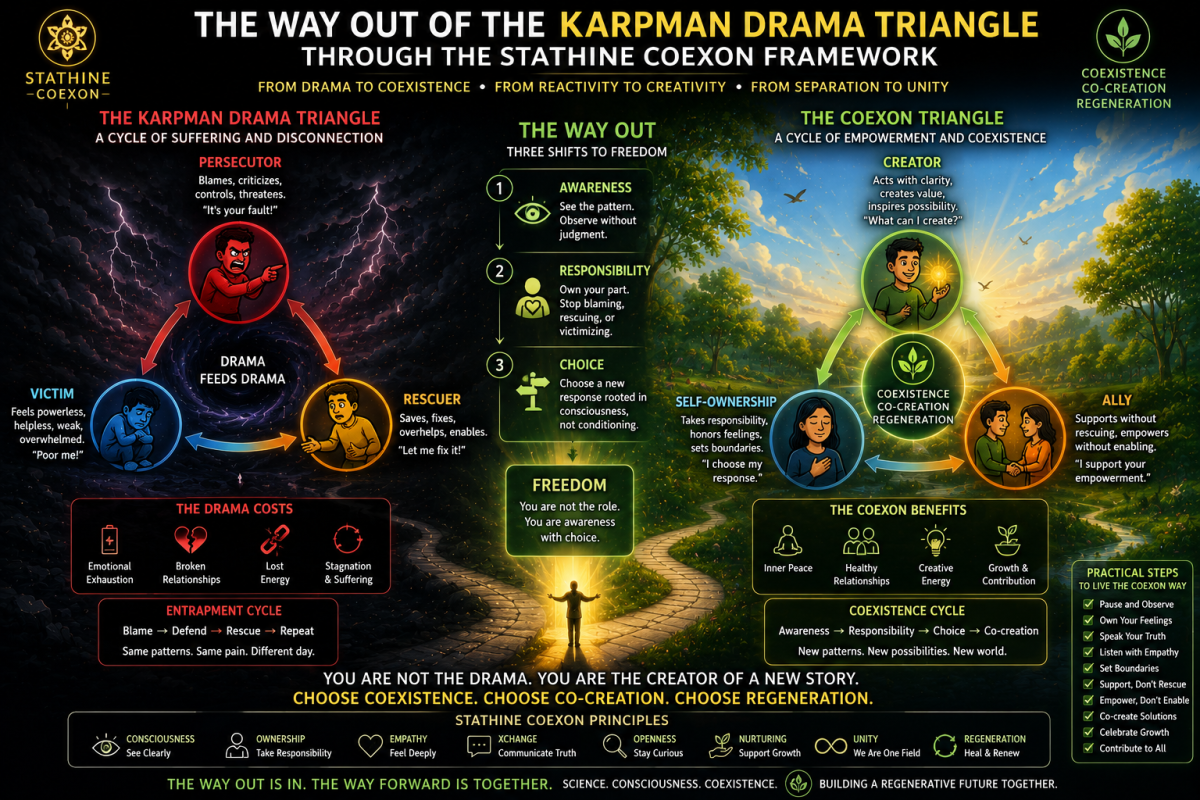
Integrating Karpman’s Drama Theory with the Stathine–Coexon Framework to Transform Toxic Relationships
Dr.Stephen Karpman’s Drama Triangle focuses on recurring interpersonal roles, while the Stathine–Coexon framework focuses on the underlying contradictions, incomplete understanding, and relational coherence that generate those roles in the first place.
The result is a practical model for transforming toxic relationships into relationships based on understanding, accountability, and cooperation.
Abstract
Human relationships often become trapped in repetitive cycles of conflict, blame, rescue, and victimhood. Karpman’s Drama Triangle, one of the most influential models in Transactional Analysis, explains how individuals unconsciously rotate between the roles of Victim, Persecutor, and Rescuer. While the model successfully describes recurring interpersonal dynamics, it does not fully explain why individuals enter these roles or how deeper understanding can permanently dissolve them.
This article proposes an integration of Karpman’s Drama Theory with the Stathine–Coexon framework. The combined model suggests that drama emerges from incomplete understanding of reality, contradictory internal narratives, and misalignment between personal expectations and existential conditions. The Coexon framework interprets toxic relational patterns as manifestations of orbital incoherence, while the Stathine continuum emphasizes the interconnected nature of human existence.
The integrated model proposes that lasting relational harmony emerges not from controlling behavior but from increasing understanding, reducing contradiction, and developing awareness of the needs, fears, and limitations of all participants in a relationship.
Introduction
Almost every toxic relationship follows a predictable pattern.
A person feels hurt.
Someone is blamed.
A third person attempts to rescue.
Soon the rescuer becomes exhausted.
The victim becomes angry.
The persecutor feels misunderstood.
Roles rotate repeatedly.
This dynamic was described by Stephen Karpman as the Drama Triangle.
The three primary positions are:
- Victim
- Persecutor
- Rescuer
Karpman observed that individuals unconsciously move between these roles, creating repetitive emotional drama.
The Stathine–Coexon framework provides an explanation for why this occurs.
Rather than viewing participants as good or bad people, the framework suggests that all three roles emerge from incomplete understanding and relational incoherence.
The Fundamental Assumption of the Stathine–Coexon Framework
The framework begins with a simple proposition:
Every human being does what appears good, necessary, or protective from their current level of understanding.
People may be mistaken.
People may act destructively.
People may be unaware.
But they generally act according to what they perceive will:
- reduce pain,
- increase safety,
- preserve identity,
- gain belonging,
- or satisfy perceived needs.
Conflict emerges when reality produces outcomes different from expectations.
Without understanding, individuals interpret this gap through blame.
Drama begins.
Understanding the Three Roles
The Victim
The Victim experiences:
- helplessness,
- unfairness,
- confusion,
- lack of control.
The underlying belief is:
“Life should not be happening this way.”
From the Coexon perspective, the Victim is experiencing contradiction between expectation and reality.
The problem is not weakness.
The problem is incomplete understanding of the forces influencing the situation.
The Persecutor
The Persecutor attempts to regain control through:
- criticism,
- domination,
- punishment,
- blame.
The underlying belief is:
“Someone must be responsible for my discomfort.”
From the Coexon perspective, the Persecutor seeks certainty by externalizing contradiction.
The person attempts to reduce internal discomfort by controlling others.
The Rescuer
The Rescuer attempts to solve everyone’s problems.
The underlying belief is:
“If I help enough, harmony will return.”
However, rescuing often prevents genuine learning and responsibility.
The Rescuer frequently becomes:
- exhausted,
- resentful,
- and eventually enters the Victim role.
From the Coexon perspective, the Rescuer is attempting to remove symptoms without addressing the underlying misunderstanding.
Why the Drama Triangle Persists
Traditional psychology often explains drama through childhood conditioning.
While this is partly true, the Stathine–Coexon framework adds a deeper layer.
Drama persists because participants:
- misunderstand reality,
- misunderstand each other’s needs,
- misunderstand themselves,
- and misunderstand the consequences of their actions.
The result is a self-reinforcing loop.
Incomplete understanding generates contradiction.
Contradiction generates emotional discomfort.
Emotional discomfort generates reactive behavior.
Reactive behavior generates new contradiction.
The cycle repeats.
The Coexon Interpretation of Toxic Relationships
The Coexon framework proposes that relationships seek coherence just as physical systems seek stability.
Healthy relationships exhibit:
- transparency,
- curiosity,
- mutual adaptation,
- accountability,
- understanding.
Toxic relationships exhibit:
- blame,
- mind-reading,
- assumptions,
- emotional reactivity,
- identity defense.
The relationship becomes trapped in what the framework describes as orbital incoherence.
The participants continuously react to interpretations rather than reality.
Moving Beyond Drama
The integration proposes replacing the three drama roles with three developmental roles.
Victim → Learner
Instead of asking:
“Why is this happening to me?”
Ask:
“What reality am I not yet understanding?”
This shifts attention from helplessness toward curiosity.
Persecutor → Investigator
Instead of asking:
“Who is wrong?”
Ask:
“What conditions produced this outcome?”
This transforms blame into understanding.
Rescuer → Facilitator
Instead of asking:
“How do I fix this person?”
Ask:
“How can I help both of us understand the situation better?”
This promotes growth rather than dependency.
The Stathine Principle of Relational Awareness
The Stathine continuum proposes that human beings are fundamentally interconnected.
Therefore healthy relationships require awareness of two realities simultaneously:
- My needs.
- Your needs.
Most relationship breakdowns occur because one side attempts to maximize one while ignoring the other.
True harmony emerges when both become visible.
This does not imply agreement.
It implies understanding.
A person may fully understand another person’s needs and still establish healthy boundaries.
Boundaries Are Not Rejection
One of the most important contributions of the integrated framework is its understanding of boundaries.
Many people assume:
- understanding means agreement,
- compassion means tolerance,
- kindness means self-sacrifice.
The framework disagrees.
Sometimes the most coherent response is distance.
When another individual:
- repeatedly deceives,
- manipulates,
- abuses,
- or refuses mutual understanding,
maintaining physical or emotional distance becomes adaptive.
The goal is not punishment.
The goal is preservation of relational coherence.
Practical Process for Relationship Transformation
When conflict appears:
Step 1
Identify your role.
Am I:
- Victim?
- Persecutor?
- Rescuer?
Step 2
Identify the unmet need.
What am I trying to protect?
Step 3
Identify the contradiction.
What expectation is colliding with reality?
Step 4
Seek understanding.
What factors may explain the other person’s behavior?
Step 5
Communicate needs clearly.
Avoid blame.
State observations and needs.
Step 6
Evaluate reciprocity.
Is the other person willing to engage in understanding?
Step 7
Choose coherence.
If mutual understanding is possible:
- cooperate.
If mutual understanding is impossible:
- create healthy boundaries.
Implications for Society
The same dynamics that damage families damage societies.
Political polarization,
tribalism,
religious conflict,
and workplace dysfunction often follow Drama Triangle patterns.
Groups adopt collective identities as:
- Victims,
- Persecutors,
- or Rescuers.
The result is perpetual conflict.
The integrated Stathine–Coexon approach suggests:
Sustainable peace emerges when understanding becomes more important than winning.
The goal is not agreement.
The goal is reduction of contradiction through shared understanding of reality.
Conclusion
Karpman’s Drama Triangle remains one of the most useful models for understanding toxic interpersonal relationships.
The Stathine–Coexon framework extends the model by explaining why drama emerges and how it can be transformed.
The integration suggests:
- every person acts according to their current understanding,
- suffering increases when expectations conflict with reality,
- blame perpetuates contradiction,
- understanding dissolves unnecessary conflict,
- healthy boundaries preserve coherence,
- and lasting harmony emerges through mutual awareness of needs and realities.
The deepest insight is simple:
Toxic relationships are rarely solved by determining who is right.
They are transformed when participants become more interested in understanding reality than defending identity.
At that point, drama gives way to learning, conflict becomes information, and relationships become opportunities for mutual growth rather than mutual suffering.
This integrated model may be one of the most practical applications of the Stathine–Coexon framework because it translates abstract ideas about consciousness and relational coherence into everyday interactions between spouses, parents and children, friends, teams, and communities.