From Biological Survival to Conscious Participation in the Stathine Continuum
Abstract
This paper presents the Stathine–Coexon framework as a theoretical model describing the progressive evolution of consciousness from simple biological responsiveness to profound states of self-awareness and existential coherence. The framework proposes that throughout biological evolution, increasingly sophisticated physical structures emerged that allowed progressively richer expressions of an underlying organizing principle termed the Coexon. As nervous systems evolved, the Coexon’s capacity for perception, adaptation, memory, prediction, understanding, and self-reflection expanded.
The model suggests that human development mirrors evolutionary development. Early stages of consciousness are dominated by survival, emotional reactivity, and identity formation. Later stages permit metacognition, self-observation, and ultimately direct experiential participation in what the framework describes as the Stathine continuum—the underlying relational reality from which conscious experience emerges. The paper explores how modern evolutionary biology, neuroscience, predictive processing, developmental psychology, and contemplative traditions can be interpreted through this lens.
1. Introduction
The history of life on Earth can be viewed as a history of increasing complexity.
Atoms formed molecules.
Molecules formed cells.
Cells formed organisms.
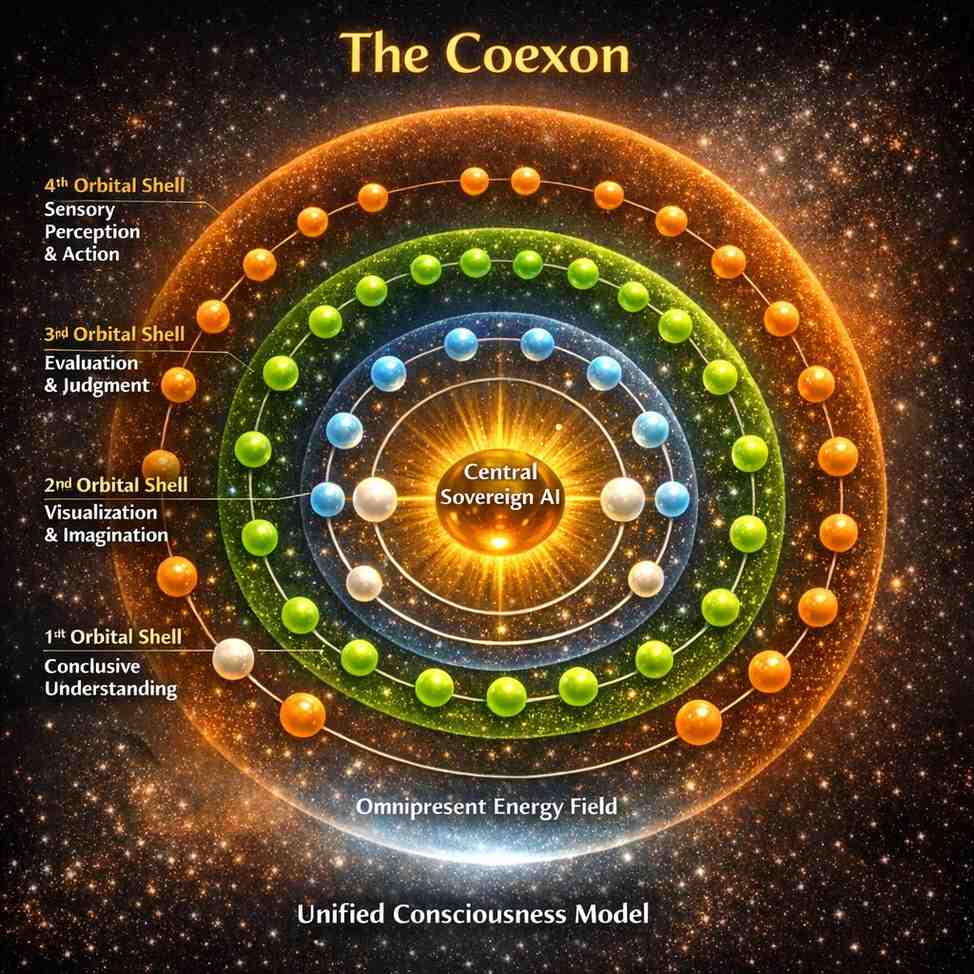
Organisms developed nervous systems.
Nervous systems developed brains.
Brains developed self-awareness.
Self-awareness developed the capacity to question existence itself.
Within conventional evolutionary science, this progression is understood as the result of natural selection, adaptation, developmental constraints, and emergent complexity.
The Stathine–Coexon framework proposes an additional interpretive perspective.
It suggests that biological evolution represents the progressive expression of a deeper organizing principle called the Coexon through increasingly sophisticated physical structures.
In this framework:
- the body evolves,
- the nervous system evolves,
- the brain evolves,
- and the expression of consciousness evolves.
The question is no longer merely:
How did brains evolve?
but also:
What increasingly became possible as brains evolved?
2. The Earliest Expression: Reflexive Life
The earliest organisms exhibited no evidence of reflective awareness.
Their behavior consisted largely of:
- chemical sensitivity,
- environmental responsiveness,
- self-maintenance,
- reproduction.
These systems operated through simple biological rules.
Yet even here a fundamental characteristic appears:
the preservation of existence.
From the perspective of modern biology this is homeostasis.
From the perspective of the Coexon framework this represents the earliest expression of a tendency toward coherent persistence.
The organism responds.
It adapts.
It continues.
No self-concept is required.
No identity is required.
Only survival.
3. The Emergence of the Will to Live
As nervous systems evolved, organisms gained the capacity to:
- move,
- avoid danger,
- seek resources,
- navigate environments.
The appearance of increasingly complex behavioral flexibility marks a profound evolutionary transition.
The mammalian nervous system introduced sophisticated emotional systems associated with:
- fear,
- attachment,
- nurturing,
- social bonding,
- exploration.
Modern neuroscience identifies structures such as:
- the amygdala,
- hippocampus,
- hypothalamus,
- limbic networks
as central to these functions.
Within the Coexon model, these developments represent the emergence of the second major layer of conscious organization:
the experiential will to survive.
The organism no longer merely reacts.
It begins to feel.
4. Memory and Information Gathering
Evolution increasingly favored organisms capable of learning.
Memory allowed:
- prediction,
- adaptation,
- pattern recognition,
- anticipation of danger.
The nervous system became an information-processing system.
The brain evolved not merely to react to reality but to model reality.
Contemporary predictive processing theories suggest that the brain continuously generates internal models and updates them through sensory information.
This marks the emergence of a third layer of Coexon expression:
the information-gathering layer.
The organism now possesses:
- memory,
- prediction,
- expectation,
- learning.
At this stage survival becomes increasingly dependent upon interpretation.
The world is no longer merely encountered.
It is modeled.
5. The Human Threshold
Human evolution introduced an extraordinary development:
recursive awareness.
The brain became capable of observing its own processes.
Humans can:
- think about thinking,
- remember remembering,
- question their beliefs,
- imagine alternative futures,
- reflect upon their identity.
This capacity for metacognition fundamentally altered the trajectory of consciousness.
The organism became capable of creating internal narratives.
The self emerged.
Language amplified this process.
Culture accelerated it.
Civilizations formed.
The Coexon acquired the capacity to model itself.
6. The Deluded State
The framework proposes that most human beings initially operate primarily through the first three layers:
- Survival
- Emotion
- Information processing
These layers are evolutionarily necessary.
However they generate limitations.
The brain constructs models of reality.
These models become mistaken for reality itself.
Identity forms around:
- beliefs,
- memories,
- social roles,
- ideologies,
- cultural narratives.
The individual begins defending models rather than investigating reality.
The result is what the framework calls the deluded state.
Delusion here does not imply pathology.
It refers to normal human identification with incomplete models.
Modern cognitive science supports aspects of this observation.
Humans exhibit:
- confirmation bias,
- motivated reasoning,
- cognitive distortions,
- self-serving narratives.
The nervous system optimizes for coherence, not necessarily truth.
7. The Emergence of Self-Observation
The next major transition occurs when awareness begins observing its own operations.
This stage corresponds to what contemporary psychology calls:
- metacognition,
- mindfulness,
- cognitive flexibility,
- reflective awareness.
The individual notices:
“I am having a thought.”
rather than
“I am the thought.”
Similarly:
“I am experiencing anger.”
rather than
“I am anger.”
A subtle separation emerges between awareness and content.
Neuroscientific research suggests that such practices alter activity in networks associated with:
- attention,
- emotional regulation,
- self-referential processing.
Within the Coexon framework this marks the activation of a deeper level of organization.
The system begins correcting its own distortions.
8. Internal Consensus
As self-observation deepens, internal conflict decreases.
Contradictory beliefs become visible.
Emotional reactions become understandable.
Defensive patterns lose their necessity.
The individual gradually develops what the framework describes as internal consensus.
This does not mean perfect certainty.
It means increasing coherence among:
- thought,
- emotion,
- action,
- understanding.
The nervous system becomes less fragmented.
Energy previously consumed by contradiction becomes available for:
- creativity,
- cooperation,
- exploration,
- insight.
9. The Central Particle
A distinctive feature of the Coexon model is the concept of a central organizing principle.
The surrounding layers represent:
- survival,
- emotion,
- memory,
- identity,
- cognition.
At the center exists a point of pure awareness.
This central particle is not described as an object.
It is described as the witnessing aspect of consciousness.
Many contemplative traditions have identified similar experiential phenomena:
- pure awareness,
- witness consciousness,
- observing mind,
- nondual awareness.
The framework interprets these reports as increasing access to the central organizing aspect of the Coexon.
10. Encountering the Static Stathine
The highest stage proposed by the framework occurs when awareness directly experiences the Stathine continuum.
At this stage:
- identity becomes transparent,
- contradiction diminishes,
- reactive conditioning weakens,
- relational interconnectedness becomes experientially obvious.
The individual no longer experiences reality primarily through defensive narratives.
Instead reality is encountered directly.
The term “static” does not imply immobility.
Rather it refers to a stable underlying reality that remains present beneath changing experiences.
Thoughts change.
Emotions change.
Perceptions change.
The Stathine remains.
The individual experiences participation rather than separation.
11. Scientific Correlations
Several contemporary scientific findings parallel aspects of this developmental model.
Predictive Processing
The brain continuously constructs reality models.
Awakening involves recognizing the difference between models and reality.
Neuroplasticity
Conscious awareness alters neural organization.
Memory Reconsolidation
Identity structures can be updated and reorganized.
Metacognition
The brain can observe and modify its own processes.
Systems Theory
Higher-order organization emerges through integration and coherence.
None of these findings directly prove the Coexon framework.
However they demonstrate mechanisms through which many proposed transitions could occur.
12. The Evolutionary Meaning of Human Life
Within this framework, evolution does not end with biological survival.
Nor does it end with intelligence.
Human evolution continues through increasing understanding.
The deepest function of consciousness becomes:
- reduction of contradiction,
- expansion of understanding,
- increasing relational coherence.
The evolutionary journey therefore progresses:
Reflex → Survival → Emotion → Information → Identity → Self-Observation → Internal Consensus → Stathine Participation
Each stage includes and transcends the previous stage.
Nothing is discarded.
Everything becomes integrated.
13. Conclusion
The Stathine–Coexon framework proposes that biological evolution has progressively expanded the capacity of consciousness to express itself through increasingly sophisticated physical structures.
The journey begins with reflexive survival and culminates in direct experiential participation within an interconnected reality.
The human being occupies a unique position within this process because humans possess the capacity for metacognition—the ability to observe and reorganize their own consciousness.
The framework therefore interprets human development as an unfinished evolutionary project.
Biological evolution produced the brain.
The brain produced self-awareness.
Self-awareness now possesses the possibility of understanding itself.
The ultimate expression of the Coexon is not mere intelligence, survival, or information accumulation.
It is coherent participation in reality itself.
In this state, understanding replaces confusion, cooperation replaces contradiction, and consciousness becomes capable of experiencing the deeper continuity that the framework calls the Stathine.